GRAU & PUREZAMoligand™?Moligand™ — Aladdin's line of ligands and bioactive small molecules. Use for receptor, pathway, and binding studies needing defined small-molecule tools.10 mM in DMSO
Determine the necessary mass, volume, or concentration for preparing a solution.
Dilution Calculator
Determine the dilution needed to prepare a stock solution.
Reconstitution Calculator
Revisões
Avaliações dos Clientes
Application Protocols
No validated immunoassay protocols (WB, IHC, IF, FC) apply to this small‑molecule reagent. For screening use in biochemical or cell‑based assays, general practices include:
Stock preparation: Dissolve in anhydrous DMSO to 10–50 mM; vortex/sonicate and warm gently (30–40 °C) if needed.
Dosing: Add to assay buffer/media slowly with strong mixing to reach desired final concentration; maintain DMSO below assay‑tolerated limits (typically 0.1–1% v/v).
Controls: Include vehicle controls and, where relevant, saturated analog (stearamide) or hydrolyzed product (oleic acid) as comparators.
Adsorption mitigation: Use low‑bind plastics and pre‑rinse tips/vials with dosing solution to reduce losses; consider BSA or surfactant where compatible.
For any application-specific parameters (e.g., enzyme kinetics with FAAH), consult primary literature and optimize conditions empirically. This product is for research use only.
Biological Roles
The following summarizes literature knowledge about oleamide as an endogenous lipid; it is provided for research planning only (no medical/clinical claims).
Endogenous signaling lipid: Oleamide ((Z)-9‑octadecenamide) has been detected in mammalian tissues and biofluids. It is associated with modulation of sleep–wake neurobiology in animal studies and is a subject of research in neuromodulation pathways.
Enzymatic turnover: Substrate for fatty acid amide hydrolase (FAAH), which hydrolyzes it to oleic acid and ammonia. Its metabolic stability, and interactions with FAAH and other amidases, are common assay topics.
Receptor interactions (indirect/modulatory, literature): Reported to influence gap junction communication, serotonergic systems, GABAergic responses, and certain TRP channels in vitro; it may modulate endocannabinoid signaling indirectly. Specific binding targets and affinities are context‑dependent and remain under investigation.
Membrane interactions: Highly lipophilic; partitions into lipid bilayers and model membranes, affecting fluidity and protein function in biophysical studies.
Analytical considerations: Due to high logP, adsorption to plastic and proteins is common; BSA or solvent carriers may alter free concentrations in bioassays.
Note: Biological effects are assay‑ and system‑specific. For robust conclusions, confirm purity, isomeric state (Z vs E), and absence of oxidation products that can confound readouts. This product is for research use only.
Buffer Applications
Oleamide is not a buffer component and does not confer pH control. As a highly hydrophobic neutral amide, it is not typically used to formulate aqueous buffers.
Practical guidance for aqueous assays:
Prepare concentrated stocks in DMSO and dose into buffered media with strong mixing to avoid precipitation.
Consider adding suitable surfactants or cyclodextrins if the biological system allows, to enhance apparent solubility.
Verify that buffer components (e.g., BSA) do not sequester oleamide and alter free concentration.
Green Alternatives
Oleamide is a target analyte/solid, not a process solvent; however, greener choices can be made for its handling and for transformations on its scaffold.
Greener handling solvents (general guidance):
Preferred: Ethyl acetate, 2‑methyltetrahydrofuran (2‑MeTHF), isopropanol — better EHS profiles than chlorinated solvents; can dissolve oleamide when warmed.
Use with caution: Dichloromethane/chloroform — effective but less desirable environmentally; reserve for cases where polarity and volatility are essential.
Aqueous systems: Consider aqueous micellar media with surfactants for some transformations/assays, minimizing organic solvent usage.
Example comparison (literature-based, qualitative):
DCM: High solvency, easy evaporation; environmental and toxicity concerns.
2‑MeTHF: Good solvency for lipophiles, bio‑based source, lower peroxide risk than THF; slightly higher bp, odor, may require drying.
EtOAc: Readily biodegradable, low toxicity; moderate solvency, may need warming.
IPA/ethanol: Safer alcohols; limited room‑temperature solubility, but effective when hot.
Process considerations:
For epoxidation/dihydroxylation of the C=C, choose greener oxidants (e.g., H2O2/organocatalysts) where compatible.
Replace stoichiometric reagents with catalytic methods (e.g., olefin metathesis under solvent‑minimized or neat conditions when feasible).
Implement solvent recycling and use nitrogen blankets to extend solution shelf‑life, reducing waste from decomposition.
Pharmaceutical Uses
No pharmacopeial or excipient grade is specified for this item, and it is designated For research use only in the Product Data.
General, literature-based context (non‑clinical, non‑therapeutic):
Formulation research: Oleamide’s hydrophobic chain and amide headgroup make it a model lipid for studying incorporation into liposomes, lipid nanoparticles, or polymer matrices. It can serve as a hydrophobic additive to probe membrane interactions or release behavior.
Materials compatibility: Known industrially as a slip/lubricant additive in polymers; in research, similar properties can be leveraged to adjust surface energy of experimental devices.
Important: This product is not supplied as a GMP or pharmacopeial excipient. Do not use for human or veterinary applications. For any regulated use, a suitable grade and full quality/impurity profile would be required.
Physical Properties
Item-specific physico-chemical specifications are not provided in the Product Data. The following are typical literature characteristics of oleamide to aid experimental planning (do not construe as guaranteed specs for this SKU):
Physical state/appearance: Not specified for this item; refer to CoA/Spec Sheet. (Commonly a white to off‑white waxy solid, literature.)
Melting point (literature): ~72–78 °C (waxy solid that softens near room temperature if impure or finely divided).
Boiling point (literature): Not commonly distilled; amides generally decompose before boiling at atmospheric pressure.
Solubility (literature):
Water: practically insoluble.
Organic: soluble in DMSO, dichloromethane, chloroform, hot ethanol/isopropanol, ethyl acetate; very soluble in nonpolar lipids/oils. Warming facilitates dissolution.
LogP (literature, XlogP3): approximately 5–6 (highly lipophilic).
pKa (literature): neutral amide; N–H acidity ca. 15–17 in DMSO; not appreciably ionized in water across physiological pH.
Density/refractive index: Not applicable/commonly reported for solids; Not specified for this item; refer to CoA/Spec Sheet.
Practical notes (general):
Prepare concentrated stock solutions in anhydrous DMSO (e.g., 10–50 mM) and dilute into assay media with vigorous mixing to avoid precipitation.
Gentle warming (30–40 °C) and sonication can speed dissolution; avoid overheating to prevent isomerization/oxidation of the double bond.
Quality and Grades
Grade/Purity for this item: Moligand™
About Moligand™ (general description):
Moligand™ denotes inclusion in a curated small‑molecule/compound library intended for ligand discovery, screening, and chemical biology. Typical attributes of Moligand™ items include high chemical purity suitable for screening, structural identity verification (e.g., NMR/LC–MS), and packaging optimized for bioassay readiness. Exact acceptance criteria (e.g., assay purity %, residual solvents, isomeric composition) are lot‑specific.
What is specified for this SKU:
Grade name only (Moligand™). No explicit purity percentage, stabilizers, residual solvent limits, metal content, or UV cutoffs are listed in the Product Data.
Therefore, for any lot‑specific metrics (purity by HPLC/GC/NMR, water, peroxides, isomer ratio Z/E, residual solvents), use: Not specified for this item; refer to CoA/Spec Sheet.
Implications for use:
For screening: Recommended to prepare DMSO stocks under inert atmosphere when possible to preserve the alkene.
For analytical work: Verify isomeric purity (Z vs E) and absence of oxidation products (peroxides, epoxides) by LC–MS before SAR conclusions.
For reference standards: If you require traceable purity values or pharmacopeial compliance, request the current CoA and analytical package for your lot.
Reaction and Applications
While primarily known as a bioactive fatty acid amide, oleamide is also a versatile synthon and performance additive in materials research.
Representative application areas (literature-based):
Model substrate for amide chemistry: Hydrolysis kinetics (enzymatic or chemical), amidase/FAAH assays, and acyl‑transfer studies.
Selective transformations at the C=C bond:
Epoxidation (e.g., mCPBA) to epoxyamide; subsequent ring opening affords vicinal diols or amino alcohols.
Dihydroxylation (OsO4/NMO) to form 9,10‑diol amides.
Hydrogenation (H2, Pd/C or Raney Ni) to stearamide, allowing property contrasts between unsaturated and saturated amides.
Cross‑metathesis (Grubbs/Hoveyda catalysts) to introduce functionality or truncate/extend chain segments.
Amidation/derivatization at the headgroup: N‑acylation or N‑alkylation to generate secondary amides for SAR, fluorescent tagging via activated carbonyl handles, or carbamate formation for probe design.
Surface science/materials: Long hydrophobic chain with amide head enables adsorption on oxides/polymers; explored for slip/lubricity modification and self‑assembled layers.
Practical notes:
Double bond geometry (Z) matters for biological assays; avoid acid/metal-catalyzed isomerization.
Use antioxidants (e.g., BHT) and inert gas blankets during oxidative transformations to control side reactions.
For enzyme assays, pre‑formulate in DMSO and confirm linear response with substrate concentration to avoid micelle artifacts.
Reaction Conditions
The following literature-style conditions illustrate common transformations of oleamide; they are general guidance, not item-specific specifications.
Hydrogenation to stearamide:
Solvent: EtOH, EtOAc, or heptane.
Catalyst: 5–10 wt% Pd/C (5–10 mol% Pd relative to substrate); H2 balloon to 3 bar.
Temperature: rt to 50 °C; Time: 2–16 h.
Workup: Filter through Celite, evaporate; typical yields high when over‑reduction is minimal.
Epoxidation (Prilezhaev):
Reagent: mCPBA (1.1–1.5 eq) in DCM at 0–25 °C; buffer with NaHCO3.
Time: 1–4 h; monitor by TLC/LC–MS.
Notes: Control epoxide opening; remove residual acids to protect the amide.
O3 in DCM/MeOH at −78 to −20 °C to form ozonide; reductive (Me2S) or oxidative (H2O2) workup to give fragments (e.g., amide‑aldehyde/acid).
Cross‑metathesis:
Catalyst: Grubbs II or Hoveyda–Grubbs II (2–10 mol%).
Solvent: DCM, toluene, or 2‑MeTHF; 25–60 °C; 2–24 h.
Partners: Terminal alkenes (allyl alcohols, acrylates) to introduce handles; remove ethylene under slight vacuum/inert purge if needed.
Hydrolysis (for controls/standards):
Basic: 1–2 M NaOH/EtOH–H2O, reflux; Acidic: 6 M HCl, reflux; yields oleic acid and ammonia/amine salts.
General tips:
Exclude air for reactions at the double bond; add BHT (50–200 ppm) as needed.
Confirm Z/E ratio by NMR (allylic coupling constants) pre‑ and post‑reaction.
Safety and Handling
GHS and hazard statements are not provided for this specific item. Always consult the SDS for authoritative safety data for your lot.
GHS classification: Not specified for this item; refer to SDS.
Signal word / H-statements / pictograms: Not specified for this item; refer to SDS.
General laboratory safety guidance (applicable to long‑chain fatty amides; literature-based):
Expected hazards: Low acute toxicity is often reported for fatty amides; nonetheless, handle as a chemical of unknown toxicity. Dusts may cause mechanical irritation. Avoid inhalation of powders and contact with eyes/skin.
PPE: Lab coat, nitrile gloves, safety glasses; use a fume hood when weighing or dissolving.
Incompatibilities: Strong oxidizing agents (risk of exotherm/oxidation at the C=C bond), strong bases or acids under heating (hydrolysis/isomerization), nitrating agents.
Thermal stability: Prolonged heating can promote double-bond isomerization or oxidation; avoid high temperatures.
First aid (overview):
Skin/eye contact: Rinse with water for ≥15 min; remove contaminated clothing; seek medical advice if irritation persists.
Inhalation: Move to fresh air; obtain medical attention if symptoms occur.
Ingestion: Rinse mouth; do not induce vomiting; seek medical advice.
Spill response: Avoid dust generation. Collect mechanically; wash area with suitable detergent.
Storage per Product Data:
Store at −80 °C. Keep tightly closed, desiccated, and protected from light/air to minimize oxidative degradation. Shipments are made on dry ice packs + cold packs.
Solvent Selection
Oleamide is highly lipophilic and poorly soluble in water; solvent choice should maximize solubility while preserving the cis double bond.
Polarity/miscibility (general): Nonpolar to slightly polar solute; favors nonpolar and aprotic media. Water miscibility is negligible.
Recommended stock solvent (screening workflows):
Anhydrous DMSO: typically supports 10–50 mM stocks. Warm (30–40 °C) and vortex/sonicate to dissolve. Filter through 0.22 µm if needed.
Alternative solvents: DMF (anhydrous), dichloromethane, chloroform, ethyl acetate, toluene, isopropanol/ethanol (hot). For biological assays, pre‑dissolve in DMSO then dilute into buffer with vigorous mixing and surfactant if compatible.
Avoid/protect against: Strongly oxidizing co‑solvents/reagents; prolonged exposure to air/light in solution (risk of autoxidation at C=C).
Comparison (general guidance):
DMSO vs DMF: DMSO offers broader biocompatibility for assays; DMF can also dissolve but is less favored biologically.
Alcohols: Hot ethanol/isopropanol can dissolve oleamide, but precipitation on cooling is common; use immediately or maintain temperature.
Hydrocarbon solvents (hexane, heptane): Good solubility; limited applicability for bioassays but useful for extractions/coatings.
Practical tips:
Make small, single‑use aliquots to avoid repeated warming/cooling cycles.
When dosing aqueous systems, keep final DMSO ≤0.1–1% v/v as assay permits; add slowly with strong mixing to prevent clouding.
Packaging: Keep tightly sealed under inert gas (e.g., nitrogen or argon) with desiccant; protect from light to limit oxidation of the double bond.
Stability: Solid oleamide is relatively stable when frozen and dry. In solution, especially in air and light, slow oxidation/polymerization can occur; prepare fresh solutions as needed.
Reconstitution and stock solutions (research guidance):
Solvents: Anhydrous DMSO recommended for bioassay stocks; alternatives include DMF or warm ethanol/isopropanol.
Concentration: 10–50 mM typical for screening libraries; filter sterilize (0.22 µm) if sterility is required.
Storage of solutions: Store at −20 to −80 °C, protected from light, under inert headspace. Check for precipitation/crystallization before use; warm and vortex if needed.
Appearance: Not specified for this item; refer to CoA/Spec Sheet.
Research Use Note: For research use only.
Structure and Identity
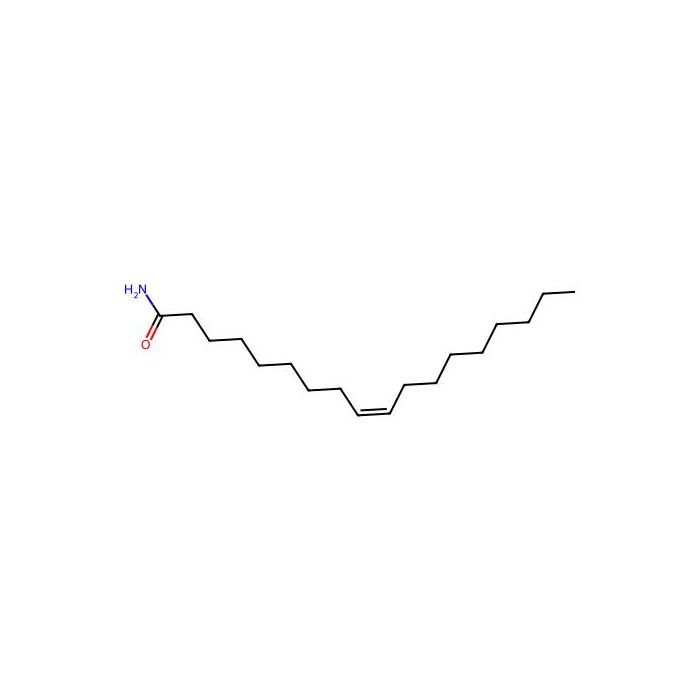
Oleamide is a long-chain fatty acid primary amide, formally the amide of oleic acid ((Z)-9-octadecenoic acid).
SKU: O1499908
Product name: Oleamide
CAS: 301-02-0
PubChem CID: 5283387
Category: Small molecule library member (Moligand series)
Structural features (general description):
Contains a linear C18 aliphatic chain with a single cis (Z) C9–C10 double bond and a terminal primary amide group (–CONH2).
Functional groups: one alkene (mono-unsaturated), one carboxamide (primary amide). No stereogenic centers; has geometric (E/Z) isomerism at the double bond; the biologically common form is Z.
2D description in words: an 18‑carbon chain starting from an amide carbonyl at C1, followed by an –NH–, a saturated methylene segment to a cis‑alkene at C9–C10, then a saturated tail to C18.
Item-specific identifiers not provided in Product Data:
SMILES: Not specified for this item; refer to CoA/Spec Sheet. (Typical literature SMILES for (Z) isomer: CCCCCCCC/C=C\CCCCCCC(=O)NH)
InChIKey: Not specified for this item; refer to CoA/Spec Sheet.
Molecular formula and mass (literature values):
Formula (literature): C18H35NO
Molecular weight (literature): ~281.48 g/mol
Note: Where exact identifiers for this catalog item are required (e.g., lot-specific isomeric purity), consult the Aladdin CoA/Specification Sheet.
Synthetic Utility
Oleamide unites a reactive amide headgroup with an internal alkene, offering two complementary loci for transformation.
Key functional elements and their reactivity (literature-based):
Primary amide (–CONH2):
Activation to imidates, acyl azides, or via coupling reagents enables conversion to esters, anilides, or peptide‑like derivatives.
N‑acylation/N‑alkylation affords secondary/tertiary amides for SAR or probe attachment (e.g., fluorescent tags).
Hydrolysis (acidic/basic or enzymatic) returns oleic acid; useful for calibrating amidase assays.
Internal alkene (cis‑9):
Epoxidation, dihydroxylation, ozonolysis/oxidative cleavage to shorter fragments (e.g., yielding amide‑terminated aldehydes/acids after workup).
Hydrogenation to stearamide (saturated analog) for control studies.
Cross‑metathesis (Grubbs/Hoveyda) with terminal olefins to append handles (allyl, styrenyl), facilitating conjugation.
Retrosynthetic/value:
Serves as a convenient starting point to access a family of fatty amide derivatives without fresh amidation from oleoyl precursors.
The amphiphile character aids in constructing surface‑active probes and biomimetic materials.
Experimental cautions:
Preserve Z‑geometry when required; avoid strong acids, high temperatures, and isomerizing metal catalysts unless E‑isomer is intended.
Protect from oxidation; antioxidants and inert atmosphere are recommended during transformations at the double bond.
Target Specificity
Not applicable. This product is a small molecule (fatty acid amide), not an antibody or biorecognition reagent. No antigen, clone, isotype, or species reactivity information applies.
Usamos cookies para garantir o funcionamento adequado do site e, quando permitido, para melhorar a sua experiência. Você pode gerenciar suas preferências a qualquer momento nas Configurações. Saiba mais em nossa Política de Cookies.
Deseja que lhe enviemos uma mensagem quando tivermos descontos disponíveis?
Lembrar-me mais tarde
Obrigado! Por favor, verifique a sua caixa de entrada de e-mail para confirmar.
Products are supplied to verified businesses, institutions, and qualified professionals for research and development use only. Not for use in humans, animals, diagnosis, or therapy.