GRADE & PURITYMoligand™?Moligand™ — Aladdin's line of ligands and bioactive small molecules. Use for receptor, pathway, and binding studies needing defined small-molecule tools.10mM in DMSO
Moligand™, 10mM in DMSO Moligand™ for sensitive chromatographic and analytical workflows requiring minimal baseline interference.
🌡
Storage & shipping
Store at -80°C Ships Dry ice packs + Cold packs Check lot-specific COA for exact specifications.
📋
Quality documents
SDS, COA, datasheet, and spec sheet available for download. Lot-specific COA accessible via lot number lookup.
📚
Literature proof
Cited in 9 peer-reviewed publications across chromatography, organic synthesis, and cross-coupling reactions.
Visão geral
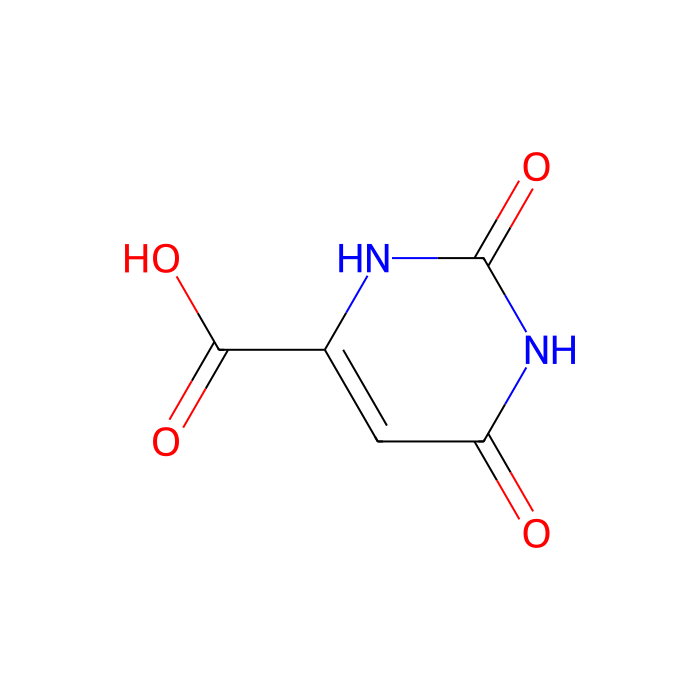
Orotic acid is a heterocyclic compound and an acid. It was once believed to be part of the vitamin B complex and was called vitamin B13, but it is now known that it is not a vitamin but is instead manufactured in the body by intestinal flora. Its salts, known as orotates, are sometimes used as mineral carriers in some dietary supplements, to increase their bioavailability. It is an intermediate in de novo pyrimidine biosynthesis that may be used to study the specificity and kinetics of orotate phosphoribosyltransferase (OPRT) which catalyzes the reversible phosphoribosyl transfer from 5′-phospho-α-d-ribose 1′-diphosphate (PRPP) to orotic acid, forming pyrophosphate and orotidine 5′-monophosphate (OMP). It may be used to study dependent cell signaling pathways and transcription regulation mechanisms that induce hepatic lipogenesis. An intermediate in de novo pyrimidine biosynthesis.
This compound belongs to the class of organic compounds known as pyrimidinecarboxylic acids. These are pyrimidines with a structure containing a carboxyl group attached to the pyrimidine ring.
External Descriptors
pyrimidinemonocarboxylic acid
1. Djoumbou Feunang Y, Eisner R, Knox C, Chepelev L, Hastings J, Owen G, Fahy E, Steinbeck C, Subramanian S, Bolton E, Greiner R, and Wishart DS. ClassyFire: Automated Chemical Classification With A Comprehensive, Computable Taxonomy. Journal of Cheminformatics, 2016, 8:61.
Usamos cookies para garantir o funcionamento adequado do site e, quando permitido, para melhorar a sua experiência. Você pode gerenciar suas preferências a qualquer momento nas Configurações. Saiba mais em nossa Política de Cookies.
Deseja que lhe enviemos uma mensagem quando tivermos descontos disponíveis?
Lembrar-me mais tarde
Obrigado! Por favor, verifique a sua caixa de entrada de e-mail para confirmar.
Products are supplied to verified businesses, institutions, and qualified professionals for research and development use only. Not for use in humans, animals, diagnosis, or therapy.