Determine the necessary mass, volume, or concentration for preparing a solution.
| Activity Type | Relation | Activity value | Units | Action Type | Journal | PubMed Id | doi | Assay Aladdin ID |
|---|

PrimorTrace™, anhydrous, ≥99.999% metals basis Anhydrous Grade,PrimorTrace™ for sensitive chromatographic and analytical workflows requiring minimal baseline interference.
Room temperature Ships Normal Check lot-specific COA for exact specifications.
SDS, COA, datasheet, and spec sheet available for download. Lot-specific COA accessible via lot number lookup.
Cited in 752 peer-reviewed publications across chromatography, organic synthesis, and cross-coupling reactions.
Oxalic acid is present as potential impurity in some active pharmaceutical ingredients.
Oxalic acid was used: · in the synthesis of hemicellulose hydrolysates of yellow poplars; · in the synthesis of three-dimensionally ordered macroporous metal oxides or carbonates via templating with polystyrene spheres; · as supporting electrolyte in the electrochemical synthesis of polyaniline-polypyrrole composite coatings.
| Pubchem Sid | 508813655 |
|---|---|
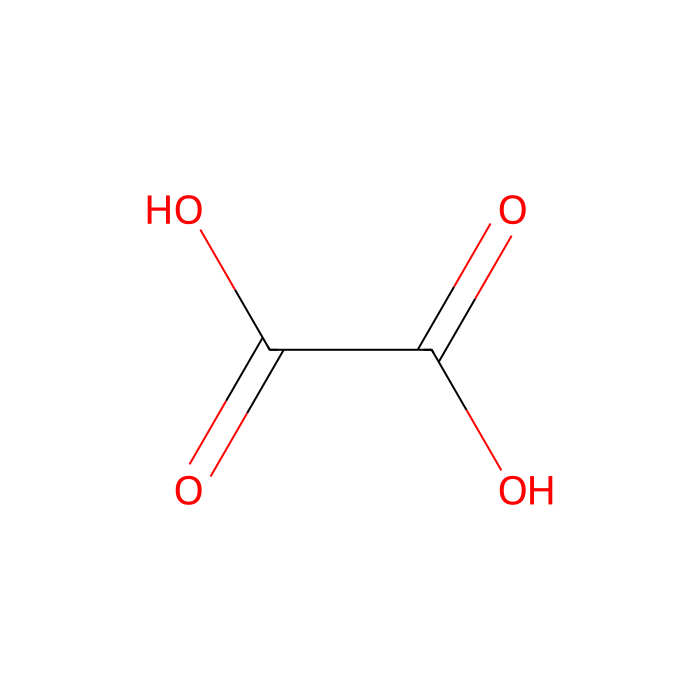
| Sorrisos canónicos | C(=O)(C(=O)O)O |
| IUPAC Name | oxalic acid |
| InChIKey | MUBZPKHOEPUJKR-UHFFFAOYSA-N |
| INCHI | 1S/C2H2O4/c3-1(4)2(5)6/h(H,3,4)(H,5,6) |
| SMILES isoméricas | C(=O)(C(=O)O)O |
| Número UN | 3261 |
| Grupo de embalagem | I |
| Peso molecular | 90.04 |
| Reaxy-Rn | 385686 |
| Reaxys-RN_link_address | https://www.reaxys.com/reaxys/secured/hopinto.do?context=S&query=IDE.XRN=385686&ln= |
Comprehensive hazard, handling, storage, and regulatory compliance document.
Download SDS →Lot-specific quality data. Enter your lot number to retrieve the exact COA.
Look up COA →Full quality attributes and acceptance criteria for this grade.
View spec sheet →Taxonomy Tree
| Kingdom | Organic compounds |
|---|---|
| Superclass | Organic acids and derivatives |
| Classe | Carboxylic acids and derivatives |
| Subclass | Dicarboxylic acids and derivatives |
| Intermediate Tree Nodes | Not available |
| Direct Parent | Dicarboxylic acids and derivatives |
| Alternative Parents | Carboxylic acids Organic oxides Hydrocarbon derivatives Carbonyl compounds |
| Molecular Framework | Aliphatic acyclic compounds |
| Substituents | Dicarboxylic acid or derivatives - Carboxylic acid - Organic oxygen compound - Organic oxide - Hydrocarbon derivative - Organooxygen compound - Carbonyl group - Aliphatic acyclic compound |
| Descrição | This compound belongs to the class of organic compounds known as dicarboxylic acids and derivatives. These are organic compounds containing exactly two carboxylic acid groups. |
| External Descriptors | alpha,omega-dicarboxylic acid |
| Activity Type | Relation | Activity value | Units | Action Type | Journal | PubMed Id | doi | Assay Aladdin ID |
|---|
| Activity Type | Relation | Activity value | Units | Action Type | Journal | PubMed Id | doi | Assay Aladdin ID |
|---|
Find and download the COA for your product by matching the lot number on the packaging.
| Lot Number | Certificate Type | Data | Item |
|---|---|---|---|
 L2217082 L2217082 | Certificate of Analysis | Sep 21, 2026 | O107181 |
| G2614480 | Certificate of Analysis | Jul 06, 2026 | O107181 |
| G2614552 | Certificate of Analysis | Jul 06, 2026 | O107181 |
| G2614475 | Certificate of Analysis | Jul 06, 2026 | O107181 |
| G2614476 | Certificate of Analysis | Jul 06, 2026 | O107181 |
| H2316704 | Certificate of Analysis | Aug 03, 2023 | O107181 |
| H2316705 | Certificate of Analysis | Aug 03, 2023 | O107181 |
| L2217084 | Certificate of Analysis | Dec 09, 2022 | O107181 |
| G2220014 | Certificate of Analysis | Jul 12, 2022 | O107181 |
| G2220030 | Certificate of Analysis | Jul 12, 2022 | O107181 |
| Ponto de inflamação (°F) | 200.1℉ |
|---|---|
| Ponto de inflamação (°C) | 93.4℃ |
| Ponto de fusão (°C) | 189-191°C |
| Peso molecular | 90.030 g/mol |
| XLogP3 | -0.300 |
| Hydrogen Bond Donor Count | 2 |
| Hydrogen Bond Acceptor Count | 4 |
| Rotatable Bond Count | 1 |
| Exact Mass | 89.9953 Da |
| Monoisotopic Mass | 89.9953 Da |
| Topological Polar Surface Area | 74.600 Ų |
| Heavy Atom Count | 6 |
| Formal Charge | 0 |
| Complexity | 71.500 |
| Isotope Atom Count | 0 |
| Defined Atom Stereocenter Count | 0 |
| Undefined Atom Stereocenter Count | 0 |
| Defined Bond Stereocenter Count | 0 |
| Undefined Bond Stereocenter Count | 0 |
| The total count of all stereochemical bonds | 0 |
| Covalently-Bonded Unit Count | 1 |
Our grade selection guide covers purity, stabilizer status, and application suitability for all variants in our catalog.
View Anhydrous Grade grade guide → View PrimorTrace™ grade guide →