GRADE & PURITYMoligand™?Moligand™ — Aladdin's line of ligands and bioactive small molecules. Use for receptor, pathway, and binding studies needing defined small-molecule tools.10 mM in DMSO
1.Xiaoxue Wang, Zexin Zhu. (2025) Investigating the role of mosquito repellents in atopic dermatitis. FOOD AND CHEMICAL TOXICOLOGY, [PMID:40403953][10.1016/j.fct.2025.115571]
Calculadoras de soluções
Molarity Calculator
Determine the necessary mass, volume, or concentration for preparing a solution.
Dilution Calculator
Determine the dilution needed to prepare a stock solution.
Reconstitution Calculator
Revisões
Avaliações dos Clientes
Application Protocols
No vendor-tested bioassay protocols are provided for this item. General guidance for small-molecule library use:
Stock preparation:
Dissolve in anhydrous DMSO to 10–100 mM as needed. Vortex and, if necessary, sonicate briefly to aid dissolution. Filter (0.22 µm PTFE) for analytical applications.
Aliquot into light-protective vials or 96/384-well plates to minimize freeze–thaw cycles.
Working solutions:
Dilute DMSO stocks into assay buffer or media, keeping final DMSO ≤0.1–1.0% v/v to maintain solubility and assay compatibility.
Analytical standards:
Prepare serial dilutions in acetonitrile, methanol, or water/acetonitrile (with 0.1% formic acid if LC–MS) for calibration curves. Store cold and protected from light.
Environmental/formulation research:
For recovery studies, spike into matrix at known levels; extract with EtOAc or MeOH; analyze by LC–MS/MS in ESI+ mode with reversed-phase chromatography.
These are general recommendations. Optimize for your assay chemistry and instrumentation.
Biological Roles
Endogenous role: None known. Picaridin is a synthetic small molecule; it is not a natural metabolite or cofactor.
Chemical biology context (literature/general):
Physicochemical profile (neutral carbamate with a primary alcohol) enables interactions via H-bonding and hydrophobic contacts with protein pockets; it is commonly discussed in the context of chemosensory receptor interactions in insects (literature background), though this product is for research use only.
ADME-relevant features (conceptual):
Reduced basicity at the piperidine nitrogen (carbamoylation) can alter membrane permeability vs free amines.
Moderate lipophilicity is consistent with partitioning into lipid-like environments; actual parameters should be verified experimentally.
Laboratory implications:
Suitable as a test article in binding/partitioning studies, formulation studies, or as a spike-in standard in environmental residue analyses (non-clinical, research-only).
Note: No claims are made regarding therapeutic or clinical efficacy. All uses are for research and laboratory investigations only.
Buffer Applications
This compound is not a buffering agent and is not typically employed to control pH. It does not define a conventional acid/base pair suitable for buffering in the physiological range because the piperidine nitrogen is carbamoylated (significantly reducing basicity), and the primary alcohol is non-ionizable under typical conditions.
Practical note: If introducing picaridin into aqueous systems, use a compatible buffer (e.g., phosphate, HEPES, MOPS) selected for your biological assay. Maintain organic co-solvent (e.g., 0.1–1% DMSO or ethanol) to aid solubility and avoid precipitation.
For electrophoresis or cell culture, picaridin has no standard buffer role; consult the sections on Solvent Selection and Application Protocols for handling guidance.
Green Alternatives
Considerations here pertain to solvent choice and process handling rather than replacing the molecule itself (which is supplied for screening/reference use).
Greener solvent choices for handling and analysis (literature-based comparison):
DCM/chloroform replacement:
Preferred: Ethyl acetate or CPME for extractions and medium-polarity chromatography; Me-THF can provide similar solvation with better safety/green metrics.
Petroleum ether/hexanes replacement:
Heptane or cyclopentyl methyl ether (CPME) can reduce toxicity and VOC impact.
Polar aprotic replacement:
Replace DMF/NMP where possible with acetonitrile, ethyl acetate, or propylene carbonate depending on task.
Example comparison (general):
EtOAc vs DCM for workup
Pros (EtOAc): biodegradable, lower toxicity, higher boiling point, broad solubility.
Cons: may extract more water; can hydrolyze carbamates if base-contaminated and heated.
Cons: Slightly different polarity; check solubility of picaridin before scale-up.
Operational green tips:
Use DMSO or ethanol for assay stocks to minimize halogenated waste.
Employ microscale screening formats (96/384-well) to reduce solvent usage.
Consolidate cold-chain shipments to minimize dry-ice consumption where feasible and compliant.
Pharmaceutical Uses
No excipient or pharmacopeial role is specified for this catalog item. It is supplied for research use only.
General formulation/contextual notes (literature/practice, non-clinical):
Can serve as a reference standard in analytical methods validating quantitation in complex matrices (e.g., stability studies, environmental residue testing of consumer formulations).
When used as a test article in formulation research, typical solvent systems include ethanol/water or propylene glycol mixtures; verify solubility and stability empirically.
Regulatory/compendial status for this item is not provided here; if compendial compliance is required for your workflow, obtain and review the CoA and any available reference standards.
No therapeutic or clinical claims are made; this product is not intended for human or animal use beyond laboratory research.
Physical Properties
Item-specific specifications (this lot):
Appearance: Not specified for this item; refer to CoA/Spec Sheet.
Measured purity/assay: Moligand™ grade listed; quantitative purity value Not specified for this item; refer to CoA/Spec Sheet.
Literature/general reference data for context (not item specifications):
Physical state: typically a colorless to pale liquid (literature).
Functional polarity: amphiphilic (carbamate + primary alcohol) with overall moderate hydrophobicity from isobutyl and piperidine ring (literature).
pKa/basicity: ring nitrogen is carbamoylated and substantially deactivated; overall molecule behaves as a neutral carbamate with weak basicity (literature qualitative note).
Solubility profile: sparingly soluble in water; readily soluble in common organic solvents such as alcohols, esters, ketones, chlorinated solvents (literature, qualitative).
Partitioning: moderate logP typical of repellents; exact value varies by source (literature; consult primary databases for precise figure).
Boiling point, melting point, density, refractive index: Not stated here; consult authoritative databases or the product CoA/SDS for values.
Practical notes:
Presence of a primary alcohol enables hydrogen bonding and increases polarity vs simple carbamates; this can influence chromatographic retention and extraction behavior.
The carbamate moiety may undergo slow hydrolysis under strong acid/base at elevated temperature; avoid assigning thermal constants without consulting SDS/CoA.
Quality and Grades
Listed grade: Moligand™ (as per Product Data). Moligand™ at Aladdin denotes inclusion in a curated small-molecule/ligand library suitable for screening, cheminformatics, and structure–activity exploration. It emphasizes identity verification and suitability for biochemical/chemical screening workflows.
Purity/assay: Not specified for this item; refer to CoA/Spec Sheet for actual assay, residual solvents, and impurity profile.
Stabilizers/inhibitors: Not specified for this item; refer to CoA/Spec Sheet.
UV/fluorescence background: Not specified for this item; if planning HPLC/UV detection or cellular imaging, verify low baseline absorbance/auto-fluorescence from the CoA or by pre-run QC.
What this means for use:
Screening contexts: Moligand™ items are typically prepared and packaged with medicinal chemistry workflows in mind—compatible with DMSO stocks, microplate handling, and informatics tracking (SKU, CAS, CID provided).
Analytical confirmation: For quantitative work, confirm identity/purity by orthogonal methods (e.g., 1H NMR, LC–MS, HRMS) as required by your SOPs.
Batch-to-batch consistency: Rely on the CoA for specific limits and methods (e.g., HPLC area%, water content, residual solvents) applicable to the lot you receive.
Reaction and Applications
This compound is principally supplied as a member of a small-molecule/ligand library for discovery and screening workflows. From a synthetic chemistry perspective, its functional array (primary alcohol + piperidine carbamate) enables several transformations.
Typical research uses (non-clinical):
Reference standard or positive control in analytical methods for repellent actives (environmental or formulation studies; literature context).
Inclusion in SAR panels probing heterocyclic carbamates in protein-binding or olfactory receptor–model systems (screening chemistry).
Transformations of interest (general synthetic context):
Carbamate reactivity: Under acidic or basic conditions, hydrolysis to 2-(2-hydroxyethyl)piperidine and isobutanol; transcarbamoylation with alcohols under catalytic conditions.
C–N functionalization at the piperidine ring is suppressed at nitrogen (carbamoylated), but C2–C5 alpha-functionalizations may be accessed after strategic protection/deprotection.
Practical tips:
Protect the primary alcohol when selective reactions at the carbamate are intended (e.g., as TBDMS or benzyl ether).
Avoid prolonged exposure to strong base or strong acid at elevated temperature to minimize carbamate cleavage.
For analytical quantitation, LC–MS with ESI+ typically affords strong [M+H]+ signals for carbamate-containing amines (literature).
Reaction Conditions
General, literature-informed conditions for transformations of picaridin’s functional groups (for planning only; verify on your system):
Alcohol esterification/carbonate formation:
Conditions: Acyl chloride or anhydride (1.1–1.5 equiv), base (Et3N, pyridine), catalytic DMAP, DCM or EtOAc, 0–25°C, 1–4 h.
Notes: Carbamate typically remains intact; avoid strong bases/long times that could cleave it.
Notes: Carbamates are generally compatible; monitor to prevent over-oxidation.
Alcohol activation and displacement:
Mesylation: MsCl (1.2 equiv), Et3N (2 equiv), DCM, 0–5°C to rt; then SN2 substitution with nucleophile in polar aprotic solvent (DMF/MeCN), 25–60°C.
Carbamate hydrolysis (deprotection to free amine):
Acidic: 6 M HCl or TFA/H2O, 50–80°C, hours to overnight.
Basic: NaOH or K2CO3 in MeOH/H2O, reflux; risk of competing side reactions—optimize.
Yields and exact conditions vary by substrate and scale; pilot experiments and in-process analytics (TLC/LC–MS/NMR) are recommended. Always account for the reduced basicity of the carbamoylated piperidine when predicting reactivity.
Safety and Handling
Authoritative safety classification for this specific item is Not specified; refer to the product SDS for definitive GHS data.
GHS information from Product Data:
Signal Word: Not specified for this item; refer to SDS.
H-Statements: Not specified for this item; refer to SDS.
GHS Classification/Pictograms: Not specified for this item; refer to SDS.
General laboratory safety guidance (literature/practice, not a substitute for SDS):
PPE: Use lab coat, safety glasses or chemical splash goggles, and appropriate chemical-resistant gloves (e.g., nitrile). Handle in a fume hood to avoid inhalation of vapors or aerosols.
Incompatibilities: Strong acids/bases can catalyze carbamate hydrolysis; strong oxidizers may oxidize the alcohol moiety; isocyanate-forming reagents or dehydrating agents may lead to decomposition.
Handling: Minimize exposure to light per item-specific storage note. Avoid prolonged heating; keep containers tightly closed to limit moisture ingress and volatilization.
First aid (overview): If inhaled—move to fresh air. Skin/eye contact—rinse with plenty of water for at least 15 minutes; remove contaminated clothing. If ingested—rinse mouth and seek medical attention. Always follow site-specific emergency procedures.
Spill/cleanup: Absorb small spills with inert material (vermiculite), collect in chemical waste. Prevent entry into drains. Ventilate area.
Waste: Dispose of as organic chemical waste according to institutional and regulatory requirements.
Always defer to the SDS and institutional EHS protocols for this product.
Solvent Selection
Picaridin is an amphiphilic neutral carbamate bearing a primary alcohol. It dissolves well in many organic solvents used for screening stocks and synthetic manipulations.
Stock solutions for screening/assays:
DMSO: Preferred for high-concentration stocks (e.g., 10–100 mM) due to broad solubility and stability; aliquot and store frozen per product storage guidance.
Ethanol or isopropanol: Useful for intermediate stocks; check compatibility with downstream biological assays.
Acetonitrile or methanol: Appropriate for analytical standards and LC use.
Workup/extraction behavior (general):
Partitioning favors moderately nonpolar organic phases (EtOAc, MTBE, DCM) but the primary alcohol and carbamate increase polarity; salting-out can aid extraction from aqueous matrices.
Chromatography:
Normal-phase silica: Elutes at moderate–high polarity; addition of 1–2% MeOH or Et3N may be required to prevent tailing due to H-bonding.
Reversed-phase LC: Retains moderately; water–acetonitrile or water–MeOH gradients with 0.1% formic acid or ammonium buffers give sharp peaks.
When to choose alternatives:
If water compatibility is essential, consider co-solvent systems (e.g., 5–20% DMSO or ethanol in buffer) to maintain solubility.
Avoid strongly basic aqueous media for prolonged periods to limit carbamate hydrolysis.
Shipped: On dry ice packs + cold packs (maintain cold chain upon receipt).
In-lab handling recommendations:
Upon receipt: Verify container integrity and temperature. Allow to equilibrate briefly at low temperature to minimize condensation on opening.
Long-term storage: Keep material tightly sealed under inert headspace if possible. Minimize headspace and moisture ingress. Maintain at -80°C in light-protective secondary containment.
Short-term working stock: For frequent use, prepare aliquots (e.g., in amber vials or foil-wrapped microtubes) and store at -20°C to avoid repeated -80°C freeze–thaw, provided your stability studies support it.
Reconstitution guidelines (for screening use):
Solvent: Anhydrous DMSO is recommended for concentrated stocks; ethanol or acetonitrile are alternatives depending on application.
Concentration: Common ranges 10–100 mM. Determine maximum soluble concentration empirically.
Freeze–thaw: Avoid repeated cycles; use single-use aliquots. Thaw on ice or at room temperature protected from light, mix gently, and promptly return unused material to storage.
Labeling note: Research use only. Consult the CoA for any item-specific stability limits, purity, and additional handling notes.
Structure and Identity
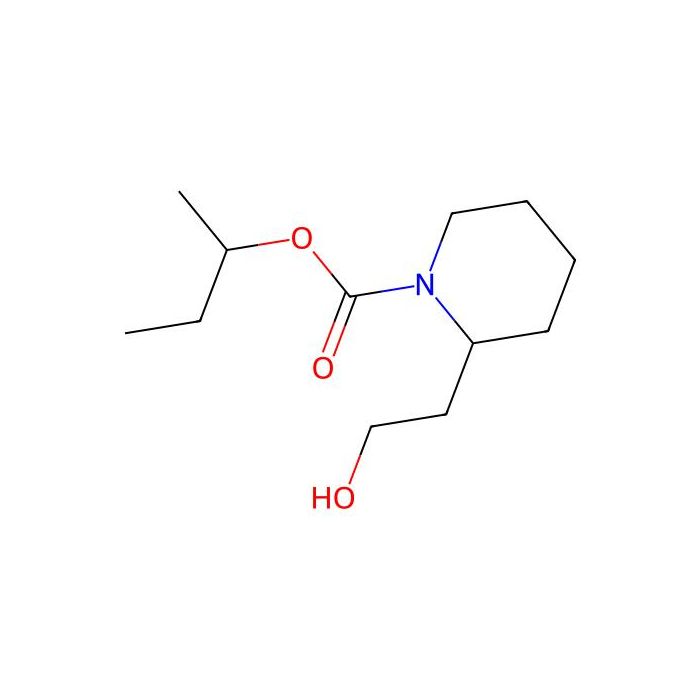
Brief overview: Picaridin (also known as icaridin; KBR 3023) is a piperidine-based carbamate bearing a primary hydroxyethyl side chain and an isobutyl carbamate moiety. In 2D, it consists of a six-membered saturated piperidine ring; the ring nitrogen is carbamoylated (urethane linkage to an isobutyl group), and the ring bears a –CH2–CH2–OH substituent.
Item-specific identifiers from Product Data:
CAS: 119515-38-7
CID: 125098
InChIKey: Not specified for this item; refer to CoA/Spec Sheet.
SMILES: Not specified for this item; refer to CoA/Spec Sheet.
Literature/Reference identity (for context only; not item specifications):
Functional groups: carbamate (urethane), tertiary amide-like N within a piperidine carbamate, primary alcohol (–CH2CH2OH), branched alkyl (isobutyl) ester side chain.
Ring system: saturated heterocycle (piperidine).
H-bonding: one H-bond donor (alcohol), multiple acceptors (carbamate C=O and O; possibly weak basicity at ring N is attenuated by carbamoylation).
Stereochemistry: none (achiral as typically supplied; literature structures are racemic at any conformational centers).
Synthetic Utility
Although commonly handled as a screening molecule or analytical reference, picaridin possesses functional handles valuable in synthesis.
Primary alcohol (–CH2CH2OH):
Protection: Convert to silyl ethers (TBDMS, TIPS) or benzyl ether to direct selectivity elsewhere.
Oxidation: Swern/DMP/TEMPO oxidations to aldehyde; further to acid under Pinnick or Jones-type conditions (literature guidance). Resulting aldehyde/acid intermediates enable coupling chemistry.
Activation for substitution: Mesylate/tosylate formation followed by displacement (e.g., azidation, halogenation) to diversify the side chain.
Carbamate (piperidine-1-carboxylate):
Stability: Reasonably stable to neutral conditions; cleaves under strong acid/base or enzymatic conditions (general carbamate behavior).
Exchange: Transcarbamoylation under alcoholysis with catalysts (e.g., organotin, DBU) can swap the O-alkyl group.
Piperidine ring:
N is deactivated by carbamoylation, limiting direct N-alkylation; strategic deprotection to the free amine (2-(2-hydroxyethyl)piperidine) enables rich downstream heterocycle chemistry.
Retrosynthetic value:
Picaridin can be disconnected to isobutanol + piperidine-1-carbonyl chloride (or equivalent) + 2-(2-hydroxyethyl)piperidine (or to a piperidine carbamate + side-chain elaboration), providing multiple entry points for analog generation in SAR studies.
Target Specificity
No antigen/biological target, clone information, or isotype applies to this small-molecule product. This item is not an antibody or biologic. For biochemical screening, any receptor or enzyme interactions must be determined experimentally within the user’s assay system.
We use cookies to ensure the website functions properly and, where permitted, to improve your experience. You can manage your preferences at any time in Settings. Learn more in our Cookie Policy.
Shall we send you a message when we have discounts available?
Remind me later
Thank you! Please check your email inbox to confirm.
Products are supplied to verified businesses, institutions, and qualified professionals for research and development use only. Not for use in humans, animals, diagnosis, or therapy.