GRADE & PURITYMoligand™?Moligand™ — Aladdin's line of ligands and bioactive small molecules. Use for receptor, pathway, and binding studies needing defined small-molecule tools.10 mM in DMSO
Moligand™, 10 mM in DMSO Moligand™ for sensitive chromatographic and analytical workflows requiring minimal baseline interference.
🌡
Storage & shipping
Store at -80°C Ships Dry ice packs + Cold packs Check lot-specific COA for exact specifications.
📋
Quality documents
SDS, COA, datasheet, and spec sheet available for download. Lot-specific COA accessible via lot number lookup.
📚
Literature proof
Cited in 0 peer-reviewed publications across chromatography, organic synthesis, and cross-coupling reactions.
Visão geral
Pinacidil is a potent activator of potassium channel . Pinacidil is an antihypertensive agent which hyperpolarises vascular smooth muscle by opening K + -channels. Pinacidil significantly improves the reperfusion function and cardiac compliance. Pinacidil has direct cardioprotective efficacy.
Specifications
Especificações e pureza
Moligand™, 10 mM in DMSO
Condições de armazenamento de armazenamento
Store at -80°C
Enviado em
Dry ice packs + Cold packs
Este produto requer transporte de cadeia fria. Serviços terrestres e outros serviços econômicos não estão disponíveis.
Determine the necessary mass, volume, or concentration for preparing a solution.
Dilution Calculator
Determine the dilution needed to prepare a stock solution.
Reconstitution Calculator
Revisões
Avaliações dos Clientes
Application Protocols
The following are general, literature-based protocols for using small-molecule ion-channel modulators like Pinacidil in common assay formats. Optimize for your system.
DMSO stock preparation:
Equilibrate vial to room temperature in a desiccator. 2) Add anhydrous DMSO to prepare a 10–50 mM stock. 3) Vortex/sonicate to dissolve. 4) Aliquot into low-bind tubes or assay plates. 5) Store aliquots at −80°C.
Seed cells expressing KATP (e.g., Kir6.2/SUR2A) at uniform density. Incubate 24–48 h.
Load membrane potential dye per manufacturer’s instructions.
Prepare serial dilutions of Pinacidil in assay buffer with matched DMSO (≤0.3% v/v).
Add compound, record fluorescence changes kinetically. Include vehicle and a known antagonist for window control.
Electrophysiology (whole-cell patch clamp):
Use internal and external solutions appropriate for KATP recordings (include Mg-ATP/ADP as required by protocol).
Perfuse cells with cumulative concentrations of Pinacidil; allow steady state before measuring current.
Analyze I–V relationships and compute EC50 from normalized current amplitudes.
86Rb+ efflux assay:
Load cells with 86Rb+, wash, then apply Pinacidil at graded concentrations.
Collect efflux fractions over time; quantify by scintillation counting and model kinetics.
Note: No tested application data are provided for this specific item; parameters above are starting points only.
Biological Roles
Research role (general, literature): Pinacidil is widely used as a tool compound to activate ATP-sensitive potassium (KATP) channels in vitro. KATP channels are hetero-octamers formed by Kir6.x pore subunits (Kir6.1/KCNJ8 or Kir6.2/KCNJ11) and sulfonylurea receptor subunits (SUR1/ABCC8, SUR2A/ABCC9, SUR2B/ABCC9 splice variants).
Mechanistic context: Pinacidil interacts with the regulatory SUR subunit to stabilize channel opening, thereby promoting K+ efflux and membrane hyperpolarization. This reduces voltage-dependent Ca2+ influx, altering downstream signaling (e.g., contraction pathways) in excitable tissues (literature).
Isoform preference: Literature reports indicate higher functional potency on SUR2-containing channels (SUR2A/SUR2B) relative to SUR1 assemblies, enabling isoform-selective studies in cardiac and smooth muscle models.
Experimental systems: Employed in recombinant expression systems (HEK293, CHO) and primary cells to benchmark KATP activation and to study metabolic coupling between cellular ATP/ADP levels and membrane excitability.
Network effects: Hyperpolarization can modulate kinase cascades and second-messenger systems indirectly (e.g., via Ca2+), useful for probing cross-talk in signaling networks.
Notes and limitations:
Potency and efficacy are assay- and system-dependent; verify concentration–response under your conditions.
For research use only (per Product Data). No clinical or diagnostic claims are made or implied.
Buffer Applications
Pinacidil is not a buffering agent and does not define a specific pH range. It is typically dosed into pre-made assay buffers as a bioactive ligand.
Practical notes:
Prepare concentrated DMSO stocks and dilute into physiological buffers (e.g., HEPES-, PBS-, or bicarbonate-based) immediately prior to use, keeping final organic co-solvent typically ≤0.1–0.5% v/v.
If solubility at working concentrations is limited, consider mild acidification or use of carriers (e.g., 0.1% w/v BSA) to reduce nonspecific adsorption, verifying that such additives do not alter channel activity.
Item-specific buffer guidance and pKa are not provided; consult CoA/Spec Sheet and validate empirically for your assay.
Green Alternatives
This product is a discrete bioactive small molecule rather than a process solvent or reagent consumed in bulk. As such, the concept of a "green alternative" is not typically applicable.
Practical green-chemistry considerations for handling bioactive ligands:
Use minimal volumes of high-boiling polar aprotic solvents (e.g., DMSO) and favor aqueous buffers when compatible with solubility and assay performance.
Implement microplate formats and automation to reduce solvent consumption and waste.
Plan aliquoting to minimize freeze–thaw cycles and compound loss, thereby reducing repeat syntheses and shipments.
If your workflow focuses on membrane potential or ion-channel assays, consider running orthogonal readouts (e.g., impedance vs. fluorescence) to reduce repeat experiments and overall chemical use.
No direct greener substitute for Pinacidil is proposed, as substitution would change the biological probe identity and data comparability.
Pharmaceutical Uses
This product is supplied strictly for research use (per Product Data) and is not intended for formulation, therapeutic, or diagnostic use.
Reference standard for analytical method development (LC–UV/LC–MS) in medicinal chemistry programs investigating KATP modulators.
In vitro control compound for target engagement and structure–activity relationship (SAR) benchmarking.
Tool for preformulation-type studies in a research setting (e.g., solubility screening, salt screening) to understand how cyanoguanidine scaffolds behave under different conditions.
No pharmacopeial monograph or excipient role is claimed. Any cGMP suitability, impurity limits, or residual solvent specifications are not provided with this listing; refer to the CoA/Spec Sheet if required for your internal QA review.
Physical Properties
Item-specific specifications are not provided with this listing. Consult the CoA/Spec Sheet for authoritative values.
Appearance: Not specified for this item; refer to CoA/Spec Sheet.
Melting point: Not specified for this item; refer to CoA/Spec Sheet. (Do not use as acceptance criteria without CoA.)
Boiling point: Not applicable (decomposes before boiling; solid organic compound). Precise value not specified for this item; refer to CoA/Spec Sheet.
Density: Not specified for this item; refer to CoA/Spec Sheet.
pKa/logP: Not specified for this item; refer to CoA/Spec Sheet. (Guanidine moiety typically confers basicity; literature pKa values for cyanoguanidines vary depending on substitution.)
Solubility profile (general, literature):
Good solubility in polar aprotic solvents such as DMSO and DMF for preparation of assay stocks.
Limited aqueous solubility at neutral pH; increased solubility upon salt formation or in mildly acidic aqueous buffers.
Miscible/soluble to varying degrees in MeOH/EtOH; check experimentally for your lot.
Refractive index/UV cutoff: Not specified for this item; refer to CoA/Spec Sheet.
Practical notes (general):
Prepare concentrated DMSO stocks (e.g., 10–50 mM) and dilute into assay buffer; avoid precipitates.
Verify solubility and clarity upon dilution; gentle warming/sonication can help dissolve recalcitrant solids.
Quality and Grades
Supplied grade: Moligand™ (per Product Data).
What Moligand™ implies (general description):
Intended for research screening and ligand-discovery workflows, where compound identity and purity support biochemical/biophysical assays, high-content screening, or reference standard use.
Typically suitable for preparation of DMSO stock solutions and downstream dilutions into assay buffers. UV transparency and low nonvolatile residue are generally desirable for plate-based readouts; verify acceptability for your method.
Item-specific acceptance criteria:
Purity, residual solvents, water content, and inorganic impurities: Not specified for this item; refer to CoA/Spec Sheet for lot-specific data.
Stabilizers/inhibitors: Not specified for this item; refer to CoA/Spec Sheet.
Best practices for screening-grade small molecules:
Verify lot-specific purity by orthogonal methods (e.g., HPLC-UV/ELSD and HRMS) before critical assays.
Prepare single-use aliquots to avoid freeze–thaw and adsorption losses.
Track plate-map and concentration history to ensure reproducible pharmacology.
Regulatory note:
For research use only (per Product Data). Not for human or veterinary use, clinical, or diagnostic applications.
Reaction and Applications
As a finished small-molecule ligand, Pinacidil is not typically used as a synthetic reagent. Its primary research applications are as a reference modulator in ion-channel and membrane-potential studies.
Assay and research applications (general, literature):
KATP channel opener reference control in electrophysiology (patch clamp) to validate SUR2/Kir6.x currents and assess antagonist potency.
Radioligand-free functional readouts (86Rb+ efflux) in smooth muscle/cardiac models for benchmarking channel activation.
Tool compound for dissecting signal transduction where KATP-mediated hyperpolarization alters Ca2+ entry and downstream kinase activity.
Comparative pharmacology vs. other openers (e.g., cromakalim, diazoxide, nicorandil) to delineate SUR isoform preferences.
Practical tips:
Prepare concentrated DMSO stocks and perform serial dilutions immediately before assays to minimize adsorption and degradation.
Include solvent controls (matching DMSO %) and positive/negative reference ligands to anchor assay windows.
Verify compound identity/purity by LC–MS prior to advanced studies; minor impurities can confound electrophysiological readouts.
Note: No item-specific activity specifications are provided. Potency and efficacy depend on expression system, subunit composition, temperature, and recording conditions.
Reaction Conditions
Not a synthetic reagent; therefore classical reaction condition guidance (catalysts/stoichiometry/yields) does not apply to this product.
Stock solutions: Dissolve in anhydrous DMSO at 10–50 mM. Sonication and brief warming (≤40°C) may assist dissolution. Filter through 0.22 μm PTFE if particulate persists.
Working concentrations: Typical in vitro ranges are 0.1–100 μM depending on expression system and readout. Perform a concentration–response curve (e.g., 10-point, half-log spacing) to establish EC50 under your conditions.
Vehicle limits: Keep DMSO at ≤0.1–0.5% v/v in the final assay to minimize solvent effects.
Stability: Prepare fresh dilutions immediately before use. Avoid extended exposure to light and ambient humidity. Monitor for precipitation on dilution into aqueous buffers.
Electrophysiology: Allow adequate equilibration time after addition to achieve steady-state effects on KATP currents; include washout steps and run solvent controls.
Item-specific stability data, solubility limits, and potency values are not provided here; verify empirically and refer to the CoA/Spec Sheet.
Safety and Handling
Safety information specific to this item is not provided here. Always consult the Safety Data Sheet (SDS) for authoritative guidance.
GHS classification: Not specified for this item; refer to SDS.
Signal word / pictograms / H-statements: Not specified for this item; refer to SDS.
General laboratory precautions for small, bioactive heteroaromatic guanidines:
Handle in a chemical fume hood; avoid inhalation, ingestion, and skin/eye contact. Pinacidil is pharmacologically active; minimize exposure.
Personal protective equipment: lab coat, safety glasses, and suitable chemical-resistant gloves (e.g., nitrile). Change gloves regularly.
Incompatibilities: Strong oxidizers and strong acids/bases may cause degradation; avoid moisture for long-term storage. Do not heat to decomposition.
First aid (overview; defer to SDS):
Skin/eyes: Rinse with water for ≥15 min. Remove contaminated clothing.
Inhalation: Move to fresh air; seek medical attention if symptoms persist.
Ingestion: Rinse mouth; seek medical attention.
Spill/accidental release: Avoid dust generation. Absorb solids with inert material; collect in a sealable container for disposal per institutional and local regulations.
Waste: Dispose as organic hazardous waste; do not discharge to drains.
Storage and shipping (item-specific):
Storage: Store at −80°C (per Product Data). Keep tightly closed, desiccated, and protected from light.
Pinacidil is a neutral-to-basic, heteroaromatic cyanoguanidine. Selection of solvent depends on the intended operation (stock solution for screening vs. preparative handling).
Primary stock solvent (screening):
DMSO is preferred for high-concentration stocks (e.g., 10–50 mM) due to excellent solvating power for heteroaromatic, H-bonding compounds and compatibility with plate-based assays.
Alternative organic solvents (literature/general):
DMF and NMP: comparable solubilization to DMSO; consider assay compatibility and cytotoxicity upon dilution.
Methanol/Ethanol: moderate solubility; good for preparing intermediate stocks if DMSO carryover must be minimized.
Acetonitrile: variable solubility; useful in LC method development.
Aqueous systems:
Neutral pH buffers may not dissolve high concentrations; solubility improves in mildly acidic media or upon salt formation. Pre-dissolve in a miscible organic co-solvent (e.g., DMSO 0.1–1% v/v) before aqueous dilution to avoid precipitation.
Selection guidance:
Choose DMSO for library plating, automated dispensing, and long-term frozen storage.
Use alcohols or acetonitrile for LC/UV analytical standards when needed, validating stability.
For biophysical assays sensitive to DMSO, test alternative co-solvents at ≤0.1–0.5% v/v in the final assay.
Note: Item-specific solubility values are not provided; confirm experimentally for your lot.
Storage and Reconstitution
Item-specific storage and shipping:
Storage: Store at −80°C (per Product Data). Keep container tightly sealed, dry, and protected from light.
Shipped in: Dry ice packs + cold packs (per Product Data) to maintain low temperature during transit.
Reconstitution (general guidance for screening compounds):
Equilibrate sealed container to room temperature in a desiccator before opening to prevent condensation.
Prepare concentrated stock solutions in anhydrous DMSO (e.g., 10–50 mM). Mix thoroughly until fully dissolved.
Optional: Prepare salt forms or mildly acidic aqueous co-solvent systems if higher aqueous solubility is required; confirm compatibility with assays.
Aliquot into single-use portions in low-bind tubes/plates. Minimize headspace and freeze at −80°C.
Handling and stability:
Avoid repeated freeze–thaw cycles; thaw on ice or at room temperature just before use.
Inspect for precipitation or discoloration prior to use. Discard if signs of decomposition are observed.
Shelf life, peroxide content, water content, and other item-specific stability attributes: Not specified for this item; refer to CoA/Spec Sheet.
Research use note: For research use only (per Product Data). Not for human or veterinary use.
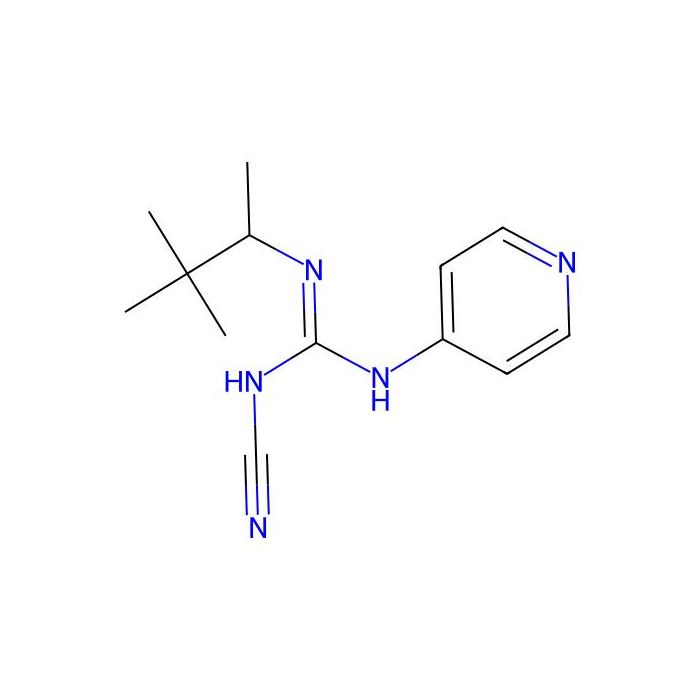
Structure and Identity
Pinacidil is a small-molecule research ligand widely used as a reference opener of ATP-sensitive potassium (KATP) channels.
SKU: P1496978
Product name: Pinacidil
CAS: 60560-33-0
PubChem CID: 4826
InChIKey: Not specified for this item; refer to CoA/Spec Sheet.
SMILES: Not specified for this item; refer to CoA/Spec Sheet.
Molecular formula: Not specified for this item; refer to CoA/Spec Sheet.
Molecular weight: Not specified for this item; refer to CoA/Spec Sheet.
Structural features (general, literature):
Contains a cyanoguanidine core (a diimide/guanidine bearing a cyano substituent), which imparts basic character and H-bonding capacity.
Bears a heteroaromatic ring (pyridinyl-type aryl) linked via an exocyclic nitrogen, contributing to π-stacking potential and polar surface area suitable for DMSO stock solutions.
2D description (in words): a substituted guanidine with a terminal cyano group, N-linked to a heteroaryl (pyridin-yl) ring, and an additional alkyl/alkylamino substituent on the exocyclic nitrogen that modulates lipophilicity. No stereocenters (literature).
Synthetic Utility
Pinacidil itself is a terminal, bioactive small molecule and is not commonly used as a building block in synthesis. Nevertheless, understanding its functional groups can aid in analog design and in assessing stability during handling.
Functional-group considerations (general):
Cyanoguanidine motif: multiple nitrogens confer basicity and H-bonding; the C≡N group can influence electron distribution and metabolic stability. Guanidine nitrogens are nucleophilic but are typically deactivated by delocalization; further derivatization on an isolated sample is uncommon.
Heteroaromatic ring (pyridinyl-type, literature): ring nitrogen can engage in coordination and affects overall pKa/logD; ring substitution patterns are central to SAR in analogs.
Salt formation: Formation of stable salts (e.g., HCl) is often used in research settings to enhance aqueous solubility for assay dosing; verify compatibility with your assay materials.
Cyanoguanidines are often prepared by coupling amines (heteroaryl amines) with carbodiimides/guanidinylating agents followed by cyanation steps or via addition of cyanamide derivatives. Conditions typically require careful control to avoid overreaction and polymerization.
Because this listing is not a reagent, use it as a reference ligand rather than a synthon. If derivatization is desired, start from known intermediates used in cyanoguanidine synthesis rather than from the final compound.
Target Specificity
No item-specific biological specifications are provided with this listing.
Literature-based target profile (for research context only):
Primary target: ATP-sensitive potassium (KATP) channels composed of Kir6.x (Kir6.1/Kir6.2) and SUR subunits.
SUR isoform preference: Functional selectivity reported toward SUR2-containing channels (SUR2A/SUR2B) over SUR1 assemblies, supporting use as a reference opener in cardiac/smooth muscle models.
Off-targets: As with many ion-channel modulators, secondary pharmacology can be system-dependent; comprehensive profiling should be performed if selectivity is critical for interpretation.
Caveats:
Observed potency and selectivity vary with species, subunit composition, membrane potential, intracellular nucleotides, Mg2+, temperature, and recording modality. Always include appropriate comparators and vehicle controls.
For definitive, lot-specific bioactivity data, users should generate their own in-house reference curves under the intended assay conditions.
Need help choosing the grade?
Our grade selection guide covers purity, stabilizer status, and application suitability for all variants in our catalog.
We use cookies to ensure the website functions properly and, where permitted, to improve your experience. You can manage your preferences at any time in Settings. Learn more in our Cookie Policy.
Shall we send you a message when we have discounts available?
Remind me later
Thank you! Please check your email inbox to confirm.
Products are supplied to verified businesses, institutions, and qualified professionals for research and development use only. Not for use in humans, animals, diagnosis, or therapy.