GRADE & PURITYMoligand™?Moligand™ — Aladdin's line of ligands and bioactive small molecules. Use for receptor, pathway, and binding studies needing defined small-molecule tools.10 mM in DMSO
Moligand™, 10 mM in DMSO Moligand™ for sensitive chromatographic and analytical workflows requiring minimal baseline interference.
🌡
Storage & shipping
Desiccated,Store at -80°C Ships Dry ice packs + Cold packs Check lot-specific COA for exact specifications.
📋
Quality documents
SDS, COA, datasheet, and spec sheet available for download. Lot-specific COA accessible via lot number lookup.
📚
Literature proof
Cited in 0 peer-reviewed publications across chromatography, organic synthesis, and cross-coupling reactions.
Visão geral
Prazosin hydrochloride is a well-tolerated, CNS-active α1-adrenergic receptor antagonist for the research of high blood pressure and alcohol use disorders. Prazosin hydrochloride potently inhibits Norepinephrine (NE)-stimulated 45Ca efflux with an IC 50 of 0.15 nM.Prazosin hydrochloride inhibits organic cation transporters OCT-1 and OCT-3 with IC 50 s of 1.8, and 13 μM, respectively.
Specifications
Especificações e pureza
Moligand™, 10 mM in DMSO
Condições de armazenamento de armazenamento
Desiccated,Store at -80°C
Enviado em
Dry ice packs + Cold packs
Este produto requer transporte de cadeia fria. Serviços terrestres e outros serviços econômicos não estão disponíveis.
Determine the necessary mass, volume, or concentration for preparing a solution.
Dilution Calculator
Determine the dilution needed to prepare a stock solution.
Reconstitution Calculator
Revisões
Avaliações dos Clientes
Application Protocols
Item-specific (Product Data)
No validated application protocols or tested assay formats are provided for this SKU. Not specified for this item; refer to CoA/Spec Sheet.
General guidance (literature/good practice; adjust to your system)
Stock preparation: dissolve at 10–50 mM in anhydrous DMSO. Vortex/sonicate gently. Prepare single-use aliquots and store at −80 °C (desiccated) per Product Data.
Working solutions: dilute stocks into pre-warmed assay buffer or culture medium with thorough mixing. Keep final DMSO ≤0.1–0.5% v/v unless your system tolerates more.
Binding assays: for radioligand or fluorescent displacement assays targeting alpha1-ARs, use serial dilutions covering at least 3–4 logs around the expected Ki/IC50; include vehicle and positive-control wells. Equilibrate at the temperature/time suitable for your receptor system; quantify non-specific binding.
Cell-based assays: pre-dilute compound into medium, add to cells, and incubate per assay design. Monitor pH to avoid precipitation upon dilution. Include cytotoxicity controls where appropriate.
Analytical reference standard use: prepare calibration curves in matrix-matched solutions; verify linearity, accuracy, precision, and stability under storage and autosampler conditions.
Documentation
Record lot number, stock concentration, solvent, and preparation date in ELN/LIMS to ensure traceability.
Biological Roles
Literature/general (no clinical claims; for research context only)
Molecular target class: adrenergic receptor ligand. Prazosin is widely used as a selective alpha1-adrenergic receptor antagonist probe in receptor pharmacology and signaling studies.
Signaling pathways: antagonism of alpha1-ARs modulates Gq/PLC/IP3–DAG pathways, reducing intracellular Ca2+ mobilization from ER stores; downstream effects include altered smooth muscle contractility signaling and transcriptional responses (model systems).
Binding/kinetics: exhibits nanomolar affinity for alpha1-AR subtypes in many expression systems; selectivity versus alpha2/beta receptors is often exploited in binding displacement assays (values are system-dependent; consult primary literature).
Cellular use cases: tool compound for validating alpha1-AR involvement in phenotypes; benchmark for comparing novel chemotypes in SAR campaigns; control for GPCR internalization/biased signaling studies.
Metabolic/transport considerations: as a cationic, moderately lipophilic heteroaromatic salt, uptake may occur through passive diffusion of the free base fraction and/or transporter-mediated pathways; pH partitioning influences intracellular levels (literature/general).
Item-specific (Product Data)
This SKU is designated Moligand™ and intended strictly for research use. No biological potency, target specificity, or QC bioassay data are provided here. For any quantitative work, confirm concentration and purity using the lot-specific CoA/Spec Sheet (Not specified for this item).
Buffer Applications
Applicability
Prazosin hydrochloride is not a buffering reagent and is not typically used to prepare buffer systems. Therefore, conventional buffer recipes (e.g., phosphate, HEPES) are not applicable.
Practical notes for solutions (literature/general)
When preparing aqueous solutions for biological assays, mild acidification (e.g., acetate or citrate buffer, pH 4–6) can increase solubility by maintaining protonation.
For neutral pH applications, dissolve first in a small volume of DMSO or ethanol, then dilute into the desired buffered medium while monitoring final DMSO/EtOH content to stay within assay tolerances.
Filter sterilize through 0.22 µm membranes if sterility is required for cell-based assays.
Item-specific
No buffer-related specifications are provided for this product. Refer to the CoA/Spec Sheet for any lot-specific solubility notes (Not specified for this item).
Green Alternatives
Context
This product is a solid small-molecule ligand rather than a process solvent or bulk reagent. “Green” considerations thus focus on solvent choice for stock solutions, waste minimization, and handling practices.
Solvent considerations (literature/general)
Replace or reduce DMSO where feasible with more benign media:
Aqueous buffers (acidic, pH 4–6): increase protonation and water solubility; best for immediate-use solutions.
Ethanol or ethanol/water mixtures: renewable origin and lower toxicity compared with DMF; ensure assay compatibility.
PEG 300/400 as co-solvent: improves solubility and reduces VOC emissions; consider viscosity and downstream impacts.
Comparison snapshot (general)
DMSO: high solvency; good stability; concerns include worker exposure and downstream biological interference at higher %.
Ethanol: greener profile; may limit maximum concentration and can perturb some assays.
Aqueous buffer: safest and greenest; limited by intrinsic solubility and pH constraints.
Operational green tips
Prepare minimal volumes at the highest practical concentration to reduce solvent usage.
Use amber vials and cold storage to extend shelf-life and prevent repeated re-prep.
Consolidate analytical runs to minimize consumables; neutralize and dispose of amine-containing waste per local regulations.
Item-specific note
No process-scale applications are anticipated for this SKU; greener choices primarily relate to dissolution media and waste handling.
Pharmaceutical Uses
Scope and limitations
This product is supplied strictly for research use (as stated in Product Data). No medical, diagnostic, or therapeutic uses are permitted or implied.
Literature/general (manufacturing and analytical context; no clinical claims)
API reference standard: prazosin hydrochloride is commonly employed as an analytical reference material in pharmaceutical development and QC for method validation (e.g., HPLC, LC–MS), impurity profiling, and stability-indicating assays.
Salt considerations: accurate assay and formulation work require knowledge of salt stoichiometry and hydration state; these affect potency calculations on a mass basis.
Solid-form behavior: different polymorphs/hydrates reported in literature can influence dissolution rate and assay reproducibility; confirm the physical form of the research material if your application is sensitive to these variables.
Item-specific
No pharmacopeial grade or compliance claims (USP/EP/JP) are stated for this SKU. Numerical specs for potency, related substances, residual solvents, or water content are Not specified for this item; refer to the CoA/Spec Sheet.
Physical Properties
Item-specific (Product Data)
Appearance: Not specified for this item; refer to CoA/Spec Sheet.
Literature/general (reference values; verify against your batch CoA)
Phase: solid, ionic organic hydrochloride salt.
Melting behavior: often reported as high-melting with decomposition in the ~280–290 °C range for the HCl salt (literature). Exact value depends on salt hydration/solvation state.
Solubility profile (qualitative):
Water: hydrochloride salt exhibits appreciably higher aqueous solubility than the free base; reported as sparingly to moderately soluble at ambient pH, with solubility increasing under acidic conditions (literature).
Organic: freely soluble in polar aprotic solvents such as DMSO and DMF; soluble in alcohols (e.g., methanol, ethanol) to varying degrees (literature).
pKa (qualitative): multiple basic centers (piperazine nitrogens) provide protonation under physiological to acidic pH; literature reports two basic pKa values in the typical piperazine range. Exact numeric values should be confirmed from primary references.
LogP/LogD: the hydrochloride salt displays lower apparent lipophilicity (logD7.4) than the free base due to ionization; reported cLogP for the neutral base is moderate (literature).
Hygroscopicity: hydrochloride salts may be hygroscopic; observe desiccated handling as per Product Data.
Measurement notes
Do not treat literature values as specifications. If precise numeric BP/MP, density, refractive index, water content, or UV cutoff are required, consult the lot-specific CoA/Spec Sheet (Not specified for this item).
Quality and Grades
Item-specific (Product Data)
Grade: Moligand™.
What’s provided: A small-molecule library/ligand grade suitable for screening and discovery workflows. Item-specific analytical details (identity/purity methods, residual solvents, water, counter-ion content, and salt stoichiometry) are Not specified for this item; refer to CoA/Spec Sheet.
About Moligand™ grade (general description)
Intended use: designed for research applications such as target engagement studies, binding assays, phenotypic screens, and as a reference standard in method development.
Identity confirmation by orthogonal techniques (e.g., 1H NMR, LC–MS/HRMS).
Purity suitable for biochemical/biophysical assays; low levels of common residual solvents. Exact thresholds are batch-specific.
Defined salt/counter-ion form where applicable; for amine salts, chloride content corresponds to declared stoichiometry.
Implications for use:
For quantitative work (e.g., standard curves), confirm exact potency on a mass basis by accounting for salt form, hydration, and assay conditions using the CoA data.
If ultra-low UV background or LC-compatibility is critical, review UV absorbance profile/impurity levels on the CoA before use.
Documentation
This catalog page does not define numerical specifications. For compliance, auditing, or regulated workflows, obtain and retain the lot-specific CoA/Spec Sheet.
Reaction and Applications
Scope of applicability
As supplied, Prazosin hydrochloride is a bioactive small-molecule ligand intended for research and screening. It is not typically employed as a synthetic reagent or catalyst. Therefore, classic reaction-family guidance (e.g., cross-coupling, Grignard) is not directly applicable to this item.
Research applications (literature/general)
Reference standard: employed as a system-suitability and calibration standard in analytical methods (HPLC/LC–MS) for adrenergic ligand profiling.
Mechanistic/target studies: used to interrogate alpha1-adrenergic receptor signaling in biochemical and cellular models, receptor occupancy assays, and competitive binding experiments. No medical or clinical claims are implied.
Phenotypic screening: can serve as a positive control for assays dependent on adrenergic pathway modulation.
Practical tips
Prepare concentrated DMSO stocks (e.g., 10 mM), store at −80 °C (desiccated), and minimize light/moisture exposure to preserve integrity.
Account for salt form and potential hydration when calculating molar concentrations; use the CoA molecular weight for exact dosing.
For LC–MS method development, monitor characteristic heteroaromatic UV absorbance (quinazoline/furan) while verifying mass transitions appropriate to the protonated molecular ion of the supplied salt (literature/general).
Notation
No item-specific application notes were provided by the manufacturer for this SKU beyond research-use context.
Reaction Conditions
Not typically applicable
This item is not supplied for use as a synthetic reagent; therefore, prescriptive “reaction condition” guidance (e.g., catalysts, temperatures, equivalents) is not applicable.
Literature/general context
Stability testing: degradation of prazosin salts has been studied under forced conditions (acid/base, oxidative, thermal, photolytic) to develop stability-indicating analytical methods. Such studies often use aqueous buffers (pH 1–10) at elevated temperatures (40–80 °C) and oxidants like H2O2 to map degradation pathways. These are analytical stress tests, not recommended handling conditions.
Solution handling: for biological assays, stock solutions are commonly prepared in DMSO at room temperature with gentle agitation, then stored frozen. Upon dilution into aqueous media, maintain pH to keep the compound protonated and in solution.
Item-specific
No recommended reaction conditions are provided for this SKU. Consult the CoA/Spec Sheet for any lot-specific handling notes (Not specified for this item).
Safety and Handling
Item-specific (Product Data)
Storage conditions: Desiccated; Store at −80 °C.
Shipping: Dry ice packs + Cold packs.
Research use: For research use only.
GHS/Signal word/H-statements/pictograms: Not specified for this item; refer to SDS.
General laboratory safety (literature/good practice; defer to SDS for authoritative guidance)
Likely hazards: organic hydrochloride salts of bioactive amines may cause irritation to eyes/skin/respiratory tract. Avoid dust generation and inhalation. Handle in a chemical fume hood.
PPE: lab coat, nitrile gloves, safety glasses or face shield. Use dust mask/respirator if airborne particulates may form (per risk assessment and SDS).
Incompatibilities: strong oxidizers; strong bases (which can liberate the free base). Avoid prolonged exposure to moisture due to potential hygroscopicity and hydrolysis of sensitive functionalities.
First aid (overview):
Inhalation: move to fresh air; seek medical advice if symptoms persist.
Skin/eye contact: rinse with water for several minutes; remove contaminated clothing; obtain medical attention as needed.
Ingestion: rinse mouth; do not induce vomiting; seek medical attention.
Spill/cleanup: avoid dust; collect solids by gentle sweeping with minimal agitation; wet-wipe residues; dispose per institutional and local regulations.
Thermal stability: many quinazoline salts char/decompose on strong heating rather than exhibiting a clean boil; avoid unnecessary thermal stress.
Documentation
Always consult the product SDS and lot-specific CoA for definitive hazard classification and handling instructions.
Solvent Selection
Compound class context
Prazosin hydrochloride is a polar, cationic organic salt with multiple basic nitrogens and heteroaromatic rings. It dissolves readily in polar aprotic media and in aqueous acidic buffers; solubility in purely nonpolar solvents is poor (literature/general).
Practical dissolution choices (research use)
DMSO: preferred for preparing high-concentration screening stocks (e.g., 10–50 mM). Ensure anhydrous DMSO to limit hydrolytic pathways. Filter-sterilize if needed through 0.22 µm PTFE.
Water/buffers: improve solubility by mild acidification (e.g., acetate/citrate buffers at pH 4–6). Avoid strong base, which can liberate the free base and reduce solubility (literature/general).
Alcohols (MeOH, EtOH): useful co-solvents for intermediate concentrations; assess compatibility with downstream biology/analytics.
DMF/PEG400: alternatives for concentrated stocks when DMSO must be minimized; consider viscosity and assay compatibility.
Small comparison (literature/general)
DMSO: maximal solubilizing power; may affect some biological assays at >0.5–1% v/v.
Aqueous acidic buffer: biocompatible and suitable for direct addition; limited by salt’s aqueous solubility.
EtOH: good miscibility with water; volatility aids removal but may limit achievable stock strength.
Handling tips
Warm gently (25–37 °C) and vortex/sonicate to speed dissolution; avoid prolonged heating.
Prepare single-use aliquots to avoid repeated freeze–thaw of DMSO stocks.
Confirm pH after dilution into assay buffers to maintain the protonated (soluble) form.
Item-specific reminder
No item-specific solvent specs are provided here. For exact solubility or UV cutoff requirements, consult the CoA/Spec Sheet (Not specified for this item).
Storage and Reconstitution
Item-specific (Product Data)
Storage: Desiccated; Store at −80 °C.
Shipping: Dry ice packs + Cold packs.
Research Use: For research use only.
Reconstitution guidance (general best practice; align with your protocol)
Solid handling: allow container to equilibrate to room temperature in a desiccator before opening to prevent condensation. Work quickly to minimize moisture uptake.
Initial dissolution: prepare a concentrated stock in anhydrous DMSO (e.g., 10–50 mM). Alternatively, dissolve in a small volume of ethanol or acidic aqueous buffer if DMSO is unsuitable.
Filtration: if sterile solutions are required, filter through a 0.22 µm PTFE (for organic) or PES (for aqueous) membrane.
Aliquoting: dispense single-use aliquots in inert, amber vials or polypropylene tubes to avoid adsorption and light exposure. Flush headspace with inert gas if long-term storage is planned.
Storage of solutions: store aliquots at −80 °C. Avoid repeated freeze–thaw cycles; thaw on ice and use promptly. Document the number of freeze–thaw events.
Stability checks: verify concentration and purity periodically by HPLC/LC–MS, especially after extended storage. Observe for color change or precipitation.
Specifications reminder
Numerical stability limits, aqueous solubility, water/peroxide/metal content, and UV cutoff are Not specified for this item; refer to the lot-specific CoA/Spec Sheet for definitive guidance.
InChIKey: Not specified for this item; refer to CoA/Spec Sheet.
SMILES: Not specified for this item; refer to CoA/Spec Sheet.
Literature/general (for reference; confirm on CoA)
Common salt form: prazosin monohydrochloride (anhydrous)
Typical molecular formula (anhydrous HCl salt): C19H22ClN5O4 (literature)
Typical molecular weight: ~419.87 g/mol for the anhydrous HCl salt (literature). Note that hydrated/solvated forms with different formulae/Mr are also reported; verify the exact form on the supplied batch CoA.
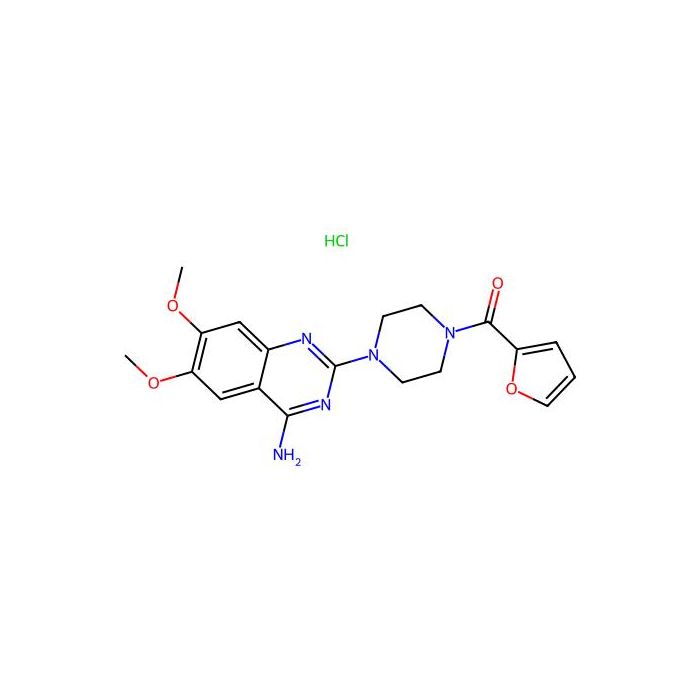
Structural features: quinazolin-4-amine core substituted at the 6,7-positions with two methoxy groups; N2 of the quinazoline ring bears a piperazine substituent that is acylated with a 2-furoyl group. The hydrochloride is a protonated salt of the basic piperazine nitrogen(s).
2D description in words: a bicyclic diazanaphthalene (quinazoline) fused ring with adjacent methoxy substituents on the benzene ring; an exocyclic amine at the 4-position; an N-linked piperazine ring extending from the 2-position and terminating in an amide connected to a furan ring. The HCl counterion balances the cationic center under acidic conditions.
Notes
Stereochemistry: molecule is achiral (no stereocenters in the commonly referenced structure).
Identity for screening libraries is typically confirmed by orthogonal methods (e.g., 1H NMR, LC–MS, HRMS); see CoA for item-specific identity data.
Synthetic Utility
Applicability
Prazosin hydrochloride is a finished, structurally complex small-molecule ligand and is not typically used as a building block or reagent in synthetic chemistry.
Literature/general notes
Retrosynthetic perspective: the molecule comprises a quinazolin-4-amine core bearing 6,7-dimethoxy substitution, linked through N-2 to a piperazine acylated by a 2-furoyl moiety. Synthetic routes generally construct the quinazoline nucleus from anthranilamide derivatives, introduce the dimethoxy pattern via appropriate anisidine/halogen intermediates, and append the piperazine–furoyl fragment through nucleophilic aromatic substitution (SNAr) at C-2 followed by acylation.
Reactivity considerations: as an isolated salt, the compound is stable under neutral conditions but can undergo hydrolysis of the amide or salt cleavage under strong acidic/basic conditions and elevated temperatures (literature/general). These pathways are more relevant to stability testing than to synthetic transformations.
Item-specific
No utility as a reagent, catalyst, or protecting group is claimed for this SKU. For synthetic campaigns, obtain precursor intermediates instead of the finished ligand.
Target Specificity
Item-specific (Product Data)
No target specificity, binding constants, or assay validation data are provided for this SKU. Not specified for this item; refer to CoA/Spec Sheet.
Literature/general (for research context; no clinical claims)
Prazosin is widely used as a selective antagonist probe for alpha1-adrenergic receptor (alpha1-AR) subtypes. Reported Ki/IC50 values are in the low-nanomolar range for many systems, with subtype selectivity patterns dependent on expression context and assay format. Researchers should consult primary literature and determine parameters under their specific conditions.
Need help choosing the grade?
Our grade selection guide covers purity, stabilizer status, and application suitability for all variants in our catalog.
We use cookies to ensure the website functions properly and, where permitted, to improve your experience. You can manage your preferences at any time in Settings. Learn more in our Cookie Policy.
Shall we send you a message when we have discounts available?
Remind me later
Thank you! Please check your email inbox to confirm.
Products are supplied to verified businesses, institutions, and qualified professionals for research and development use only. Not for use in humans, animals, diagnosis, or therapy.