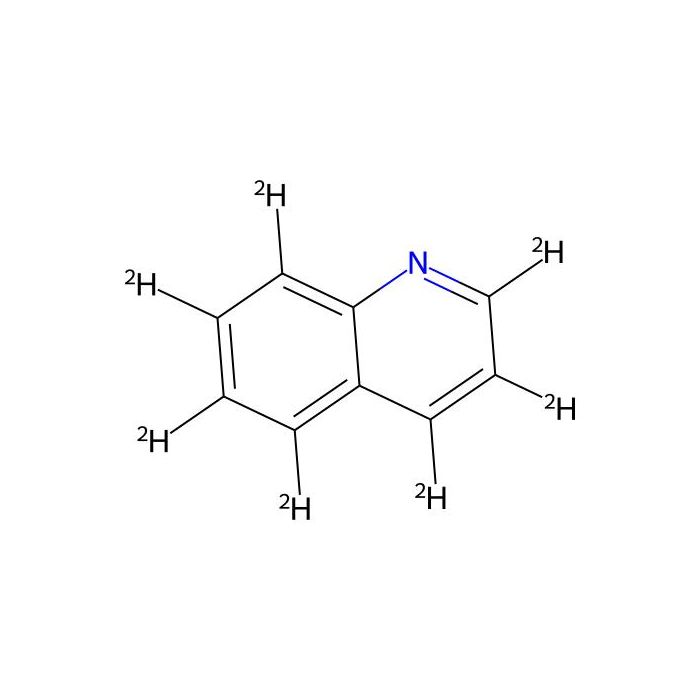
This compound belongs to the class of organic compounds known as quinolines and derivatives. These are compounds containing a quinoline moiety, which consists of a benzene ring fused to a pyrimidine ring to form benzo[b]azabenzene.
External Descriptors
Not available
1. Djoumbou Feunang Y, Eisner R, Knox C, Chepelev L, Hastings J, Owen G, Fahy E, Steinbeck C, Subramanian S, Bolton E, Greiner R, and Wishart DS. ClassyFire: Automated Chemical Classification With A Comprehensive, Computable Taxonomy. Journal of Cheminformatics, 2016, 8:61.
Determine the necessary mass, volume, or concentration for preparing a solution.
Dilution Calculator
Determine the dilution needed to prepare a stock solution.
Reconstitution Calculator
Revisões
Avaliações dos Clientes
Application Protocols
No item-specific validated protocols are provided. The following general procedures illustrate common uses of Quinoline-d7 as an internal standard. Adjust to your method and instrumentation.
LC–MS internal standard (general)
Prepare a 1.0 mg/mL stock in acetonitrile (anhydrous). Store aliquots at −20 °C.
Prepare a 1.0 µg/mL working solution in 50:50 ACN:H2O with 0.1% formic acid (or your mobile phase). Minimize residence time in aqueous/protic media if deuterium retention is critical.
Spike samples at 10–100 ng/mL final concentration. Analyze by MRM/HRMS monitoring the M+7 isotopologue.
GC–MS internal standard (general)
Prepare a 1.0 mg/mL stock in toluene or ethyl acetate.
Spike extracts post-extraction at 50–500 ng/mL. Monitor the characteristic +7 Da ions by EI.
Isotopic integrity check
Verify isotopic distribution by HRMS at receipt and periodically (e.g., monthly) if solutions are stored. Confirm minimal back-exchange (<1–2% loss of D if critical for quantitation).
These are general guidance examples and do not constitute product-validated methods. Always follow your laboratory’s SOPs.
Biological Roles
Quinoline-d7 is a non-natural, isotopically labeled heteroaromatic compound. It does not have intrinsic biological roles; however, the quinoline scaffold is widely encountered in bioorganic chemistry and analytics.
Contextual (literature/general)
Quinoline ring system appears in numerous bioactive molecules and probes, facilitating studies of binding and metabolism. The deuterated isotopologue is primarily used to trace analytical recovery and monitor matrix effects in bioanalytical assays rather than to engage biological targets.
Isotopic labeling with deuterium can subtly affect metabolic oxidation rates (primary/secondary isotope effects), but Quinoline-d7 is generally deployed as an external/internal standard to quantify unlabeled congeners in biological matrices.
Practical laboratory use cases
LC–MS/MS quantitation in plasma, tissue homogenates, or cell lysates: Quinoline-d7 can correct for extraction efficiency and ion suppression when measuring quinoline or structurally similar analytes. Spiking levels are typically in the low ng/mL to µg/mL range, depending on method sensitivity.
Note: No medical or clinical claims are made. This product is intended strictly for research use, method development, and analytical quality control.
Buffer Applications
Quinoline-d7 is not a buffering reagent and is not typically used to prepare biological or chromatographic buffers. For work involving this compound, select buffers based on your analytical platform (e.g., ammonium formate/acetate for LC–MS) and spike Quinoline-d7 as an internal standard into the prepared buffer or sample extract.
Green Alternatives
This product is a deuterium-labeled reference compound rather than a process solvent or commodity reagent; “green alternative” assessment focuses on usage minimization and analytical practice rather than substitution.
Greener practice recommendations (general)
Use micro-scale stocks (e.g., mg to µg quantities) and prepare dilute, single-use aliquots to avoid repeated thaw–freeze and disposal of expired solutions.
Choose lower-toxicity diluents where compatible with the analytical method (e.g., acetonitrile over chlorinated solvents for LC–MS; ethyl acetate over benzene/toluene for GC–MS where feasible).
Avoid unnecessary evaporation steps by spiking internal standard into final diluent to reduce solvent consumption.
Waste segregation: Collect nitrogen-containing aromatic wastes and deuterated materials separately if your facility requires isotopic waste tracking; otherwise follow local regulations.
Possible substitutions (contextual)
If isotopic tracing rather than exact structural matching is acceptable, consider 13C- or 15N-labeled quinoline for certain MS workflows, which may offer improved robustness against H/D exchange. Trade-off: different mass shift and cost/sourcing considerations.
Supply-chain note
Deuterated compounds are energy-intensive to produce; minimizing batch sizes and optimizing method sensitivity to lower spike levels meaningfully reduces environmental impact without compromising data quality.
Pharmaceutical Uses
While Quinoline-d7 is not an excipient or therapeutic agent, it is valuable in pharmaceutical analytics and process development.
Bioanalytical/QA roles (general)
Internal standard in LC–MS or GC–MS methods supporting pharmacokinetic, metabolism, or impurity profiling studies of quinoline-containing entities. The isotopic label enables accurate quantitation by compensating for matrix effects and recovery variability.
Reference material for method validation (linearity, accuracy, precision, carryover, recovery) and for establishing system suitability in assays targeting quinoline or closely related heteroaromatics.
Formulation analytics
Used to challenge extraction and sample-prep workflows (protein precipitation, LLE, SPE) by providing a stable, co-eluting surrogate across formulation matrices.
Regulatory context
Not a pharmacopeial excipient. For GMP contexts, obtain and archive the CoA detailing isotopic enrichment, purity, and trace impurities; establish appropriate reference standard qualification per internal SOPs.
No therapeutic or clinical claims are made. For research and analytical laboratory use only.
Physical Properties
Item-specific specifications are not provided; consult the CoA for certificate values.
Not specified for this item; refer to CoA/Spec Sheet.
General/literature properties for the unlabeled parent (quinoline) and expectations for the d7 isotopologue (for context only; not product specifications):
Appearance: Colorless to pale yellow liquid (quinoline, literature); the d7 isotopologue is typically similar.
Melting point (quinoline, literature): ~−15 °C.
Boiling point (quinoline, literature): ~237–239 °C at 1 atm.
Density (quinoline, literature): ~1.09 g/mL at 20 °C; the d7 isotopologue is expected to be slightly higher due to deuterium.
Refractive index (quinoline, literature): n20 D ~1.62.
Solubility (general): Moderately soluble in water; miscible with common organic solvents (EtOH, MeOH, acetone, CH2Cl2, toluene, ethers). The d7 form exhibits essentially the same solvent compatibility.
Basicity: Aromatic ring nitrogen (pyridine-like) with conjugate acid pKaH ~4.9 (quinoline, literature). Isotopic substitution with deuterium has negligible effect on pKa.
Notes for practitioners
Deuterated compounds can show small density/boiling point shifts relative to protiated analogs; for method development, treat Quinoline-d7 as physically analogous to quinoline unless high-precision thermophysical data are required.
Quality and Grades
Item-specific grade/purity and appearance: Not specified for this item; refer to CoA/Spec Sheet.
General considerations for isotopically labeled small molecules (guidance; not product-specific):
Isotopic enrichment: For deuterated standards, enrichment (%) and positional distribution matter for quantitative MS. Review the CoA for the deuterium content (e.g., ≥98 atom % D overall and per position, if reported).
Chemical purity vs. isotopic purity: Chemical purity (e.g., GC/HPLC area %) and isotopic enrichment are distinct. High-quality deuterated references report both. Trace protiated analog (quinoline-h7) content can affect internal-standard responses.
Residual solvents/stabilizers: Not typically stabilized. If a stabilizer or additive is present, it will be listed on the CoA; absence here does not imply absence.
Water/metal/peroxide/UV specs: Not specified for this item; refer to CoA/Spec Sheet.
Analytical suitability: Lots intended for LC–MS/GC–MS often have low nonvolatile residue and are packaged to minimize isotopic exchange.
Practical tips for users
Request or consult the certificate of analysis for: isotopic enrichment profile, chemical purity, residual solvents, and any counter-ions/salts.
If using as a quantitative internal standard, perform a quick lot-qualification: verify retention time match to quinoline-h7 and consistent response factors under your exact chromatographic conditions.
Reaction and Applications
Primary uses of Quinoline-d7 center on its value as an isotopic tracer and internal standard rather than as a bulk reagent.
Isotopic/internal standard applications (literature/practice)
LC–MS/GC–MS internal standard for quantifying quinoline or quinoline-like analytes in environmental, petrochemical, or process samples. The close structural identity ensures matched ionization and chromatographic behavior while the +7 Da mass shift enables clean resolution of M+7 isotopologue signals.
Mechanistic probes in catalysis and C–H activation: assess kinetic isotope effects (KIEs), H/D scrambling, and reaction pathways on the quinoline scaffold.
Calibration of hydrogen–deuterium exchange workflows for heteroaromatic systems and to benchmark back-exchange during sample workup.
As a labeled substrate in named transformations (general guidance)
Directed metalation/C–H activation at the 8-position of quinoline (e.g., with TMP-bases or Ir/Rh catalysts) to track site selectivity via MS/NMR when deuterium is preinstalled elsewhere.
Cross-couplings (Suzuki–Miyaura, Buchwald–Hartwig N-oxide routes) on quinoline derivatives to follow isotopic fidelity through multi-step sequences.
Practical tips
Prepare stock solutions under anhydrous conditions to minimize H/D exchange; store frozen aliquots.
Confirm isotopic distribution by HRMS before and after reactions/workup to quantify any exchange.
When used as an internal standard, spike after extraction but before evaporation to minimize isotopic fractionation and volatilization losses.
Reaction Conditions
Because Quinoline-d7 is typically an analytical standard, there are no item-specific reaction conditions. The following are general, literature-informed guidelines for handling quinoline scaffolds while preserving deuterium labeling.
Stock solutions and analytical use
Solvents: ACN, MeOH, IPA, DCM, toluene, or hexane depending on platform (LC–MS vs GC–MS). Use dry, neutral solvents to limit H/D exchange.
Concentrations: Prepare 0.1–1.0 mg/mL primary stocks; dilute to 1–1000 ng/mL for MS workflows, as method sensitivity dictates.
Temperature: Room temperature handling is fine; minimize prolonged heating.
Synthetic manipulations of quinoline cores (if used as labeled substrate)
C–H activation: Ir/Rh catalysis (e.g., [IrCp*] with acetate base) in polar aprotic solvents at 60–120 °C can functionalize the 8-position; expect potential H/D exchange. Monitor by HRMS/2H NMR.
Directed metalation: Strong bases (s-BuLi/TMEDA, LiTMP) at −78 to 0 °C can deprotonate adjacent to N; quench carefully to avoid exchange.
Electrophilic substitutions: Nitration/halogenation under controlled conditions (0–25 °C) possible; acidic media may induce back-exchange of D with H.
Expected outcomes
Yields and rates vary with substrate and catalyst; report deuterium recovery alongside chemical yield. Always validate isotopic integrity after workup.
All values above are general literature guidance only, not product specifications.
Safety and Handling
Item-specific hazard coding is not provided here. Always consult the product SDS for authoritative information.
Provided hazard fields
Signal word: Not specified for this item; refer to CoA/Spec Sheet.
H-Statements: Not specified for this item; refer to CoA/Spec Sheet.
GHS classification/pictograms: Not specified for this item; refer to CoA/Spec Sheet.
General laboratory safety guidance for quinoline-class heteroaromatics (literature/practice; not product-specific):
PPE: Wear lab coat, safety glasses, and appropriate chemically resistant gloves (e.g., nitrile). Use in a fume hood to avoid inhalation of vapors.
Handling: Avoid skin/eye contact and inhalation. Prevent exposure to strong oxidizers and strong acids/bases that may promote side reactions or H/D exchange.
Incompatibilities: Strong oxidizing agents; strong acids (can form salts and catalyze exchange); strong bases (can initiate nucleophilic reactions and exchange at activated positions).
Spill response: Absorb small spills with inert material (vermiculite), avoid ignition sources, and ventilate area. Dispose in accordance with local regulations.
First aid (overview): If inhaled, move to fresh air; if on skin, wash with soap and water; if in eyes, rinse cautiously with water for several minutes; if ingested, rinse mouth. Seek medical attention in all cases of exposure. Follow SDS instructions.
Special note for deuterated materials: No unique acute hazards from isotopic substitution are expected; however, preserve isotopic integrity by minimizing exposure to protic media during handling.
Shipping/storage
Follow the stated storage at −20 °C. Shipments are supplied cold (ice chest + ice packs) per Product Data.
Solvent Selection
Quinoline-d7 is a neutral, basic, aromatic heterocycle and behaves in solution like quinoline. It is typically used dissolved in organic solvents for analytical spiking or as a labeled substrate.
Polarity and miscibility (literature/general)
Polarity class: Moderately polar aromatic base (pyridine-like nitrogen).
Miscibility: Miscible with many organics (MeOH, EtOH, acetonitrile, acetone, DCM, THF, toluene, ethyl acetate). Limited water solubility.
Dielectric context: Amenable to both polar aprotic and less polar aromatic media; choose according to downstream method (LC–MS vs GC–MS).
Choosing solvents for typical uses
LC–MS internal standard stocks: Acetonitrile, methanol, or isopropanol provide good solubility and chromatographic compatibility. For low-µM stocks, ACN is often preferred for stability and low viscosity.
GC–MS applications: Nonpolar or mid-polar solvents with low background (hexane, isooctane, toluene, ethyl acetate) are common; avoid high boiling residuals in injector.
NMR reference or probe experiments: Use deuterated solvents only if needed for lock/shim; however, since analyte is already deuterated, protonated solvents may be used for 1H suppression, but beware H/D exchange in protic media.
Practical notes
Avoid strongly protic/acidic/basic solvents if preserving deuterium incorporation is critical; trace acid/base catalysis can promote H/D exchange at activated positions.
Filter through PTFE when necessary; adsorptive losses on silica/glass are typically minimal but verify for µg/mL-level work.
Stability and handling (general best practices for deuterated aromatics)
Container: Store in amber, airtight vials to limit photochemical and atmospheric moisture exposure. PTFE-lined caps recommended.
Atmosphere: Dry, inert headspace (e.g., nitrogen or argon) is beneficial for long-term storage.
Aliquoting: Prepare single-use aliquots of concentrated stock solutions to avoid repeated freeze–thaw cycles and atmospheric exposure.
Reconstitution/preparation
Solvents: Reconstitute in dry acetonitrile, methanol, toluene, or other compatible organic solvents. Avoid strong acids/bases and strongly protic media if deuterium preservation is critical.
Concentrations: Typical primary stocks 0.1–10 mg/mL depending on application; filter (0.2 µm PTFE) if particulate is observed.
Shelf-life guidance (non-specification)
Neat material kept at −20 °C under dry conditions is generally stable long-term. Working solutions at room temperature in protic solvents should be prepared fresh or stored short-term at 2–8 °C; frozen aliquots at −20 °C can be stable for weeks to months, subject to verification by MS.
Always refer to the product CoA/SDS for definitive storage and stability information. Research use only.
Structure and Identity
Quinoline-d7 is the fully deuterium-labeled isotopologue of quinoline, a bicyclic aromatic nitrogen heterocycle (benzannulated pyridine) used widely as an isotopic standard and mechanistic probe.
Item-specific identifiers (from Product Data)
CAS: 34071-94-8
CID (PubChem): 12202083
InChIKey: 340013 (as provided; consult CoA/SDS for definitive identifier)
SMILES: Not specified for this item; refer to CoA/Spec Sheet.
Computed/literature identifiers and features (non-specification)
Molecular formula (isotopic): C9D7N (literature/computed for d7 isotopologue)
Molecular weight: ~136.20 g/mol (literature/computed using D = 2.014 amu)
Core scaffold: fused benzene–pyridine system (quinoline), planar, aromatic, one ring nitrogen (sp2) at the 1-position of the pyridine ring.
Isotopic labeling: Seven ring hydrogens of quinoline (C9H7N) are replaced by deuterium (2H). The precise labeling pattern may vary by synthesis route; verify positional isotopic distribution on the CoA/NMR.
2D structure description (general)
A six-membered benzene ring fused to a six-membered pyridine ring, sharing a C–C bond. The ring nitrogen is part of the pyridine ring. The deuteriums occupy the ring C–H positions of the quinoline framework, yielding an isotopologue suitable for MS/NMR tracing.
Synthetic Utility
As a fully deuterated aromatic heterocycle, Quinoline-d7 is especially useful for mechanistic and tracer studies within synthetic chemistry.
Key features
Isotopic label (D7) allows tracking of hydrogen transfer, exchange, and incorporation pathways by MS or NMR.
Basic nitrogen enables coordination to metals, influencing site-selectivity in C–H activation, and provides a handle for N-oxidation or quaternization to tune reactivity.
Representative transformations leveraging the label (literature context)
Kinetic isotope effect (KIE) investigations in electrophilic aromatic substitution or metal-catalyzed C–H functionalization on quinoline frameworks.
H/D exchange benchmarking under catalytic conditions (e.g., Pd/C, Pt/C, Ir-catalyzed hydrogenation/deuteration) to quantify scrambling and reversible steps.
Isotopic mass balance across multi-step sequences (e.g., nitration, halogenation, cross-coupling of quinoline derivatives) where preservation or relocation of deuterium informs mechanism.
Retrosynthetic value
Serves as a labeled starting material for preparing deuterated quinoline derivatives, maintaining a predictable mass offset (+7 Da) that simplifies isotopologue assignment.
Note: Verify positional deuterium distribution when positional specificity matters; some downstream steps (strong acid/base, high heat, catalytic hydrogenation) can reduce or redistribute deuterium.
Target Specificity
Not applicable. Quinoline-d7 is a small-molecule chemical standard, not a biological targeting reagent (no antigen/epitope, clone, or isotype). For specificity in analytics, it serves as an isotopologue-matched internal standard to the unlabeled quinoline analyte.
We use cookies to ensure the website functions properly and, where permitted, to improve your experience. You can manage your preferences at any time in Settings. Learn more in our Cookie Policy.
Shall we send you a message when we have discounts available?
Remind me later
Thank you! Please check your email inbox to confirm.
Products are supplied to verified businesses, institutions, and qualified professionals for research and development use only. Not for use in humans, animals, diagnosis, or therapy.