Determine the necessary mass, volume, or concentration for preparing a solution.
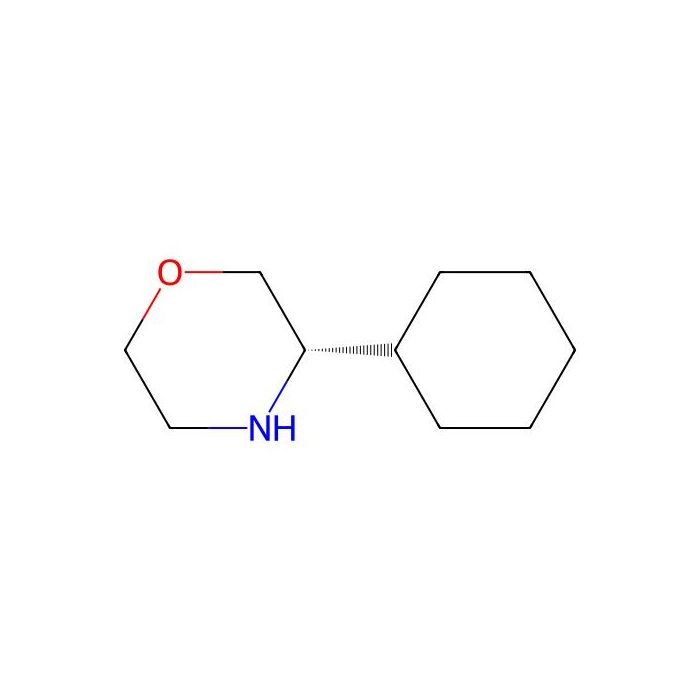
(S)-3-Cyclohexylmorpholine - ≥95% , CAS No.1270289-34-3
Disponível para encomenda
GRADE & PURITY ≥95%
Storage
Room temperature

≥95% for sensitive chromatographic and analytical workflows requiring minimal baseline interference.
Room temperature Ships Check lot-specific COA for exact specifications.
SDS, COA, datasheet, and spec sheet available for download. Lot-specific COA accessible via lot number lookup.
Cited in 0 peer-reviewed publications across chromatography, organic synthesis, and cross-coupling reactions.
| Sorrisos canónicos | C1CCC(CC1)C2COCCN2 |
|---|---|
| IUPAC Name | (3S)-3-cyclohexylmorpholine |
| InChIKey | WXMKKAIUIVUTTQ-SNVBAGLBSA-N |
| INCHI | 1S/C10H19NO/c1-2-4-9(5-3-1)10-8-12-7-6-11-10/h9-11H,1-8H2/t10-/m1/s1 |
| SMILES isoméricas | C1CCC(CC1)[C@H]2COCCN2 |
| PubChem CID | 55294709 |
| Peso molecular | 169.26 |
Comprehensive hazard, handling, storage, and regulatory compliance document.
Download SDS →Lot-specific quality data. Enter your lot number to retrieve the exact COA.
Look up COA →Full quality attributes and acceptance criteria for this grade.
View spec sheet →Taxonomy Tree
| Kingdom | Organic compounds |
|---|---|
| Superclass | Organoheterocyclic compounds |
| Classe | Oxazinanes |
| Subclass | Morpholines |
| Intermediate Tree Nodes | Not available |
| Direct Parent | Morpholines |
| Alternative Parents | Oxacyclic compounds Dialkylamines Dialkyl ethers Azacyclic compounds Organopnictogen compounds Hydrocarbon derivatives |
| Molecular Framework | Aliphatic heteromonocyclic compounds |
| Substituents | Morpholine - Oxacycle - Azacycle - Secondary amine - Ether - Secondary aliphatic amine - Dialkyl ether - Organic nitrogen compound - Organic oxygen compound - Organopnictogen compound - Hydrocarbon derivative - Organooxygen compound - Organonitrogen compound - Amine - Aliphatic heteromonocyclic compound |
| Descrição | This compound belongs to the class of organic compounds known as morpholines. These are organic compounds containing a morpholine moiety, which consists of a six-member aliphatic saturated ring with the formula C4H9NO, where the oxygen and nitrogen atoms lie at positions 1 and 4, respectively. |
| External Descriptors | Not available |
| Peso molecular | 169.260 g/mol |
|---|---|
| XLogP3 | 1.900 |
| Hydrogen Bond Donor Count | 1 |
| Hydrogen Bond Acceptor Count | 2 |
| Rotatable Bond Count | 1 |
| Exact Mass | 169.147 Da |
| Monoisotopic Mass | 169.147 Da |
| Topological Polar Surface Area | 21.300 Ų |
| Heavy Atom Count | 12 |
| Formal Charge | 0 |
| Complexity | 132.000 |
| Isotope Atom Count | 0 |
| Defined Atom Stereocenter Count | 1 |
| Undefined Atom Stereocenter Count | 0 |
| Defined Bond Stereocenter Count | 0 |
| Undefined Bond Stereocenter Count | 0 |
| The total count of all stereochemical bonds | 0 |
| Covalently-Bonded Unit Count | 1 |
Not applicable. No immunoassay or bioanalytical “tested applications” (e.g., WB, IHC, IF, FC) pertain to this small-molecule reagent. For synthetic uses, see the “Reaction Conditions,” “Reaction & Applications,” and “Synthetic Utility” sections for general guidance.
This product is a small organic amine intended for research and synthesis. No biological role or function is specified for this item.
General/biochemistry context (literature-based, not product-specific):
• Morpholine rings appear in numerous bioactive molecules as polarity/basicity modulators and solubility enhancers. However, (S)-3-cyclohexylmorpholine itself is a synthetic intermediate/building block rather than a known endogenous metabolite.
• Protonation state in physiological media: Secondary amines are predominantly protonated under neutral aqueous conditions (pH ~7), leading to increased aqueous solubility for their salts; this is relevant only for in vitro assay design and not indicative of any biological activity.
• ADME considerations for related amines show that cycloalkyl substitution increases lipophilicity and can affect membrane permeability; such statements are general trends and not claims for this item.
Important: This product is for research use only. No clinical, diagnostic, or therapeutic uses are intended or implied.
Not typically applicable. (S)-3-Cyclohexylmorpholine is a small organic base/building block rather than a dedicated buffering agent. While secondary amines can form conjugate acid salts that display limited buffering capacity near their pKaH (literature for morpholine derivatives ~8–9), this compound is not commonly used to prepare analytical or biochemical buffers.
Recommendation: For controlled pH systems, select established buffering agents (e.g., HEPES, MOPS, phosphate) and consult their validated buffering ranges and recipes. Use this compound in the synthetic or derivatization contexts described in the “Reaction & Applications” and “Synthetic Utility” sections.
Perspective: As a nitrogen-containing organic base/building block, the compound itself is not a solvent to be substituted, but greener choices apply to its synthesis, use, and workup.
Greener choices in use (general):
• Solvent selection: Prefer bio-based ethers/esters when feasible (e.g., 2-MeTHF, CPME, EtOAc) over chlorinated solvents.
• Salt formation/purification: Choose less hazardous acids (e.g., CO2 to form carbamates for transient protection; organic acids like citric acid) when compatible with the downstream steps.
• Workup: Minimize halogenated solvent waste; use aqueous ethanol or EtOAc/aqueous systems for extractions.
• Energy: Many amine functionalizations proceed at ambient temperature; avoid unnecessary heating.
Illustrative comparison (literature-based, typical solvent roles):
• DCM/CHCl3 (traditional) vs EtOAc/2-MeTHF (greener): Lower toxicity and improved lifecycle; may require optimization of reaction rates/solubility.
• DMF/NMP (polar aprotic) vs propylene carbonate/dimethyl carbonates: Safer profiles; check base stability and miscibility with amines.
Trade-offs:
• Greener solvents can alter reaction kinetics, selectivity, or salt solubility profiles; screening is recommended.
• Some bio-based ethers (e.g., 2-MeTHF) form peroxides on storage—implement peroxide testing if used extensively.
Note: No item-specific green certification is provided; consult the CoA/Spec Sheet and internal green-chemistry guidelines for selection matrices (e.g., CHEM21/ACS GCI solvent guides).
No pharmacopeial or excipient status is provided for this item. It is offered for research use only.
General formulation/manufacturing context (literature-based, not product-specific):
• Small chiral amines such as 3-substituted morpholines are frequently employed as intermediates during discovery chemistry to modulate basicity, polarity, and 3D shape in candidate molecules.
• Salt forms (e.g., HCl, fumarate) of amines are often used to improve crystallinity and handling during process development; if salt screening is pursued with this compound, document counterion selection, stoichiometry, and hydrate/solvate propensity.
• As a processing aid, amines may function as chiral resolving agents or transient protecting groups in synthetic sequences, but such use is case-specific and not standardized.
Compliance note: This product is not intended for human or veterinary use, nor for incorporation into finished drug products without appropriate qualification and regulatory assessment.
Item-specific specifications:
• Appearance: Not specified for this item; refer to CoA/Spec Sheet.
• Molecular weight: Not specified for this item; refer to CoA/Spec Sheet.
• Density, refractive index, UV cutoff, water/peroxide content, residual metals: Not specified for this item; refer to CoA/Spec Sheet.
General/literature-based guidance for the chemical class (morpholine derivatives):
• Physical state: 3-substituted morpholines are typically liquids or low-melting solids at ambient conditions; the cyclohexyl substituent often maintains a liquid state and lowers water miscibility relative to morpholine itself.
• Polarity/solubility: Morpholine rings confer polarity and hydrogen-bond basicity; cyclohexyl substitution increases hydrophobicity. Expect good solubility in common organic solvents (e.g., EtOAc, alcohols, chlorinated solvents, ethers). Water miscibility may be moderate to limited compared to morpholine (literature trend).
• Basicity: Ring nitrogen is a secondary amine (pKaH for analogous morpholines typically ~8–9, literature). Actual pKaH for this exact compound should be verified.
• Volatility: Heavier, higher-boiling than morpholine; handle with standard precautions to minimize vapor exposure.
Important: Do not treat the above as product specifications. For experimental design, consult the item’s CoA/Spec Sheet for definitive values.
Item-specific quality information:
• Grade/purity: Not specified for this item; refer to CoA/Spec Sheet.
• Stabilizers/inhibitors: Not specified for this item; refer to CoA/Spec Sheet.
• UV/LC suitability, trace metals, residual solvents, water content: Not specified for this item; refer to CoA/Spec Sheet.
General guidance on grades for amine building blocks and chiral intermediates:
• Research grade: Suitable for most synthetic and screening applications. May have typical residual solvent/water levels.
• High-purity or HPCL grade: Lower non-volatile residue and improved UV transparency—useful for analytical method development or when the amine serves as a chiral ligand/modifier in enantioselective catalysis.
• Chiral quality: For stereodefined materials, enantiomeric excess (ee) and absolute configuration assignment are critical. Confirm ee and optical rotation on the CoA; authenticate configuration versus a reference standard where needed.
• Salt form: Free base vs. salt (e.g., HCl) impacts handling and assay. Verify form on CoA.
• Metal content: If the compound will be used in catalysis or as a chiral ligand, trace metal content can matter; check CoA for ICP data.
Recommendation: Use the item’s CoA/Spec Sheet as the single source of truth for assay, ee, residual solvents, water, and any stabilizers present.
This chiral morpholine derivative serves as a versatile building block and chiral environment donor. While the catalog entry does not list specific applications, the following are common uses for related (S)-3-substituted morpholines (literature/general):
• Chiral auxiliary/ligand motif: The adjacent O/N heteroatoms and defined stereocenter make 3-substituted morpholines valuable as chiral bases, phase-transfer organocatalysts, or as elements in ligand frameworks for asymmetric transformations (e.g., enantioselective additions, reductions).
• Nucleophilic amine: Participates in acylation (amides, carbamates), sulfonylation (sulfonamides), and urea/thiourea formation. The resulting derivatives can act as chiral selectors or intermediates.
• Electrophile at the chiral carbon (after activation): Oxidation to the corresponding N-oxide followed by rearrangement (Polonovski-type, literature) or derivatization at C-3 via deprotonation/functionalization strategies used for alpha-heteroatom stereocenters (case-dependent).
• Salt chemistry: Formation of crystalline salts (e.g., HCl, p-TsOH) can aid in purification, ee-enrichment, and storage.
• Building block in medicinal chemistry: Incorporated into scaffolds to modulate polarity and basicity while introducing a well-positioned chiral center (non-clinical, research-only context).
Practical tips:
• Keep free base dry; amines absorb CO2/H2O to form carbamates/salts that alter assay and chromatographic behavior.
• For asymmetric uses, verify ee by chiral HPLC or GC and monitor optical rotation against the CoA standard.
• In acylations, control temperature and base to preserve configuration; avoid strongly acidic or high-temperature conditions that could racemize chiral alpha-heteroatom centers (substrate-dependent).
Because item-specific performance data are not provided, the following conditions are general literature guidance for reactions of secondary amines and chiral morpholine derivatives:
• Acylation (to amides/carbamates):
Yields and kinetics are substrate- and system-dependent; consult primary literature and run small-scale trials to establish conditions compatible with the desired stereochemical integrity.
Authoritative safety data must be obtained from the product SDS. The following are general considerations for morpholine derivatives.
Item-specific hazard information (from Product Data):
• Signal word: Not specified for this item; refer to SDS.
• H-statements: Not specified for this item; refer to SDS.
• GHS classification and pictograms: Not specified for this item; refer to SDS.
General safety guidance (literature/analog class):
• Hazards: Secondary amine ethers can be irritating to skin, eyes, and respiratory tract. Amines may be harmful if swallowed and can cause allergic skin reactions in sensitized individuals. Avoid aerosol formation and inhalation of vapors.
• PPE: Use lab coat, safety goggles, and appropriate chemically resistant gloves (e.g., nitrile). Work in a fume hood.
• Incompatibilities: Strong oxidizers, acylating and alkylating agents, acid chlorides/anhydrides (can form amides or salts exothermically), strong acids (protonation, salt formation), nitrosating agents (risk of nitrosamine formation).
• First aid (overview; consult SDS):
Always defer to the SDS for definitive hazard classification, exposure limits, and emergency procedures.
Relevance: (S)-3-Cyclohexylmorpholine is an amphipathic small molecule combining a secondary amine (basic, H-bond donor/acceptor) with an ether oxygen (H-bond acceptor) and a hydrophobic cyclohexyl group.
General solvent compatibility (literature/analogy):
• High solubility expected in many organic solvents: alcohols (MeOH, EtOH, i-PrOH), ethereal solvents (THF, MTBE), chlorinated solvents (DCM, CHCl3), and esters (EtOAc).
• Hydrocarbon solubility: Improved versus morpholine due to the cyclohexyl substituent; soluble in toluene and possibly hexanes mixtures.
• Water: Likely moderate to limited miscibility compared with morpholine; forms water-soluble salts under acidic conditions.
When to choose particular media:
• Base-mediated reactions and nucleophilic substitutions: Use polar aprotic solvents (DMF, DMSO, NMP, MeCN) to enhance rates; ensure dryness to avoid salt formation.
• Salt handling/purification: Convert to HCl or other mineral-acid salts for crystallization from alcohol/ether mixtures; reconvert to free base as needed.
• Chromatography: Tertiary amine behavior on silica (tailing) is mitigated with basic modifiers (0.1–1% Et3N) in eluents or by using neutral alumina.
Comparison (general):
• Versus morpholine: Lower polarity, better solubility in nonpolar solvents, reduced water miscibility.
• Versus more hindered amines (e.g., dicyclohexylamine): Higher polarity and better behavior in polar organic media; easier salt formation and handling.
Item-specific storage:
• Storage conditions: Room temperature (per Product Data).
• Shipped in: Not specified for this item; refer to CoA/Spec Sheet.
• Appearance/physical form: Not specified for this item; refer to CoA/Spec Sheet.
General handling guidance for amine-containing small molecules:
• Container: Store tightly closed in an inert container (amber glass recommended) to limit moisture and CO2 uptake.
• Atmosphere: If long-term storage is planned, consider protecting the free base under inert gas (N2/Ar) and desiccation.
• Light: Not known to be photosensitive; protect from direct sunlight as a best practice.
• Stability: Secondary amines are generally stable at ambient temperature; avoid prolonged exposure to strong acids/bases and oxidizers.
• Reconstitution: If supplied as a solid or viscous oil, warm gently to ambient temperature. Dissolve in a dry, appropriate solvent (e.g., EtOAc, THF, MeOH) immediately before use. For aqueous work, prepare acid salts to enhance solubility.
• Freeze–thaw: Typically not required; if refrigerated or frozen for any reason, allow to equilibrate to room temperature before opening to prevent moisture condensation.
Research Use Only: As indicated in Product Data, this material is for research use only.
• Product name: (S)-3-Cyclohexylmorpholine (SKU: S1044884)
• CAS: 1270289-34-3; PubChem CID: 55294709
• InChIKey (as provided in Product Data): 410615
• SMILES: Not specified for this item; refer to CoA/Spec Sheet.
• Molecular formula: Not specified for this item; refer to CoA/Spec Sheet.
• Molecular weight: Not specified for this item; refer to CoA/Spec Sheet.
Structural description (general/literature-based):
• Core scaffold: A six-membered morpholine ring containing one ring nitrogen and one ring oxygen (heteroatoms at 1,4-positions in oxazacyclohexane).
• Substitution: A cyclohexyl group is attached at the ring’s C-3 position, creating a stereogenic center. The specified absolute configuration is S at the morpholine C-3 carbon.
• Functional groups: A tertiary ether (the ring oxygen) and a secondary amine (ring nitrogen).
• 2D layout in words: Starting at the ring nitrogen, proceed along –CH2–CH(–C6H11)–CH2–O– back to N; the chiral center is the carbon bearing the cyclohexyl substituent.
• Stereochemistry: Single defined enantiomer (S); enantiopure amine ethers of this type are often used for asymmetric synthesis or as chiral building blocks (general note).
Note: Where not specified above, definitive identifiers (e.g., SMILES, standardized InChIKey, exact formula/MW) should be taken from the item’s CoA/Spec Sheet to avoid ambiguity between stereoisomers.
Functional elements and reactivity:
• Secondary amine (nucleophilic, basic): readily acylated, sulfonylated, carbamoylated, or alkylated to generate diversified libraries.
• Ether oxygen (H-bond acceptor): participates in intramolecular organization and can influence stereochemical outcomes in coordination to Lewis acids or metals (literature precedence in chiral ligand design).
• Chiral center at C-3: provides a handle for enantiospecific transformations and the potential to transfer stereochemical information.
Representative transformations (literature/general):
• Formation of amide/sulfonamide libraries via coupling reagents (EDC/HATU/T3P); control base to avoid over-alkylation or racemization of sensitive neighboring stereocenters.
• Urea/thiourea generation with isocyanates/isothiocyanates to access H-bond donor motifs for organocatalysis.
• Quaternization/alkylation to tune basicity and generate ionic derivatives (e.g., for phase-transfer).
• Incorporation into ligands: Condensation or coupling onto scaffolds to create bidentate or tridentate chiral ligands exploiting the N/O motif.
• Salt-based resolution: Use of chiral acids (e.g., tartaric derivatives, camphorsulfonic acid) to set or confirm configuration; applicable if the base is racemic prior to resolution.
Practical notes: Dry the free base, exclude CO2/H2O, and verify enantiomeric purity periodically. For sensitive steps, maintain temperatures that prevent potential epimerization at the alpha-heteroatom stereocenter.
Not applicable. This product is a small-molecule reagent/building block and is not an antibody, enzyme, or affinity reagent. No antigen/epitope, clone, isotype, or species reactivity data apply.