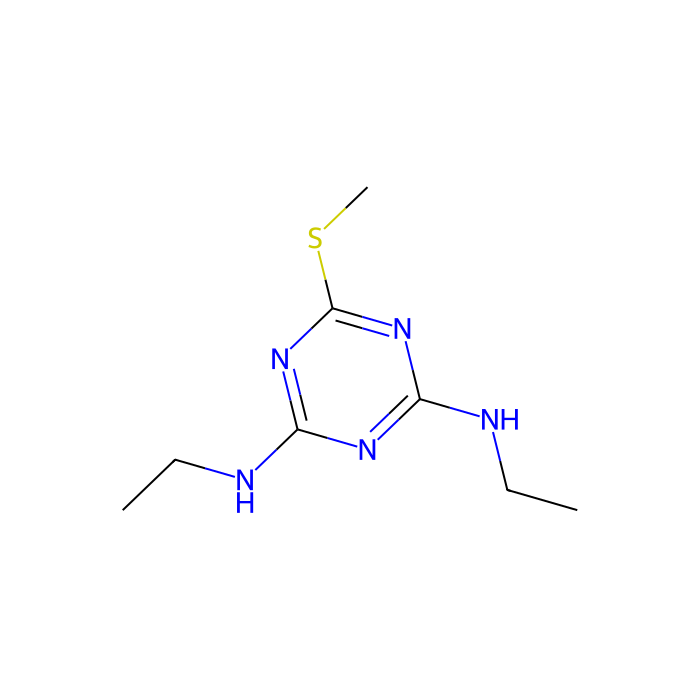
Simetryne Standard - 1000ug/ml in Purge and Trap Methanol , CAS No.1014-70-6

CAS: 1014-70-6 Cat. No.: S128280 Fórmula: C8H15N5S Peso molecular: 213.3 Beilstein Registry Number: 11728 Número CE: 213-801-7
Disponível para encomenda
GRADE & PURITY 1000ug/ml in Purge and Trap Methanol
Synonyms
2,4-Bis(ethylamino)-6-(methylmercapto)-s-triazine | n2,n4-diethyl-6-(methylthio)-1,3,5-triazine-2,4-diamine | 4,6-Bis(ethylamino)-2-methylthio-1,3,5-triazine | BS-42475 | G 32911 | 4,3,5-triazine | N,N'-diethyl-6-(methylsulfanyl)-1,3,5-triazine-2,4-diamin
Storage
Room temperature
Shipped In
Normal
★
Size
Alemanha (EU)
USA*
Price
Qty
1ml
S128280-1ml
Sob encomenda · 8–12 semanas

137,88€

206,44€
Gravar 68,55 € (33.21%)
Enter a quantity for the sizes you want to add.
🧪

Why this grade

1000ug/ml in Purge and Trap Methanol for sensitive chromatographic and analytical workflows requiring minimal baseline interference.

🌡

Storage & shipping

Room temperature Ships Normal Check lot-specific COA for exact specifications.

📋

Quality documents

SDS, COA, datasheet, and spec sheet available for download. Lot-specific COA accessible via lot number lookup.

📚

Literature proof

Cited in 11 peer-reviewed publications across chromatography, organic synthesis, and cross-coupling reactions.

Visão geral

Pesticides Single Component Standards

Specifications

Sinónimos
2,4-Bis(ethylamino)-6-(methylmercapto)-s-triazine | n2,n4-diethyl-6-(methylthio)-1,3,5-triazine-2,4-diamine | 4,6-Bis(ethylamino)-2-methylthio-1,3,5-triazine | BS-42475 | G 32911 | 4,3,5-triazine | N,N'-diethyl-6-(methylsulfanyl)-1,3,5-triazine-2,4-diamin
Especificações e pureza
1000ug/ml in Purge and Trap Methanol
Condições de armazenamento de armazenamento
Room temperature
Enviado em
Normal
Nomes e identificadores
Sorrisos canónicosCCNC1=NC(=NC(=N1)SC)NCC
IUPAC Name2-N,4-N-diethyl-6-methylsulfanyl-1,3,5-triazine-2,4-diamine
InChIKeyMGLWZSOBALDPEK-UHFFFAOYSA-N
INCHI1S/C8H15N5S/c1-4-9-6-11-7(10-5-2)13-8(12-6)14-3/h4-5H2,1-3H3,(H2,9,10,11,12,13)
SMILES isoméricas CCNC1=NC(=NC(=N1)SC)NCC
WGK Alemanha 3
Peso molecular 213.3
Beilstein 11728
Reaxy-Rn 11728
Reaxys-RN_link_address https://www.reaxys.com/reaxys/secured/hopinto.do?context=S&query=IDE.XRN=11728&ln=

Documentation

📋 Safety Data Sheet (SDS)

Comprehensive hazard, handling, storage, and regulatory compliance document.

Download SDS →

✅ Certificate of Analysis (COA)

Lot-specific quality data. Enter your lot number to retrieve the exact COA.

Look up COA →

📊 Datasheet

Quick-reference summary of product specifications and applications.

View datasheet →

🔬 Specification Sheet

Full quality attributes and acceptance criteria for this grade.

View spec sheet →

Advanced Data

Taxonomic Classification

Taxonomy Tree

KingdomOrganic compounds
SuperclassOrganoheterocyclic compounds
ClasseTriazines
Subclass1,3,5-triazines
Intermediate Tree Nodes Not available
Direct ParentMethylthio-s-triazines
Alternative Parents Alkyl-2-thio-S-triazines  Alkylarylthioethers  Heteroaromatic compounds  Sulfenyl compounds  Azacyclic compounds  Organopnictogen compounds  Organonitrogen compounds  Hydrocarbon derivatives  
Molecular FrameworkAromatic heteromonocyclic compounds
Substituents Methylthio-s-triazine - Alkyl-2-thio-s-triazine - Aryl thioether - Alkylarylthioether - Heteroaromatic compound - Azacycle - Sulfenyl compound - Thioether - Organic nitrogen compound - Organopnictogen compound - Hydrocarbon derivative - Organosulfur compound - Organonitrogen compound - Aromatic heteromonocyclic compound
DescriçãoThis compound belongs to the class of organic compounds known as methylthio-s-triazines. These are aromatic compounds containing a 1,3,5-triazine ring that is substituted at the 2-position with a methylthio group.
External Descriptors Triazine herbicides
Estrutura 3D
Modelo de Estrutura Química Interativa


Alvos associados (humanos)
AR Tclin Androgen Receptor (11781 Activities)
Activity TypeRelationActivity valueUnitsAction TypeJournalPubMed IddoiAssay Aladdin ID
PPARG Tclin Peroxisome proliferator-activated receptor gamma (15191 Activities)
Activity TypeRelationActivity valueUnitsAction TypeJournalPubMed IddoiAssay Aladdin ID
AHR Tclin Aryl hydrocarbon receptor (1071 Activities)
Activity TypeRelationActivity valueUnitsAction TypeJournalPubMed IddoiAssay Aladdin ID
Alvos associados (não humanos)
rep Replicase polyprotein 1ab (378 Activities)
Activity TypeRelationActivity valueUnitsAction TypeJournalPubMed IddoiAssay Aladdin ID
Nfe2l2 Nuclear factor erythroid 2-related factor 2 (214 Activities)
Activity TypeRelationActivity valueUnitsAction TypeJournalPubMed IddoiAssay Aladdin ID
Protoporphyrinogen IX oxidase (35 Activities)
Activity TypeRelationActivity valueUnitsAction TypeJournalPubMed IddoiAssay Aladdin ID
petD Cytochrome b6-f complex subunit 4 (179 Activities)
Activity TypeRelationActivity valueUnitsAction TypeJournalPubMed IddoiAssay Aladdin ID
Poa annua (183 Activities)
Activity TypeRelationActivity valueUnitsAction TypeJournalPubMed IddoiAssay Aladdin ID
Scenedesmus acutus (534 Activities)
Activity TypeRelationActivity valueUnitsAction TypeJournalPubMed IddoiAssay Aladdin ID
Mecanismos de ação
Certificados(CoA,COO,BSE/TSE e Mapa de Análise)
C of A & Other Certificates(BSE/TSE, COO):
Analytical Chart:

Find and download the COA for your product by matching the lot number on the packaging.

1 results found

Lot NumberCertificate TypeDataItem
E1529126Certificate of AnalysisOct 18, 2024 S128280
Propriedades químicas e físicas
Ponto de fusão (°C)82-83°C
Peso molecular213.310 g/mol
XLogP32.500
Hydrogen Bond Donor Count2
Hydrogen Bond Acceptor Count6
Rotatable Bond Count5
Exact Mass213.105 Da
Monoisotopic Mass213.105 Da
Topological Polar Surface Area88.000 Ų
Heavy Atom Count14
Formal Charge0
Complexity143.000
Isotope Atom Count0
Defined Atom Stereocenter Count0
Undefined Atom Stereocenter Count0
Defined Bond Stereocenter Count0
Undefined Bond Stereocenter Count0
The total count of all stereochemical bonds0
Covalently-Bonded Unit Count1
FAQs e artigos
Citations of This Product
Referências
1. Chun Wang, Qianqian Wang, Jintao Yu, Xinmeng Wang, Lijuan Wang, Bin Zhao, Lin Hao, Weihua Liu, Zhi Wang, Hao Chen, Qiuhua Wu.  (2023)  Converting waste expanded polystyrene into higher-value-added hyper-crosslinked porous polymer for rapid and high-efficient adsorption of aflatoxins.  Journal of Cleaner Production,      [PMID:] [10.1016/j.jclepro.2023.137102]
2. Qianqian Wang, Ranxiao Tang, Mingming Xu, Junmin Wang, Shuofeng Li, Weihua Liu, Lin Hao, Shuaihua Zhang, Junhong Zhou, Chun Wang, Qiuhua Wu, Zhi Wang.  (2022)  Sustainable synthesis of hydroxyl-functional porous organic framework as novel adsorbent for effective removal of organic micropollutants from water.  JOURNAL OF ENVIRONMENTAL MANAGEMENT,      [PMID:35985270] [10.1016/j.jenvman.2022.115952]
3. Qiuhua Wu, Yuhong Song, Qianqian Wang, Weihua Liu, Lin Hao, Zhi Wang, Chun Wang.  (2020)  Combination of magnetic solid-phase extraction and HPLC-UV for simultaneous determination of four phthalate esters in plastic bottled juice.  FOOD CHEMISTRY,      [PMID:32858384] [10.1016/j.foodchem.2020.127855]
4. Qianqian Wang, Weihua Liu, Lin Hao, Chun Wang, Qiuhua Wu, Zhi Wang.  (2020)  Fabrication of magnetic porous organic framework for effective enrichment and assay of nitroimidazoles in chicken meat.  FOOD CHEMISTRY,      [PMID:32619936] [10.1016/j.foodchem.2020.127427]
5. Wang Qianqian, Li Gaigai, Wang Chun, Wu Qiuhua, Wang Zhi.  (2020)  Layered porous organic frameworks as a novel adsorbent for the solid phase extraction of chlorophenols prior to their determination by HPLC-DAD.  MICROCHIMICA ACTA,  187  (4): (1-11).  [PMID:32152748] [10.1007/s00604-020-4195-x]
6. Wenqiang Jing, Yanying Zhou, Jiaqin Wang, Miao Ni, Wentao Bi, David Da Yong Chen.  (2019)  Dispersive Magnetic Solid-Phase Extraction Coupled to Direct Analysis in Real Time Mass Spectrometry for High-Throughput Analysis of Trace Environmental Contaminants.  ANALYTICAL CHEMISTRY,      [PMID:31373488] [10.1021/acs.analchem.9b02197]
7. Li Xinpei, Wang Yuanpeng, Sun Qun, Xu Bo, Yang Zhaoqing, Wang Xinghua.  (2016)  Molecularly Imprinted Dispersive Solid-Phase Extraction for the Determination of Triazine Herbicides in Grape Seeds by High-Performance Liquid Chromatography.  JOURNAL OF CHROMATOGRAPHIC SCIENCE,  54  (5): (871-877).  [PMID:27013667] [10.1093/chromsci/bmw018]
8. Guijiao Zhao, Chenhuan Wang, Min Kang, Lin Hao, Weihua Liu, Zhi Wang, Xiaodong Shi, Qiuhua Wu.  (2024)  Construction of magnetic azo-linked porous polymer for highly-efficient enrichment and separation of phenolic endocrine disruptors from environmental water and fish.  FOOD CHEMISTRY,      [PMID:38350198] [10.1016/j.foodchem.2024.138698]
9. Zichen Zhao, Ruiyang Ma, Juntao Wang, Qing Zhang, Miao Jing, Chun Wang, Qiuhua Wu, Zhi Wang.  (2025)  Preparation of boric acid functionalized hyper-crosslinked polymer for efficient extraction of phenylurea herbicides from lake water, green tea drink and tomato samples.  JOURNAL OF CHROMATOGRAPHY A,      [PMID:40036914] [10.1016/j.chroma.2025.465823]
10. Linna Guo, Qianqian Wang, Qiuhua Wu, Chun Wang, Baojiang Chen.  (2024)  β-Cyclodextrin based magnetic hyper-crosslinked polymer: A recyclable adsorbent for effective preconcentration of triazine herbicides in complex sample matrices.  FOOD CHEMISTRY,      [PMID:39276543] [10.1016/j.foodchem.2024.141219]
11. Juntao Wang, Ruiyang Ma, Yaxing Guo, Fuyuan Zhang, Seid Mahdi Jafari.  (2025)  Design of sulfonic acid-functionalized hyper cross-linked polymer as a mixed-mode sorbent for nitroimidazoles detection.  FOOD CHEMISTRY,      [PMID:41100985] [10.1016/j.foodchem.2025.146684]
Calculadoras de soluções
Revisões

Avaliações dos Clientes

Application Protocols

No vendor‑validated protocols are provided in the product data. General practices for analytical standards:

  • Weighing and stock preparation:
    • Equilibrate vial to room temperature in a desiccator before opening to avoid moisture condensation.
    • Weigh accurately on an analytical balance; prepare a primary stock in acetonitrile or methanol using Class A volumetrics or gravimetry.
  • Calibration:
    • Prepare multi‑point calibration curves (at least 5–7 levels) spanning expected concentrations; include a zero or solvent blank.
    • Use matrix‑matched calibrations or standard additions for complex matrices.
  • Quality control:
    • Include continuing calibration verification (CCV), laboratory control samples (LCS), and matrix spikes.
    • Track response factors and retention times over time to flag drift.

Refer to your laboratory SOPs and regulatory guidelines (e.g., SANTE/US EPA) for full method details.

Biological Roles

General biological context (literature; not a claim for use in living systems):

  • Simetryne is a selective herbicide of the s‑triazine class. Its primary mode of action is inhibition of photosystem II (PSII) by binding to the D1 protein (QB site) in the thylakoid membrane of chloroplasts, blocking electron transport and leading to inhibited photosynthesis in susceptible plants.
  • The s‑triazine core confers affinity to the PSII binding pocket; plant selectivity arises from differential uptake, translocation, and detoxification pathways.
  • Environmental fate (high level): subject to photolysis, microbial degradation, and adsorption to soils; thioether functionality can undergo oxidation to sulfoxide/sulfone in the environment (literature). Hydrolysis of the triazine under acidic/basic conditions contributes to breakdown over time.

Relevance to this product:

  • These biological notes provide context for why simetryne appears on multi‑residue screening lists. The present item is supplied strictly as an analytical standard for research use only (product data note).
Buffer Applications

Not typically applicable. Simetryne is a neutral organic analyte used as an analytical reference standard, not a buffering reagent. For laboratory use, prepare stock solutions in appropriate organic solvents (see Solvent Selection) and dilute into mobile phases or extraction media as required.

Green Alternatives

Context: This listing is an analytical standard, so “green alternatives” relate primarily to solvent systems and workflow design rather than substituting the analyte.

Greener choices in method development (literature/practice):

  • Prefer acetonitrile or ethanol/methanol over chlorinated solvents when compatible with instrumentation and analyte stability.
  • Reduce solvent consumption via micro‑extraction techniques, on‑line SPE, or miniaturized LC (narrow‑bore columns, lower flow rates).
  • Employ QuEChERS with buffered salts to avoid large‑volume liquid‑liquid extraction.

Trade‑off highlights:

  • Chlorinated solvents (DCM) provide strong solvating power and GC compatibility but have higher environmental and health burdens.
  • Acetonitrile offers excellent LC compatibility and lower toxicity but is petroleum‑derived; consider solvent recycling and capture.

Example comparison (general guidance):

  • DCM vs. Acetonitrile for standard preparation:
    • Environmental score: DCM (less favorable) vs. MeCN (more favorable)
    • Analytical performance: both suitable; MeCN preferred for LC‑MS, DCM sometimes preferred for GC sample cleanup.

Recommendation: Optimize your workflow for minimal solvent volume and select the least hazardous solvent that maintains accuracy, precision, and analyte stability.

Pharmaceutical Uses

Not applicable as a pharmaceutical ingredient. Simetryne is an agricultural analyte used as an analytical standard in research and quality control contexts. It is not an excipient or API. No pharmacopeial monograph usage is indicated for this item. For regulated analytical work, rely on the CoA for purity assignment and uncertainty.

Physical Properties

Item-specific specifications (product data):

  • Appearance: Not specified for this item; refer to CoA/Spec Sheet.
  • Molecular weight: Not specified for this item; refer to CoA/Spec Sheet.

Typical physical properties (literature/general; for reference only, not item specifications):

  • Physical state: solid, crystalline organic compound typical of s‑triazine herbicides.
  • Volatility: low; nonvolatile at ambient conditions compared with solvents.
  • Solubility profile: sparingly soluble in water; readily soluble in organic solvents commonly used for pesticide standards such as acetonitrile, methanol, acetone, dichloromethane (literature). Exact solubilities vary by solvent and temperature.
  • Acid–base: weakly basic exocyclic amino nitrogens; the s‑triazine ring is electron‑deficient and undergoes nucleophilic substitution under forcing conditions (literature). No well‑defined pKa used operationally in standard prep; rely on neutral organic solutions for calibration.
  • Stability: stable under dry, room‑temperature storage away from light; may slowly degrade under strong UV/oxidative conditions (literature). Avoid prolonged exposure to acids/bases when preparing stock solutions.

Always consult the CoA for lot‑specific purity and the SDS for safe handling. Do not treat literature values as specifications.

Quality and Grades
  • Product designation: Standard. While the exact grade/purity are not specified in the product data, “Standard” typically denotes material suitable for preparation of calibration solutions and quality control in analytical workflows (e.g., GC‑MS/LC‑MS for pesticide residue analysis). It emphasizes identity and consistency rather than process grade.
  • What “Standard” generally implies (literature/industry practice):
    • Verified identity by orthogonal techniques (e.g., NMR/IR/MS) and traceable documentation (CoA) with an assigned purity value or mass balance.
    • Information on recommended solvents for stock solution preparation and suggested storage conditions for solid and solution forms.
    • May include uncertainty estimates for quantitative use; check the CoA for details.
  • Item‑specific notes from Product Data:
    • Grade/Purity: Not specified for this item; refer to CoA/Spec Sheet.
    • Appearance: Not specified for this item; refer to CoA/Spec Sheet.
    • Storage: Room temperature (product data).
    • Shipping: Normal (product data).

Recommendation: For regulated analytical use, retain the CoA, confirm lot traceability, and prepare calibration solutions gravimetrically using solvent blanks compatible with your detection method.

Reaction and Applications

Reactivity as a chemical entity:

  • As a triazine with exocyclic dialkylamino and thioether substituents, simetryne undergoes nucleophilic aromatic substitution on the triazine ring under strongly basic/nucleophilic conditions, and oxidative transformations at sulfur (literature). However, this product is marketed as a standard, not as a synthetic reagent.

Applications as an analytical standard (most relevant):

  • Calibration and quantitation in environmental and food residue analysis by LC‑MS/MS and GC‑MS methods (literature). Suitable for:
    • Method development and validation (linearity, accuracy, precision, LOD/LOQ).
    • Recovery studies in QuEChERS workflows for fruits, vegetables, grains, and soil/water.
    • Quality control samples, continuing calibration verification (CCV), and proficiency testing.
  • Stability testing: benchmarking extraction/cleanup performance across sorbents (PSA/C18/GCB) and matrices.
  • Interlaboratory comparisons: use as part of multi‑analyte pesticide mixes.

Practical tips:

  • Use gravimetric preparation for primary stocks to minimize volumetric bias; record temperature for density corrections if using solvent mass.
  • For LC‑MS/MS: monitor transitions characteristic of s‑triazines; verify retention time stability under your gradient and column conditions.
  • Minimize adsorption: pre‑condition glassware with the working solvent; for low‑ppb work, consider silanized vials if carryover is observed.
Reaction Conditions

Analytical use conditions (most relevant):

  • LC‑MS/MS: Prepare stock solutions in acetonitrile or methanol (e.g., 1–10 mg/mL). Working solutions in 10–80% organic in water with formic acid or ammonium formate as required by the method. Typical autosampler temps 4–10 °C for solution stability (method dependent). Monitor multiple reaction monitoring (MRM) transitions validated in your lab (literature practice).
  • GC‑MS: Dilute in acetone, ethyl acetate, isooctane, or hexane per method. Injector liners and column phases should be selected to minimize adsorption. Use appropriate temperature programs validated for s‑triazines.
  • Extraction/cleanup: QuEChERS with citrate/acetate buffers and PSA/C18/GCB cleanup are commonly used for plant matrices; confirm recoveries with matrix spikes (literature).

Chemical reaction conditions (context only):

  • Simetryne is generally stable at ambient conditions; degradation can occur under strong acid/base or oxidizing conditions. Avoid such conditions when preparing standards to maintain integrity.

Note: All conditions above are general literature guidance; they are not item specifications. Validate in‑house with system suitability and recovery tests.

Safety and Handling

Item-specific hazard data (product data):

  • Signal word: Not specified for this item; refer to SDS.
  • H‑statements: Not specified for this item; refer to SDS.
  • GHS classification/pictograms: Not specified for this item; refer to SDS.

General safety guidance (literature/good lab practice):

  • Simetryne is a triazine herbicide reference material. Handle in a chemical fume hood to minimize inhalation of dust or aerosols. Avoid skin and eye contact.
  • PPE: lab coat, nitrile gloves, splash goggles. For weighing fine solids, consider a dust mask or use a balance enclosure.
  • Incompatibilities: strong oxidizers; strong acids or bases may promote degradation or hydrolysis of the triazine core or thioether. Avoid prolonged UV exposure.
  • First aid (overview; defer to SDS):
    • Skin/eye contact: rinse with water for at least 15 minutes; remove contaminated clothing; seek medical attention if irritation persists.
    • Inhalation: move to fresh air; seek medical attention if symptoms occur.
    • Ingestion: rinse mouth; do not induce vomiting; get medical attention.
  • Environmental note: prevent release to the environment; collect spills with inert absorbent and dispose of as hazardous waste.

Always defer to the current SDS for authoritative hazard, exposure limits, and emergency procedures.

Solvent Selection

Purpose-specific guidance (analytical standard preparation):

  • Primary criteria: solubility, stability, detector compatibility, and matrix effects.
  • Common choices (literature/analytical practice):
    • Acetonitrile (MeCN): excellent solubility and LC‑MS compatibility; low UV background. Often the solvent of choice for multi‑residue pesticide methods (QuEChERS/LC‑MS/MS).
    • Methanol (MeOH): good solubility; strong elution strength in reversed‑phase LC; widely used for stock solutions and dilutions.
    • Acetone: good solvating power; suitable for GC sample prep; volatile for easy evaporation during spiking.
    • Dichloromethane (DCM) or ethyl acetate: for GC methods or extraction steps; ensure compatibility with liners/columns and avoid excessive nonpolar matrices for LC.
  • Water: simetryne is sparingly soluble; use mixed aqueous‑organic eluents for LC only after preparing a concentrated organic stock.

Practical tips:

  • Prepare a primary stock (e.g., 1–10 mg/mL) in acetonitrile or methanol, store in amber vials; prepare working solutions daily or weekly depending on stability checks.
  • Filter solutions (PTFE, 0.22–0.45 µm) if particles are present; avoid nylon if strong adsorption is observed.
  • For GC: consider non‑polar solvents (iso‑octane, hexane) for final dilutions if method requires, ensuring solubility at target levels.

Note: Choose the solvent system that matches your analytical platform and matrix; verify with system suitability tests.

Storage and Reconstitution
  • Storage conditions (product data): Room temperature. Store tightly closed in a dry place, away from direct light. For long‑term stability, many laboratories keep standards in amber glass under inert gas; follow your SOPs.
  • Shipping (product data): Normal.
  • Reconstitution/preparation:
    • No specific solvent is mandated in the product data. For analytical use, prepare primary stocks in acetonitrile or methanol (literature practice). Record preparation date, solvent, and concentration on the vial.
    • Use amber vials with PTFE‑lined caps. If preparing low‑level standards, pre‑rinse vials and syringes with the standard solution to minimize adsorption.
  • Solution storage (general guidance):
    • Short‑term: 2–8 °C in the dark for working solutions; minimize freeze–thaw cycles.
    • Long‑term: consider aliquoting primary stock and storing at ≤–20 °C if your method supports it; confirm stability via periodic re‑analysis.
  • Expiry: No item‑specific shelf life is provided. Establish in‑house based on stability studies and regulatory guidance. Always refer to the CoA/Spec Sheet for any lot‑specific instructions.

Research Use Note: For research use only (product data).

Structure and Identity
  • Product name: Simetryne Standard (SKU: S128280)
  • CAS: 1014-70-6 (product data)
  • PubChem CID: 13905 (product data)
  • InChIKey: 218463 (product data; format appears truncated—consult CoA/SDS for the definitive key for this lot)
  • SMILES: Not specified for this item; refer to CoA/Spec Sheet.
  • Molecular formula: Not specified for this item; refer to CoA/Spec Sheet.
  • Molecular weight: Not specified for this item; refer to CoA/Spec Sheet.

General structural description (literature):

  • Simetryne is a member of the s‑triazine herbicides. It features a 1,3,5‑triazine (s‑triazine) ring bearing two dialkylamino substituents and a thioether (–S–alkyl) substituent on the ring. The scaffold is planar at the triazine core with exocyclic amino groups capable of limited rotation.
  • Functional groups: s‑triazine heteroaromatic, secondary amino substituents (dialkylamino), thioether. No stereocenters are present in the parent structure.
  • 2D description: a six‑membered 1,3,5‑triazine ring (alternating C/N) with substituents at the 2,4,6 positions; two positions carry N‑alkylamino groups, and one position carries an S‑alkyl group.

Notes:

  • This listing is for an analytical “Standard” material; structure corresponds to the pesticide simetryne used as a reference in residue analysis (literature).
Synthetic Utility

As supplied, this product is intended as an analytical standard rather than a building block. Therefore, synthetic applications are generally out of scope. For completeness (literature context):

  • The s‑triazine ring is an electron‑deficient heteroaromatic that can undergo nucleophilic aromatic substitution (SNAr) at ring carbons bearing good leaving groups. In simetryne, exocyclic amino and thioether substituents modulate reactivity and stability.
  • The thioether can be oxidized to sulfoxide/sulfone or undergo S‑alkyl cleavage under strong oxidative or radical conditions.
  • Dealkylation of exocyclic amino groups can occur under harsh acidic/basic hydrolytic conditions, but such transformations are not typical in standard laboratory syntheses using this material.

If you require a reactive triazine building block, consider chloro‑s‑triazines (e.g., cyanuric chloride) rather than simetryne.

Target Specificity

Not applicable. This product is a small‑molecule analytical standard, not a biological affinity reagent (e.g., antibody, enzyme, probe). No target specificity data are provided in the product data.

Shall we send you a message when we have discounts available?

Remind me later

Thank you! Please check your email inbox to confirm.

Oops! Notifications are disabled.