≥99% for sensitive chromatographic and analytical workflows requiring minimal baseline interference.
🌡
Storage & shipping
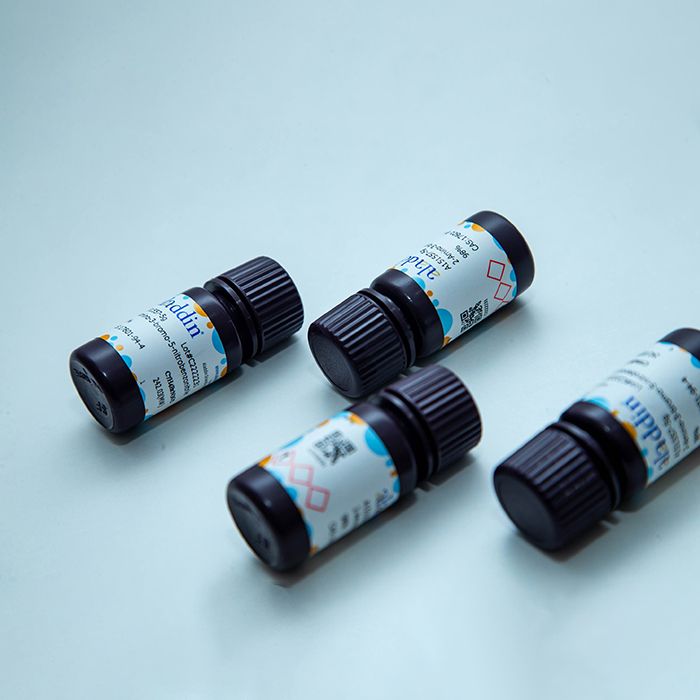
Store at -20°C,Argon charged Ships Ice chest + Ice pads Check lot-specific COA for exact specifications.
📋
Quality documents
SDS, COA, datasheet, and spec sheet available for download. Lot-specific COA accessible via lot number lookup.
📚
Literature proof
Cited in 0 peer-reviewed publications across chromatography, organic synthesis, and cross-coupling reactions.
Visão geral
SNIPER(ABL)-020, conjugating Dasatinib (ABL inhibitor) to Bestatin ( IAP ligand) with a linker, induces the reduction of BCR-ABL protein.
Appearance:Solid
Biological Activity:SNIPER(ABL)-020, conjugating Dasatinib (ABL inhibitor) to Bestatin ( IAP ligand) with a linker, induces the reduction of BCR-ABL protein.
Specifications
Especificações e pureza
≥99%
Condições de armazenamento de armazenamento
Store at -20°C,Argon charged
Enviado em
Ice chest + Ice pads
Este produto requer transporte de cadeia fria. Serviços terrestres e outros serviços econômicos não estão disponíveis.
Pureza
≥99%
Nomes e identificadores
Peso molecular
923.52
Documentation
📋 Safety Data Sheet (SDS)
Comprehensive hazard, handling, storage, and regulatory compliance document.
Determine the necessary mass, volume, or concentration for preparing a solution.
Dilution Calculator
Determine the dilution needed to prepare a stock solution.
Reconstitution Calculator
Revisões
Avaliações dos Clientes
Application Protocols
No tested application protocols (WB, IHC, IF, FC, etc.) are provided for this SKU.
General research-use guidance (not item-specific)
Cell treatment: dilute DMSO stock into prewarmed culture medium to desired concentrations, keeping final DMSO constant across samples (e.g., ≤0.1–0.5% v/v as assay permits).
Time course: sample at multiple time points (e.g., 2, 6, 16, 24 h) for degradation kinetics; include washout to assess recovery.
Readouts: Western blot for target and pathway markers; proteasome-dependence controls using MG132 or similar; viability controls to decouple cytotoxicity from degradation.
Data reporting: provide DC50/Dmax with replicate statistics; report solvent percentage and plasticware type to aid reproducibility.
These points are offered as general literature practices and are not validated protocols for this specific item.
Biological Roles
No target identity or biological profile is provided for this SKU. The following notes are general, based on literature for SNIPER-class degraders and ABL-associated biology, and are not item-specific claims.
SNIPER mechanism (general)
Bifunctional chimeras recruit IAP-family E3 ligases to a target protein, forming a ternary complex that promotes ubiquitination and subsequent proteasomal degradation.
Degradation (versus inhibition) can produce distinct phenotype and durability effects due to catalytic turnover of the degrader molecule and sustained loss of the protein.
ABL kinase context (biochemistry, literature)
ABL1/ABL2 are non-receptor tyrosine kinases involved in cytoskeletal dynamics and signal transduction. Their activity/state modulates processes such as cell adhesion, migration, and DNA-damage responses.
Chemical probes that modulate ABL abundance or activity are used to dissect pathway wiring, feedback regulation, and kinase network crosstalk.
Experimental readouts (general)
Western blotting or targeted proteomics to quantify target levels and downstream markers (e.g., phosphorylation patterns).
Time-course studies to capture degradation kinetics and recovery upon washout.
Off-target assessment via global proteomics and kinase profiling, as appropriate.
Note: No biological activity, potency, or selectivity is provided for this specific product. Consult the CoA or request technical support for any available characterization.
Buffer Applications
This product is a small-molecule library member and is not a buffering reagent. Therefore, classical buffer recipes or pH control applications do not typically apply.
Practical note (general)
When preparing working solutions for biochemical or cell-based assays, choose a biologically relevant buffer (e.g., HEPES-, Tris-, or phosphate-based) validated for your assay system, and control the final cosolvent (e.g., DMSO) to consistent levels across conditions.
If using surfactants or cyclodextrins to aid solubility, verify that the additives do not interfere with assay readouts.
Item-specific buffer compatibility is not provided; refer to the CoA/Spec Sheet and validate empirically.
Green Alternatives
Because item-specific synthesis/solvent data are not provided, the guidance below focuses on general greener-practice considerations for handling degrader-type small molecules.
Reduce hazardous solvent usage (general)
Prefer lower volumes of DMSO by preparing higher-concentration stocks and miniaturizing assays (e.g., 384- or 1536-well formats).
When feasible, use ethanol or aqueous PEG-400 as cosolvents in place of high DMSO fractions, after verifying assay compatibility.
Greener synthesis context (literature, not item-specific)
For custom synthesis of degrader analogs, consider 2-MeTHF or CPME instead of THF/diethyl ether in coupling steps; employ aqueous micellar catalysis for amide formations where possible.
Use modern coupling reagents with improved EHS profiles (e.g., DMTMM) and minimize stoichiometric carbodiimides; recover/purify via crystallization or aqueous workups to reduce chlorinated solvent use.
Comparison (general)
DMSO: excellent solubilizer and assay-compatible; persistence in wastewater, though low volatility; minimize volumes and ensure proper collection/disposal.
Ethanol: renewable feedstock options, good miscibility; may perturb some biological assays—validate signal windows.
PEG-400/water: low volatility and good solvency for hydrophobes; viscosity complicates liquid handling—optimize pipetting.
These are general best practices and not specific requirements for this SKU.
Pharmaceutical Uses
No pharmacopeial status or excipient role is provided for this item. This product is supplied strictly for research use only and is not intended for human or veterinary use.
General context (not item-specific)
Bifunctional degraders are widely used as research chemical probes in discovery settings to evaluate targeted protein degradation concepts, structure–activity relationships (SAR), and mechanistic biology.
Any consideration of formulation strategies (e.g., solubilization with cyclodextrins, lipid vehicles) is confined to preclinical research and should be validated under institutional guidelines.
Compliance note
For any nonclinical in vivo research, ensure compound handling and documentation (purity, identity, endotoxin where relevant) meet institutional and regulatory requirements.
No clinical or therapeutic claims are made or implied for this SKU.
Physical Properties
Item-specific physical data are not provided.
Item-specific (from Product Data)
Appearance: Not specified for this item; refer to CoA/Spec Sheet.
BP/MP/Density/Refractive index/LogP/pKa/Solubility/UV cutoff: Not specified for this item; refer to CoA/Spec Sheet.
General literature expectations for SNIPER/PROTAC-like degraders (not item-specific)
Molecular weight: commonly 700–1,200 Da (literature)
Physical state: frequently off-white solids or films; hygroscopicity varies (literature)
Solubility: often sparingly soluble in water; typically soluble in DMSO and DMF; co-solvent systems (DMSO + aqueous buffer with surfactant or cyclodextrin) are sometimes used (literature)
lipophilicity: moderate-to-high; amphiphilic designs with multiple HBD/HBA groups are common (literature)
Practical implications (general)
Prepare concentrated anhydrous DMSO stocks and dilute into assay media with care to keep final DMSO ≤0.1–0.5% v/v where feasible (literature guidance).
Filter sterilization of working solutions (0.22 μm) may be used for cell-based studies when compatible with solubility.
Always consult the item’s CoA/SDS for measured specifications and handling limits for this specific SKU.
Quality and Grades
Item-specific grade/purity
Grade/Purity: Not specified for this item; refer to CoA/Spec Sheet.
How to interpret grades for small-molecule library members (general)
Screening/Library grade typically prioritizes high chemical identity and adequate purity for biochemical/cellular screening. Purity is commonly confirmed by LC–MS and/or HPLC-UV; water/peroxide/metal limits are rarely specified for complex probes unless needed for specific assays.
Where “analytical” or “≥98%” grades are stated in catalogs, this typically reflects HPLC area% purity under specified conditions; confirm details (method, detection wavelength) in the CoA.
Stabilizers/additives
Not specified for this item; refer to CoA/Spec Sheet. If present (e.g., as a TFA salt or with antioxidants), they will be listed in the CoA and may influence solubility/pH behavior.
Documentation to request/consult
CoA: identity confirmation (LC–MS/HRMS), purity, and lot-specific handling notes.
Spec Sheet: recommended solvents, reconstitution advice, and any stability testing (freeze–thaw tolerance, solution stability).
Practical QA recommendations (general)
Upon receipt, allow to equilibrate to room temperature in sealed packaging before opening to avoid condensation.
Record first-open date; if feasible, verify purity by quick LC–MS in-house prior to mission-critical experiments.
Reaction and Applications
Item-specific applications from catalog
Manufacturer Applications: Not specified for this item; refer to CoA/Spec Sheet.
General research applications for SNIPER-class compounds (literature, not item-specific)
Targeted protein degradation: SNIPERs recruit IAP-family E3 ligases to induce ubiquitination and proteasomal degradation of a bound target protein.
Mechanistic studies: enable interrogation of protein function via knockdown by degradation rather than inhibition; useful for mapping signaling dependencies and compensatory pathways.
Assays: evaluation of DC50 (half-maximal degradation concentration), Dmax (maximum degradation), time-to-degradation and recovery kinetics via Western blotting or proteomics.
Control experiments: include non-degrading analogs (e.g., stereoisomeric controls or ligand-only controls), proteasome inhibitors (e.g., MG132) to confirm proteasome dependence, and IAP-ligase pathway modulators to confirm E3-ligase engagement.
Practical tips (general)
Preincubate compound stocks with media to achieve final solvent composition before addition to cells to avoid precipitation.
Confirm compound uptake and stability in the chosen medium; monitor for adsorption to plastics (use low-binding labware).
Consider evaluating effects across multiple cell lines with varying target expression to probe selectivity windows.
All points above are general literature guidance and are not specific performance claims for this SKU.
Reaction Conditions
This product is not typically used as a synthetic reagent; hence, classical reaction-condition guidance (catalysts, temperatures, yields) does not apply.
General experimental conditions for degrader evaluation (literature, not item-specific)
Stock solutions: prepare in anhydrous DMSO (e.g., 5–20 mM); store aliquots at −20°C protected from moisture/air.
Cellular assays: working concentrations often explored in the 1 nM–10 μM range with exposure times from 4–48 h to map DC50/Dmax and kinetics. Optimize per cell line and endpoint.
Controls: include vehicle controls and, where appropriate, proteasome inhibitors to confirm degradation pathways.
Biochemical/biophysical studies (general)
Ternary complex formation can be probed via ITC, SPR, or TR-FRET using buffers that tolerate modest DMSO (e.g., 1–5%).
These are literature-based practices and not specifications for this SKU. Validate and optimize for your system.
Safety and Handling
Item-specific hazard and classification
Signal word: Not specified for this item; refer to SDS.
H-statements: Not specified for this item; refer to SDS.
GHS classification/pictograms: Not specified for this item; refer to SDS.
General laboratory precautions (non-item-specific)
Handle in a fume hood with standard PPE: lab coat, safety glasses, and appropriate chemical-resistant gloves (e.g., nitrile). Avoid inhalation of powders/aerosols and skin contact.
If preparing solutions in DMSO/DMF, avoid skin contact; these solvents can facilitate dermal absorption of solutes.
First aid (general): rinse skin/eyes with water for ≥15 min upon contact; move to fresh air if inhaled; seek medical attention. Refer to SDS for authoritative guidance.
Storage incompatibilities and stability (based on Product Data and general practice)
Product Data indicates storage at −20°C under argon; keep tightly sealed, protected from moisture, light, and prolonged air exposure to minimize oxidative or hydrolytic degradation.
Avoid strong oxidizers, strong acids/bases, and reactive acylating/alkylating agents unless compatibility is documented for the specific structure.
Spill/leak response (general)
For solids: gently cover with damp disposable towels or inert absorbent to prevent dusting; collect into sealable container for disposal per institutional/territorial regulations.
For solutions: absorb with inert material; decontaminate work surface and dispose per regulations.
Always defer to the specific SDS for this SKU for definitive hazard statements and response measures.
Solvent Selection
Item-specific solubility/solvent compatibility are not provided; consult the CoA/Spec Sheet. The following is general guidance for hydrophobic, bifunctional degrader-type small molecules.
Polarity class and miscibility (general)
Many degrader chimeras are poorly water-soluble but dissolve in polar aprotic solvents such as DMSO and DMF (miscible with water upon dilution within limits).
Cosolvent strategies: DMSO stock followed by dilution into aqueous buffers containing 0.05–0.5% v/v DMSO; add nonionic surfactants (e.g., 0.01–0.05% Tween-20) or cyclodextrins if compatible.
Selection tips (general)
Stock preparation: anhydrous DMSO at 5–20 mM to minimize freeze–thaw. Aliquot under inert gas in low-binding tubes.
For biochemical assays: maintain DMSO ≤0.1–1% v/v depending on assay tolerance; match DMSO in controls.
For in vitro protein-binding/SPR: consider HEPES-buffered saline with up to 2–5% DMSO to maintain compound solubility (instrument dependent).
When to choose alternatives (general)
Ethanol or PEG-400/water mixtures may be used when DMSO is incompatible; verify background effects on assay readouts.
For lyophilized materials that resist dissolution, brief warming (≤37°C) and sonication can help, provided the compound is temperature-stable.
Note: None of the above implies solubility for this specific SKU; verify experimentally or via the CoA.
Storage and Reconstitution
Item-specific storage and shipping (from Product Data)
Storage Conditions: Store at −20°C, Argon charged.
Shipped In: Ice chest + ice pads.
Item-specific reconstitution
Not specified for this item; refer to CoA/Spec Sheet.
General guidance (not item-specific)
Allow the sealed container to reach room temperature before opening to prevent condensation. Open under inert gas if possible when “argon charged” is indicated.
For many degrader-type small molecules, prepare stock solutions in anhydrous DMSO (e.g., 5–20 mM). Vortex and, if needed, briefly sonicate. Avoid heating above ~37°C unless stability data permit.
Aliquot into low-binding tubes, purge with inert gas, and refreeze at −20°C or below. Minimize freeze–thaw cycles (≤3). Discard aliquots showing precipitation or discoloration upon thawing if not resolubilized by gentle warming.
For aqueous working solutions, prepare fresh before use; verify clarity after dilution and maintain consistent final cosolvent across samples.
Always consult the lot-specific CoA/SDS for definitive storage limits, solution stability, and reconstitution recommendations for this SKU.
Structure and Identity
Brief overview: SNIPER(ABL)-020 is listed within a small-molecule/compound library. No structural identifiers are provided for this specific item. Content below separates item-specific facts from general literature context on SNIPER-class degraders.
Item-specific (from Product Data)
SKU: S658736
Product Name: SNIPER(ABL)-020
CAS: S658736 (catalog placeholder)
Molecular formula: Not specified for this item; refer to CoA/Spec Sheet.
Molecular weight: Not specified for this item; refer to CoA/Spec Sheet.
SMILES / InChI / InChIKey: Not specified for this item; refer to CoA/Spec Sheet.
General literature context (not item-specific)
SNIPER compounds (Specific and Non-genetic IAP-dependent Protein Erasers) are bifunctional small molecules designed to recruit an IAP-family E3 ligase to a target protein, leading to ubiquitination and proteasomal degradation.
Typical structural features: a target-binding “warhead,” a chemical linker (often flexible, aliphatic or PEG-like), and an IAP-recruiting ligand (e.g., based on bestatin or related motifs), forming a heterobifunctional chimera.
For “ABL”-labeled SNIPERs in literature, the target-binding motif often recognizes ABL-family kinases; however, the exact recognition element, linker length, and ligase ligand for this specific catalog item are not provided here.
2D structural description (literature, generic to SNIPERs)
Two pharmacophores connected by a linker; multiple heteroatoms (O/N) enabling H-bonding; often contains amide/urea/ether linkages; may carry aromatic systems in each head group. Stereocenters may be present depending on the ligands used.
Synthetic Utility
This SKU is a finished small-molecule library member and is not positioned as a synthetic building block or reagent.
General synthetic commentary for degrader chemotypes (literature, not item-specific)
Modular assembly: independent synthesis of a target-binding ligand, an E3-ligase ligand (e.g., IAP ligand), and a linker, followed by convergent coupling (amide/urea/ether linkages are common).
Linker engineering: length, rigidity, and polarity modulation (alkyl vs PEG) profoundly influence ternary complex formation and degradation efficiency.
Purification: preparative HPLC is frequently required; salts (e.g., TFA) may aid handling but can affect downstream assays.
Retrosynthetic value (general)
Degrader platforms enable systematic SAR by swapping head groups and linkers; however, their complexity and MW typically reduce their utility as intermediates in unrelated syntheses.
No reactive-function guidance can be provided for this specific SKU because functional groups are not disclosed.
Target Specificity
Item-specific data
Target/epitope/clone/isotype/species reactivity: Not applicable; this is a small-molecule product.
Specific target information for this SKU: Not specified for this item; refer to CoA/Spec Sheet.
General note (literature, not item-specific)
SNIPER molecules are designed to recruit IAP E3 ligases to specific protein targets (often kinases, transcription factors, etc.). For compounds labeled “ABL,” the intended biochemical focus is typically ABL-family kinases; however, no target binding or degradation data are provided for this catalog entry.
We use cookies to ensure the website functions properly and, where permitted, to improve your experience. You can manage your preferences at any time in Settings. Learn more in our Cookie Policy.
Shall we send you a message when we have discounts available?
Remind me later
Thank you! Please check your email inbox to confirm.
Products are supplied to verified businesses, institutions, and qualified professionals for research and development use only. Not for use in humans, animals, diagnosis, or therapy.