Sodium Hyaluronate - Ph.Eur. , CAS No.9067-32-7

CAS: 9067-32-7 Cat. No.: S774025 Fórmula: (C14H21NaNO11)n   Número CE: 618-620-0
Disponível para encomenda
GRADE & PURITY Ph.Eur. ? European Pharmacopoeia grade — conforms to Ph.Eur. monographs across EU member states. Use for pharmaceutical work needing European compendial compliance.
Storage
Store at -20°C,Argon charged
Shipped In
Ice chest + Ice pads
★
Size
Alemanha (EU)
USA*
Price
Qty
1g
S774025-1g
—
1 Em stock
95,36€
5g
S774025-5g
—
1 Em stock

273,25€

320,98€
Gravar 47,73 € (14.87%)
25g
S774025-25g
Sob encomenda · 8–12 semanas

991,74€

1162,68€
Gravar 170,94 € (14.70%)
Enter a quantity for the sizes you want to add.
🧪
Why this grade

Ph.Eur. Ph.Eur. for sensitive chromatographic and analytical workflows requiring minimal baseline interference.

🌡

Storage & shipping

Store at -20°C,Argon charged Ships Ice chest + Ice pads Check lot-specific COA for exact specifications.

📋

Quality documents

SDS, COA, datasheet, and spec sheet available for download. Lot-specific COA accessible via lot number lookup.

📚

Literature proof

Cited in 174 peer-reviewed publications across chromatography, organic synthesis, and cross-coupling reactions.

Visão geral

Hyaluronic acid is the main component of connective tissues such as intercellular matrix, vitreous humor, and synovial fluid in the human body. It plays an important physiological role in water retention, maintaining extracellular space, regulating osmotic pressure, lubrication, and promoting cell repair in the body. Hyaluronic acid molecules contain a large number of carboxyl and hydroxyl groups, which form hydrogen bonds within and between molecules in aqueous solutions, giving them strong water retention properties and the ability to bind to over 400 times their own amount of water; At higher concentrations, the complex tertiary network structure formed by intermolecular interactions exhibits significant viscoelasticity in its aqueous solution. Hyaluronic acid, as the main component of the intercellular matrix, directly participates in the regulation of electrolyte exchange inside and outside the cell, playing a filtering role in physical and molecular information. Large molecule hyaluronic acid has inhibitory effects on cell movement, proliferation, differentiation, and phagocytic function, while small molecule hyaluronic acid has promoting effects. Hyaluronic acid has unique physicochemical properties and physiological functions, and has been widely used in medicine

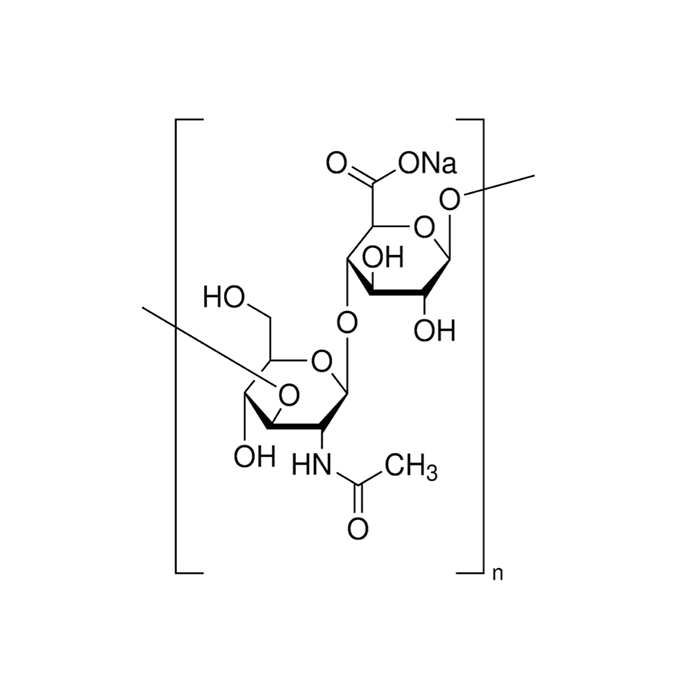
Specifications

Especificações e pureza
Ph.Eur.
Condições de armazenamento de armazenamento
Store at -20°C,Argon charged
Enviado em
Ice chest + Ice pads
Este produto requer transporte de cadeia fria. Serviços terrestres e outros serviços econômicos não estão disponíveis.
Grau
Ph.Eur.
Nomes e identificadores
Sorrisos canónicos
CC(=O)NC1CC(C(OC1OC2C(C(C(OC2C(=O)[O-])O)O)O)CO)O.[Na+]
InChIKey
MAKUBRYLFHZREJ-JWBQXVCJSA-M
INCHI
1S/C14H23NO11.Na/c1-4(17)15-5-2-6(18)7(3-16)24-14(5)26-10-8(19)9(20)13(23)25-11(10)12(21)22;/h5-11,13-14,16,18-20,23H,2-3H2,1H3,(H,15,17)(H,21,22);/q;+1/p-1/t5-,6+,7-,8-,9-,10+,11+,13-,14+;/m1./s1
SMILES isoméricas
CC(=O)N[C@@H]1C[C@@H]([C@H](O[C@H]1O[C@H]2[C@@H]([C@H]([C@@H](O[C@@H]2C(=O)[O-])O)O)O)CO)O.[Na+]
WGK Alemanha
3
RTECS
MT7250000

Documentation

📋 Safety Data Sheet (SDS)

Comprehensive hazard, handling, storage, and regulatory compliance document.

Download SDS →

✅ Certificate of Analysis (COA)

Lot-specific quality data. Enter your lot number to retrieve the exact COA.

Look up COA →

📊 Datasheet

Quick-reference summary of product specifications and applications.

View datasheet →

🔬 Specification Sheet

Full quality attributes and acceptance criteria for this grade.

View spec sheet →

Advanced Data

Taxonomic Classification

Taxonomy Tree

KingdomOrganic compounds
SuperclassOrganic oxygen compounds
ClasseOrganooxygen compounds
SubclassCarbohydrates and carbohydrate conjugates
Intermediate Tree Nodes Sugar acids and derivatives
Direct ParentGlucuronic acid derivatives
Alternative Parents Disaccharides  Oxanes  Pyrans  Acetamides  Secondary alcohols  Carboxylic acid salts  Secondary carboxylic acid amides  Hemiacetals  Polyols  Acetals  Oxacyclic compounds  Carboxylic acids  Monocarboxylic acids and derivatives  Hydrocarbon derivatives  Organic oxides  Organic sodium salts  Organic zwitterions  Organonitrogen compounds  Carbonyl compounds  Organopnictogen compounds  Primary alcohols  
Molecular FrameworkAliphatic heteromonocyclic compounds
Substituents Glucuronic acid or derivatives - Disaccharide - Oxane - Pyran - Acetamide - Carboxamide group - Carboxylic acid salt - Hemiacetal - Secondary alcohol - Secondary carboxylic acid amide - Acetal - Carboxylic acid derivative - Carboxylic acid - Oxacycle - Monocarboxylic acid or derivatives - Organic alkali metal salt - Polyol - Organoheterocyclic compound - Organic nitrogen compound - Carbonyl group - Hydrocarbon derivative - Organic oxide - Organonitrogen compound - Alcohol - Organopnictogen compound - Primary alcohol - Organic sodium salt - Organic salt - Organic zwitterion - Aliphatic heteromonocyclic compound
DescriçãoThis compound belongs to the class of organic compounds known as glucuronic acid derivatives. These are compounds containing a glucuronic acid moiety (or a derivative), which consists of a glucose moiety with the C6 carbon oxidized to a carboxylic acid.
External Descriptors Not available
Estrutura 3D
Modelo de Estrutura Química Interativa


Certificados(CoA,COO,BSE/TSE e Mapa de Análise)
C of A & Other Certificates(BSE/TSE, COO):
Analytical Chart:

Find and download the COA for your product by matching the lot number on the packaging.

10 results found

Lot NumberCertificate TypeDataItem
B2604395Certificate of AnalysisJan 26, 2026 S774025
B2604396Certificate of AnalysisJan 26, 2026 S774025
B2604397Certificate of AnalysisJan 26, 2026 S774025
H2612058Certificate of AnalysisJan 26, 2026 S774025
D2530355Certificate of AnalysisApr 01, 2025 S774025
D2530357Certificate of AnalysisApr 01, 2025 S774025
E2509522Certificate of AnalysisApr 01, 2025 S774025
E2509531Certificate of AnalysisApr 01, 2025 S774025
E2509534Certificate of AnalysisApr 01, 2025 S774025
K2520014Certificate of AnalysisApr 01, 2025 S774025
Propriedades químicas e físicas
SensibilidadeMoisture sensitive
FAQs e artigos
An Introduction to Research-Grade Carbohydrates: Decoding the “Glycan Language” and a Product-Selection Guide (with Tables 1–3)
Understanding Hydrophilic Polymers in Aqueous Systems: Hydration Mechanisms, Structural Knobs, and Task-Oriented Selection Guide (Including Tables 1–3)
Biomedical Polymer Insights: Role-Based Task Map, Six Key Material Levers, and a Risk-Driven Evidence Chain (including the Product Navigation Guide and Product Tables 1–3)
Glutaraldehyde-mediated Microbial Inactivation: Chemical Mechanisms, Determinants, and Key Validation Considerations
Research Value of Polyelectrolyte Multilayers: Layer-by-Layer Design of Interfacial Composition, Mass Transport, and Function
Key Judgments in Medical Hydrogel R&D: From Polymer Source and Crosslinking Strategy to Sterilization Planning, Scale-Up Feasibility, and Quality Control
Injectable Thermosensitive Gels: Gelation Behavior, Rheological Properties, and Drug Release Characteristics
Applications of Enzymatic Protein Crosslinking Systems in Gel Construction and Functional Evaluation
Designing Hydrogel Scaffolds as Programmable Cell Microenvironments: From Click-Chemistry Functionalization to 3D Cell Culture Experimental Design
Thickening, Suspension, Auxiliary Stabilization, and Agglomeration Mechanisms of Xanthan Gum in Personal Care Formulations: From Molecular Structure to Processing Applications
From Structure to Rheology: Thickening, Stabilization, and Selection Logic of Cellulose Ethers for Personal Care Applications
What Is Synthetic Biology? The Industrialization Pathway from Upstream Reagent Toolchains to Biomanufacturing Applications
Performance Sources and Formulation Applications of Enzyme-Based Ingredients in Daily Chemical Products: Fermentation Transformation, Enzymatic Reactions, and Application Principles
Understanding Ceramides from the Perspective of the Stratum Corneum Lipid Barrier: Moisturizing and Barrier-Repair Mechanisms, Ingredient Selection, and Formulation Research Considerations
Mechanistic Analysis of Topical Glutathione in Skincare: Cellular Redox Regulation, Skin Delivery Challenges, and SLN-Based Delivery Strategies
Structure, Degradation Behavior, and Applications of Poly(trimethylene carbonate) (PTMC) in Flexible Absorbable Materials
Analysis of Hydrolyzed Pearl as a Cosmetic Raw Material: Preparation Process, Active Components, and Skincare Formulation Applications
Moisturizing Mechanism of Polyglutamic Acid: From the γ-Glutamyl Structure to Hydration Networks and Surface Film-Forming Behavior
Probiotics, Prebiotics, and Postbiotics in Skin Care: Conceptual Distinctions, Mechanisms of Action, and Their Applications in the Care of Dry, Itchy, and Rough Skin
How Do Collagen Peptides Act on the Skin? From Surface Hydration and Percutaneous Delivery to Fibroblasts and Collagen Homeostasis
The Moisturizing and Low-Moisture Protective Mechanisms of Trehalose: From Its α,α-1,1 Structure and Hydration Dynamics to In Vitro Skin Barrier Research
Anti-Photoaging Potential of Artemia Extract: UV-Induced Damage Cascades, HSP70-Related Stress Protection, and GP4G Metabolic Insights
Gentiana Root Extract and Gentiopicroside: Chemical Composition, Antioxidant and Inflammation-Modulating Mechanisms, and Their Potential Effects on Skin Barrier Homeostasis
Structure and Functions of Fibronectin: Cell Adhesion, Cutaneous Wound Repair, and Topical Applications
Mechanism of Action of Tranexamic Acid in Pigmentation Care: From the Plasmin System to Regulation of Inflammation-Driven Pro-Melanogenic Signaling
Moisturizing Mechanisms of Tremella fuciformis Polysaccharides: From Polysaccharide Structure and Hydration Rheology to Dynamic Film Formation on the Skin Surface
Multilevel Moisturizing Mechanisms of Sodium Hyaluronate and Its Derivatives: Molecular Weight Modulation, Crosslinking, Acetylation, and Major Sites of Action
Skin Mechanism of Action of Pro-Xylane: From C-Xyloside Priming and CS/DS Chain Remodeling to the Dermal–Epidermal Junction
How Does Collagen Tripeptide Act on the Skin: Stratum Corneum Delivery, Matrix Protection, and Regulation of Collagen Homeostasis
What Is “Plant Collagen”? Distinguishing Ingredient Types, Structural Differences, Production Methods, and Skincare Effects
The Combination Logic of Palmitoyl Tripeptide-1 and Palmitoyl Pentapeptide-4: Skin Delivery, Matrix Signaling, and Regulation of Collagen Homeostasis
Mechanistic Basis of Acetyl Hexapeptide-8 in the Management of Expression Lines: SNARE Complex Interference, Constraints on Percutaneous Delivery, and Combination Strategies
How Ectoine Regulates Skin Hydration: Zwitterionic Structure, Preferential Hydration, and Barrier-Support Mechanisms
Structure, Emollient and Moisturizing Effects, and Source Identification of Squalane: From Complete Hydrogenation of Squalene to Stable Isotope Analysis
Citations of This Product
Calculadoras de soluções
Revisões

Avaliações dos Clientes

Need help choosing the grade?

Our grade selection guide covers purity, stabilizer status, and application suitability for all variants in our catalog.

View Ph.Eur. grade guide →

Shall we send you a message when we have discounts available?

Remind me later

Thank you! Please check your email inbox to confirm.

Oops! Notifications are disabled.