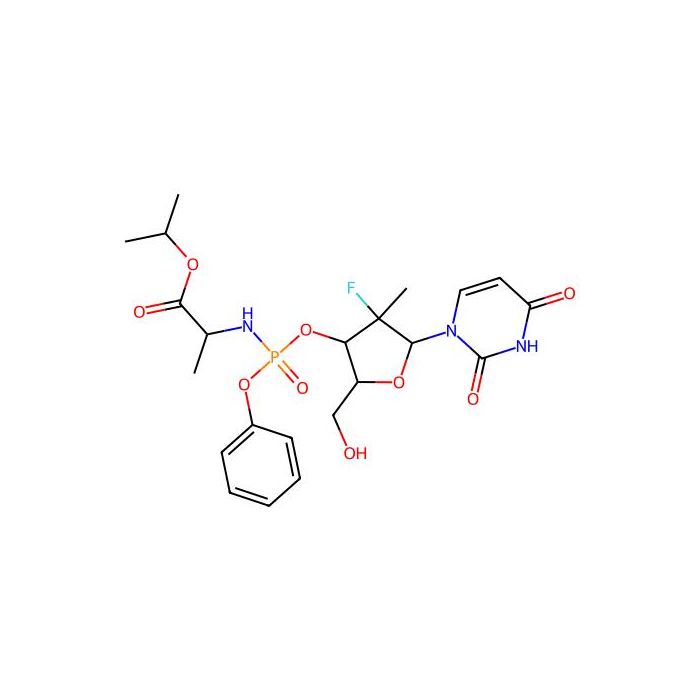
Sofosbuvir impurity G, an diastereoisomer of Sofosbuvir, is the impurity of Sofosbuvir. Sofosbuvir (PSI-7977) is an inhibitor of HCV RNA replication, demonstrates potent anti-hepatitis C virus activity.
Especificações
Especificações e pureza
10mM in DMSO
Mecanismos bioquímicos e fisiológicos
Sofosbuvir impurity G, an diastereoisomer of Sofosbuvir, is the impurity of Sofosbuvir. Sofosbuvir (PSI-7977) is an inhibitor of HCV RNA replication, demonstrates potent anti-hepatitis C virus activity.
Condições de armazenamento de armazenamento
Store at -80°C
Enviado em
Dry ice packs + Cold packs
Este produto requer transporte de cadeia fria. Serviços terrestres e outros serviços econômicos não estão disponíveis.
Determine the necessary mass, volume, or concentration for preparing a solution.
Dilution Calculator
Determine the dilution needed to prepare a stock solution.
Reconstitution Calculator
Revisões
Avaliações dos Clientes
Application Protocols
No item-specific, tested application protocols are provided in the product data. For use as an analytical reference standard:
Establish laboratory-specific SOPs for the preparation of stock and working solutions, injection sequences, and data processing.
Validate all methods (linearity, accuracy, precision, range, LoD/LoQ, robustness) according to applicable guidelines (e.g., ICH Q2(R2)/Q14).
For detailed handling and preparation instructions, refer to the item’s CoA/Spec Sheet and SDS.
Biological Roles
This product is supplied as a chemical/analytical reference material. No biological function or role is assigned to this specific impurity in the context of research reagents.
General context (literature, not item-specific): Sofosbuvir is a nucleotide prodrug, and its related substances can include process impurities and degradation products. Such impurities are typically evaluated for safety/quality in pharmaceutical development but are not used to elicit biological effects in research protocols.
Research use note: For research use only. Not for human or veterinary use, diagnostic procedures, or clinical applications.
If biological testing is contemplated (e.g., as part of impurity qualification in a drug-development program), conduct under appropriate institutional oversight and with full characterization and documentation from the CoA. No biological activity or targets are specified for this item.
Buffer Applications
This material is not a buffering agent, and no buffer-capacity data are provided.
Typical usage: As an analytical reference standard, it may be prepared or injected in buffers/mobile phases used for chromatographic separations, but it is not used to establish or maintain pH.
Practical note: If buffer-containing mobile phases are used (e.g., ammonium formate/acetate for LC–MS), ensure compatibility of the chosen buffer with the analyte and detection mode. Validate solution stability of the impurity standard in the specific buffer system as part of method robustness. No item-specific buffer recommendations are provided.
Green Alternatives
While the compound itself is fixed, greener choices can be applied to the analytical workflow in which this impurity standard is used. The suggestions below are general and should be balanced against method performance and regulatory acceptance.
Greener solvent considerations for LC workflows (general):
Replace or reduce acetonitrile with methanol where chromatographic selectivity permits; MeOH has lower life-cycle environmental impact but may increase backpressure and change selectivity.
Consider ethanol–water systems for preparative or non-MS work when sensitivity allows; ethanol is bio-derived and less toxic but has higher viscosity and UV background.
Use water-rich gradients and shorter columns with sub-2 µm or core–shell particles to reduce solvent consumption per sample.
Operational improvements:
Miniaturize injection volumes and adopt UHPLC to reduce mobile-phase volume and waste.
Implement on-line waste segregation to keep halogenated solvents separate and minimize hazardous waste mass.
Optimize autosampler thermostating to extend solution stability, reducing the need for frequent remakes of standards.
Comparison (general):
Acetonitrile: Excellent performance; petrochemical-derived; lower viscosity, strong MS compatibility.
Methanol: Greener profile; higher viscosity; may require higher temperatures or shorter columns to manage backpressure.
Ethanol: Renewable option; limited MS use due to ionization effects; acceptable for UV detection.
Any transition to greener methods must be revalidated per ICH Q2(R2)/Q14 to ensure continued fitness-for-purpose.
Pharmaceutical Uses
No therapeutic or excipient use is claimed or intended. This product is provided strictly as a research/analytical reference material.
Typical roles in pharmaceutical R&D and QC (general):
Reference standard for identification and quantitation of a specific related substance (“impurity G”) in drug substance/drug product for sofosbuvir manufacturing and stability programs.
System suitability and method control: co-injection or spiking to verify resolution, retention-time stability, and detector response in validated assays.
Support for impurity fate-and-purge studies in process development and for establishing specifications and acceptance criteria per ICH Q3A/B.
Documentation and compliance:
Obtain the item-specific CoA to verify purity assignment, characterization data, storage conditions, and any uncertainty statements required for GMP-adjacent use (where allowed by site procedures).
For compendial submissions or regulatory interactions, ensure traceability of the reference material and retain full documentation of use, handling, and qualification.
Note: This is not an API, not a formulated excipient, and not intended for clinical use.
Physical Properties
Item-specific physicochemical data are not supplied in the product data and should be verified from the CoA/Spec Sheet.
Appearance: Not specified for this item; refer to CoA/Spec Sheet.
Molecular weight: Not specified for this item; refer to CoA/Spec Sheet.
Melting point: Not specified for this item; refer to CoA/Spec Sheet.
Boiling point: Not applicable/Not measured for solid reference standards; refer to CoA/Spec Sheet if provided.
Density: Not specified for this item; refer to CoA/Spec Sheet.
Solubility: Not specified for this item; refer to CoA/Spec Sheet.
LogP, pKa, refractive index: Not specified for this item; refer to CoA/Spec Sheet.
General context (literature, not item-specific):
Sofosbuvir-related impurities often show good solubility in polar aprotic solvents used for analytical work (e.g., acetonitrile, DMSO) and moderate solubility in methanol/water mixtures, but exact solubility for “impurity G” is not provided here and must not be inferred.
Practical guidance:
For method development or preparation of stock solutions, perform a small-scale solubility screen (DMSO, acetonitrile, methanol, and aqueous buffer with organic modifier) and document the solvent of record in analytical methods. Always defer to the item’s CoA for any specification-grade properties.
Quality and Grades
Item-specific grade/purity data are not provided in the product entry.
Grade/Purity (item-specific): Not specified for this item; refer to CoA/Spec Sheet.
Appearance (item-specific): Not specified for this item; refer to CoA/Spec Sheet.
Context for impurity/reference standards (general knowledge):
Impurity standards are typically supplied with detailed characterization: LC/UPLC purity by area%, structure confirmation (NMR, MS, possibly HRMS), and occasionally water/RSO/volatile content by KF/GC. For pharmacopoeial or in-house reference standards, certified purity with uncertainty may be provided.
If labeled “qualified” or “certified,” documentation may include a certificate stating assigned value, uncertainty, and traceability. Ensure alignment with ICH Q2(R2)/Q14 expectations for method validation and Q3A/B for impurity reporting/qualification.
Stabilizers: Not specified for this item; refer to CoA/Spec Sheet if any stabilizer is present.
Practical recommendations:
Request the CoA to confirm assay purity, residual solvent profile, and any stabilizers before use in calibration or spike-recovery experiments.
For quantitative work, consider establishing a working standard via comparison to the primary lot using a validated method (e.g., mass-balance or purity-corrected weighings), documenting metrological traceability.
Reaction and Applications
This product is intended primarily as an analytical/reference material, not as a synthetic reagent. Applications typically focus on pharmaceutical quality control and analytical method development surrounding sofosbuvir and its related substances.
Typical uses (general, non-item-specific):
Reference standard for LC/UPLC–UV/LC–MS system suitability, retention-time alignment, and relative response factor (RRF) evaluation in stability-indicating assays for sofosbuvir.
Calibration and quantitation of specified/unspecified impurities per ICH Q3A/B and Q3C guidelines during process development and release/stability testing.
Method development and validation per ICH Q2(R2)/Q14: linearity, accuracy (spike/recovery), precision, LoD/LoQ, robustness, and solution stability.
Degradation pathway elucidation: Comparative profiling of stressed samples (acid/base/oxidative/thermal/photo) to assign peaks by RT/MS and, where available, reference co-injection.
Practical tips:
Prepare primary stock in a strong solvent (e.g., DMSO or MeCN) and dilute into initial mobile phase to mitigate peak distortion; verify absence of precipitates.
Use low-adsorption vials; many nucleotide-like structures adsorb to glass—consider PP or silanized glass if carryover/adsorption is observed.
Establish bracketing standards and include a reference injection at intervals to monitor RT drift in long sequences.
Notes:
No item-specific reactivity or transformation data are provided; this product is not generally used in chemical synthesis.
Reaction Conditions
Not applicable. This product is not intended for use as a reagent in chemical reactions, and no item-specific reaction parameters are provided.
For analytical workflows (general, not item-specific):
Chromatography: Reverse-phase LC using water/organic (MeCN or MeOH) with volatile buffers (e.g., ammonium acetate/formate) is commonly applied to sofosbuvir and related substances. Optimize gradient, temperature, and pH based on your method development SOPs.
Detection: UV-DAD and LC–MS (ESI) are typical. Evaluate ionization efficiency and potential in-source fragmentation when establishing quantitative methods.
All method conditions should be validated according to ICH Q2(R2)/Q14. Refer to the CoA/Spec Sheet for any available item-specific recommendations.
Safety and Handling
Safety data specific to this item are not provided in the product data. Treat as a laboratory chemical of unknown hazards and consult the SDS prior to use.
GHS information (item-specific):
Signal word: Not specified for this item; refer to SDS.
Hazard statements (H-phrases): Not specified for this item; refer to SDS.
GHS classification and pictograms: Not specified for this item; refer to SDS.
General precautions (good lab practice):
Use in a chemical fume hood; avoid inhalation of dust/aerosols.
Wear appropriate PPE: lab coat, safety glasses, and chemical-resistant gloves (e.g., nitrile). Consider double-gloving for weighing microgram–milligram quantities to minimize contamination of reference materials.
Prevent cross-contamination of analytical standards; use dedicated spatulas and weigh boats. Cap vials promptly to avoid moisture uptake.
Storage incompatibilities and stability (general):
Store at −80°C as specified; keep tightly sealed in original container. Avoid repeated freeze–thaw; aliquot if frequent access is anticipated.
Protect from light and moisture until more information is known. Avoid contact with strong oxidizers or acids/bases unless required by validated sample preparation protocols.
First-aid overview (general):
Skin/eye contact: Rinse with water for at least 15 minutes; remove contaminated clothing; seek medical attention.
Inhalation: Move to fresh air; seek medical attention if symptoms occur.
Ingestion: Rinse mouth; do not induce vomiting; seek medical attention.
Always defer to the SDS/CoA for authoritative safety and handling instructions.
Solvent Selection
Item-specific solubility has not been provided. The guidance below reflects general best practices for small-molecule impurity standards structurally related to nucleoside/nucleotide prodrugs and should be verified experimentally.
Primary solvents to trial (analytical-grade):
DMSO: High solvating power; often suitable for preparing concentrated stock solutions for LC–MS. Hygroscopic—use anhydrous grades and minimize water pickup.
Acetonitrile (MeCN): Common for LC; miscible with water; typically low UV background. Good for intermediate stocks and mobile phases.
Methanol (MeOH): Useful as co-solvent; can aid dissolution for polar materials.
Aqueous handling:
If aqueous solutions are needed, prepare mixed organic/aqueous diluents (e.g., MeCN/H2O or MeOH/H2O) to mitigate precipitation. Filter through 0.2 µm PTFE/RC filters as appropriate.
Selection considerations (general):
Analytical detection: Choose solvent compatible with UV/UV-DAD wavelength of interest or MS ionization (ESI). MeCN is often preferred for LC–MS due to lower viscosity and stronger desolvation.
Stability: Some impurities may undergo hydrolysis in water or alcohols; assess solution stability over intended use (bench-top, autosampler, long-term) and store cold, protected from light.
Small comparison (general):
DMSO: Maximum solvency; higher viscosity; can suppress MS if injected neat—dilute with mobile phase.
MeCN: Balanced solvency, excellent for LC–MS; low UV absorbance.
MeOH: Protic; may influence ionization and retention; good as co-solvent.
Always confirm solvent choice against the item-specific CoA and your validated method.
Storage and Reconstitution
Storage and shipping (item-specific):
Storage conditions: Store at −80°C.
Shipped in: Dry ice packs + cold packs.
Reconstitution and handling:
Reconstitution/solvent recommendations: Not specified for this item; refer to CoA/Spec Sheet.
General guidance (non-item-specific): Allow the container to equilibrate to room temperature in a desiccated environment before opening to prevent moisture condensation. If multiple uses are expected, prepare single-use aliquots to avoid repeated freeze–thaw cycles.
Solution stability: Not specified for this item; determine empirically under intended storage (autosampler, refrigerator) and document in your method.
Packaging/labels:
Retain labels and CoA with the container; record lot number, open date, and any aliquot IDs in laboratory notebooks/LIMS.
Always consult the item-specific CoA and SDS for definitive instructions.
Structure and Identity
Brief description: Sofosbuvir impurity G is a named process/degradation impurity associated with the nucleotide prodrug sofosbuvir, provided as a research/analytical reference material.
Product identifiers
SKU: S654955
Product name: Sofosbuvir impurity G
CAS: 1337482-15-1
PubChem CID: 58463528
InChIKey: Not specified for this item; refer to CoA/Spec Sheet.
SMILES: Not specified for this item; refer to CoA/Spec Sheet.
Composition
Molecular formula: Not specified for this item; refer to CoA/Spec Sheet.
Molecular weight: Not specified for this item; refer to CoA/Spec Sheet.
Structural features (general context)
As a sofosbuvir-related impurity, it is typically structurally related to the phosphoramidate/nucleoside scaffold of the parent drug (general literature context for “sofosbuvir impurities”). Exact functional groups, stereochemistry, and ring systems for impurity G are not specified for this item.
2D structure description
Not specified for this item; refer to CoA/Spec Sheet.
Notes:
Where structure identifiers are required for regulatory filing or method transfer, request the item-specific CoA/Spec Sheet to obtain definitive SMILES/InChI/InChIKey.
Synthetic Utility
This product is not typically employed as a synthetic reagent or intermediate. Its primary value is as an analytical reference standard.
General considerations (non-item-specific):
Structural relatives of sofosbuvir impurities can occasionally aid in mechanistic studies of degradation (e.g., identifying hydrolysis or isomerization pathways) but are not commonly used as building blocks.
If used in research synthesis (e.g., derivatization for structural confirmation), ensure that such transformations are documented as separate experiments and do not compromise the integrity of the reference material used for quantitation.
Takeaway: Treat this material as a characterization aid rather than a synthetic precursor.
Target Specificity
Not applicable. This product is a small-molecule impurity reference standard and does not possess biological target specificity in the context of antibodies, enzymes, or receptor ligands. No item-specific target or binding data are provided.
Perguntas frequentes
How should this product be stored?
Store at ?80 °C. Ultra-low temperature storage is required to maintain the specified shelf life.
How is this product shipped?
This product ships frozen with dry ice and cold packs. Unpack on arrival and transfer it to the storage condition stated above; handle dry ice with insulated gloves in a ventilated area.
What are the CAS number, molecular formula and molecular weight?
The CAS Number is 1337482-15-1, the molecular formula is C22H29FN3O9P, and the molecular weight is 529.45 g/mol.
What documentation is provided?
Available product documentation, including Certificates of Analysis (COA), Safety Data Sheets (SDS), and specification sheets, is shown in the product document area. Document availability and access follow the current site policy.
Usamos cookies para garantir o funcionamento adequado do site e, quando permitido, para melhorar a sua experiência. Você pode gerenciar suas preferências a qualquer momento nas Configurações. Saiba mais em nossa Política de Cookies.
Deseja que lhe enviemos uma mensagem quando tivermos descontos disponíveis?
Lembrar-me mais tarde
Obrigado! Por favor, verifique a sua caixa de entrada de e-mail para confirmar.
Products are supplied to verified businesses, institutions, and qualified professionals for research and development use only. Not for use in humans, animals, diagnosis, or therapy.