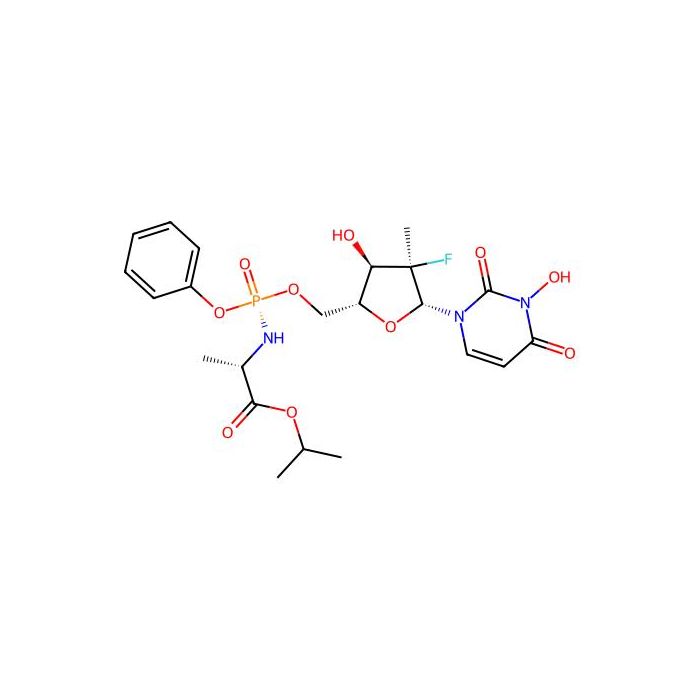
Sofosbuvir impurity L, an diastereoisomer of Sofosbuvir, is the impurity of Sofosbuvir. Sofosbuvir (PSI-7977) is an inhibitor of HCV RNA replication, demonstrates potent anti-hepatitis C virus activity.
IC50& Target:HCV
Biological Activity:Sofosbuvir impurity L, an diastereoisomer of Sofosbuvir, is the impurity of Sofosbuvir. Sofosbuvir (PSI-7977) is an inhibitor of HCV RNA replication, demonstrates potent anti-hepatitis C virus activity.
Especificações
Especificações e pureza
10mM in DMSO
Condições de armazenamento de armazenamento
Store at -80°C
Enviado em
Dry ice packs + Cold packs
Este produto requer transporte de cadeia fria. Serviços terrestres e outros serviços econômicos não estão disponíveis.
Determine the necessary mass, volume, or concentration for preparing a solution.
Dilution Calculator
Determine the dilution needed to prepare a stock solution.
Reconstitution Calculator
Revisões
Avaliações dos Clientes
Application Protocols
No item‑specific, validated application protocols are provided in the product data.
General workflow for using impurity standards in LC–UV/LC–MS (not item‑specific):
Equilibrate the column with initial mobile phase; verify backpressure and baseline stability.
Prepare fresh working solutions by diluting concentrated stock (e.g., in ACN/MeOH/DMSO) into mobile phase or diluent compatible with the method; target ≤1–2% DMSO in final injections to avoid peak distortion.
Inject a series of standards to establish retention time and detector response; assess system suitability (e.g., %RSD of peak area/RT over 5–6 injections).
Build calibration curves as required; verify linearity, LOD/LOQ, and carryover.
Analyze samples; confirm peak identity by RT match and MS/MS where available; use orthogonal detection if necessary.
Refer to the CoA/SDS for any item‑specific instructions on solvent, concentration limits, or light sensitivity. Validate all methods per institutional SOPs.
Biological Roles
This item is an analytical impurity standard associated with sofosbuvir and is supplied strictly for laboratory research. No biological function or role is assigned to this material in this listing.
Item-specific biological activity: Not specified for this item; refer to CoA/SDS. Do not infer pharmacological or biochemical behavior from the name alone.
Context (general):
API‑related impurities are used to characterize and control the quality of pharmaceutical substances and products. Their presence and limits are addressed in regulatory guidelines (e.g., ICH Q3A/B), but the impurity itself is not intended to exert a biological role in experiments.
Recommendation:
Avoid use in any biological system unless the structure, purity, and safety are fully understood and appropriate risk assessments are performed. No clinical, diagnostic, or therapeutic applications are supported.
Buffer Applications
This product is not a buffering reagent. Buffer preparation is generally not applicable.
Analytical relevance (general):
In LC–UV/LC–MS assays for impurity profiling, volatile buffers such as ammonium formate/acetate (5–20 mM) or acid modifiers (0.1% formic acid) are commonly used to control ionization and peak shape. Selection should be validated for the specific impurity and column chemistry.
Practical tips:
Filter and degas mobile phases; maintain consistent pH and ionic strength to ensure reproducible retention and response. Avoid non‑volatile buffers for MS detection.
Green Alternatives
While impurity reference standards themselves are not directly subject to “green” substitution, the analytical workflow can be optimized for greener solvent usage without compromising data quality.
Greener chromatographic choices (general):
Prefer ethanol or water‑rich mobile phases where selectivity allows, using modern RP columns compatible with higher aqueous content. However, analyte solubility and peak shape must be verified.
Replace ACN with MeOH when feasible; MeOH has a more favorable environmental profile but may change selectivity and increase backpressure.
Stock/diluent considerations:
Reduce DMSO fraction in final injections to ≤1–2% to minimize environmental load and chromatographic distortions.
Use smaller injection volumes and higher concentration stocks to reduce total solvent usage.
Comparison (general):
ACN: Excellent MS performance; petrochemical origin; disposal considerations.
MeOH (bio‑based options available): Greener sourcing possible; higher viscosity and different selectivity.
Ethanol: Greener profile; may reduce MS sensitivity and alter selectivity; check miscibility and baseline noise.
Operational practices:
Implement solvent recycling where permitted; use low‑dead‑volume systems to cut purges; schedule batch analyses to minimize repeated equilibration.
Note: All substitutions must be validated for the specific impurity L to ensure resolution, sensitivity, and accurate quantitation are maintained.
Pharmaceutical Uses
This product is not a drug substance, excipient, or formulation component. It is supplied as an analytical reference impurity for research and quality‑control method development only.
Item-specific pharmacopeial status: Not specified for this item; refer to CoA/Spec Sheet.
Role in pharmaceutical development (general):
Supports establishment of impurity limits, identification, and quantitation during API/drug product development, stability studies, and batch release testing.
Enables system suitability testing and peak tracking in stability‑indicating methods.
Compliance context (general):
Use of characterized reference impurities aligns with ICH Q3A/Q3B (impurities) and ICH Q2(R2)/Q14 (analytical validation and development). Laboratories should document traceability, purity assignment, and storage conditions per internal SOPs.
No therapeutic, diagnostic, or clinical use is implied or permitted.
Physical Properties
Item-specific physical constants are not provided in the product data.
Item-specific values
Appearance: Not specified for this item; refer to CoA/Spec Sheet.
Melting/boiling points: Not specified for this item; refer to CoA/Spec Sheet.
Density, refractive index, pKa, logP: Not specified for this item; refer to CoA/Spec Sheet.
Solubility: Not specified for this item; refer to CoA/Spec Sheet.
Practical guidance (general, literature-based for impurity standards):
Reference impurities for nucleoside/nucleotide‑like APIs are frequently handled as DMSO or acetonitrile stock solutions for LC–UV/LC–MS. Where structure permits, methanol can also be used. Always verify solvent compatibility with the specific impurity.
For LC–MS workflows, 50–100% acetonitrile or methanol with 0.1% formic acid or 5–10 mM ammonium formate is commonly used as diluent (literature, method‑development practice). Use glass or certified low‑adsorption plastics to minimize analyte loss.
Light and moisture sensitivity vary widely among impurities; handle under subdued light and dry conditions until the item‑specific guidance is confirmed.
Stability notes:
Storage at −80°C (provided for this item) and shipment on dry ice are consistent with a frozen solution or a temperature‑sensitive solid. Limit freeze–thaw events and prepare single‑use aliquots.
Quality and Grades
Item-specific grade/purity: Not specified for this item; refer to CoA/Spec Sheet for assay, residual solvents, and related testing.
Context for impurity/reference standards:
Reference impurities for pharmaceutical R&D are typically provided with a detailed Certificate of Analysis (CoA) documenting identity (NMR/HRMS/LC), purity by HPLC/LC–MS, and sometimes water content (KF) or residual solvents. Where available, these documents enable accurate qualification and quantitation in analytical methods.
Trace stabilizers or counter-ions (if any) will be stated on the CoA. Do not assume the presence or absence of stabilizers for this item without documentation.
What the grade implies (general):
Analytical/reference grade material is intended for method development, system suitability, impurity profiling, and calibration. Low non-volatile residue and low UV background are typical aims, but item-specific UV cutoffs or metal limits are not provided here.
Practical notes:
Verify the exact structural assignment for “Impurity L” in the accompanying documents; naming conventions (Impurity A, B, L, etc.) are catalog-specific.
For quantitative work, confirm the assigned purity, any correction factors, and balance-of-impurities accounting on the CoA prior to preparing calibration curves.
Reaction and Applications
Primary use is as an analytical reference impurity associated with sofosbuvir. It is generally not employed as a reagent to drive transformations, but it is highly valuable in the following R&D contexts:
Method development and validation:
Establish retention time and MS/MS fingerprints in LC–UV/LC–MS methods for the parent API’s impurity profile.
Optimize selectivity and resolution in stability‑indicating methods using gradient profiles and pH buffers.
Calibration and quantitation:
Prepare multi‑point calibration curves for impurity L when quantitation is required by ICH Q2(R2)/Q14 frameworks (general guidance). Confirm purity and any correction factors from the CoA before use.
Stress and degradation studies:
Use as a reference marker to track formation/consumption during forced degradation (acid/base, oxidative, thermal, photolytic), aiding peak assignment.
Synthesis support:
Spike reaction mixtures or intermediates to confirm pathway‑specific impurity carryover by LC–MS.
Practical tips (general):
Work from frozen, single‑use aliquots to avoid adsorption and freeze–thaw degradation.
Verify linearity and solution stability over the anticipated run time; assess carryover on autosampler needles and tubing.
Implement orthogonal detection (UV + HRMS) when identity confirmation is critical. Item‑specific reactivity/chemistry is not provided.
Reaction Conditions
This product is not intended to be used to drive chemical reactions; reaction conditions are therefore not typically applicable. For analytical and stability contexts, the following general conditions are relevant for studying impurities (not item‑specific):
Forced degradation screens (literature, general practice):
Acidic: 0.1–1 M HCl, ambient to 60°C, hours to days.
Basic: 0.1–1 M NaOH, ambient to 60°C, short exposures due to rapid hydrolysis risk.
Oxidative: 0.1–3% H2O2, ambient to 40°C.
Thermal: 60–80°C dry heat or in solution; monitor periodically.
Photolytic: ICH Q1B light exposure; protect samples in amber vials when not under test.
Chromatography (general guidance):
Columns: C18 or polar‑embedded RP phases; particle size 1.7–5 µm depending on system.
Mobile phases: Water with 0.1% FA or 5–10 mM ammonium formate/acetate; ACN or MeOH as organic modifier.
Detection: UV at 210–260 nm depending on chromophore; MS in positive/negative mode based on analyte ionization.
These conditions are examples for method development and are not specifications for this item. Always validate conditions for the specific impurity and matrix.
Safety and Handling
Research use note: For research use only.
Item-specific GHS information
Signal word: Not specified for this item; refer to SDS.
H‑Statements: Not specified for this item; refer to SDS.
GHS classification/pictograms: Not specified for this item; refer to SDS.
General laboratory precautions (good practice for small‑molecule impurity standards):
Wear appropriate PPE: lab coat, nitrile gloves, safety glasses; handle in a chemical fume hood to avoid inhalation of vapors/aerosols from solvents used for dilution (e.g., DMSO, acetonitrile, methanol).
Avoid skin/eye contact and ingestion; prevent aerosol formation during aliquoting and pipetting.
If supplied or prepared in DMSO, remember DMSO enhances dermal absorption of solutes; practice strict glove hygiene and promptly clean spills.
Incompatibilities are structure dependent; until the CoA/SDS is reviewed, keep away from strong oxidizers/reductants, strong acids/bases, and reactive metals. Use amber vials if light sensitivity is suspected.
First‑aid overview (consult SDS for definitive guidance):
Skin/eye contact: Rinse with plenty of water for at least 15 minutes; remove contaminated clothing; seek medical attention if irritation persists.
Inhalation: Move to fresh air; seek medical attention if symptoms occur.
Ingestion: Rinse mouth; do not induce vomiting; seek medical attention.
Waste: Collect solutions and rinsates as hazardous organic waste per institutional and local regulations.
Solvent Selection
Item-specific solubility is not provided. The following guidance reflects common practice for small‑molecule impurity standards used in chromatographic assays.
Typical stock solvents (general):
DMSO: High solubilizing power; miscible with water/organic mobile phases in small proportions; useful for mg/mL stocks. Note enhanced dermal transport risk.
Acetonitrile (ACN): LC‑MS friendly, low viscosity; excellent for direct injections and gradient HPLC.
Methanol (MeOH): Broadly compatible with LC‑UV and LC‑MS; may offer different elution selectivity vs ACN.
Aqueous compatibility:
For reversed‑phase LC, dilute organic stocks into water/mobile phase immediately before analysis to reduce precipitation and adsorption. Include 0.1% formic acid or 5–10 mM ammonium acetate/formate if MS detection is used (general practice).
Selection tips:
Choose ACN for highest MS sensitivity and fast evaporation; choose MeOH when seeking different selectivity or improved solubility for polar species; choose DMSO for challenging solubility with small injection volumes.
Comparison (general, literature):
Polarity (ET(30), relative): MeOH > ACN > DMSO; Viscosity: DMSO > MeOH > ACN; MS background: ACN ≈ MeOH < DMSO. Balance these factors against your assay needs.
Always confirm solvent compatibility, concentration limits, and any precipitation on dilution for this specific impurity prior to routine use.
Storage and Reconstitution
Storage conditions (item-specific):
Store at −80°C.
Shipped in dry ice packs + cold packs to maintain low temperature during transit.
Stability handling (general best practice):
Upon receipt, promptly transfer to a −80°C freezer. Minimize time at ambient temperature.
If the material is supplied as a frozen solution, thaw on ice, mix gently, and immediately aliquot into low‑adsorption vials to avoid repeated freeze–thaw cycles. If supplied as a solid, allow to equilibrate briefly in a desiccator before opening to prevent moisture uptake.
Reconstitution (item-specific):
Not specified for this item; refer to CoA/Spec Sheet for the recommended solvent and concentration limits.
Working solutions (general):
Prepare single‑use aliquots in a suitable solvent (commonly ACN, MeOH, or DMSO) and store at −20°C to −80°C as stability permits. Protect from light if photosensitivity is suspected.
Shelf life:
Not specified for this item; confirm retest/expiry dates on the product label or CoA. Reassess potency/purity by LC prior to critical use if the material has been stored for extended periods.
Structure and Identity
This product is a designated process/degeneration impurity associated with the small‑molecule API sofosbuvir, intended for analytical and research use.
Item-specific identifiers
Product name: Sofosbuvir impurity L (SKU: S661612)
CAS: Not specified for this item; refer to CoA/Spec Sheet. (Listing shows “S661612(DMSO)” as a catalog notation, not a CAS.)
InChIKey: Not specified for this item; refer to CoA/Spec Sheet.
SMILES: Not specified for this item; refer to CoA/Spec Sheet.
Molecular formula: Not specified for this item; refer to CoA/Spec Sheet.
Molecular weight: Not specified for this item; refer to CoA/Spec Sheet.
Structural features (general context, literature):
“Impurity L” denotes a specific, structurally related component arising from sofosbuvir synthesis or stability pathways; exact structure is catalog-defined and may vary across manufacturers. No structural assumptions are made here; consult the CoA/SDS for the verified structure.
Typical sofosbuvir-related impurities are small organic molecules; many are isomers, intermediates, or degradants of the parent nucleotide prodrug. However, identity for “Impurity L” in this listing is not specified.
2D structural description (applicability):
Not provided for this item; refer to CoA/Spec Sheet. If structure is supplied on the CoA, depict functional groups, ring systems, and any stereogenic centers accordingly.
Synthetic Utility
As a designated impurity standard, this material is generally not used as a synthetic reagent or building block. However, it can provide value to synthetic and process chemists in the following ways:
Reaction pathway elucidation (general):
Spiking experiments: Add small, known quantities to reaction mixtures to confirm proposed impurity formation pathways by LC–MS/HRMS.
Reference spectra: Compare NMR/LC–MS data with isolated side‑products to accelerate structure confirmation.
Process optimization:
Monitor impurity purge across unit operations (workups, crystallizations, chromatographic steps) by spiking at defined levels to establish mass balances.
Method transfer:
Use as a control during site/method transfer to ensure consistent detection and quantitation at specification levels.
Item-specific reactivity, functional groups, and named reaction behavior are not provided for this listing; consult the CoA if structural details are needed to assess chemical compatibility.
Target Specificity
Not applicable. This product is a small‑molecule impurity standard and does not possess antigen/epitope specificity, clone information, or isotype characteristics. No biological target specificity is claimed or implied.
Perguntas frequentes
How should this product be stored?
Store at ?80 °C. Ultra-low temperature storage is required to maintain the specified shelf life.
How is this product shipped?
This product ships frozen with dry ice and cold packs. Unpack on arrival and transfer it to the storage condition stated above; handle dry ice with insulated gloves in a ventilated area.
What are the CAS number, molecular formula and molecular weight?
The CAS Number is S661612(DMSO), the molecular formula is C22H29FN3O10P, and the molecular weight is 545.45 g/mol.
What documentation is provided?
Available product documentation, including Certificates of Analysis (COA), Safety Data Sheets (SDS), and specification sheets, is shown in the product document area. Document availability and access follow the current site policy.
Usamos cookies para garantir o funcionamento adequado do site e, quando permitido, para melhorar a sua experiência. Você pode gerenciar suas preferências a qualquer momento nas Configurações. Saiba mais em nossa Política de Cookies.
Deseja que lhe enviemos uma mensagem quando tivermos descontos disponíveis?
Lembrar-me mais tarde
Obrigado! Por favor, verifique a sua caixa de entrada de e-mail para confirmar.
Products are supplied to verified businesses, institutions, and qualified professionals for research and development use only. Not for use in humans, animals, diagnosis, or therapy.