GRADE & PURITYMoligand™?Moligand™ — Aladdin's line of ligands and bioactive small molecules. Use for receptor, pathway, and binding studies needing defined small-molecule tools.10 mM in DMSO
Moligand™, 10 mM in DMSO Moligand™ for sensitive chromatographic and analytical workflows requiring minimal baseline interference.
🌡
Storage & shipping
Desiccated,Store at -80°C Ships Dry ice packs + Cold packs Check lot-specific COA for exact specifications.
📋
Quality documents
SDS, COA, datasheet, and spec sheet available for download. Lot-specific COA accessible via lot number lookup.
📚
Literature proof
Cited in 0 peer-reviewed publications across chromatography, organic synthesis, and cross-coupling reactions.
Visão geral
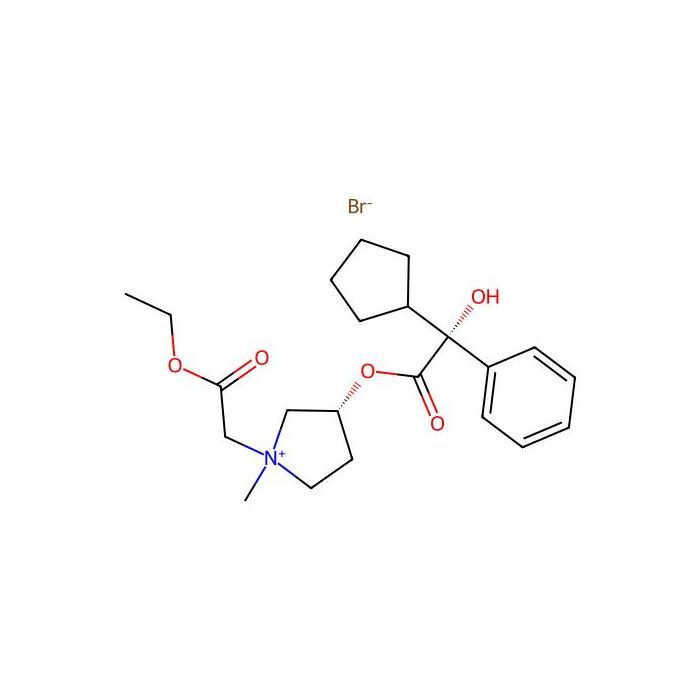
Sofpironium bromide (BBI 4000) is an anticholinergic agent used in the study of primary axillary hyperhidrosis (PAH). Sofpironium bromide reduces sweating by inhibiting M3 muscarinic receptors in eccrine glands at the application site. Sofpironium bromide also has a high afnity for the M1, M2, M4 and M5 subtypes.
Specifications
Especificações e pureza
Moligand™, 10 mM in DMSO
Condições de armazenamento de armazenamento
Desiccated,Store at -80°C
Enviado em
Dry ice packs + Cold packs
Este produto requer transporte de cadeia fria. Serviços terrestres e outros serviços econômicos não estão disponíveis.
Determine the necessary mass, volume, or concentration for preparing a solution.
Dilution Calculator
Determine the dilution needed to prepare a stock solution.
Reconstitution Calculator
Revisões
Avaliações dos Clientes
Application Protocols
No tested application protocols are provided for this item in the Product Data. The following are general, non-item-specific guidelines suitable for small-molecule screening and should be adapted to your system.
Stock preparation: Dissolve in anhydrous DMSO at 10–50 mM. Vortex and, if needed, sonicate briefly. Filter through 0.22 µm PTFE for particulate removal.
Assay dilution: Add to assay buffer to achieve final DMSO ≤0.5–1% v/v. Mix thoroughly and verify absence of precipitation. Include vehicle controls matched for DMSO.
Concentration–response: Prepare 10-point half-log serial dilutions (top concentration selected from pilot solubility/potency data). Run triplicates.
Binding assays: Use appropriate radioligand/fluorescent tracer and saturating controls. Perform non-specific binding controls and fit to competitive binding models.
Functional assays (GPCR): For antagonist mode, pre-incubate compound (e.g., 5–30 min) prior to agonist addition. Capture full kinetic or endpoint readout per platform instructions. Include reference antagonists as system controls.
Data quality: Track Z′-factor, S/B, and CV%. Use four-parameter logistic fits with shared bottom/top constraints where justified.
Note: These are general practices. Item-specific validated protocols, recommended dilutions, and positive controls are not specified for this item.
Biological Roles
Biological context (literature/general; no clinical claims):
Sofpironium bromide is reported in the literature as a small-molecule antimuscarinic (muscarinic acetylcholine receptor antagonist). Quaternary ammonium character typically limits passive CNS penetration, focusing activity on peripheral cholinergic pathways in in vitro systems.
Muscarinic receptors (M1–M5) are GPCRs coupled to diverse signaling cascades (Gq/11, Gi/o). Antagonists are used in research to dissect cholinergic contributions to smooth muscle tone, glandular secretion, and other parasympathetic functions.
In biochemical assays, antagonists shift agonist concentration–response curves rightward (parallel shift) and reduce maximal response at sufficient occupancy; Schild analysis can quantify competitive behavior.
Quaternary salts frequently show strong interactions with anionic phospholipids and can exhibit reduced membrane permeability; uptake mechanisms may involve transporters or endocytosis in certain cellular models.
Off-target profiling across GPCRs, ion channels, and transporters is commonly undertaken to define selectivity; results are assay- and lab-dependent and should be confirmed for each lot and method.
Important notes for users:
The specific binding profile, subtype selectivity (e.g., M1–M5), and functional potency values for this item are not specified in the Product Data and should be sourced from peer-reviewed literature or determined experimentally.
Report concentrations based on the bromide salt mass unless converting to the cation equivalent with a validated molecular weight.
Buffer Applications
This product is not a buffering agent and is not typically used to establish or maintain pH.
For assay work, prepare standard biological buffers (e.g., HEPES, phosphate, Tris) at the pH appropriate to your biological system, then add Sofpironium bromide from a concentrated stock (commonly in DMSO or water) to the desired final concentration.
Maintain consistent ionic strength and include appropriate controls (vehicle, positive/negative) to distinguish compound effects from buffer composition.
If precipitation occurs on dilution:
Increase buffer ionic strength modestly, add 0.1–1% DMSO or MeOH as co-solvent, or adjust pH within the physiological range to optimize solubility (ensure changes do not perturb the biological readout).
Green Alternatives
As a research ligand rather than a process solvent, “green alternatives” pertain to solvent and workflow choices that reduce environmental impact while preserving analytical performance.
Greener handling choices (literature/general):
Prefer water-based buffers with minimal DMSO (≤0.5–1% v/v) for assays whenever solubility permits.
Use MeOH in place of acetonitrile when LC performance is adequate; MeOH has a more favorable environmental profile in many contexts.
Choose aqueous mobile phases with volatile buffers (ammonium formate/acetate) and low organic content for LC–MS where feasible.
Example comparison (contextual, not item-specific):
DMSO vs. 2-methyl-2-butanol (t-amyl alcohol) as co-solvent: DMSO offers superior solvency and stability but has higher EHS burdens in large-scale use; at screening scale, minimizing DMSO percentage is typically the greener lever.
ACN vs. MeOH for LC: ACN often gives sharper peaks at lower backpressure; MeOH is generally greener but may require higher pressures and can change selectivity.
Operational tips:
Consolidate shipments and use cold-chain shippers with reusable gel packs where regulations permit.
Dispose of halide-containing organic waste via designated streams to enable appropriate treatment.
Note: The active substance itself has no practical “alternative” in target-specific studies; greening focuses on solvents, scale, and waste management.
Pharmaceutical Uses
No clinical or therapeutic uses are claimed for this catalog item. Content below addresses non-clinical laboratory and development contexts only.
Analytical reference standard: Employed to develop and validate chromatographic and mass-spectrometric methods (specificity, linearity, accuracy, precision) in preclinical matrices.
Excipient compatibility screening: Quaternary ammonium salts can exhibit counterion or excipient interactions; forced-degradation and compatibility studies (with common excipients, light, heat, humidity, peroxide) help define stability-indicating methods.
Permeation/partition studies: Because permanently charged cations show limited passive diffusion, they are useful probes for transporter involvement and formulation strategies aimed at local delivery in vitro.
Salt/counterion investigations: Bromide can be exchanged for alternative anions (e.g., chloride, acetate, mesylate) to study effects on solubility, hygroscopicity, and crystallinity; such work should be documented with XRPD/DSC/TGA and moisture uptake profiles.
Regulatory note:
This item is labeled For research use only and is not produced under GMP for human use. Pharmacopeial monographs, if any, are not referenced here. For regulated applications, qualify the material through internal specifications, identity testing, purity profiling, and stability protocols.
Physical Properties
Item-specific physicochemical parameters (spec values) are not provided in the Product Data.
Appearance: Not specified for this item; refer to CoA/Spec Sheet.
Melting point (MP): Not specified for this item; refer to CoA/Spec Sheet.
Boiling point (BP): Not applicable to salts under ambient pressure; decomposition often occurs before boiling (literature, general for quaternary ammonium bromides).
Density: Not specified for this item; refer to CoA/Spec Sheet.
Solubility: Not specified for this item; refer to CoA/Spec Sheet.
LogP/logD: Not specified for this item; refer to CoA/Spec Sheet.
pKa: Not applicable; the nitrogen is permanently quaternized (literature, general concept).
Refractive index/UV cutoff: Not specified for this item; refer to CoA/Spec Sheet.
Literature/general guidance for quaternary ammonium bromides (context only; verify experimentally for this item):
Aqueous behavior: Permanently cationic salts typically exhibit good water miscibility and high solubility in polar protic solvents; however, hydrophobic substituents can reduce aqueous solubility. Empirical solubility testing (water, buffer, MeOH, EtOH, acetonitrile, DMSO) is recommended.
Hygroscopicity: Many quaternary salts are moderately hygroscopic; handle rapidly in low humidity to preserve mass accuracy.
Thermal stability: Such salts often show solid-state stability at low temperature but may decompose rather than melt cleanly when heated; avoid prolonged exposure to elevated temperatures.
Practical tip:
For screening stocks, begin with 10 mM in anhydrous DMSO as a universal approach, then back-dilute into aqueous assay buffers containing 0.1–1% DMSO while monitoring for precipitation.
Quality and Grades
Grade/Purity: Moligand™ (as provided in Product Data)
About Moligand™ (general description for Aladdin small-molecule library grade):
Intended use: Research-grade small molecules suitable for discovery workflows (screening, profiling, reference spiking, method development). Not intended for clinical use, API manufacturing, or diagnostic procedures.
Documentation: For lot-specific identity, purity, and residual solvent data, consult the Certificate of Analysis (CoA) and Specification Sheet. If UV absorbance, chromatographic purity, or elemental analysis are critical to your work, confirm values per lot.
Purity metrics: Item-specific purity percentage, related substances, and residual solvent limits are not listed here. If needed for quantitative assays, request the CoA or perform incoming QC (e.g., HPLC-UV/ELSD, HRMS).
Stabilizers/additives: Not specified for this item; refer to CoA/Spec Sheet. Absence of declared stabilizers does not preclude trace residues—verify by NMR or LC–MS if stabilizer sensitivity is a concern.
Implications for use:
Suitable for SAR studies, target engagement assays, qualitative and semi-quantitative work.
For regulated bioanalytical or impurity reference standards, consider orthogonal characterization (NMR, HRMS, HPLC) and stability-indicating methods under your specific conditions.
Note: No item-specific specs (e.g., water content, residual bromide assays, metals, UV cutoff) are provided. Treat all unstated attributes as “Not specified for this item; refer to CoA/Spec Sheet.”
Reaction and Applications
This product is offered as a research-grade small molecule for chemical biology and screening, rather than as a synthetic reagent. Accordingly, the most relevant applications are assay- and analytics-focused.
Research applications (literature/general):
Target engagement studies: Evaluate binding to cholinergic (muscarinic) receptors using radioligand displacement or fluorescence polarization assays. Reported in literature as an antimuscarinic small molecule; confirm target panel per your study design.
ADME profiling: Determine permeability (e.g., PAMPA, Caco-2), plasma protein binding, metabolic stability (microsomes/S9), and solubility/pH stability to inform screening cascades.
Analytical reference: Use as a system suitability or spike-in standard for LC–MS/MS method development in matrices relevant to in vitro studies.
Practical considerations:
Maintain consistent lot and storage history to minimize potency drift due to hydrolysis or moisture uptake (general risk for ester-containing quats; verify for this item experimentally).
Include counterion-aware calculations (report concentrations as the bromide salt unless converting to free-cation equivalents).
For orthogonal confirmation, combine binding assays with functional antagonism readouts and structure–activity comparison to close the mechanism-of-action loop.
Note: No manufacturer application specifics are provided beyond “For research use only.”
Reaction Conditions
No item-specific synthetic reaction conditions are provided, as this product is supplied as a finished research ligand rather than as a reagent. The following general conditions apply to characterization and limited transformations often performed for development purposes (literature/general):
Counterion exchange:
Solvents: Water/MeOH or water/ACN mixtures; optional use of ion-exchange resins (Cl−, PF6−, BF4− forms depending on study aims).
Temperature: Ambient.
Workup: Concentration under reduced pressure at ≤40 °C; dryness under high vacuum to remove residual solvents.
Acid/base hydrolysis: 0.1–1 M HCl or NaOH, RT–60 °C, 1–24 h.
Oxidation: 0.1–3% H2O2, RT, 1–24 h.
Thermal/humidity: 40–60 °C, 60–75% RH, up to several weeks.
Analyze by LC–MS with mass balance tracking.
Solubility screens:
Media: Water, PBS, HBSS, MeOH, EtOH, ACN, DMSO.
Endpoints: Thermodynamic solubility (shake-flask) or kinetic solubility (turbidimetric), 25–37 °C.
These are general guidance ranges from the analytical development literature. Confirm suitability for your specific objectives and ensure stability of Sofpironium bromide under the chosen conditions prior to scale-up.
Safety and Handling
Hazard classification for this specific item is not provided in the Product Data. Always consult the official SDS for authoritative, up-to-date safety information.
Signal word / GHS classification / H-statements / pictograms: Not specified for this item; refer to SDS.
General hazards (literature/general): Quaternary ammonium salts can cause irritation to skin, eyes, and respiratory tract. Avoid ingestion, inhalation of dust, or contact with skin and eyes.
PPE: Laboratory coat, safety glasses or chemical splash goggles, and appropriate chemical-resistant gloves (e.g., nitrile). Use in a chemical fume hood to minimize exposure to dust or aerosols.
First aid (general):
Skin contact: Remove contaminated clothing, wash with soap and water. Seek medical attention if irritation persists.
Eye contact: Rinse cautiously with water for several minutes; remove contact lenses if present and easy to do; continue rinsing and seek medical advice.
Inhalation: Move to fresh air; obtain medical attention if symptoms occur.
Ingestion: Rinse mouth; do not induce vomiting; seek medical attention.
Incompatibilities: Strong oxidizers and strong bases/acids may lead to degradation of ester-containing quaternary ammonium compounds (literature, general). Avoid contact with moisture if the substance is hygroscopic.
Handling tips: Minimize time at ambient humidity; weigh quickly in a desiccated environment. Prepare solutions with anhydrous solvents when long-term stability is required. Use amber vials if conducting light-sensitivity studies.
Disposal: Dispose of contents/container according to institutional, local, and national regulations for organic, halide-containing salts.
Solvent Selection
Sofpironium bromide is a quaternary ammonium bromide; solvent choice should balance ionic character with any hydrophobic substituents.
General solvent guidance (literature/general):
Polar aprotic (screening stocks): DMSO is typically preferred for 10–50 mM master stocks due to broad solvency and assay compatibility at ≤1% v/v.
Polar protic: Water and aqueous buffers often dissolve quaternary ammonium salts; however, hydrophobic motifs can limit solubility. Co-solvents (0.1–5% DMSO, MeOH, or EtOH) may be needed. Verify visually for precipitation on dilution.
Alcohols: MeOH > EtOH > i-PrOH in solvency; good for analytical sample prep but assess ion suppression in LC–MS.
Acetonitrile: Useful for LC method development and sample dilution; combine with water and 0.1% formic acid or ammonium formate for MS-friendly mobile phases.
Nonpolar solvents (e.g., hexanes, toluene, MTBE): Typically poor for quaternary salts. Avoid unless performing ion-pairing or counterion exchange protocols.
Small comparison (contextual):
DMSO: Highest solvency; widely used in HTS. Potential to affect receptor assays above ~1% v/v.
Water/buffer: Physiologically relevant; may require co-solvent for hydrophobic cations.
MeOH/ACN: Good for analytical workflows; monitor peak shape and recovery in LC–MS.
Practical tips:
Prepare concentrated DMSO stocks, aliquot, and back-dilute into buffer with rapid mixing.
If solubility is uncertain, perform a micro-scale solubility screen (water, PBS, DMSO, MeOH, ACN) at target concentrations (e.g., 1–1000 µM).
Storage and Reconstitution
Storage conditions (as provided): Desiccated, Store at −80 °C.
Upon receipt, keep container closed and equilibrate briefly to room temperature in a desiccator before opening to prevent moisture condensation.
Prepare single-use aliquots of concentrated stock (e.g., 10–50 mM in anhydrous DMSO or as appropriate) and store at −80 °C. Avoid repeated freeze–thaw cycles.
Protect from moisture; quaternary ammonium bromides and ester-containing molecules can be sensitive to hydrolysis. Use anhydrous solvents and work quickly when exposed to air.
For aqueous working solutions, prepare fresh on the day of use. If stability allows, short-term storage at 2–8 °C may be acceptable; verify by LC–MS/HPLC.
If precipitation occurs after thaw/dilution, gently warm to room temperature and vortex. Do not heat above ambient without confirming thermal stability.
Unspecified parameters for this item:
Appearance, stabilizers, pH of supplied form, and reconstitution solvent preference are not specified for this item; refer to CoA/Spec Sheet. Validate stability and concentration by analytical methods (e.g., UV, HPLC, or quantitative NMR) before critical experiments.
Structure and Identity
Sofpironium bromide is a synthetic, cationic organic salt supplied for discovery and screening use within small-molecule libraries.
InChIKey: Not specified for this item; refer to CoA/Spec Sheet.
SMILES: Not specified for this item; refer to CoA/Spec Sheet.
Molecular formula: Not specified for this item; refer to CoA/Spec Sheet.
Molecular weight: Not specified for this item; refer to CoA/Spec Sheet.
Structural features (literature/general description):
Ionic composition: Quaternary ammonium cation paired with a bromide counterion.
Functional groups: Contains a permanently charged quaternary ammonium center; typical scaffolds of this class often include ester and tertiary alcohol/ether-like motifs (literature, general for this compound class).
Stereochemistry: Sofpironium is reported in the literature as a single, well-defined small molecule; specific stereochemical descriptors for this item are not specified here. Refer to the product CoA for definitive stereochemical assignment.
2D structure (verbal): A bulky, hydrophobic organic core bearing a tethered dialkylated (or polyalkylated) tertiary amine that is quaternized, giving a permanently cationic ammonium; overall isolated as the bromide salt.
Notes:
Item-specific identifiers beyond CAS/CID are not provided in the Product Data and should be confirmed against the product CoA/SDS prior to use in regulated or quantitative studies.
Synthetic Utility
Sofpironium bromide is supplied as a finished small molecule for screening and analytical use; it is not typically employed as a general-purpose synthetic building block. However, several laboratory manipulations are relevant in chemical development and characterization.
Useful transformations and studies (literature/general):
Counterion exchange: Ion metathesis (e.g., via anion-exchange resin or salt metathesis in mixed solvents) can provide alternative salts for solid-state or solubility studies. Verify via ion chromatography or argentometric titration for residual bromide.
Hydrolysis/stability assessment: If ester functionalities are present (as is common in this class), perform acid/base and enzymatic hydrolysis studies to map degradation pathways; analyze with LC–MS and NMR.
Crystallization and polymorph screening: Explore solvent–antisolvent systems to identify polymorphs/solvates; characterize with XRPD and thermal methods (DSC/TGA).
Derivatization for analytical probes: Quaternary ammonium motifs can be appended with isotopic labels or reporter tags for mechanistic studies, though such derivatization yields new chemical entities distinct from this item.
Caveats:
Reaction chemistry on the intact quaternary ammonium center is limited; strong nucleophiles/bases may induce undesired cleavage or degradation.
Any transformation alters the identity relative to the catalog item; such derivatives should be treated as new compounds with their own characterization and safety assessment.
Target Specificity
Item-specific target data are not provided in the Product Data for SKU S1494223.
Antigen/epitope/clone/isotype: Not applicable; this is a small molecule, not an antibody.
Target panel, binding constants (Kd/Ki), functional IC50/EC50, and receptor subtype selectivity are not specified for this item.
Guidance (literature/general):
Sofpironium bromide has been described in the literature as an antimuscarinic small molecule. If your work requires precise values (e.g., Ki at M1–M5), consult peer-reviewed sources and generate confirmatory data under your assay conditions, as potency is sensitive to buffer composition, temperature, receptor expression level, and detection modality.
Perguntas frequentes
How should this product be stored?
Store at ?80 °C, desiccated. Keep the container tightly closed with desiccant — the material is moisture-sensitive.
What is Moligand??
Moligand? is one of Aladdin Scientific's premium product lines, formulated for high-purity applications across multiple workflows. Compared to standard grades in the same workflow, Moligand? products typically offer tighter specifications, more rigorous QC, and stronger lot-to-lot consistency.
How is this product shipped?
This product ships frozen with dry ice and cold packs. Unpack on arrival and transfer it to the storage condition stated above; handle dry ice with insulated gloves in a ventilated area.
What are the CAS number, molecular formula and molecular weight?
The CAS Number is 1628106-94-4, the molecular formula is C22H32BrNO5, and the molecular weight is 470.40 g/mol.
What documentation is provided?
Available product documentation, including Certificates of Analysis (COA), Safety Data Sheets (SDS), and specification sheets, is shown in the product document area. Document availability and access follow the current site policy.
Need help choosing the grade?
Our grade selection guide covers purity, stabilizer status, and application suitability for all variants in our catalog.
Usamos cookies para garantir o funcionamento adequado do site e, quando permitido, para melhorar a sua experiência. Você pode gerenciar suas preferências a qualquer momento nas Configurações. Saiba mais em nossa Política de Cookies.
Deseja que lhe enviemos uma mensagem quando tivermos descontos disponíveis?
Lembrar-me mais tarde
Obrigado! Por favor, verifique a sua caixa de entrada de e-mail para confirmar.
Products are supplied to verified businesses, institutions, and qualified professionals for research and development use only. Not for use in humans, animals, diagnosis, or therapy.