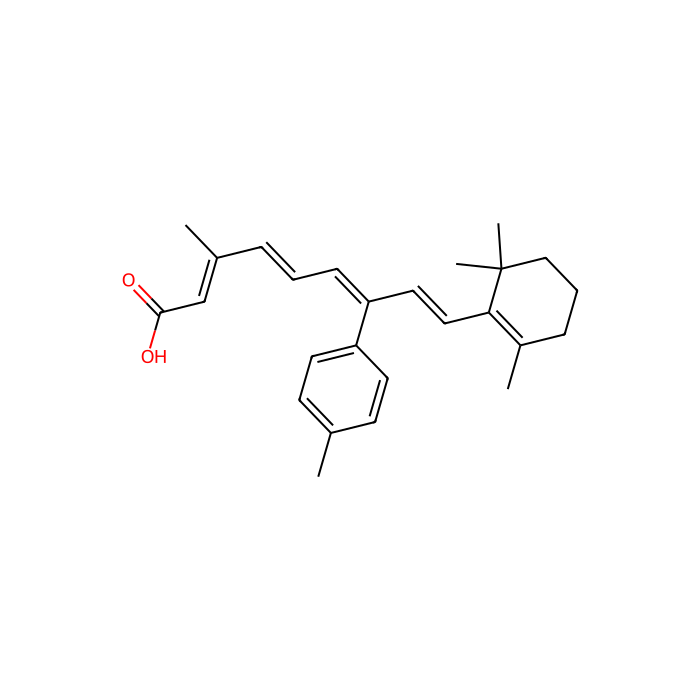
Inhibitor of activator protein-1 (AP-1) transcription factor activity that displays antitumor effectsin vivo. Does not activate transcription from the retinoic acid response element (RARE) and displays no activity at retinoic acid receptors (EC50> 1μM for RARα, RARβ, RARγand RXRα).
Condições de armazenamento de armazenamento
Store at -20°C
Enviado em
Ice chest + Ice pads
Este produto requer transporte de cadeia fria. Serviços terrestres e outros serviços econômicos não estão disponíveis.
This compound belongs to the class of organic compounds known as diterpenoids. These are terpene compounds formed by four isoprene units.
External Descriptors
Not available
1. Djoumbou Feunang Y, Eisner R, Knox C, Chepelev L, Hastings J, Owen G, Fahy E, Steinbeck C, Subramanian S, Bolton E, Greiner R, and Wishart DS. ClassyFire: Automated Chemical Classification With A Comprehensive, Computable Taxonomy. Journal of Cheminformatics, 2016, 8:61.
Solvent:DMSO, Max Conc. mg/mL: 37.6, Max Conc. mM: 100; Solvent:ethanol, Max Conc. mg/mL: 3.76, Max Conc. mM: 10
Peso molecular
376.5
XLogP3
7.900
Hydrogen Bond Donor Count
1
Hydrogen Bond Acceptor Count
2
Rotatable Bond Count
6
Exact Mass
376.24 Da
Monoisotopic Mass
376.24 Da
Topological Polar Surface Area
37.300 Ų
Heavy Atom Count
28
Formal Charge
0
Complexity
705.000
Isotope Atom Count
0
Defined Atom Stereocenter Count
0
Undefined Atom Stereocenter Count
0
Defined Bond Stereocenter Count
4
Undefined Bond Stereocenter Count
0
The total count of all stereochemical bonds
4
Covalently-Bonded Unit Count
1
Segurança e perigos (GHS)
Declarações de precaução
P264:Wash hands [and …] thoroughly after handling.
Calculadoras de soluções
Molarity Calculator
Determine the necessary mass, volume, or concentration for preparing a solution.
Dilution Calculator
Determine the dilution needed to prepare a stock solution.
Reconstitution Calculator
Revisões
Avaliações dos Clientes
Application Protocols
No item-specific, tested application protocols are provided in the Product Data.
General starting-point protocols (literature-inspired, to be optimized by the user):
Stock solution preparation
Dissolve SR 11302 in anhydrous DMSO at 10 mM. Mix gently until fully dissolved. Aliquot into amber microtubes (e.g., 20–50 µL) and store at −20°C. Avoid >3 freeze–thaw cycles.
Cell-based assay dosing
Prepare serial dilutions in DMSO to 1000× final concentrations. Add 1 µL of each dilution to 1 mL of pre-warmed medium to achieve final DMSO 0.1% v/v (example). Mix immediately and apply to cells. Include vehicle-only controls.
AP-1 reporter assay (conceptual outline)
Transfect cells with an AP-1–luciferase reporter. After recovery, treat with SR 11302 at a range of concentrations alongside appropriate pathway controls. Incubate per assay requirements (e.g., 6–24 h). Read luminescence and normalize to cell number or protein content.
Compound integrity check
Analyze a thawed aliquot by LC–MS (single-ion monitoring for the expected [M+H]+) before key experiments to confirm no significant degradation.
All parameters (dose, time, serum content) must be optimized for the specific cell line/model. Research use only.
Biological Roles
Biological context (literature, general for SR 11302):
SR 11302 is widely cited as a synthetic retinoid-like compound used to probe transcriptional regulation, particularly inhibition of AP-1 (Activator Protein-1)–dependent transcription. It has been employed to decouple retinoid receptor–mediated signaling from AP-1 pathways in cell-based experiments.
As a chemical biology tool, it helps delineate gene networks responsive to retinoid signaling and provides a control for evaluating specificity of transcriptional modulators.
Experimental use-cases (literature examples, without claiming outcomes):
Transient transfection reporter assays featuring AP-1 response elements to study pathway modulation.
RNA expression profiling (qPCR/RNA-seq) following compound treatment to map pathway-linked gene expression changes.
Protein-level readouts (e.g., immunoblotting of AP-1 target proteins) after time-course dosing.
Selectivity notes (literature, general):
Reported to modulate AP-1–linked transcription with minimal activation of canonical RAR-mediated gene transcription; nevertheless, off-target effects are assay- and cell-type–dependent. Titrate doses and include orthogonal controls.
Good practice:
Confirm activity in your system using positive/negative controls and verify compound integrity by LC–MS before critical experiments.
Keep final solvent concentrations constant across treatments; perform cytotoxicity/tolerance titrations to define non-perturbing ranges for your cells or biochemical assays.
Research use only: Not for diagnostic procedures, clinical applications, or human/animal consumption.
Buffer Applications
This product is not a buffering reagent. There are no intrinsic buffer systems associated with SR 11302.
Practical guidance for use with buffers (general):
Prepare concentrated stocks in DMSO and dilute into the desired assay buffer or culture medium immediately prior to use.
Maintain a constant final DMSO percentage across all wells/conditions (commonly ≤0.1–0.5% v/v, literature practice) to avoid solvent-driven artifacts.
If precipitation occurs on dilution, consider:
Slightly warming the buffer (room temperature), gentle mixing, or using serum-containing media to increase apparent solubility.
Using small amounts of tolerated co-solvents (e.g., ethanol) or carriers (e.g., cyclodextrins) after validating biological compatibility.
No specific pH buffering ranges, recipes, or electrophoresis applications apply to this compound.
Green Alternatives
This product is a specialized bioactive small molecule rather than a solvent or process reagent. “Green alternatives” are generally not applicable to the compound itself.
However, greener choices can be applied to the associated workflow:
Solvent selection for sample preparation/analysis:
Prefer ethanol (bio-derived) over DMF when assay-acceptable; maintain very low final percentages to protect cell viability.
Use minimal DMSO volumes and implement solvent recycling in analytical labs where feasible.
Minimizing waste:
Plan dosing and aliquoting to avoid thaw–refreeze cycles and compound discard.
Employ microscale assays and 96/384-well formats to reduce consumption.
Energy/light management:
Store at recommended low temperature efficiently (consolidate freezer space) and use amber secondary containment to reduce light-induced waste.
Trade-offs (general):
Ethanol is greener but may be less effective than DMSO for hydrophobic compounds and can volatilize, altering effective dose.
Aqueous cosolvent systems (e.g., PEG400/Tween/HP-β-CD) can reduce DMSO usage in in vivo-like formulations, but may not be suitable for all cell systems and are not validated for this specific item.
Conclusion: Apply green chemistry principles to solvents and scale rather than substituting the active compound itself.
Pharmaceutical Uses
This product is supplied strictly for research use only. It is not formulated or approved for pharmaceutical use, clinical applications, or diagnostic procedures.
For in vitro and ex vivo research, SR 11302 is typically handled as DMSO stock solutions and diluted into assay media. No pharmacopeial monograph or excipient status is provided for this item.
If formulation-like studies are performed (e.g., vehicle screening in preclinical research), common solubilization systems for hydrophobic small molecules include DMSO/PEG400/saline, ethanol/cremophor/saline, or cyclodextrin complexes. These are provided as general options only and are not validated for this item.
Regulatory and quality notes:
No cGMP status, DMF, or compendial compliance is specified for this item. Refer to the CoA/Spec Sheet for available analytical controls.
Users are responsible for determining suitability for their specific non-clinical research application and for complying with institutional and regulatory requirements.
Summary: Treat SR 11302 as a laboratory research chemical and not as a drug substance or excipient.
Physical Properties
Item-specific specifications have not been provided. Do not treat any value below as an item specification.
Appearance: Not specified for this item; refer to CoA/Spec Sheet.
Melting point: Not specified for this item; refer to CoA/Spec Sheet.
Boiling point: Not applicable for typical solid bioactives; not specified for this item.
Density: Not specified for this item; refer to CoA/Spec Sheet.
Refractive index: Not applicable to solids; not specified for this item.
LogP, pKa: Not specified for this item; consult literature databases for general values if needed.
Solubility (practical handling, literature):
Frequently prepared as concentrated stocks in anhydrous DMSO (e.g., 10–50 mM) due to hydrophobic character of retinoid-like scaffolds.
Limited aqueous solubility is typical; working dilutions are commonly achieved by diluting DMSO stocks into buffer immediately before use, maintaining final DMSO ≤0.1–0.5% v/v when compatible with the assay (literature guidance).
Stability considerations (literature, general):
Retinoid-like compounds can be light-sensitive and prone to oxidative degradation; protect from light and minimize air exposure.
Adsorption to plastics can occur for hydrophobic molecules; prefer low-binding plastics or glass for critical assays.
Always verify lot-specific properties on the product CoA/Spec Sheet and follow your internal method validation.
Quality and Grades
Grade/Purity: Not specified for this item; refer to CoA/Spec Sheet.
How to interpret quality information for small-molecule tool compounds (general guidance):
Purity by HPLC/UPLC: Tool compounds used in cell biology typically require ≥95% area purity (literature expectation). If your application is target-validation or chemical biology, review the chromatogram on the CoA.
Identity: Confirmed by NMR/HRMS/LC–MS per manufacturer’s specifications; request spectra if your QA process requires documentary evidence.
Residual solvents, water content, and counter-ions: Not specified for this item; refer to CoA/Spec Sheet. For sensitive cell assays, residual solvent levels may affect baseline responses; consider additional drying if permitted by the stability profile.
Optical/light stability: Retinoid-like chemotypes are frequently light-sensitive; packaging in amber vials and storage at low temperature helps maintain integrity (general practice, verify on CoA).
What is specific to this item:
Storage condition provided by manufacturer: Store at -20°C.
Shipping: Ice chest + Ice pads to limit thermal excursions.
Recommendation:
Upon receipt, document condition, allow to equilibrate in a desiccator to avoid condensation, and verify identity/purity against the accompanying CoA/Spec Sheet before use in critical experiments.
Reaction and Applications
This product is primarily a bioactive tool compound for research and is not typically used as a synthetic reagent or catalyst.
Applications in research workflows (literature/general):
Chemical biology: Used to modulate transcriptional programs (e.g., AP-1–related pathways) for pathway dissection in cell models.
Phenotypic screening: Serves as a reference/control compound when evaluating retinoid signaling modulators.
Omics and target engagement: Can be dosed to cells to examine transcriptional signatures and confirm on-pathway responses.
Practical notes for use in assays (general):
Prepare fresh DMSO stocks (e.g., 10 mM) under reduced light; aliquot and store at −20°C in amber tubes. Thaw on ice and avoid multiple freeze–thaw cycles.
Validate concentration by UV–vis or LC–MS if your QA requires dosing accuracy; many retinoid-like compounds absorb in the UV; verify λmax for this specific item on CoA/literature before employing spectrophotometric quantitation.
Establish a vehicle control curve to account for DMSO effects on cells/enzymes.
If a chemistry application is intended (e.g., as a building block), note that no reactivity or coupling specifications are provided for this item; consult the CoA and conduct small-scale feasibility checks.
Reaction Conditions
Not typically applicable. SR 11302 is supplied for use as a bioactive small molecule in biological assays rather than as a reagent for chemical synthesis.
For users seeking to use the compound in assays (general, practical conditions):
Stock preparation: Dissolve in anhydrous DMSO (e.g., 10 mM). Vortex and, if necessary, briefly sonicate under reduced light. Filter only if particulate is observed and recovery is validated.
Dosing: Typical cell-based studies explore sub-micromolar to low-micromolar nominal ranges for hydrophobic transcriptional modulators; exact concentrations, exposure times, and temperatures must be optimized empirically for each system.
Vehicle controls: Match final DMSO concentration across all samples (e.g., ≤0.1–0.5% v/v, assay-dependent).
Stability during incubation: Protect plates/tubes from strong light; minimize prolonged pre-incubation in aqueous media to reduce precipitation or degradation (general advice for retinoid-like molecules).
If actual chemical reactions are planned with this molecule, note that no catalyst/solvent/temperature guidance is provided for SR 11302. Any synthetic use requires independent method development.
Safety and Handling
GHS classification: Not specified for this item; refer to SDS.
Signal word / H-statements / Pictograms: Not specified for this item; refer to SDS.
General laboratory safety (good practice):
Handle in a chemical fume hood wearing appropriate PPE: lab coat, safety glasses, and chemically resistant gloves (e.g., nitrile). Avoid inhalation of dust and contact with skin/eyes.
Prevent environmental release; dispose according to institutional and local regulations for organic laboratory chemicals.
Incompatibilities and precautions (literature, general for retinoid-like small molecules):
Avoid prolonged exposure to light and air/oxidants; work under reduced light and use amber vials when possible.
Use anhydrous solvents (DMSO, DMF, ethanol) for stock preparation; water may cause precipitation.
Avoid strong bases/acids and strong oxidizers unless intentionally used in controlled synthetic contexts.
First-aid overview (defer to SDS for authoritative guidance):
Skin/eye contact: Rinse with plenty of water for ≥15 minutes; remove contaminated clothing; seek medical attention if irritation persists.
Inhalation: Move to fresh air; seek medical attention if symptoms occur.
Ingestion: Rinse mouth; do not induce vomiting; seek medical attention.
SDS is the primary source for hazard classification, exposure limits, and spill/accidental release instructions.
Solvent Selection
SR 11302 is a hydrophobic, retinoid-like small molecule tool compound; solvent choice focuses on preparing stable, homogeneous stocks for biological assays rather than bulk process chemistry.
Primary solvent (literature practice): DMSO is the solvent of choice for concentrated stocks (e.g., 10–50 mM), offering high solvency power and compatibility with most biochemical and cell-based assays at ≤0.1–0.5% final v/v.
Alternative solvents (literature):
Ethanol or DMF can dissolve similar hydrophobic modulators; verify assay tolerance and precipitation upon aqueous dilution.
Acetonitrile may be used for analytical workflows (LC injection solutions) when compatible with autosampler materials.
Aqueous buffers: Direct dissolution is typically poor; prepare DMSO stocks and dilute immediately before use to mitigate precipitation. Use serum/albumin-containing media to enhance apparent solubility if biologically acceptable.
Practical tips:
Filter working solutions only if necessary; some hydrophobic compounds adsorb to filters. If filtration is required, use low-binding PTFE or PVDF and validate recovery.
Use amber vials and minimize freeze–thaw of stock solutions to prevent degradation (literature advice for retinoid-like molecules).
Simple comparison (general):
DMSO: best solvency/assay compatibility; hygroscopic.
Ethanol: good solvency; volatility can change dosing during long incubations.
DMF: strong solvent; ensure biocompatibility at very low final percentages.
Storage and Reconstitution
Storage conditions (as provided): Store at -20°C.
Shipping (as provided): Ice chest + Ice pads to maintain a cold chain.
Long-term stability: Not specified for this item; refer to CoA/Spec Sheet.
Protect from: Light and moisture (general best practice for retinoid-like small molecules; verify on CoA).
Reconstitution guidance (general):
Solvent: Use anhydrous DMSO for primary stock solutions. Alternative solvents (ethanol, DMF) may be considered if compatible with your assay.
Typical stock concentration: 10–50 mM (literature practice). Adjust based on solubility and dosing needs.
Aliquoting: Dispense single-use aliquots into amber, low-binding microtubes to avoid repeated freeze–thaw and adsorption losses.
Thawing: Warm to room temperature briefly and vortex to ensure homogeneity. Return unused thawed aliquots to −20°C promptly; avoid multiple freeze–thaw cycles.
Working solutions: Prepare immediately before use by diluting stock into buffer or culture medium. Keep final DMSO content consistent across samples and as low as assay permits.
Container and labeling:
Store in well-sealed amber vials within a desiccated secondary container. Label with preparation date, concentration, and lot number to support traceability.
Always consult the product’s CoA/Spec Sheet and SDS for definitive storage/stability specifications.
Structure and Identity
Product name: SR 11302 (SKU: S287411)
CAS: 160162-42-5
PubChem CID: 9976842
InChIKey: 322917 (as provided in Product Data)
SMILES: Not specified for this item; refer to CoA/Spec Sheet.
Molecular formula: Not specified for this item; refer to CoA/Spec Sheet.
Molecular weight: Not specified for this item; refer to CoA/Spec Sheet.
General description (literature):
SR 11302 is a synthetic retinoid-like small molecule reported as an AP-1 transcriptional pathway inhibitor and retinoid signaling modulator in biochemical studies. It is commonly used as a tool compound in cell biology to dissect transcriptional programs downstream of retinoid receptors and AP-1 (literature).
Structural features (literature, qualitative):
Typically described as an aromatic retinoid analog containing conjugated aromatic/alkenyl motifs and amide/ester-type functionality in published structures; exact functional group count and regiochemistry should be confirmed against the item-specific CoA/Spec Sheet.
2D structure (verbal, literature-based and generic):
A polyaromatic retinoid-like scaffold with conjugation spanning aryl and alkenyl units is commonly depicted for SR-class compounds; substitution patterns and heteroatom placement should be verified from the certificate of analysis for this specific lot.
Synthetic Utility
SR 11302 is sold as a finished bioactive tool compound and is not typically employed as a synthetic intermediate.
If considered as a building block (general, hypothetical):
Retinoid-like scaffolds often feature conjugated aromatic/alkenyl systems and heteroatom-bearing linkages (e.g., amide/ester). Such motifs can, in principle, participate in cross-coupling, acyl transfer, or late-stage diversification; however, no reactivity or protecting-group information is provided for this specific item.
Practical stance for chemists:
Without item-specific functional group disclosure, stability data, or coupling performance, the compound should not be presumed suitable for derivatization. If derivatization is intended, obtain the full structural specification and run milligram-scale scouting reactions to assess compatibility (e.g., with Pd-catalyzed cross-couplings, mild ester/amide manipulations).
Be mindful that many bioactive small molecules are sensitive to strong bases, oxidants, and extended heating. Protect from light and oxygen during any attempted transformations (general for retinoid-like molecules).
Conclusion:
Treat SR 11302 primarily as a tool compound for biological studies. For synthetic campaigns, acquire the needed precursors or analog libraries rather than modifying this finished compound unless you have validated structural and stability information.
Target Specificity
Item-specific target information is not provided in the Product Data.
Antigen/target name: Not specified for this item; refer to CoA/Spec Sheet.
Mechanism or binding data: Not specified for this item; refer to CoA/Spec Sheet.
Species selectivity: Not specified for this item; refer to CoA/Spec Sheet.
General literature context (not item-specific specifications):
SR 11302 is commonly used as a chemical probe for the AP-1 transcriptional pathway and retinoid signaling studies. Users should verify target engagement in their system using orthogonal assays (reporter assays, gene expression, or proteomic readouts) and confirm compound identity/purity prior to critical decision-making.
Usamos cookies para garantir o funcionamento adequado do site e, quando permitido, para melhorar a sua experiência. Você pode gerenciar suas preferências a qualquer momento nas Configurações. Saiba mais em nossa Política de Cookies.
Deseja que lhe enviemos uma mensagem quando tivermos descontos disponíveis?
Lembrar-me mais tarde
Obrigado! Por favor, verifique a sua caixa de entrada de e-mail para confirmar.
Products are supplied to verified businesses, institutions, and qualified professionals for research and development use only. Not for use in humans, animals, diagnosis, or therapy.