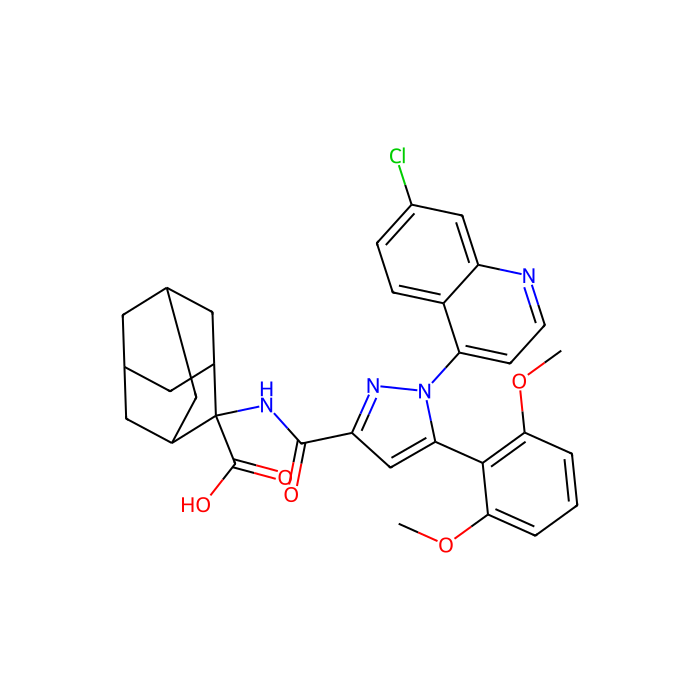
SR 48692 - Moligand™, ≥98%(HPLC) , Neurotensin receptor 1 antagonist, CAS No.146362-70-1, Neurotensin receptor 1 antagonist

CAS: 146362-70-1 Cat. No.: S287777 Fórmula: C32H31ClN4O5 Peso molecular: 587.07 PubChem CID: 119192
Disponível para encomenda
GRAU & PUREZA Moligand™ ? Moligand™ — Aladdin's line of ligands and bioactive small molecules. Use for receptor, pathway, and binding studies needing defined small-molecule tools. ≥98%(HPLC)
Synonyms
Tricyclo(3.3.1.13,7)decane-2-carboxylic acid, 2-(((1-(7-chloro-4-quinolinyl)-5-(2,6-dimethoxyphenyl)-1H-pyrazol-3-yl)carbonyl)amino)-|2-[[1-(7-chloranylquinolin-4-yl)-5-(2,6-dimethoxyphenyl)pyrazol-3-yl]carbonylamino]adamantane-2-carboxylic acid|Meclinertant|2-(((1-(7-CHLORO-4-QUINOLINYL)-5-(2,6-DIMETHOXYPHENYL)-1H-PYRAZOL-3-YL)CARBONYL)AMINO)-TRICYCLO(3.3.1.1(SUP 3,7))DECANE-2-CARBOXYLIC ACID|Tricyclo[3.3.1.13,7]decane-2-carboxylic acid, 2-[[[1-(7-chloro-4-quinolinyl)-5-(2,6-dimethoxyphenyl)-1H-pyrazol-3-yl]carbonyl]amino]-|2-(((1-(7-Chloroquinolin-4-yl)-5-(2,6-dimethoxyphenyl)-1H-pyrazol-3-yl)carbonyl)amino)tricyclo(3.3.1.1(sup 3,7) )decane-2-carboxylic acid|alpha-Amylcinnamaldehyde, cis-|Reminertant|SR 48692|2-[[[1-(7-Chloro-4-quinolinyl)-5-(2,6-dimethoxyphenyl)-1H-pyrazol-3-yl]carbonyl]amino]-tricyclo[3.3.1.13,7]decane-2-carboxylic acid|Meclinertant [INN]|SR48692|SR-48692|2-[[1-(7-chloroquinolin-4-yl)-5-(2,6-dimethoxyphenyl)pyrazole-3-carbonyl]amino]adamantane-2-carboxylic acid.|2-{[1-(7-Chloro-quinolin-4-yl)-5-(2,6-dimethoxy-phenyl)-1H-pyrazole-3-carbonyl]-amino}-adamantane-2-carboxylic acid|(1r,3r,5r,7r)-2-(1-(7-chloroquinolin-4-yl)-5-(2,6-dimethoxyphenyl)-1H-pyrazole-3-carboxamido)adamantane-2-carboxylic acid|2-((1-(7-Chloro-4-quinolinyl)-5-(2,6-dimethoxyphenyl)pyrazol-3-yl)carbonylamino)tricyclo(3.3.1.1.(3.7))decan-2-carboxylic acid
Storage
Store at 2-8°C
Shipped In
Wet ice
★
Tamanho
Alemanha (EU)
USA*
Preço
Qtd
5mg
S287777-5mg
Sob encomenda · 8–12 semanas
607,33€
Enter a quantity for the sizes you want to add.

Especificações

Sinónimos
Tricyclo(3.3.1.13,7)decane-2-carboxylic acid, 2-(((1-(7-chloro-4-quinolinyl)-5-(2,6-dimethoxyphenyl)-1H-pyrazol-3-yl)carbonyl)amino)- | 2-[[1-(7-chloranylquinolin-4-yl)-5-(2,6-dimethoxyphenyl)pyrazol-3-yl]carbonylamino]adamantane-2-carboxylic acid | Meclinertant | 2-(((1-(7-CHLORO-4-QUINOLINYL)-5-(2,6-DIMETHOXYPHENYL)-1H-PYRAZOL-3-YL)CARB Show more
Especificações e pureza
Moligand™, ≥98%(HPLC)
Mecanismos bioquímicos e fisiológicos
Neurotensin antagonist; selective for NTS1over NTS2(apparent affinity, Ke, is 36 nM for NTS1). Competitively inhibits binding of [125I]-neurotensin to HT29 and N1E115 cell membranes (IC50values are 15.3 and 20.4 nM respectively). Orally bioavailable.
Condições de armazenamento de armazenamento
Store at 2-8°C
Enviado em
Wet ice
Este produto requer transporte de cadeia fria. Serviços terrestres e outros serviços econômicos não estão disponíveis.
Grau
Moligand™
Tipo de ação
AGONIST, ANTAGONIST
Mecanismo de ação
Neurotensin receptor 1 antagonist
Pureza
≥98%(HPLC)
Nomes e identificadores
SMILES
COC1=C(C(=CC=C1)OC)C2=CC(=NN2C3=C4C=CC(=CC4=NC=C3)Cl)C(=O)NC5(C6CC7CC(C6)CC5C7)C(=O)O
IUPAC Name
2-[[1-(7-chloroquinolin-4-yl)-5-(2,6-dimethoxyphenyl)pyrazole-3-carbonyl]amino]adamantane-2-carboxylic acid
InChIKey
DYLJVOXRWLXDIG-UHFFFAOYSA-N
InChI
1S/C32H31ClN4O5/c1-41-27-4-3-5-28(42-2)29(27)26-16-24(36-37(26)25-8-9-34-23-15-21(33)6-7-22(23)25)30(38)35-32(31(39)40)19-11-17-10-18(13-19)14-20(32)12-17/h3-9,15-20H,10-14H2,1-2H3,(H,35,38)(H,39,40)
SMILES isoméricas
COC1=C(C(=CC=C1)OC)C2=CC(=NN2C3=C4C=CC(=CC4=NC=C3)Cl)C(=O)NC5(C6CC7CC(C6)CC5C7)C(=O)O
WGK Alemanha
3
RTECS
YD1988500
PubChem CID
119192
Peso molecular
587.07

Dados avançados

Taxonomic Classification

Taxonomy Tree

KingdomOrganic compounds
SuperclassOrganic acids and derivatives
ClasseCarboxylic acids and derivatives
SubclassAmino acids, peptides, and analogues
Intermediate Tree Nodes Amino acids and derivatives - Alpha amino acids and derivatives - N-acyl-alpha amino acids and derivatives
Direct ParentN-acyl-alpha amino acids
Alternative Parents Phenylpyrazoles  Chloroquinolines  Dimethoxybenzenes  Phenoxy compounds  Anisoles  Alkyl aryl ethers  Pyridines and derivatives  Aryl chlorides  Heteroaromatic compounds  Propargyl-type 1,3-dipolar organic compounds  Azacyclic compounds  Monocarboxylic acids and derivatives  Carboximidic acids  Carboxylic acids  Hydrocarbon derivatives  Carbonyl compounds  Organic oxides  Organochlorides  Organonitrogen compounds  Organopnictogen compounds  
Molecular FrameworkAromatic heteropolycyclic compounds
Substituents N-acyl-alpha-amino acid - Phenylpyrazole - Chloroquinoline - Haloquinoline - M-dimethoxybenzene - Dimethoxybenzene - Quinoline - Phenol ether - Methoxybenzene - Anisole - Phenoxy compound - Alkyl aryl ether - Pyridine - Aryl halide - Monocyclic benzene moiety - Benzenoid - Aryl chloride - Azole - Heteroaromatic compound - Pyrazole - Organoheterocyclic compound - Azacycle - Propargyl-type 1,3-dipolar organic compound - Organic 1,3-dipolar compound - Carboximidic acid - Carboximidic acid derivative - Carboxylic acid - Monocarboxylic acid or derivatives - Ether - Organooxygen compound - Organic oxygen compound - Organohalogen compound - Organochloride - Carbonyl group - Hydrocarbon derivative - Organic nitrogen compound - Organic oxide - Organopnictogen compound - Organonitrogen compound - Aromatic heteropolycyclic compound
DescriçãoThis compound belongs to the class of organic compounds known as n-acyl-alpha amino acids. These are compounds containing an alpha amino acid which bears an acyl group at its terminal nitrogen atom.
External Descriptors Not available
Estrutura 3D
Modelo de Estrutura Química Interativa


Alvos associados (humanos)
SORT1 Tchem Sortilin (1 Activities)
Activity TypeActivity Value -log(M)Mechanism of ActionActivity ReferencePublications (PubMed IDs)
NTSR1 Tchem Neurotensin receptor type 1 (10 Activities)
Activity TypeActivity Value -log(M)Mechanism of ActionActivity ReferencePublications (PubMed IDs)
NTSR2 Tchem Neurotensin receptor type 2 (2 Activities)
Activity TypeActivity Value -log(M)Mechanism of ActionActivity ReferencePublications (PubMed IDs)
ABL1 Tclin Tyrosine-protein kinase ABL (18331 Activities)
Activity TypeRelationActivity valueUnitsAction TypeJournalPubMed IddoiAssay Aladdin ID
ADRB2 Tclin Beta-2 adrenergic receptor (11824 Activities)
Activity TypeRelationActivity valueUnitsAction TypeJournalPubMed IddoiAssay Aladdin ID
ADRA2A Tclin Alpha-2a adrenergic receptor (9450 Activities)
Activity TypeRelationActivity valueUnitsAction TypeJournalPubMed IddoiAssay Aladdin ID
AGTR1 Tclin Type-1 angiotensin II receptor (5176 Activities)
Activity TypeRelationActivity valueUnitsAction TypeJournalPubMed IddoiAssay Aladdin ID
GSK3B Tclin Glycogen synthase kinase-3 beta (11785 Activities)
Activity TypeRelationActivity valueUnitsAction TypeJournalPubMed IddoiAssay Aladdin ID
CSNK1D Tchem Casein kinase I delta (4546 Activities)
Activity TypeRelationActivity valueUnitsAction TypeJournalPubMed IddoiAssay Aladdin ID
NTSR2 Tchem Neurotensin receptor 2 (296 Activities)
Activity TypeRelationActivity valueUnitsAction TypeJournalPubMed IddoiAssay Aladdin ID
SORT1 Tchem Neurotensin receptor 3 (102 Activities)
Activity TypeRelationActivity valueUnitsAction TypeJournalPubMed IddoiAssay Aladdin ID
S1PR1 Tclin Sphingosine 1-phosphate receptor Edg-1 (5806 Activities)
Activity TypeRelationActivity valueUnitsAction TypeJournalPubMed IddoiAssay Aladdin ID
CDK2 Tchem Cyclin-dependent kinase 2 (9050 Activities)
Activity TypeRelationActivity valueUnitsAction TypeJournalPubMed IddoiAssay Aladdin ID
GLP1R Tclin Glucagon-like peptide 1 receptor (111429 Activities)
Activity TypeRelationActivity valueUnitsAction TypeJournalPubMed IddoiAssay Aladdin ID
C5AR1 Tclin C5a anaphylatoxin chemotactic receptor (2677 Activities)
Activity TypeRelationActivity valueUnitsAction TypeJournalPubMed IddoiAssay Aladdin ID
AURKA Tchem Serine/threonine-protein kinase Aurora-A (10240 Activities)
Activity TypeRelationActivity valueUnitsAction TypeJournalPubMed IddoiAssay Aladdin ID
HT-29 (80576 Activities)
Activity TypeRelationActivity valueUnitsAction TypeJournalPubMed IddoiAssay Aladdin ID
SK-OV-3 (52876 Activities)
Activity TypeRelationActivity valueUnitsAction TypeJournalPubMed IddoiAssay Aladdin ID
U2OS (164939 Activities)
Activity TypeRelationActivity valueUnitsAction TypeJournalPubMed IddoiAssay Aladdin ID
LNCaP (8286 Activities)
Activity TypeRelationActivity valueUnitsAction TypeJournalPubMed IddoiAssay Aladdin ID
CX3CR1 Tchem C-X3-C chemokine receptor 1 (1686 Activities)
Activity TypeRelationActivity valueUnitsAction TypeJournalPubMed IddoiAssay Aladdin ID
FPR2 Tchem Lipoxin A4 receptor (3472 Activities)
Activity TypeRelationActivity valueUnitsAction TypeJournalPubMed IddoiAssay Aladdin ID
FFAR4 Tchem G-protein coupled receptor 120 (2999 Activities)
Activity TypeRelationActivity valueUnitsAction TypeJournalPubMed IddoiAssay Aladdin ID
BRD4 Tchem Bromodomain-containing protein 4 (13122 Activities)
Activity TypeRelationActivity valueUnitsAction TypeJournalPubMed IddoiAssay Aladdin ID
GPR35 Tchem G-protein coupled receptor 35 (2643 Activities)
Activity TypeRelationActivity valueUnitsAction TypeJournalPubMed IddoiAssay Aladdin ID
TRIM24 Tchem Transcription intermediary factor 1-alpha (2087 Activities)
Activity TypeRelationActivity valueUnitsAction TypeJournalPubMed IddoiAssay Aladdin ID
BRPF1 Tchem Peregrin (2217 Activities)
Activity TypeRelationActivity valueUnitsAction TypeJournalPubMed IddoiAssay Aladdin ID
HEK-293T (167025 Activities)
Activity TypeRelationActivity valueUnitsAction TypeJournalPubMed IddoiAssay Aladdin ID
Alvos associados (não humanos)
Ntsr1 Neurotensin receptor 1 (48 Activities)
Activity TypeRelationActivity valueUnitsAction TypeJournalPubMed IddoiAssay Aladdin ID
Aplnr Apelin receptor (201 Activities)
Activity TypeRelationActivity valueUnitsAction TypeJournalPubMed IddoiAssay Aladdin ID
Mapk1 MAP kinase ERK2 (650 Activities)
Activity TypeRelationActivity valueUnitsAction TypeJournalPubMed IddoiAssay Aladdin ID
Hdac6 Histone deacetylase 6 (222 Activities)
Activity TypeRelationActivity valueUnitsAction TypeJournalPubMed IddoiAssay Aladdin ID
Fgfr3 Fibroblast growth factor receptor 3 (21 Activities)
Activity TypeRelationActivity valueUnitsAction TypeJournalPubMed IddoiAssay Aladdin ID
rep Replicase polyprotein 1ab (378 Activities)
Activity TypeRelationActivity valueUnitsAction TypeJournalPubMed IddoiAssay Aladdin ID
Gpr119 Glucose-dependent insulinotropic receptor (270 Activities)
Activity TypeRelationActivity valueUnitsAction TypeJournalPubMed IddoiAssay Aladdin ID
SARS-CoV-2 (38078 Activities)
Activity TypeRelationActivity valueUnitsAction TypeJournalPubMed IddoiAssay Aladdin ID
Mecanismos de ação
Certificados(CoA,COO,BSE/TSE e Mapa de Análise)
C of A & Other Certificates(BSE/TSE, COO):
Analytical Chart:
Propriedades químicas e físicas
SolubilidadeSolvent:DMSO, Max Conc. mg/mL: 11.74, Max Conc. mM: 20
Peso molecular587.100 g/mol
XLogP35.800
Hydrogen Bond Donor Count2
Hydrogen Bond Acceptor Count7
Rotatable Bond Count7
Exact Mass586.198 Da
Monoisotopic Mass586.198 Da
Topological Polar Surface Area116.000 Ų
Heavy Atom Count42
Formal Charge0
Complexity991.000
Isotope Atom Count0
Defined Atom Stereocenter Count0
Undefined Atom Stereocenter Count0
Defined Bond Stereocenter Count0
Undefined Bond Stereocenter Count0
The total count of all stereochemical bonds0
Covalently-Bonded Unit Count1
Calculadoras de soluções
Revisões

Avaliações dos Clientes

Application Protocols

No item-specific, vendor-validated protocols are provided. Below are general, literature-style protocols for using small-molecule GPCR antagonists like SR 48692.

  1. Stock solution preparation (general):
  • Weigh compound quickly at room temperature. Dissolve in anhydrous DMSO to 10–50 mM. Vortex and, if needed, sonicate briefly. Aliquot into amber vials; store at 2–8°C as recommended, or frozen if stability permits (verify).
  1. Competitive binding assay (membranes or intact cells):
  • Prepare membranes expressing NTSR1. Incubate with a fixed concentration of radiolabeled or fluorescent neurotensin and serial dilutions of SR 48692 for 60 min at 25–30°C in binding buffer (e.g., HEPES, Mg2+, protease inhibitors). Separate bound/free (filtration or centrifugation) and quantify. Fit inhibition curves to extract IC50 and convert to Ki as appropriate.
  1. Functional antagonism (Ca2+ flux):
  • Load cells expressing NTSR1 with a Ca2+-sensitive dye. Pre-incubate with SR 48692 for 15–30 min at 37°C. Challenge with neurotensin and record responses. Generate concentration–response curves to calculate apparent KB or pA2 via Schild analysis.

Controls:

  • Include vehicle-only wells, non-specific binding controls (excess unlabeled ligand), and, if available, a second antagonist as a reference.

Note: Optimize temperature, buffer composition, and incubation times for your specific cell line and detection platform.

Biological Roles

SR 48692 is a pharmacological antagonist used to interrogate the neurotensin (NT) signaling axis.

  • Target pathway (literature/general):

    • Neurotensin is a 13-amino acid neuropeptide acting via GPCRs NTSR1 and NTSR2 (and sortilin/NTSR3 as a binding protein). NTSR1 primarily couples to Gq/11 leading to PLC activation, IP3 generation, Ca2+ mobilization, and downstream ERK signaling.
    • SR 48692 is widely reported as a selective antagonist of NTSR1, enabling dissection of NT-dependent physiological signaling in neuronal and peripheral models.
  • Research utility:

    • Define receptor subtype contribution by comparing responses with SR 48692 versus alternative ligands (e.g., SR 142948A for broader NTSR1/2 coverage; literature).
    • Probe roles of NT in receptor internalization, desensitization, and cross-talk with dopaminergic pathways in cellular models.
  • Experimental considerations:

    • Antagonist potency depends on receptor density and assay conditions; determine apparent KB/Ki under your specific conditions using Schild or Cheng–Prusoff analyses.
    • Monitor off-target effects by using orthogonal assays and including inactive analog controls where available.

Note: No medical or clinical claims are made. This product is for laboratory research on neurotensin receptor signaling only.

Buffer Applications

This compound is not a buffering agent and is not used to set or maintain pH. Accordingly, classic buffer system recipes (e.g., phosphate, HEPES, Tris) do not apply.

Practical guidance for assay buffers (general):

  • Prepare SR 48692 stocks in DMSO and dilute into your assay buffer (e.g., HEPES- or PBS-based) to a final DMSO content typically ≤0.5–1% v/v.
  • Include matched vehicle controls and verify that surfactants (e.g., 0.01–0.1% Tween-20 or Pluronic F-127) do not affect receptor function if used to aid solubility.
  • Maintain physiological ionic strength and pH appropriate to your target system (commonly pH 7.2–7.4 for mammalian cell assays).
Green Alternatives

Green chemistry considerations for SR 48692 focus on solvent choices and waste minimization during solution preparation and assays, as the compound itself is a fixed structure tool molecule.

  • Prefer greener solvents for handling/cleanup:

    • Replace chlorinated solvents (e.g., dichloromethane, chloroform) with ethyl acetate, methyl tert-butyl ether (MTBE), or 2-MeTHF for analytical work-up when compatible.
    • For stock solutions, DMSO is generally acceptable and less hazardous than many aprotic alternatives; avoid DMF/DMAC/NMP where possible due to reproductive toxicity profiles.
  • Micro-scale and high-throughput practices:

    • Prepare concentrated stocks to reduce total solvent volume.
    • Use low dead-volume vials and automated dispensing to minimize waste and exposure.
  • Energy/light:

    • Store at recommended 2–8°C; avoid unnecessary freezing/thawing cycles to reduce energy use and maintain integrity.

Illustrative comparison (general):

  • DMSO vs DMF for stock prep: DMSO preferred for lower toxicity and broader assay compatibility.
  • 2-MeTHF vs DCM for extraction: 2-MeTHF offers improved safety and renewability; verify analyte recovery.

Trade-offs:

  • Some greener solvents can alter recovery or stability; validate with small-scale tests and LC–MS to verify concentration and integrity after solvent changes.
Pharmaceutical Uses

SR 48692 is provided strictly for research use only and is not intended for human or veterinary use, diagnostic procedures, or as an API.

Formulation-related roles in research (general):

  • Reference standard/tool antagonist for method development in ligand-binding assays (e.g., LC–MS bioanalytical calibration after appropriate qualification).
  • Control article in preclinical pharmacology experiments to benchmark neurotensin pathway antagonism.

Regulatory/pharmacopeia status:

  • No pharmacopeial monograph is indicated for SR 48692. Any GMP-related attributes, residual solvents, or impurity profiles are not specified and should not be assumed.

Practical considerations:

  • For exploratory formulation in animal studies or ex vivo tissues, vehicles often include DMSO/PEG/saline or DMSO/cremophor/saline in the literature. Selection must be justified by IACUC/ethical approvals and stability data; outside the scope of this catalog item.

Note: No therapeutic or clinical claims are made. Use is limited to laboratory research.

Physical Properties

Item-specific physical constants are not provided for this catalog entry. Where helpful, literature/general guidance is noted for planning experiments.

  • Appearance: Not specified for this item; refer to CoA/Spec Sheet.
  • Molecular weight: Not specified for this item; refer to CoA/Spec Sheet.
  • Molecular formula: Not specified for this item; refer to CoA/Spec Sheet.
  • Melting point, boiling point, density, refractive index: Not specified for this item; refer to CoA/Spec Sheet.

Practical handling characteristics (literature/general):

  • Solubility: Commonly handled as DMSO stock solutions (e.g., 10–50 mM) for receptor pharmacology assays; aqueous solubility is often limited for hydrophobic GPCR ligands. Exact solubility depends on lot and should be verified experimentally.
  • LogP/cLogP: Antagonists of NTSR1 in this chemotype are typically lipophilic to support membrane penetration; quantitative values should be taken from calculated properties or CoA if available.
  • pKa: If present, basic or acidic centers may weakly ionize; consult literature/CoA for numeric values to inform buffer selection.

Important: Do not treat literature trends as item specifications. When method validation requires numeric constants, obtain them from the CoA/Spec Sheet or determine experimentally for the lot in hand.

Quality and Grades
  • Grade/Purity for this item: Moligand™ (as provided).

What Moligand™ implies (general description):

  • Designed for small-molecule screening and ligand discovery workflows, emphasizing identity confirmation and suitability for biochemical/cellular assays.
  • Typically prioritizes high chemical identity and purity compatible with pharmacological testing, while not necessarily meeting analytical reagent (AR) or pharmacopeial monograph standards.

How to use this grade effectively:

  • For receptor binding, functional antagonism, and mechanism studies, prepare DMSO stocks with careful documentation of concentration and any excipients used.
  • If ultra-low UV background or metal trace limits are critical (e.g., LC–MS quantitation, sensitive probe assays), verify requirements via CoA/Spec Sheet. Do not assume HPLC-grade solvent/background specifications unless explicitly stated.

Item-specific notes:

  • Stabilizers, residual solvent limits, water content, metal limits, and UV cutoff: Not specified for this item; refer to CoA/Spec Sheet.
  • Appearance and purity assay method (HPLC/UPLC/NMR): Not specified for this item; refer to CoA/Spec Sheet.

Documentation:

  • Retain batch CoA and, if needed, request additional QC details (e.g., chromatograms, NMR) for method validation, especially when comparing activity across lots or vendors.
Reaction and Applications

This product is primarily a pharmacological tool compound rather than a synthetic reagent. Accordingly, its value lies in receptor pharmacology and signaling studies rather than in promoting chemical transformations.

Research applications (literature/general):

  • Competitive antagonist of the neurotensin receptor 1 (NTSR1), used to suppress neurotensin-mediated responses in cells and tissues.
  • Employed in radioligand binding displacement assays with [3H]- or fluorescent neurotensin analogs to determine Ki/IC50 values and receptor occupancy.
  • Utilized in downstream signaling assays (e.g., Ca2+ mobilization, cAMP modulation, ERK phosphorylation) to establish pathway dependence on NTSR1.
  • In vivo/ex vivo pharmacology (animal studies) is reported in literature; for this catalog item, use is restricted to research use only.

Assay implementation tips:

  • Titrate vehicle (DMSO) controls at identical final concentrations to account for solvent effects.
  • Pre-incubation with antagonist (e.g., 10–30 min) is commonly used before agonist addition in functional assays.
  • Verify receptor expression level (endogenous vs overexpressed) to ensure assay dynamic range; include orthogonal readouts (binding and function) where possible.

Note: If your need is for a reaction solvent or reagent, this compound is not typically applicable. See our solvent/reagent categories for suitable alternatives.

Reaction Conditions

Not applicable as a chemical reagent: SR 48692 is a pharmacological tool compound rather than a substrate, catalyst, or solvent used to drive chemical reactions.

Assay conditions (literature/general) for its intended use:

  • Stock preparation: Prepare concentrated DMSO stock (e.g., 10–50 mM); store as aliquots to minimize freeze–thaw and adsorption losses.
  • Binding assays: Perform competitive binding versus radiolabeled or fluorescent neurotensin with pre-incubation (e.g., 30–60 min at 25–37°C) in a suitable buffer containing protease inhibitors where appropriate.
  • Functional assays: Pre-incubate cells with antagonist prior to agonist challenge; readouts include Ca2+ flux, IP1 accumulation, or ERK phosphorylation. Maintain constant final DMSO across all wells.
  • Data analysis: Use appropriate models (e.g., Cheng–Prusoff to convert IC50 to Ki, or Schild analysis for KB) and report temperature, receptor expression, and buffer composition for reproducibility.

Note: The above are general literature practices and are not item-specific specifications.

Safety and Handling

Safety information specific to this item is not fully specified in the Product Data. Handle using best laboratory practices for small-molecule bioactives and consult the SDS for authoritative guidance.

  • GHS/CLP classification, signal word, hazard statements, pictograms: Not specified for this item; refer to SDS.
  • General hazards (literature/general): Small-molecule receptor ligands may cause irritation upon contact or inhalation; avoid exposure.

Recommended PPE and practices:

  • Wear lab coat, safety glasses, and appropriate chemically resistant gloves (e.g., nitrile).
  • Work in a chemical fume hood when weighing powders or preparing solutions to minimize inhalation exposure.
  • Avoid ingestion, inhalation, and skin/eye contact. Wash thoroughly after handling.

Storage and incompatibilities:

  • Storage (item-specific): Store at 2–8°C (as provided). Protect from excessive heat and moisture.
  • Shipped on wet ice (as provided).
  • Keep tightly closed; avoid prolonged exposure to light if chromophoric groups are present (general precaution for aromatic ligands).

First aid (overview; defer to SDS):

  • Skin/eye contact: Rinse with water for several minutes; remove contaminated clothing; seek medical attention if irritation persists.
  • Inhalation: Move to fresh air; seek medical attention if symptoms occur.
  • Ingestion: Rinse mouth; do not induce vomiting; seek medical attention.

Waste: Dispose of solutions/solids as organic hazardous waste in accordance with institutional and local regulations.

Solvent Selection

SR 48692 is commonly used as a hydrophobic research ligand. While item-specific solubility data are not provided, the following literature/general guidance applies to this compound class.

  • Primary stock solvent: DMSO is typically preferred due to high solvating power for lipophilic GPCR ligands and cell/tissue compatibility at low final percentages (<0.5–1% v/v in assay).
  • Alternative solvents: DMF or ethanol can dissolve many nonpeptidic antagonists; however, DMSO provides superior stability and is more universally compatible with bioassays. Avoid high ethanol in cell assays.
  • Aqueous buffers: Direct aqueous dissolution is often limited. Use co-solvent strategies (DMSO into buffer with vigorous mixing) and include vehicle controls.
  • Polarity/miscibility (general): DMSO is fully miscible with water; DMF is miscible; ethanol is miscible—choose based on assay tolerance.

Practical tips:

  • Prepare concentrated DMSO stocks (e.g., 10–50 mM), then dilute into pre-warmed assay buffer/media to minimize precipitation.
  • Filter sterilize only if necessary; adsorption to filters can occur with hydrophobic ligands—validate recovery.
  • Avoid chlorinated solvents in bioassay workflows; if used for analytical sample prep, fully remove prior to biological testing.

Comparison (general):

  • DMSO: maximal solubility and stability for hydrophobics; potential to affect some targets at high %.
  • Ethanol: acceptable for some biochemical assays; more cytotoxic at lower % than DMSO.
  • Aqueous cyclodextrins: can enhance apparent solubility; evaluate for target interference.
Storage and Reconstitution
  • Storage conditions (item-specific): Store at 2–8°C. Keep container tightly closed. Minimize exposure to moisture and light. Shipped on wet ice.

  • Reconstitution (general guidance for small-molecule ligands):

    • Solvent: Use anhydrous DMSO for primary stock solutions unless your application requires another solvent. The SMILES/formula are not specified for this item; confirm compatibility with your analytical and biological systems.
    • Concentration: Commonly 10–50 mM stocks to limit DMSO carryover. Verify solubility experimentally.
    • Technique: Bring vial to room temperature before opening to prevent condensation. Weigh quickly, add measured DMSO, vortex, and, if necessary, sonicate briefly. Avoid repeated warming/cooling cycles.
    • Aliquoting: Dispense single-use aliquots into amber vials or low-bind tubes to minimize adsorption and freeze–thaw.
  • Stability (item-specific): Not specified for this item; refer to CoA/Spec Sheet for any stability or retest date information.

  • Working solutions: Prepare fresh on the day of use when possible. Maintain consistent vehicle content across samples. Discard solutions showing precipitation or discoloration.

  • Documentation: Record lot number, stock concentration, preparation date, and solvent to support reproducibility in screening campaigns.

For authoritative safety and stability guidance, consult the product SDS and CoA.

Structure and Identity

SR 48692 is a well-known small-molecule tool compound used as a nonpeptidic antagonist of the neurotensin receptor (primarily NTSR1) in pharmacological research.

  • Product identifiers (item-specific):

    • CAS: 146362-70-1
    • CID: 119192 (PubChem reference; literature)
    • InChIKey: 76118 (as provided in Product Data)
    • SMILES: Not specified for this item; refer to CoA/Spec Sheet.
    • Molecular Formula: Not specified for this item; refer to CoA/Spec Sheet.
    • Molecular Weight: Not specified for this item; refer to CoA/Spec Sheet.
  • Structural features (general/literature description):

    • Nonpeptidic, aromatic small molecule designed to mimic key pharmacophores of neurotensin while blocking receptor activation.
    • Typically features multiple fused/aromatic rings, hydrogen-bond acceptors/donors (e.g., amide/urea-like motifs), and hydrophobic substituents conferring high receptor affinity and membrane permeability.
    • Stereochemistry: commonly used as a single, defined small molecule (no peptide chirality); any chiral centers and exact configuration should be confirmed from the CoA or primary literature.
  • 2D structural description (literature/generic):

    • A polyaromatic scaffold bearing one or more heteroatom-containing linkages that align with the neurotensin binding pocket on NTSR1, functioning as a competitive antagonist in binding assays.

Note: For definitive structural string identifiers (SMILES/InChI) and exact elemental composition for the supplied lot, consult the CoA/Spec Sheet.

Synthetic Utility

SR 48692 is an end-use bioactive ligand and is not typically employed as a reagent, catalyst, or building block in synthetic chemistry.

  • Not commonly used to promote or mediate chemical reactions.
  • If included in synthetic sequences, it would usually be as a target compound or internal standard in analytical method development rather than as a synthon.

For researchers interested in analog synthesis (literature/general):

  • Reported antagonist chemotypes often feature polyaromatic scaffolds with heteroatom linkages. Medicinal chemistry around SR 48692 has explored SAR at aromatic substituents and linker functionalities to modulate potency/selectivity.
  • Typical transformations in related SAR campaigns include amide couplings, urea/sulfonamide formations, aromatic substitutions, and cross-couplings (Suzuki/Negishi) to diversify aryl motifs.

If your goal is to perform synthetic reactions, consult our reagents and catalysts portfolio. This product should be reserved for pharmacological studies and analytical standards work.

Target Specificity

Item-specific bioassay validations are not provided. The following reflects literature/general knowledge about SR 48692 as a tool compound.

  • Primary target (literature): Neurotensin receptor 1 (NTSR1, NTR1), a class A GPCR. SR 48692 is widely described as a selective, competitive antagonist at NTSR1.
  • Selectivity: Frequently reported to have much weaker activity at NTSR2 compared with NTSR1. Exact Ki/IC50 values depend on assay system and should be determined experimentally for your setup.
  • Species: NTSR1 orthologs in human/rat are commonly profiled; rank order of potency is generally preserved, but verify in your expression system.
  • Off-targets: As with many lipophilic ligands, occasional off-target interactions can occur at micromolar concentrations; include orthogonal controls and concentration–response profiling.

For this item, no vendor-verified target panel or activity data are provided—consult primary literature or generate in-house validation under your assay conditions.

Perguntas frequentes

What is the purity of this product, and how is it determined?
This product is supplied at ≥98% purity, determined by HPLC. Lot-specific values are stated on the Certificate of Analysis.
What is Moligand??
Moligand? is one of Aladdin Scientific's premium product lines, formulated for high-purity applications across multiple workflows. Compared to standard grades in the same workflow, Moligand? products typically offer tighter specifications, more rigorous QC, and stronger lot-to-lot consistency.
How should this product be stored?
Store at 2–8 °C. Refrigerated storage is required to maintain the specified shelf life.
How is this product shipped?
This product ships chilled on wet ice. Unpack on arrival and transfer it to the storage condition stated above.
What are the CAS number, molecular formula and molecular weight?
The CAS Number is 146362-70-1, the molecular formula is C??H??ClN?O?, and the molecular weight is 587.07 g/mol. InChIKey DYLJVOXRWLXDIG-UHFFFAOYSA-N.
What documentation is provided?
Available product documentation, including Certificates of Analysis (COA), Safety Data Sheets (SDS), and specification sheets, is shown in the product document area. Document availability and access follow the current site policy.

Precisa de ajuda para escolher o grau?

O nosso guia de seleção de graus abrange pureza, estado do estabilizador e adequação à aplicação para todas as variantes do nosso catálogo.

Ver o guia de graus Moligand™ →

Deseja que lhe enviemos uma mensagem quando tivermos descontos disponíveis?

Lembrar-me mais tarde

Obrigado! Por favor, verifique a sua caixa de entrada de e-mail para confirmar.

Ops! As notificações estão desativadas.