GRAU & PUREZAMoligand™?Moligand™ — Aladdin's line of ligands and bioactive small molecules. Use for receptor, pathway, and binding studies needing defined small-molecule tools.≥98%(HPLC)
Adenylyl cyclase 1 (AC1) inhibitor (IC50= 2.3 μM). Exhibits some selectivity for AC1 over other AC isoforms, with no significant activity against AC8. Inhibits Ca2+/calmodulin-stimulated cAMP accumulation in hippocampal homogenates. Enhances μ opioid rece
Condições de armazenamento de armazenamento
Store at -20°C
Enviado em
Ice chest + Ice pads
Este produto requer transporte de cadeia fria. Serviços terrestres e outros serviços econômicos não estão disponíveis.
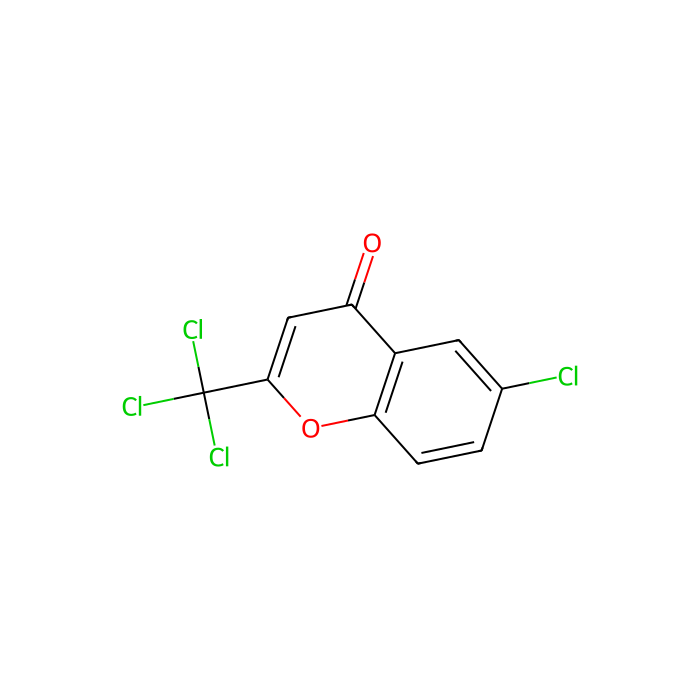
This compound belongs to the class of organic compounds known as chromones. These are compounds containing a benzopyran-4-one moiety.
External Descriptors
Not available
1. Djoumbou Feunang Y, Eisner R, Knox C, Chepelev L, Hastings J, Owen G, Fahy E, Steinbeck C, Subramanian S, Bolton E, Greiner R, and Wishart DS. ClassyFire: Automated Chemical Classification With A Comprehensive, Computable Taxonomy. Journal of Cheminformatics, 2016, 8:61.
Solvent:DMSO, Max Conc. mg/mL: 29.8, Max Conc. mM: 100; Solvent:ethanol, Max Conc. mg/mL: 5.96, Max Conc. mM: 20
Peso molecular
297.900 g/mol
XLogP3
3.800
Hydrogen Bond Donor Count
0
Hydrogen Bond Acceptor Count
2
Rotatable Bond Count
0
Exact Mass
297.894 Da
Monoisotopic Mass
295.897 Da
Topological Polar Surface Area
26.300 Ų
Heavy Atom Count
16
Formal Charge
0
Complexity
334.000
Isotope Atom Count
0
Defined Atom Stereocenter Count
0
Undefined Atom Stereocenter Count
0
Defined Bond Stereocenter Count
0
Undefined Bond Stereocenter Count
0
The total count of all stereochemical bonds
0
Covalently-Bonded Unit Count
1
Calculadoras de soluções
Molarity Calculator
Determine the necessary mass, volume, or concentration for preparing a solution.
Dilution Calculator
Determine the dilution needed to prepare a stock solution.
Reconstitution Calculator
Revisões
Avaliações dos Clientes
Application Protocols
Item-specific (Product Data)
No tested applications, protocols, or dilution recommendations are provided.
General protocols for small-molecule screening stocks (not item-specific)
Stock preparation: Dissolve in anhydrous DMSO to a convenient concentration (commonly 10–50 mM). Vortex and, if needed, brief sonication. Filter through 0.2 µm PTFE if particulate persists.
Aliquoting: Dispense single-use aliquots (10–50 µL) in inert-atmosphere vials or low-dead-volume plates. Avoid repeated freeze–thaw cycles.
Working solutions: Prepare serial DMSO dilutions, then dilute into assay buffer to the desired final concentration with matched vehicle controls.
Documentation: Record lot number, preparation date, concentration, and solvent. Confirm concentration by UV (if chromophore known) or quantitative NMR/LC when possible.
Note
For target- or assay-specific conditions (e.g., incubation time, temperature), follow your validated SOPs. No item-specific parameters are available in this listing.
Biological Roles
Item-specific (Product Data)
No biological function, target class, or pathway information is provided for ST 034307 in this listing.
General context for small-molecule library members (not item-specific)
Potential roles: Such compounds are typically used as chemical probes or candidate ligands to interrogate protein targets, modulate signaling pathways, or perturb cellular phenotypes in discovery research.
Validation steps: Establish on-target activity through orthogonal assays, counter-screens against related targets, and, where possible, genetic perturbation corroboration.
ADME profiling (research stage): For programs advancing a hit, determine solubility, permeability (e.g., PAMPA/MDCK), microsomal stability, and basic CYP/PPB behavior to understand exposure and selectivity. These are program-specific and not provided for this item.
Important
No claims of biological activity or therapeutic benefit are made for this product. Any biological role must be established experimentally by the end user using appropriate controls and documentation.
Buffer Applications
Not typically applicable
ST 034307 is listed as a discrete small molecule from a screening library, not a buffering agent. No pKa or buffering capacity data are provided.
Practical note (general)
When diluting DMSO stocks into assay buffers, maintain final vehicle at ≤0.5–1.0% v/v and confirm that the buffer composition (ionic strength, cosolvents, surfactants) prevents precipitation and nonspecific aggregation.
Green Alternatives
Applicability
This listing is a discrete small-molecule library member rather than a commodity solvent or reagent. Green replacement is generally not applicable at the compound level.
Sustainable practice around use (general guidance)
Solvent minimization: Prepare higher-concentration DMSO stocks to reduce solvent volumes; dispense via acoustic or pin tools to lower waste in HTS.
Preferred vehicles: Favor DMSO and ethanol over more hazardous aprotic solvents (DMF, NMP) where solubility allows, to improve operator safety and reduce environmental burden.
Micro-scale workflows: Use miniaturized assay formats (384/1536-well) to decrease chemical consumption and waste stream volume.
Storage efficiency: Aliquot into low-dead-volume vials/plates to minimize discard due to freeze–thaw–induced degradation.
Comparison of common vehicles (general; not item-specific)
Ethanol: Renewable feedstock possible, higher volatility; limited solubility for very lipophilic compounds.
PEG 400/propylene glycol: Useful co-solvents for in vivo formulation research (not for clinical use); higher viscosity and potential assay interference.
Note
Because the compound identity and hazards are not specified here, a greener substitute compound cannot be recommended. Optimize the surrounding workflow for greener impact.
Pharmaceutical Uses
Not applicable for this listing
This product is designated For research use only. There are no pharmacopeial designations or excipient roles provided.
General information (not item-specific)
If a compound from a screening library is later chosen for formulation research, excipient selection, dosage form, and stability studies must be developed de novo. None of these uses are specified or implied for ST 034307 in this catalog entry.
Physical Properties
Item-specific (Product Data)
Appearance: Not specified for this item; refer to CoA/Spec Sheet.
Melting point, boiling point, density, refractive index, logP/logD, pKa, and aqueous/organic solubility are structure-dependent and are not available from the provided data.
Practical guidance for screening compounds (general)
Stock solutions: In the absence of item-specific solubility data, small-molecule library members are commonly prepared at 10–50 mM in anhydrous DMSO, then diluted into assay buffers to ≤1% v/v DMSO final concentration to minimize solvent effects.
Solubility troubleshooting: If precipitation occurs upon aqueous dilution, consider cosolvent strategies (DMSO→buffer stepwise dilution), inclusion of 0.01–0.1% nonionic surfactant (e.g., Pluronic F-68 or Tween-20), or warming to ambient and brief sonication. Verify compound integrity by LC-MS after treatment.
Stability considerations: Many screening compounds are moisture/oxygen/light sensitive to varying extents. Work under dry, inert conditions when possible, and minimize freeze–thaw cycles.
Authoritative values
Any definitive physical constants for this catalog item: Not specified for this item; refer to CoA/Spec Sheet and SDS.
What Moligand-type listings typically indicate (general explanation; not a specification)
Intended use: Screening-grade small molecule intended for research discovery workflows (e.g., target validation, hit identification, probe development). Such materials are generally supplied for non-clinical, research use only.
Analytical confirmation: Library-grade compounds are commonly qualified by identity (e.g., LC-MS, NMR) and purity by chromatographic methods; however, specific test methods and thresholds for this item are Not specified for this item; refer to CoA/Spec Sheet.
Documentation: For assay-critical lots, request and retain CoA/Spec Sheet and, where available, analytical chromatograms to meet internal QC requirements.
What this means in practice
Use in screening: Appropriate for primary/secondary screening once solubility and stability in the chosen assay matrix are verified.
Trace stabilizers/format: Not specified for this item; refer to CoA/Spec Sheet. If present, stabilizers can affect UV absorbance/background signals—validate in optical assays.
Compliance
Research Use Only (RUO): Explicitly not for diagnostic or therapeutic use. No pharmacopeial grade is claimed for this item based on the provided data.
Reaction and Applications
Item-specific (Product Data)
Manufacturer applications: Not specified in the listing beyond inclusion in a small-molecule/compound library (Moligand™). No specific target or reaction use is provided.
General research applications for library compounds (not item-specific)
Assay development: Use as a reference ligand/candidate in biochemical or cell-based assays to probe target engagement, pathway modulation, or phenotypic outcomes.
SAR workflows: Prepare serial dilutions to generate concentration–response curves; confirm reproducibility across independent preparations.
Orthogonal readouts: Pair primary assay results with orthogonal biophysical methods (e.g., DSF, SPR, MST) to reduce false positives and detect aggregation.
Interference controls: Test for redox cycling, fluorescence, or detergent-sensitive aggregation to avoid PAINS-related artifacts.
Analytical recommendations
Identity/quality check before use: LC-MS purity profile, accurate mass, and, where possible, 1H NMR to confirm lot integrity post-shipment.
Stability in assay media: Incubate at assay temperature and sample over time by LC-MS to detect hydrolysis/oxidation.
Note
No synthetic or named reaction applications can be suggested without structural information. For reagent-style applications, consult the CoA/Spec Sheet or contact technical support with the CAS/CID for structure disclosure under CDA if necessary.
Reaction Conditions
Not applicable without structural information
Typical reaction conditions, catalysts, and solvent systems cannot be suggested without knowing the functional groups present in ST 034307.
General note (not item-specific)
If you intend to use this compound as a substrate or ligand in synthesis, first obtain the full structure and analytical profile. Then consult literature precedents for analogous scaffolds to define temperatures, catalysts, and expected selectivity. No item-specific reaction guidance is available in the present listing.
Safety and Handling
Item-specific (Product Data)
GHS classification, signal word, pictograms, and H-statements: Not specified for this item; refer to the SDS supplied with the shipment.
Storage conditions: Store at -20°C (Product Data).
Shipping: Ice chest + ice pads (Product Data).
General laboratory safety (not item-specific; defer to SDS)
PPE: Laboratory coat, safety glasses, and appropriate chemical-resistant gloves (e.g., nitrile). Use in a fume hood to avoid inhalation of dusts/vapors/aerosols.
Handling: Avoid contact with skin/eyes and prolonged breathing of vapors or dust. Prevent contamination of stocks—use dry, clean tools and inert gas backfill if available.
Incompatibilities: Unknown for this specific item. As a conservative practice for organic small molecules, avoid strong oxidizers and strong acids/bases until compatibility is confirmed.
First aid (overview): In case of skin/eye contact, rinse with plenty of water for ≥15 min; remove contaminated clothing. If inhaled, move to fresh air. If ingested, rinse mouth; do not induce vomiting. Seek medical attention and provide the SDS.
Waste: Collect in organic waste compatible with your site’s chemical hygiene plan. Label clearly and dispose per institutional and local regulations.
Important
Because hazard classifications are not provided here, treat as potentially harmful. Consult the product-specific SDS before first use for definitive hazard and response information.
Solvent Selection
Item-specific (Product Data)
No solvent recommendations or solubility data are provided for this item; refer to CoA/Spec Sheet.
General guidance for small-molecule library members (not item-specific)
Primary stock solvent: Anhydrous DMSO is the default for diverse drug-like molecules due to broad solvating power and biological compatibility at ≤1% v/v in assays.
Alternative solvents when DMSO is unsuitable: DMF or NMP (strong polar aprotics); ethanol or isopropanol (more volatile, biocompatible co-solvents). Assess assay tolerance to each vehicle.
Aqueous dilution strategy: Perform serial pre-dilution in DMSO, then stepwise dilution into buffer with vigorous mixing to avoid precipitation. Consider 0.01–0.05% nonionic surfactant for hydrophobic compounds.
Vehicle controls: Always match the highest DMSO (or alternative solvent) percentage in control wells/samples.
Comparison (general)
DMSO vs ethanol: DMSO solubilizes a wider polarity range; ethanol is more volatile/biocompatible but often provides lower solubility for highly lipophilic compounds.
DMF/NMP: Strong solvency but with higher toxicity and potential assay interference—use only when required and at minimal final concentrations.
Verification
Confirm actual solubility and absence of aggregation by nephelometry, UV-Vis baseline check, or LC analysis after dilution. Item-specific solubility: Not specified for this item; refer to CoA/Spec Sheet.
Storage and Reconstitution
Item-specific (Product Data)
Storage: Store at -20°C.
Shipment: Ice chest + ice pads.
Appearance: Not specified for this item; refer to CoA/Spec Sheet.
General best practices for library compounds (not item-specific)
Light/moisture protection: Store in amber, tightly sealed containers under dry inert gas if possible. Include desiccant in secondary containment.
Aliquoting: Prepare single-use aliquots to avoid repeated freeze–thaw. For plate formats, seal with high-barrier films and purge with dry nitrogen/argon.
Thawing: Allow to reach room temperature before opening to prevent moisture condensation. Mix thoroughly after thaw; inspect for precipitate.
Reconstitution: If supplied as a solid, dissolve in anhydrous DMSO to a convenient concentration (e.g., 10–50 mM). If supplied in solution, verify concentration and solvent on the label/CoA.
Stability monitoring: Periodically check by LC-MS for degradation, especially after >6 months storage or multiple thaw events.
Definitive parameters
Any stabilizers, water content, or retest date: Not specified for this item; refer to CoA/Spec Sheet.
Research Use Note: For research use only.
Structure and Identity
Item-specific (Product Data)
Product name: ST 034307 (SKU: S288789)
CAS: 133406-29-8
PubChem CID: 867466
InChIKey: 247326 (as provided)
SMILES: Not specified for this item; refer to CoA/Spec Sheet.
Molecular formula: Not specified for this item; refer to CoA/Spec Sheet.
Molecular weight: Not specified for this item; refer to CoA/Spec Sheet.
Category: Small molecules and compound libraries (Moligand series)
General structural notes
Structural features (rings, heteroatoms, stereochemistry) cannot be described without a structure. Please consult the CoA/Spec Sheet for the definitive 2D structure, functional groups, and any chiral information.
How to reference/encode
If you require canonical identifiers (InChI, SMILES, exact mass), request the latest specification sheet/CoA. These identifiers are essential for registration in ELNs and compound management systems.
Synthetic Utility
Limited applicability
Without a disclosed structure or functional group information, ST 034307 cannot be recommended as a general synthetic reagent or building block.
General guidance (not item-specific)
If the compound contains reactive handles (e.g., halogens, boronates, acids/amines), derivatization for SAR may be feasible. Such assessments require structural disclosure; consult the CoA/Spec Sheet or contact support referencing CAS 133406-29-8 / CID 867466 to obtain or confirm structural details under appropriate confidentiality.
Target Specificity
Item-specific (Product Data)
No target, selectivity profile, or mode-of-action information is provided for ST 034307.
Guidance for end users (general)
Establish specificity through: concentration–response evaluation vs. a target panel, orthogonal binding/activity assays, and counterscreens against common off-targets relevant to your biology. Consider early profiling for assay interference (fluorescence, redox, aggregation) to rule out nonspecific effects.
Perguntas frequentes
What is the purity of this product, and how is it determined?
This product is supplied at ≥98% purity, determined by HPLC. Lot-specific values are stated on the Certificate of Analysis.
What is Moligand??
Moligand? is one of Aladdin Scientific's premium product lines, formulated for high-purity applications across multiple workflows. Compared to standard grades in the same workflow, Moligand? products typically offer tighter specifications, more rigorous QC, and stronger lot-to-lot consistency.
How should this product be stored?
Store at ?20 °C. Freezer storage is required to maintain the specified shelf life.
How is this product shipped?
This product ships in an insulated container with ice pads. Unpack on arrival and transfer it to the storage condition stated above.
What are the CAS number, molecular formula and molecular weight?
The CAS Number is 133406-29-8, the molecular formula is C10H4Cl4O2, and the molecular weight is 297.95 g/mol. InChIKey NTDHYMSVCBGQJF-UHFFFAOYSA-N.
What documentation is provided?
Available product documentation, including Certificates of Analysis (COA), Safety Data Sheets (SDS), and specification sheets, is shown in the product document area. Document availability and access follow the current site policy.
Precisa de ajuda para escolher o grau?
O nosso guia de seleção de graus abrange pureza, estado do estabilizador e adequação à aplicação para todas as variantes do nosso catálogo.
Usamos cookies para garantir o funcionamento adequado do site e, quando permitido, para melhorar a sua experiência. Você pode gerenciar suas preferências a qualquer momento nas Configurações. Saiba mais em nossa Política de Cookies.
Deseja que lhe enviemos uma mensagem quando tivermos descontos disponíveis?
Lembrar-me mais tarde
Obrigado! Por favor, verifique a sua caixa de entrada de e-mail para confirmar.
Products are supplied to verified businesses, institutions, and qualified professionals for research and development use only. Not for use in humans, animals, diagnosis, or therapy.

 I2222181