Synta66 - Moligand™, ≥99%, used for Synta66 has been used:
as a Ca2+ release-activated calcium (CRAC) channel inhibitor to study its effects on ORAI isoforms
as an ORAI1 blocker to study its effects on the entry of Ca2+ in chronic lymphocytic leukemia (CL
Synta66 - Moligand™, ≥99%, used for Synta66 has been used:
as a Ca2+ release-activated calcium (CRAC) channel inhibitor to study its effects on ORAI isoforms
as an ORAI1 blocker to study its effects on the entry of Ca2+ in chronic lymphocytic leukemia (CL
GRAU & PUREZAMoligand™?Moligand™ — Aladdin's line of ligands and bioactive small molecules. Use for receptor, pathway, and binding studies needing defined small-molecule tools.≥99%
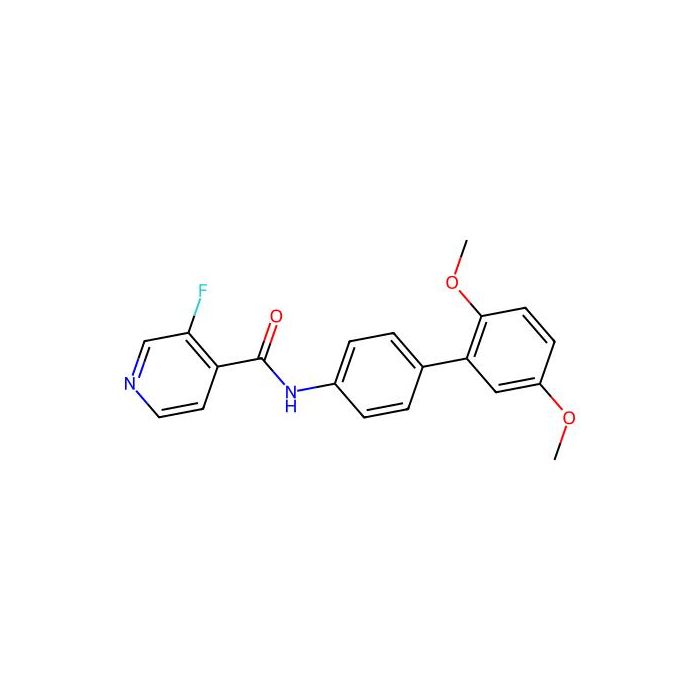
Synta66 is an inhibitor of store-operated calcium entry channel Orai , which forms the pore of the CRAC channel, and used for the research of neurological disease .
In Vitro
Synta66 is an inhibitor of Orai, which forms the pore of the CRAC channel. Synta66 (10 μM) attenuates peak SOCE in Müller glia. Synta66 (10 μM) prevents orai channels mediating the residual SOC current in Trpc1 −/− Müller cells. Synta66 (10 μM) nearly completely blocks the Ca 2+ entry signal evoked by CaCl 2 addition, whereas it moderately reduces Ca 2+ mobilization from stores with 10% to 30% in platelet. Synta66 (10 μM) suppresses human platelet activation in plasma and whole-blood thrombus formation. Synta66 (10 μM) also inhibits murine platelet responses and thrombus formation. Synta66 (10 μM) inhibits LAD2 human mast cell line. Synta66 (10 μM) significantly inhibits FcεRI stimulated histamine and TNFα secretion, and has differential effects on FcεRI stimulated prostaglandin D2 and cytokine release in human lung mast cells (HLMCs)
A selective SOCE inhibitor that blocks CRAC current (ICRAC) without significant off-target potency or affinity.
Synta66 (S66) is a CRAC (Ca2+ release-activated Ca2+) channel inhibitor that blocks SOCE (store-operated Ca2+ entry) upon Ca2+ depletion from intracellular stores by thapsigargin in human vascular smooth muscle cells (VSMCs) with high potency (IC50 = 26 nM & 43 nM based on maximum Ca2+ level & rate of increase, respectly). Synta66 exhibits no affinity toward a range of receptors and ion channels (e.g. L-type Ca2+ channel) and does not affect TRPC1/5-mediated SOCE or store-operated non-selective cationic current. Leukocytes are reported to be less sensitive to CRAC inhibition by Synta66 (IC50 = 1.76 μM/HL-60, 1 ?M/Jurkat, 1.4 μM/rat RBL).
Aplicação
Synta66 has been used:
as a Ca2+ release-activated calcium (CRAC) channel inhibitor to study its effects on ORAI isoforms
as an ORAI1 blocker to study its effects on the entry of Ca2+ in chronic lymphocytic leukemia (CLL) B cells
as a CRAC blocker to stud
Condições de armazenamento de armazenamento
Store at -20°C,Desiccated
Enviado em
Ice chest + Ice pads
Este produto requer transporte de cadeia fria. Serviços terrestres e outros serviços econômicos não estão disponíveis.
This compound belongs to the class of organic compounds known as aromatic anilides. These are aromatic compounds containing an anilide group in which the carboxamide group is substituted with an aromatic group. They have the general structure RNC(=O)R', where R= benzene, and R = aryl group.
External Descriptors
Not available
1. Djoumbou Feunang Y, Eisner R, Knox C, Chepelev L, Hastings J, Owen G, Fahy E, Steinbeck C, Subramanian S, Bolton E, Greiner R, and Wishart DS. ClassyFire: Automated Chemical Classification With A Comprehensive, Computable Taxonomy. Journal of Cheminformatics, 2016, 8:61.
Usamos cookies para garantir o funcionamento adequado do site e, quando permitido, para melhorar a sua experiência. Você pode gerenciar suas preferências a qualquer momento nas Configurações. Saiba mais em nossa Política de Cookies.
Deseja que lhe enviemos uma mensagem quando tivermos descontos disponíveis?
Lembrar-me mais tarde
Obrigado! Por favor, verifique a sua caixa de entrada de e-mail para confirmar.
Products are supplied to verified businesses, institutions, and qualified professionals for research and development use only. Not for use in humans, animals, diagnosis, or therapy.

 K2611995