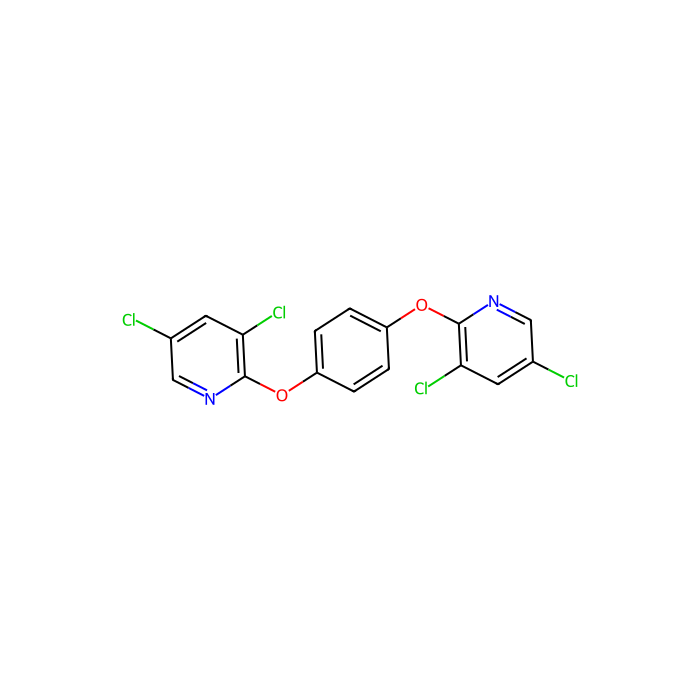
TCPOBOP - Moligand™, 10mM in DMSO , Agonist of Constitutive androstane receptor, CAS No.76150-91-9, Agonist of Constitutive androstane receptor

CAS: 76150-91-9 Cat. No.: T425870 Fórmula: C16H8Cl4N2O2 Peso molecular: 402.06 PubChem CID: 5382
Disponível para encomenda
GRAU & PUREZA Moligand™ ? Moligand™ — Aladdin's line of ligands and bioactive small molecules. Use for receptor, pathway, and binding studies needing defined small-molecule tools. 10mM in DMSO
Synonyms
Pyridine, 2,2'-(1,4-phenylenebis(oxy))bis(3,5-dichloro-|1,4-bis((3,5-dichloropyridin-2-yl)oxy)benzene|3,5-DICHLORO-2-{4-[(3,5-DICHLOROPYRIDIN-2-YL)OXY]PHENOXY}PYRIDINE|BIDD:PXR0116|Lopac-T-1443|1,4-Bis(3,5-Dichloro-2-pyridinyloxy)benzene|2,2'-(1,4-Phenylenebis(oxy))bis(3,5-dichloropyridine)|2,2'-[1,4-phenylenebis(oxy)]bis(3,5-dichloropyridine)|1,4-Bis(2-(3,5-dichloropyridyloxy))benzene|1,4-BDPOB|1,4-Bis-[2-(3,5-dichloropyridyloxy)]benzene|1,4-Bis[2-(3,5-dichloropyridyloxy)]benzene|SDCCGSBI-0051141.P002|2-[4-[3,5-bis(chloranyl)pyridin-2-yl]oxyphenoxy]-3,5-bis(chloranyl)pyridine|3,5-dichloro-2-[4-[(3,5-dichloro-2-pyridyl)oxy]phenoxy]pyridine|tcpobop|1,4-Bis(3,5-dichloro-2-pyridyloxy)benzene|1,4-bis(3,5-dichloropyridin-2-yloxy)benzene|1,4-bis[(3,5-dichloropyridin-2-yl)oxy]benzene|PYRIDINE, 2,2'-[1,4-PHENYLENEBIS(OXY)]BIS[3,5-DICHLORO-|3,5-Dichloro-2-[4-[(3,5-dichloropyridin-2-yl)oxy]phenoxy]pyridine|2,2'-[benzene-1,4-diylbis(oxy)]bis(3,5-dichloropyridine)|Pyridine,2,2'-[1,4-phenylenebis(oxy)]bis[3,5-dichloro-|2,2'-[1,4-Phenylenebis(oxy)]bis[3,5-dichloropyridine]
Storage
Protected from light,Store at -80°C
Shipped In
Dry ice packs + Cold packs
★
Tamanho
Alemanha (EU)
USA*
Preço
Qtd
1ml
T425870-1ml
Sob encomenda · 8–12 semanas

92,76€

109,25€
Gravar 16,49 € (15.09%)
Enter a quantity for the sizes you want to add.

Visão geral

Store at -20°C. It is important to note that this product is reported to be light sensitive. Store In the Dark. Store under desiccating conditions.

Especificações

Sinónimos
Pyridine, 2,2'-(1,4-phenylenebis(oxy))bis(3,5-dichloro- | 1,4-bis((3,5-dichloropyridin-2-yl)oxy)benzene | 3,5-DICHLORO-2-{4-[(3,5-DICHLOROPYRIDIN-2-YL)OXY]PHENOXY}PYRIDINE | BIDD:PXR0116 | Lopac-T-1443 | 1,4-Bis(3,5-Dichloro-2-pyridinyloxy)benzene | 2,2'-(1,4-Phenylenebis(oxy))bis(3,5-dichloropyridine) | 2,2'-[1,4-phenylenebis(oxy)]bis(3, Show more
Especificações e pureza
Moligand™, 10mM in DMSO
Mecanismos bioquímicos e fisiológicos
Potent murine constitutive androstane receptor (mCAR) agonist. Pharmacologically active in vivo .
Condições de armazenamento de armazenamento
Protected from light,Store at -80°C
Enviado em
Dry ice packs + Cold packs
Este produto requer transporte de cadeia fria. Serviços terrestres e outros serviços econômicos não estão disponíveis.
Grau
Moligand™
Tipo de ação
AGONIST
Mecanismo de ação
Agonist of Constitutive androstane receptor
Nomes e identificadores
SMILES
C1=CC(=CC=C1OC2=C(C=C(C=N2)Cl)Cl)OC3=C(C=C(C=N3)Cl)Cl
IUPAC Name
3,5-dichloro-2-[4-(3,5-dichloropyridin-2-yl)oxyphenoxy]pyridine
InChIKey
BAFKRPOFIYPKBQ-UHFFFAOYSA-N
InChI
1S/C16H8Cl4N2O2/c17-9-5-13(19)15(21-7-9)23-11-1-2-12(4-3-11)24-16-14(20)6-10(18)8-22-16/h1-8H
SMILES isoméricas
C1=CC(=CC=C1OC2=C(C=C(C=N2)Cl)Cl)OC3=C(C=C(C=N3)Cl)Cl
PubChem CID
5382
Peso molecular
402.06

Dados avançados

Taxonomic Classification

Taxonomy Tree

KingdomOrganic compounds
SuperclassOrganic oxygen compounds
ClasseOrganooxygen compounds
SubclassEthers
Intermediate Tree Nodes Not available
Direct ParentDiarylethers
Alternative Parents Polyhalopyridines  Phenoxy compounds  Phenol ethers  Aryl chlorides  Heteroaromatic compounds  Azacyclic compounds  Organopnictogen compounds  Organonitrogen compounds  Organochlorides  Hydrocarbon derivatives  
Molecular FrameworkAromatic heteromonocyclic compounds
Substituents Diaryl ether - Phenoxy compound - Phenol ether - Polyhalopyridine - Aryl chloride - Aryl halide - Monocyclic benzene moiety - Pyridine - Benzenoid - Heteroaromatic compound - Organoheterocyclic compound - Azacycle - Organopnictogen compound - Organonitrogen compound - Organochloride - Organohalogen compound - Organic nitrogen compound - Hydrocarbon derivative - Aromatic heteromonocyclic compound
DescriçãoThis compound belongs to the class of organic compounds known as diarylethers. These are organic compounds containing the dialkyl ether functional group, with the formula ROR', where R and R' are aryl groups.
External Descriptors Not available
Estrutura 3D
Modelo de Estrutura Química Interativa


Alvos associados (humanos)
NR1I3 Tchem Nuclear receptor subfamily 1 group I member 3 (1 Activities)
Activity TypeActivity Value -log(M)Mechanism of ActionActivity ReferencePublications (PubMed IDs)
ESR1 Tclin Estrogen receptor alpha (17718 Activities)
Activity TypeRelationActivity valueUnitsAction TypeJournalPubMed IddoiAssay Aladdin ID
CHRM1 Tclin Muscarinic acetylcholine receptor M1 (12690 Activities)
Activity TypeRelationActivity valueUnitsAction TypeJournalPubMed IddoiAssay Aladdin ID
TSHR Tclin Thyroid stimulating hormone receptor (29986 Activities)
Activity TypeRelationActivity valueUnitsAction TypeJournalPubMed IddoiAssay Aladdin ID
PPARG Tclin Peroxisome proliferator-activated receptor gamma (15191 Activities)
Activity TypeRelationActivity valueUnitsAction TypeJournalPubMed IddoiAssay Aladdin ID
THRB Tclin Thyroid hormone receptor beta-1 (7926 Activities)
Activity TypeRelationActivity valueUnitsAction TypeJournalPubMed IddoiAssay Aladdin ID
ARSA Tbio Cerebroside-sulfatase (655 Activities)
Activity TypeRelationActivity valueUnitsAction TypeJournalPubMed IddoiAssay Aladdin ID
CYP2D6 Tclin Cytochrome P450 2D6 (33882 Activities)
Activity TypeRelationActivity valueUnitsAction TypeJournalPubMed IddoiAssay Aladdin ID
CYP1A2 Tchem Cytochrome P450 1A2 (26471 Activities)
Activity TypeRelationActivity valueUnitsAction TypeJournalPubMed IddoiAssay Aladdin ID
PIN1 Tchem Peptidyl-prolyl cis-trans isomerase NIMA-interacting 1 (36611 Activities)
Activity TypeRelationActivity valueUnitsAction TypeJournalPubMed IddoiAssay Aladdin ID
CYP2C9 Tchem Cytochrome P450 2C9 (32119 Activities)
Activity TypeRelationActivity valueUnitsAction TypeJournalPubMed IddoiAssay Aladdin ID
CYP2C19 Tchem Cytochrome P450 2C19 (29246 Activities)
Activity TypeRelationActivity valueUnitsAction TypeJournalPubMed IddoiAssay Aladdin ID
CYP3A4 Tclin Cytochrome P450 3A4 (53859 Activities)
Activity TypeRelationActivity valueUnitsAction TypeJournalPubMed IddoiAssay Aladdin ID
HEK293 (82097 Activities)
Activity TypeRelationActivity valueUnitsAction TypeJournalPubMed IddoiAssay Aladdin ID
NR1I3 Tchem Nuclear receptor subfamily 1 group I member 3 (655 Activities)
Activity TypeRelationActivity valueUnitsAction TypeJournalPubMed IddoiAssay Aladdin ID
APEX1 Tchem DNA-(apurinic or apyrimidinic site) lyase (38016 Activities)
Activity TypeRelationActivity valueUnitsAction TypeJournalPubMed IddoiAssay Aladdin ID
EHMT2 Tchem Histone-lysine N-methyltransferase, H3 lysine-9 specific 3 (93046 Activities)
Activity TypeRelationActivity valueUnitsAction TypeJournalPubMed IddoiAssay Aladdin ID
SMN1 Tchem Survival motor neuron protein (34246 Activities)
Activity TypeRelationActivity valueUnitsAction TypeJournalPubMed IddoiAssay Aladdin ID
LMNA Tbio Prelamin-A/C (36751 Activities)
Activity TypeRelationActivity valueUnitsAction TypeJournalPubMed IddoiAssay Aladdin ID
GMNN Tbio Geminin (128009 Activities)
Activity TypeRelationActivity valueUnitsAction TypeJournalPubMed IddoiAssay Aladdin ID
CBX1 Tbio Chromobox protein homolog 1 (92434 Activities)
Activity TypeRelationActivity valueUnitsAction TypeJournalPubMed IddoiAssay Aladdin ID
MPHOSPH8 Tbio M-phase phosphoprotein 8 (656 Activities)
Activity TypeRelationActivity valueUnitsAction TypeJournalPubMed IddoiAssay Aladdin ID
Alvos associados (não humanos)
Cruzipain (33337 Activities)
Activity TypeRelationActivity valueUnitsAction TypeJournalPubMed IddoiAssay Aladdin ID
Nr1i3 Constitutive androstane receptor (427 Activities)
Activity TypeRelationActivity valueUnitsAction TypeJournalPubMed IddoiAssay Aladdin ID
Plasmodium falciparum (966862 Activities)
Activity TypeRelationActivity valueUnitsAction TypeJournalPubMed IddoiAssay Aladdin ID
Txnrd1 Thioredoxin reductase 1, cytoplasmic (45279 Activities)
Activity TypeRelationActivity valueUnitsAction TypeJournalPubMed IddoiAssay Aladdin ID
Nfe2l2 Nuclear factor erythroid 2-related factor 2 (214 Activities)
Activity TypeRelationActivity valueUnitsAction TypeJournalPubMed IddoiAssay Aladdin ID
Impa1 Inositol monophosphatase 1 (16203 Activities)
Activity TypeRelationActivity valueUnitsAction TypeJournalPubMed IddoiAssay Aladdin ID
FTL Ferritin light chain (43324 Activities)
Activity TypeRelationActivity valueUnitsAction TypeJournalPubMed IddoiAssay Aladdin ID
Mecanismos de ação
Certificados(CoA,COO,BSE/TSE e Mapa de Análise)
C of A & Other Certificates(BSE/TSE, COO):
Analytical Chart:
Propriedades químicas e físicas
Sensibilidadelight sensitive
Peso molecular402.1
XLogP36.000
Hydrogen Bond Donor Count0
Hydrogen Bond Acceptor Count4
Rotatable Bond Count4
Exact Mass401.931 Da
Monoisotopic Mass399.934 Da
Topological Polar Surface Area44.200 Ų
Heavy Atom Count24
Formal Charge0
Complexity362.000
Isotope Atom Count0
Defined Atom Stereocenter Count0
Undefined Atom Stereocenter Count0
Defined Bond Stereocenter Count0
Undefined Bond Stereocenter Count0
The total count of all stereochemical bonds0
Covalently-Bonded Unit Count1
Segurança e perigos (GHS)
Declarações de precaução

P264:Wash hands [and …] thoroughly after handling.

Calculadoras de soluções
Revisões

Avaliações dos Clientes

Application Protocols

Only application protocols explicitly provided for this SKU can be listed here.

  • Tested/validated applications, recommended dilutions, positive controls: Not specified for this item; refer to CoA/Spec Sheet or product page.

General note: For small-molecule ligands, users commonly prepare DMSO stocks (e.g., 10–50 mM as solubility allows) and perform serial dilutions into assay media, maintaining constant vehicle across conditions. Validate concentration by UV or LC methods if required for quantitative studies.

Biological Roles

Context from literature (not product claims):

  • TCPOBOP is widely cited as a potent, selective tool compound for interrogating nuclear receptor signaling in rodent models, particularly in pathways governing xenobiotic metabolism, lipid homeostasis, and energy balance. It has been used to probe transcriptional programs involving phase I/II metabolic enzymes and transporters.
  • Species considerations: Literature emphasizes species-selective pharmacology for certain nuclear receptors. As such, the response profile observed in murine systems may not translate to human cells, and alternative ligands are often used for human receptors. This property makes TCPOBOP useful for dissecting species-dependent regulation in comparative studies.
  • Experimental modalities: Employed in reporter gene assays, gene expression profiling (qPCR, RNA-seq), chromatin studies (ChIP-qPCR/ChIP-seq), and proteomic readouts of metabolic pathway modulation. Time-course experiments can differentiate primary receptor-mediated transcriptional effects from downstream secondary responses.
  • Dosing/vehicle practices (general): Prepared as DMSO stocks and diluted into culture media or in vivo formulations with appropriate vehicles. Researchers monitor final vehicle percentage and include matched controls.

No clinical or diagnostic use is implied. All applications are for research use only. Always confirm target engagement with orthogonal readouts (e.g., marker gene panels) and verify species relevance for your biological system.

Buffer Applications

This item is a hydrophobic research ligand rather than a buffering reagent. It does not serve as a pH buffer or electrolyte component in the conventional sense.

Practical notes for buffer compatibility (general literature guidance):

  • Stock solutions: Prepare in anhydrous DMSO, then dilute into biologically relevant buffers (e.g., PBS, HBSS, or culture media) while maintaining a low final DMSO percentage.
  • Surfactants/serum: The presence of serum proteins or mild surfactants can aid dispersion and reduce precipitation for lipophilic ligands; validate that additives do not confound your readouts.
  • pH range: No intrinsic buffering capacity; use standard biological buffers appropriate to your assay.
Green Alternatives

While “green alternatives” are traditionally discussed for bulk solvents or reagents, a similar mindset can be applied to bioactive tool compounds by considering solvent choices and handling practices.

  • Solvent choice: Prefer DMSO for concentrated stocks due to broad solubilizing power and low required assay percentages. When feasible, avoid higher-toxicity vehicles (e.g., NMP) in live-cell experiments.
  • Minimal solvent usage: Prepare high-concentration stocks to reduce solvent volume in assays, keeping final DMSO ≤0.1–0.5% where biology allows.
  • Waste minimization: Aliquot small volumes to reduce discard due to freeze–thaw degradation; this also improves data reproducibility.
  • Alternative tool compounds (literature perspective; not product-specific recommendations): Depending on the biological question, researchers sometimes compare multiple ligands with differing selectivity profiles to reduce off-target risks and dose requirements. Selecting compounds with better aqueous compatibility can reduce reliance on organic cosolvents. We recommend reviewing contemporary literature for ligands best matched to your species/model and safety constraints.

Trade-offs: Highly lipophilic ligands often provide strong target engagement but require organic vehicles and careful handling. Choosing ligands with improved solubility may lower environmental and exposure burdens but might alter target selectivity or potency.

Pharmaceutical Uses

This product is supplied strictly for research use only and is not intended for human or veterinary use.

Formulation and process-relevant notes (general, literature-based):

  • Role: Employed as a reference/tool compound in preclinical research to modulate nuclear receptor signaling in cell-based or animal studies. Not used as an excipient.
  • Vehicles: For in vivo research formulations, lipophilic ligands of this class are often delivered in vehicles containing DMSO, PEG derivatives, polysorbates, or lipid emulsions to enhance dispersion. Selection of vehicle components should be justified by study design and approved by institutional committees.
  • Analytical support: Quantification in biological matrices often uses LC–MS/MS with stable isotope-labeled internal standards when available; method development should address strong hydrophobicity and potential nonspecific binding.

No pharmacopeial monograph or clinical formulation role is implied by this listing. Do not use in diagnostics or as a drug substance.

Physical Properties

Item-specific physico-chemical specifications were not provided in this listing.

  • Appearance: Not specified for this item; refer to CoA/Spec Sheet.
  • Melting point: Not specified for this item; refer to CoA/Spec Sheet.
  • Boiling point: Not applicable; compound is a high-melting, nonvolatile polyaryl solid (general expectation for this class; verify item-specific data on CoA).
  • Density: Not specified for this item; refer to CoA/Spec Sheet.
  • Solubility: Not specified for this item; refer to CoA/Spec Sheet.

Literature/general guidance (not product specifications):

  • Solubility profile: Typically formulated as concentrated stock solutions in anhydrous DMSO; water solubility is very low due to high lipophilicity. Limited solubility in alcohols; miscible upon cosolvent dilution into assay buffers with surfactants or serum proteins.
  • LogP: Expected to be high (strongly lipophilic) for a polyaryl, multi-chloro scaffold (qualitative, literature-based rationale).
  • pKa: The molecule is neutral; no strongly ionizable centers expected under physiological pH (literature rationale for pyridyl ethers). If the scaffold contains pyridyl nitrogens, very weak basicity may be observed but typically does not yield water solubility at neutral pH.
  • UV/Vis: Aryl chromophores often absorb in the near-UV; exact cutoff and ε are compound- and solvent-dependent (literature).
Quality and Grades
  • Grade/Purity listed: Moligand™.
  • What Moligand™ typically implies (general description): A research-ligand grade intended for biochemical and cellular screening, focusing on identity and purity suitable for assay development and SAR studies. Lots are typically supported by identity methods (e.g., NMR/HRMS/HPLC) and packaged to protect from light and moisture. Exact test items and acceptance criteria are lot-specific.
  • Item-specific specifications (water, residual solvents, metal content, stabilizers, UV cutoff): Not specified for this item; refer to CoA/Spec Sheet.
  • Practical implications for users:
    • Expect high chemical purity tailored for small-molecule screening. Confirm lot purity and counter-ion/solvate content on the CoA before quantitative dosing.
    • For bioassay reproducibility, use consistent solvent grade (e.g., anhydrous DMSO) and record final vehicle percentage in assays.
    • If you require orthogonal QC (e.g., enantiopurity, trace halogens), contact us for lot documentation or custom testing.
  • Packaging/storage controls: Light-protective, low-temperature shipping and -80°C storage minimize photolysis and slow any potential degradation, supporting long-term reproducibility.
Reaction and Applications

This product is supplied as a bioactive small-molecule ligand rather than a general synthetic reagent or solvent. Consequently, its primary application domain is biochemical and cellular research, not stoichiometric or catalytic organic synthesis.

Research applications (literature context):

  • Used as a tool compound in nuclear receptor biology to modulate signaling pathways in preclinical models. Employed in transcriptional reporter assays, qPCR arrays, and omics workflows to benchmark receptor engagement.
  • Utilized to characterize species-selective nuclear receptor pharmacology by comparing responses across cell lines or primary cultures (literature).

Practical tips for research use (general):

  • Prepare concentrated DMSO stocks (e.g., 10–50 mM, as solubility allows) under low light. Verify clarity; warm gently and sonicate if needed. Filter through PTFE if particulates persist.
  • Keep final vehicle constant across dose ranges; include a vehicle-only control.
  • For plate-based assays, pre-dilute into media to minimize precipitation and edge effects.

Note: If you intend to derivatize or conjugate this scaffold, consult primary literature for reactivity of aryl–O–aryl ethers and halopyridyl motifs; however, such transformations are outside typical use for this item.

Reaction Conditions

Not typically applicable. TCPOBOP is supplied as a finished bioactive ligand rather than a reagent for running synthetic reactions.

For researchers interested in making analogs (general literature):

  • Aryl–O–aryl ether formation can proceed via SNAr between an electron-deficient heteroaryl halide (e.g., chloro-pyridine derivatives) and a para-dihydroxybenzene core, or via copper/ligand-mediated or palladium-catalyzed C–O coupling (Ullmann-type or Buchwald–Hartwig-type etherification).
  • Typical conditions (literature, non-specific): polar aprotic solvents (DMSO, DMF, dioxane), bases such as K3PO4/Cs2CO3, and temperatures 80–140°C under inert atmosphere. Exact conditions are substrate-dependent and should be optimized.

These notes are provided only for conceptual context; they do not describe how to use this catalog item.

Safety and Handling

Authoritative safety guidance must be taken from the product SDS.

  • GHS classification, signal word, H-statements, pictograms: Not specified for this item; refer to SDS.
  • General hazards (literature/good practice): Lipophilic small molecules handled in DMSO may traverse skin more readily; avoid skin contact and inhalation of dust. Treat as harmful if swallowed, inhaled, or absorbed through skin.
  • PPE: Wear lab coat, nitrile gloves, and safety glasses. Use a certified chemical fume hood for weighing, dissolving, and aliquoting.
  • Incompatibilities: Avoid strong oxidizers and strong acids/bases that can degrade aryl–O–aryl ether linkages. Avoid prolonged exposure to light as directed by storage conditions.
  • Handling tips:
    • Prepare and store small, single-use DMSO aliquots to minimize freeze–thaw and light exposure.
    • Filter stock solutions through PTFE if particulate is observed (avoid cellulose if strong organic solutions are used).
  • First aid (overview; defer to SDS): Move to fresh air if inhaled; rinse skin with soap and water upon contact; flush eyes with water for 15 minutes if exposed; seek medical attention and show SDS.
  • Waste: Collect organic solutions and contaminated materials in halogenated organic waste per institutional and local regulations.
Solvent Selection

Applicability: TCPOBOP is a hydrophobic research ligand rather than a reaction solvent. This section discusses dissolving/handling solvents for assays.

General guidance (literature/experience; not product specs):

  • Primary stock solvent: Anhydrous DMSO is the standard due to strong solvating power for lipophilic polyaryl compounds and compatibility with biological assays at low vehicle percentages (≤0.1–0.5%).
  • Alternative organic solvents: DMF and NMP can dissolve similar scaffolds, but they are less favored in biological contexts. Ethanol may work at modest concentrations; cosolvent strategies with PEG400 or surfactant-containing media may assist.
  • Aqueous systems: Water solubility is expected to be extremely low. For cell or enzyme assays, dilute the DMSO stock into buffered media while keeping final DMSO low and constant across treatments.
  • Dielectric/polarity context (literature): Lipophilic, halogenated aryl ligands generally prefer high-dipole, aprotic solvents (DMSO, DMF). Poor performance is expected in nonpolar hydrocarbons for concentrated stocks.

Small comparison (literature):

  • DMSO: best solubilizer; biologically compatible at low %; may enhance skin permeation—handle carefully.
  • DMF/NMP: good solubility; less preferred for live-cell work.
  • Ethanol: moderate solubility; higher assay vehicle % may be needed, which can impact cells.
Storage and Reconstitution

Item-specific directions:

  • Storage conditions: Protected from light, Store at -80°C (as provided).
  • Shipping conditions: Shipped on dry ice packs + cold packs (as provided).

Reconstitution (general guidance for hydrophobic ligands; not a specification):

  • Solvent: Reconstitute in anhydrous DMSO to prepare a concentrated stock solution. If needed, warm gently (ambient to 37°C) and sonicate briefly to aid dissolution. Do not overheat.
  • Aliquoting: Dispense into amber, low-bind microtubes in single-use aliquots to avoid repeated freeze–thaw cycles and light exposure.
  • Working solutions: Dilute DMSO stocks into assay buffer or culture media immediately before use, keeping the final DMSO fraction low and consistent across treatments.

Stability handling tips:

  • Avoid repeated freeze–thaw; thaw only what is needed. Keep protected from light during handling and storage.
  • For long-term projects, verify integrity periodically by HPLC or LC–MS.

For definitive stability limits, shelf-life, and purity data, consult the lot-specific CoA and SDS.

Structure and Identity

Brief overview: TCPOBOP is a well-known small-molecule research ligand widely used as a tool compound in nuclear receptor biology (literature). Item-specific identifiers provided by this listing are limited.

  • Product name: TCPOBOP
  • CAS: 76150-91-9 (literature-consistent)
  • PubChem CID: 5382 (as provided; verify before citation)
  • InChIKey: 19538 (provided; atypical format—verify against CoA/SDS)
  • SMILES: Not specified for this item; refer to CoA/Spec Sheet.
  • Molecular formula: Not specified for this item; refer to CoA/Spec Sheet.
  • Molecular weight: Not specified for this item; refer to CoA/Spec Sheet.

Structural features (literature description, for context only):

  • TCPOBOP is reported to be a highly chlorinated, polyaryl ether that bears pyridyl-oxy substituents on a para-disubstituted phenylene core. The scaffold is rigid, lipophilic, and electron-poor due to multiple chloro substituents and heteroaryl groups.
  • Functional groups typically discussed: aryl–O–aryl ether linkages, chloro-substituted pyridyl rings, and a central para-phenylene spacer (literature).

2D structure in words (literature):

  • A central benzene ring para-disubstituted by two aryl–oxy linkages, each connecting to a chloro-substituted pyridyl ring; overall symmetry approximates C2 due to para substitution.
Synthetic Utility

Primary use: bioactive tool compound. It is not typically deployed as a reagent or intermediate in synthesis.

General chemistry context (literature):

  • Structural class: polyaryl ether bearing chloro-heteroaryl rings. Such scaffolds, in principle, arise from nucleophilic aromatic substitution (SNAr) or transition-metal-catalyzed aryl–O coupling between a phenolic core and activated (halo)heteroarenes.
  • Potential transformations (conceptual, not typical for this item’s use):
    • Ether cleavage under harsh conditions (e.g., strong Lewis acids or reducing conditions) could, in principle, deconstruct aryl–O–aryl linkages.
    • Cross-coupling or further functionalization at residual halo sites on heteroaryl rings (if present) could enable derivatization for SAR studies.

Because this catalog item is intended as a finished ligand, users generally avoid chemical modification and instead focus on formulation and assay deployment.

Target Specificity

Only item-specific target information from the product data may be listed here.

  • Target, epitope, species reactivity, clone/isotype: Not specified for this item; refer to CoA/Spec Sheet or product page.

Note: Literature frequently discusses this compound in the context of nuclear receptor biology, but those details are intentionally not repeated here to comply with the requirement that this tab reflect product-provided data only.

Perguntas frequentes

What is Moligand??
Moligand? is one of Aladdin Scientific's premium product lines, formulated for high-purity applications across multiple workflows. Compared to standard grades in the same workflow, Moligand? products typically offer tighter specifications, more rigorous QC, and stronger lot-to-lot consistency.
How should this product be stored?
Store at ?80 °C, protected from light. The material is light-sensitive — keep it in its original opaque or amber container.
How is this product shipped?
This product ships frozen with dry ice and cold packs. Unpack on arrival and transfer it to the storage condition stated above; handle dry ice with insulated gloves in a ventilated area.
What are the CAS number, molecular formula and molecular weight?
The CAS Number is 76150-91-9, the molecular formula is C16H8Cl4N2O2, and the molecular weight is 402.06 g/mol. InChIKey BAFKRPOFIYPKBQ-UHFFFAOYSA-N.
What documentation is provided?
Available product documentation, including Certificates of Analysis (COA), Safety Data Sheets (SDS), and specification sheets, is shown in the product document area. Document availability and access follow the current site policy.

Precisa de ajuda para escolher o grau?

O nosso guia de seleção de graus abrange pureza, estado do estabilizador e adequação à aplicação para todas as variantes do nosso catálogo.

Ver o guia de graus Moligand™ →

Deseja que lhe enviemos uma mensagem quando tivermos descontos disponíveis?

Lembrar-me mais tarde

Obrigado! Por favor, verifique a sua caixa de entrada de e-mail para confirmar.

Ops! As notificações estão desativadas.