
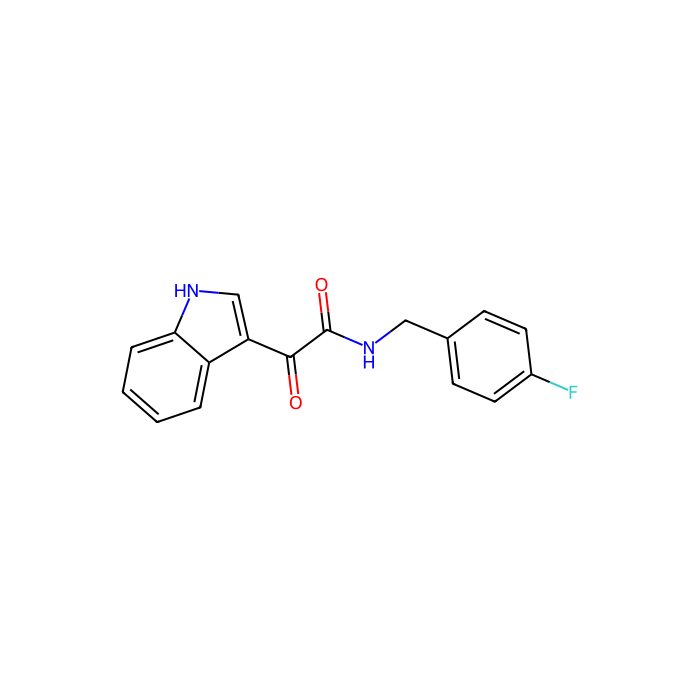
Determine the necessary mass, volume, or concentration for preparing a solution.
| Activity Type | Relation | Activity value | Units | Action Type | Journal | PubMed Id | doi | Assay Aladdin ID |
|---|
Taxonomy Tree
| Kingdom | Organic compounds |
|---|---|
| Superclass | Organoheterocyclic compounds |
| Classe | Indoles and derivatives |
| Subclass | Indoles |
| Intermediate Tree Nodes | Not available |
| Direct Parent | Indoles |
| Alternative Parents | Aryl ketones Fluorobenzenes Substituted pyrroles Aryl fluorides Vinylogous amides Heteroaromatic compounds Secondary carboxylic acid amides Azacyclic compounds Organopnictogen compounds Organonitrogen compounds Organofluorides Organic oxides Hydrocarbon derivatives |
| Molecular Framework | Aromatic heteropolycyclic compounds |
| Substituents | Indole - Aryl ketone - Fluorobenzene - Halobenzene - Aryl fluoride - Aryl halide - Monocyclic benzene moiety - Benzenoid - Substituted pyrrole - Heteroaromatic compound - Vinylogous amide - Pyrrole - Carboxamide group - Secondary carboxylic acid amide - Ketone - Carboxylic acid derivative - Azacycle - Organonitrogen compound - Organooxygen compound - Organic nitrogen compound - Hydrocarbon derivative - Organic oxide - Carbonyl group - Organopnictogen compound - Organic oxygen compound - Organohalogen compound - Organofluoride - Aromatic heteropolycyclic compound |
| Descrição | This compound belongs to the class of organic compounds known as indoles. These are compounds containing an indole moiety, which consists of pyrrole ring fused to benzene to form 2,3-benzopyrrole. |
| External Descriptors | Not available |
| Activity Type | Relation | Activity value | Units | Action Type | Journal | PubMed Id | doi | Assay Aladdin ID |
|---|
| Activity Type | Relation | Activity value | Units | Action Type | Journal | PubMed Id | doi | Assay Aladdin ID |
|---|
| Activity Type | Relation | Activity value | Units | Action Type | Journal | PubMed Id | doi | Assay Aladdin ID |
|---|
| Activity Type | Relation | Activity value | Units | Action Type | Journal | PubMed Id | doi | Assay Aladdin ID |
|---|
Find and download the COA for your product by matching the lot number on the packaging.
| Lot Number | Certificate Type | Data | Item |
|---|---|---|---|
 I2219280 | Certificate of Analysis | Jul 10, 2025 | T286790 |
| I2219281 | Certificate of Analysis | Jul 10, 2025 | T286790 |
| I2219282 | Certificate of Analysis | Jul 10, 2025 | T286790 |
| I2219354 | Certificate of Analysis | Jul 10, 2025 | T286790 |
| I2219355 | Certificate of Analysis | Jul 10, 2025 | T286790 |
| Solubilidade | Solvent:DMSO, Max Conc. mg/mL: 29.63, Max Conc. mM: 100; Solvent:ethanol, Max Conc. mg/mL: 5.93, Max Conc. mM: 20 |
|---|---|
| Peso molecular | 296.290 g/mol |
| XLogP3 | 3.200 |
| Hydrogen Bond Donor Count | 2 |
| Hydrogen Bond Acceptor Count | 3 |
| Rotatable Bond Count | 4 |
| Exact Mass | 296.096 Da |
| Monoisotopic Mass | 296.096 Da |
| Topological Polar Surface Area | 62.000 Ų |
| Heavy Atom Count | 22 |
| Formal Charge | 0 |
| Complexity | 421.000 |
| Isotope Atom Count | 0 |
| Defined Atom Stereocenter Count | 0 |
| Undefined Atom Stereocenter Count | 0 |
| Defined Bond Stereocenter Count | 0 |
| Undefined Bond Stereocenter Count | 0 |
| The total count of all stereochemical bonds | 0 |
| Covalently-Bonded Unit Count | 1 |
No manufacturer-validated protocols are provided for this item. The following general steps apply to small-molecule use in research settings (non-item-specific):
Item-specific biological target(s) or mechanism(s) of action for TCS 1105 are not provided in the product data. No claims are made regarding biological activity. For research planning, consult primary literature using the CAS (185391-33-7) or PubChem CID (2986030) to determine any reported targets, pathways, and assay systems.
General considerations for small-molecule tool compounds (not item-specific):
Research use only: This product is not intended for human or animal therapeutic use, clinical diagnostics, or in vivo administration without appropriate ethical and regulatory approvals.
TCS 1105 is not a buffering agent, and no item-specific pKa data are provided. Consequently, it is not typically used to establish or maintain buffer pH.
Practical notes for incorporating small molecules into buffers (general guidance):
Because TCS 1105 is a discrete small-molecule research chemical (not a solvent or bulk reagent), the primary “green chemistry” considerations relate to solvent and process choices during handling, analysis, and any derivative synthesis rather than to substituting the molecule itself.
Greener practice suggestions (general, not item-specific):
Illustrative comparison (literature, general):
Always balance green metrics with data quality, safety, and the specific solubility/stability profile of the compound.
Context for researchers (general, non-item-specific):
No therapeutic claims are made. This product is not intended for human or veterinary administration or diagnostic use.
Item-specific physico-chemical properties are not provided in the product data. The following fields should be confirmed on the CoA/Spec Sheet or via primary literature:
General guidance (literature/practice, not item-specific):
Interpreting common grades (general guidance):
What to verify for this item:
Recommendations:
No item-specific reactivity or application notes are provided. Given that TCS 1105 is supplied as a research-use small molecule rather than a commodity reagent, it is not typically employed as a general-purpose catalyst, solvent, or stoichiometric reagent in synthesis.
General research uses (non-item-specific):
Practical tips:
No item-specific reaction conditions are applicable because TCS 1105 is not provided as a reagent for a defined transformation. If synthetic modification is undertaken for research purposes, adopt standard, literature-based conditions aligned to the functional groups present (once known), for example:
All conditions above are generic literature guidance and must be tailored only after the compound’s structure and compatibility are known.
General laboratory precautions (good practice, not item-specific):
Item-specific solubility is not provided. The following is a practical, non-item-specific approach for small-molecule dissolution and handling:
Primary stock solvents
Cosolvent and vehicle strategies
Selection considerations
Quick screening panel
Research use only.
Item-specific identifiers (as provided)
Structural features
Descriptive notes
No structure or functional group information is provided, so we cannot assert specific reactivity or named-reaction participation for TCS 1105.
General guidance for working with unknown/unspecified small molecules:
Target, mechanism, species reactivity, and any selectivity profile are not provided for this item. No clone/isotype information applies (this is not a biologic). For studies that require a defined target profile, consult primary literature using CAS 185391-33-7 or PubChem CID 2986030, and validate in-house with appropriate controls and orthogonal assays.