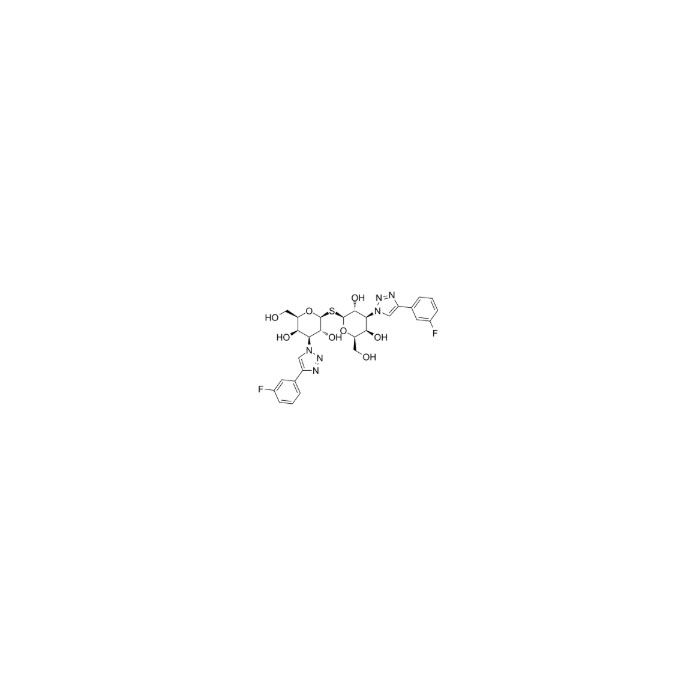
TD-139 - Moligand™, ≥99% , Galectin-3 inhibitor, CAS No.1450824-22-2, Galectin-3 inhibitor

CAS: 1450824-22-2 Cat. No.: T412406 Fórmula: C28H30F2N6O8S Peso molecular: 648.64
Disponível para encomenda
GRAU & PUREZA Moligand™ ? Moligand™ — Aladdin's line of ligands and bioactive small molecules. Use for receptor, pathway, and binding studies needing defined small-molecule tools. ≥99%
Synonyms
GB 0139 | TD2 | 3-Deoxy-3-[4-(3-Fluorophenyl)-1h-1,2,3-Triazol-1-Yl]-Beta-D-Galactopyranosyl 3-Deoxy-3-[4-(3-Fluorophenyl)-1h-1,2,3-Triazol-1-Yl]-1-Thio-Beta-D-Galactopyranoside | 60Y0GUO72B | AC-719 | (2R,2'R,3R,3'R,4S,4'S,5R,5'R,6S,6'S)-6,6'-Thiobis(4-(
Storage
Store at -20°C,Argon charged
Shipped In
Ice chest + Ice pads
★
Tamanho
Alemanha (EU)
USA*
Preço
Qtd
1mg
T412406-1mg
Sob encomenda · 8–12 semanas
51,98€
5mg
T412406-5mg
Sob encomenda · 8–12 semanas

234,20€

351,35€
Gravar 117,14 € (33.34%)
10mg
T412406-10mg
Sob encomenda · 8–12 semanas

429,44€

644,64€
Gravar 215,20 € (33.38%)
Enter a quantity for the sizes you want to add.
🧪
Por que este grau

Moligand™, ≥99% Moligand™ para fluxos de trabalho cromatográficos e analíticos sensíveis que exigem interferência mínima da linha de base.

🌡

Armazenamento e envio

Store at -20°C,Argon charged Envio Ice chest + Ice pads. Consulte o COA específico do lote para obter as especificações exatas.

📋

Documentos de qualidade

SDS, COA, ficha técnica e folha de especificações disponíveis para download. COA específico do lote acessível por meio de pesquisa por número de lote.

📚

Comprovação documental

Citado em 0 publicações revisadas por pares nas áreas de cromatografia, síntese orgânica e reações de acoplamento cruzado.

Visão geral

Information

TD-139 TD-139 (GB0-139) is a potent and selective inhibitor of galectin-3 with Kd of 0.036 µM over galectin-1 and galectin-7 with Kd of 2.2 µM and 32 µM, respectively. TD-139 is used potentially for the treatment of idiopathic pulmonary fibrosis (IPF).


Targets

galectin-3 (Cell-free assay); galectin-1 (Cell-free assay); galectin-7 (Cell-free assay) 0.036 μM(Kd); 2.2 μM(Kd); 32 μM(Kd)

Especificações

Sinónimos
GB 0139 | TD2 | 3-Deoxy-3-[4-(3-Fluorophenyl)-1h-1,2,3-Triazol-1-Yl]-Beta-D-Galactopyranosyl 3-Deoxy-3-[4-(3-Fluorophenyl)-1h-1,2,3-Triazol-1-Yl]-1-Thio-Beta-D-Galactopyranoside | 60Y0GUO72B | AC-719 | (2R,2'R,3R,3'R,4S,4'S,5R,5'R,6S,6'S)-6,6'-Thiobis(4-(
Especificações e pureza
Moligand™, ≥99%
Mecanismos bioquímicos e fisiológicos
TD-139 (GB0-139) is a potent and selective inhibitor of galectin-3 with Kd of 0.036 µM over galectin-1 and galectin-7 with Kd of 2.2 µM and 32 µM, respectively. TD-139 is used potentially for the treatment of idiopathic pulmonary fibrosis (IPF).
Condições de armazenamento de armazenamento
Store at -20°C,Argon charged
Enviado em
Ice chest + Ice pads
Este produto requer transporte de cadeia fria. Serviços terrestres e outros serviços econômicos não estão disponíveis.
Grau
Moligand™
Tipo de ação
INHIBITOR
Mecanismo de ação
Galectin-3 inhibitor
Pureza
≥99%
Propriedades do produto
ALogP
1.53
hba_count
6
Contagem HBD
6
Ligação rotativa
8
Nomes e identificadores
Sorrisos canónicos
OC[C@H]1O[C@@H](S[C@@H]2O[C@H](CO)[C@H](O)[C@@H]([C@H]2O)n2cc(nn2)-c2cccc(F)c2)[C@H](O)[C@H]([C@H]1O)n1cc(nn1)-c1cccc(F)c1
IUPAC Name
(2S,3R,4S,5R,6R)-4-[4-(3-fluorophenyl)triazol-1-yl]-2-[(2S,3R,4S,5R,6R)-4-[4-(3-fluorophenyl)triazol-1-yl]-3,5-dihydroxy-6-(hydroxymethyl)oxan-2-yl]sulfanyl-6-(hydroxymethyl)oxane-3,5-diol
InChIKey
YGIDGBAHDZEYMT-MQFIMZJJSA-N
INCHI
1S/C28H30F2N6O8S/c29-15-5-1-3-13(7-15)17-9-35(33-31-17)21-23(39)19(11-37)43-27(25(21)41)45-28-26(42)22(24(40)20(12-38)44-28)36-10-18(32-34-36)14-4-2-6-16(30)8-14/h1-10,19-28,37-42H,11-12H2/t19-,20-,21+,22+,23+,24+,25-,26-,27+,28+/m1/s1
SMILES isoméricas
C1=CC(=CC(=C1)F)C2=CN(N=N2)[C@H]3[C@H]([C@H](O[C@H]([C@@H]3O)S[C@H]4[C@@H]([C@H]([C@H]([C@H](O4)CO)O)N5C=C(N=N5)C6=CC(=CC=C6)F)O)CO)O
Peso molecular
648.64

Documentação

📋 Ficha de dados de segurança (FDS)

Documento abrangente sobre perigos, manuseamento, armazenamento e conformidade regulamentar.

<<<<<<< HEAD Baixar SDS → ======= Baixar SDS → >>>>>>> release248-p3

✅ Certificado de análise (COA)

Dados de qualidade específicos do lote. Introduza o número de lote para obter o COA exato.

Consultar COA →

📊 Ficha técnica

Resumo de referência rápida das especificações e aplicações do produto.

Ver ficha técnica →

🔬 Folha de especificações

Atributos de qualidade completos e critérios de aceitação para este grau.

Ver folha de especificações →

Dados avançados

Taxonomic Classification

Taxonomy Tree

KingdomOrganic compounds
SuperclassOrganic oxygen compounds
ClasseOrganooxygen compounds
SubclassCarbohydrates and carbohydrate conjugates
Intermediate Tree Nodes Not available
Direct ParentDisaccharides
Alternative Parents Phenyl-1,2,3-triazoles  Fluorobenzenes  Oxanes  Aryl fluorides  Monothioacetals  Heteroaromatic compounds  Secondary alcohols  Sulfenyl compounds  Oxacyclic compounds  Azacyclic compounds  Primary alcohols  Organonitrogen compounds  Organofluorides  Hydrocarbon derivatives  
Molecular FrameworkAromatic heteromonocyclic compounds
Substituents Disaccharide - Phenyltriazole - Phenyl-1,2,3-triazole - Fluorobenzene - Halobenzene - Benzenoid - Oxane - Aryl fluoride - Aryl halide - Monocyclic benzene moiety - Heteroaromatic compound - 1,2,3-triazole - Triazole - Azole - Monothioacetal - Secondary alcohol - Organoheterocyclic compound - Oxacycle - Sulfenyl compound - Azacycle - Hydrocarbon derivative - Alcohol - Organic nitrogen compound - Organohalogen compound - Organofluoride - Organonitrogen compound - Organosulfur compound - Primary alcohol - Aromatic heteromonocyclic compound
DescriçãoThis compound belongs to the class of organic compounds known as disaccharides. These are compounds containing two carbohydrate moieties linked to each to each other through a glycosidic bond, no set of three or more glycosidically linked carbohydrate units.
External Descriptors Not available
Estrutura 3D
Modelo de Estrutura Química Interativa


Alvos associados (não humanos)
Lgals3 Galectin-3 (98 Activities)
Activity TypeRelationActivity valueUnitsAction TypeJournalPubMed IddoiAssay Aladdin ID
Mecanismos de ação
Certificados(CoA,COO,BSE/TSE e Mapa de Análise)
C of A & Other Certificates(BSE/TSE, COO):
Analytical Chart:

Find and download the COA for your product by matching the lot number on the packaging.

3 results found

Lot NumberCertificate TypeDataItem
I2515577I2515577Certificate of AnalysisSep 10, 2025 T412406
I2515589I2515589Certificate of AnalysisSep 10, 2025 T412406
I2515590I2515590Certificate of AnalysisSep 10, 2025 T412406
Propriedades químicas e físicas
SolubilidadeSolubility (25°C) In vitro DMSO: 100 mg/mL (154.16 mM); Water: ˂1 mg/mL Ethanol: ˂1 mg/mL
SensibilidadeMoisture sensitive
DMSO (mg/mL) Solubilidade máxima100
DMSO (mM) Solubilidade máxima154.16872224963
Água (mg/mL) Solubilidade máxima˂1
Peso molecular648.600 g/mol
XLogP30.200
Hydrogen Bond Donor Count6
Hydrogen Bond Acceptor Count15
Rotatable Bond Count8
Exact Mass648.181 Da
Monoisotopic Mass648.181 Da
Topological Polar Surface Area227.000 Ų
Heavy Atom Count45
Formal Charge0
Complexity903.000
Isotope Atom Count0
Defined Atom Stereocenter Count10
Undefined Atom Stereocenter Count0
Defined Bond Stereocenter Count0
Undefined Bond Stereocenter Count0
The total count of all stereochemical bonds0
Covalently-Bonded Unit Count1
Calculadoras de soluções
Revisões

Avaliações dos Clientes

Application Protocols

The Product Data for SKU T412406 do not include validated application protocols or recommended assay conditions. As such, no item-specific protocols can be provided.

General, non-spec guidance for small-molecule ligand handling in assays:

  • Stock preparation: Dissolve in anhydrous DMSO to prepare a concentrated stock (e.g., 10–50 mM). Vortex and, if necessary, briefly sonicate. Filter through 0.22 µm PTFE if particulate persists.
  • Aliquoting: Dispense single-use aliquots to avoid repeated freeze–thaw cycles. Store at −20°C under inert gas as recommended.
  • Dosing: Add to pre-equilibrated assay buffer/cell media to achieve the target concentration while keeping DMSO constant across samples. Mix thoroughly to avoid local supersaturation.
  • Controls: Include vehicle-only controls and, where appropriate, an orthogonal probe or inactive analog. For biophysical assays, run reference surfaces or blank injections.
  • Data integrity: Verify solubility at working concentrations by visual inspection or light scattering; monitor baseline drift in optical assays.

For detailed, target-specific protocols, consult the primary literature on TD-139 and adapt to your assay platform (SPR, ITC, FP, cell-based readouts).

Biological Roles

General literature context (not a product specification and not a medical claim):

  • Molecular target: TD-139 is widely cited as a potent, selective small-molecule ligand/inhibitor of galectin-3, a carbohydrate-binding lectin involved in cell–cell and cell–matrix interactions, endocytosis, and modulation of immune signaling. Galectin-3 recognizes β-galactoside motifs on glycoconjugates and participates in lattice formation at the cell surface.
  • Mechanistic notes: High-affinity binding typically exploits a dense array of hydrogen-bond donors/acceptors and hydrophobic contacts within the carbohydrate-recognition domain (CRD) of galectin-3. Selectivity arises from complementarity to subsite residues unique to galectin-3 relative to other galectins.
  • Research applications: TD-139 is routinely used as a chemical probe to dissect galectin-3-dependent processes in biochemical and cellular systems, including lectin–glycan interactions, endocytosis of glycoproteins, extracellular matrix remodeling, and macrophage activation pathways.
  • Pathway mapping: Employed in omics-integrated studies to correlate galectin-3 modulation with downstream transcriptional changes and cytokine profiles, often in conjunction with CRISPR knock-down/knock-out or antibody blockade for orthogonal validation.
  • Selectivity considerations: Researchers commonly benchmark TD-139 against other galectin ligands to quantify cross-reactivity (e.g., galectin-1, -7, -9) using SPR/ITC titrations and cell-based readouts.

Note: All uses are for research only. This summary is for biochemical understanding and should not be construed as clinical guidance or a therapeutic claim.

Buffer Applications

TD-139 is a small-molecule research ligand and is not itself a buffering agent. Therefore, classical buffer system design (pH range, pKa, buffer capacity) is not applicable.

Practical notes for buffer use with TD-139 in assays (general guidance):

  • Vehicle compatibility: When dosing from DMSO stocks, maintain a constant final DMSO percentage across all wells or samples (e.g., 0.1–1% v/v) to isolate compound effects from vehicle effects.
  • Common assay buffers: Phosphate (PBS), HEPES, or Tris buffers are frequently used in galectin binding assays. Ensure that salt concentration and pH match the requirements of your detection modality (e.g., SPR running buffer ionic strength) and the stability of protein targets.
  • Additives: For biophysical assays, a small amount of non-ionic detergent (e.g., 0.01% Tween-20) can help mitigate nonspecific adsorption and aggregation, subject to compatibility with the target protein and sensor surface.
  • Calcium/metal ions: Galectin-3 binding is generally not Ca2+-dependent, but verify that your buffer composition does not disrupt the lectin’s carbohydrate-recognition domain or assay surface chemistry.

Recommendation: Pilot solubility/compatibility tests should be performed to check for precipitation or baseline drift when TD-139 is introduced into the selected buffer at working concentrations.

Green Alternatives

This item functions as a target-directed research ligand rather than a process solvent or bulk reagent. “Green alternative” analysis is therefore not typically applicable in the same way it is for solvents or common reagents.

That said, you can implement greener practices in the way TD-139 is handled and formulated:

  • Solvent minimization: Use high-concentration DMSO stocks to reduce total solvent volumes in assays; validate the lowest vehicle percentage that maintains solubility and performance.
  • Solvent selection: Prefer DMSO over more hazardous aprotic solvents (e.g., DMF, NMP) for routine assay use, provided the biology permits.
  • Waste reduction: Consolidate compatible organic waste streams and use microplate formats to minimize per-experiment material usage.
  • Energy: Store only the required aliquots at −20°C and keep bulk at recommended conditions to reduce repeated warm/cold cycles and associated energy use.

Comparison table (general practices, not product specifications):

  • Practice: DMSO stock solutions vs. dilute aqueous suspensions • Greener benefit: Lower solvent throughput, fewer failed runs due to precipitation
  • Practice: Aliquoting to single-use vials • Greener benefit: Reduced discard due to degradation, improving overall material efficiency
  • Practice: Validating minimal effective concentration • Greener benefit: Lowers compound consumption and waste generation

For synthetic route greenness of TD-139 itself, consult primary literature; route selection and metrics (PMI/E-factor) are highly context-dependent and not specified for this SKU.

Pharmaceutical Uses

This product is designated For research use only and is not approved for human or veterinary use, diagnostic procedures, or as an active pharmaceutical ingredient.

General, non-clinical context from the literature (not a claim for this SKU):

  • Role: TD-139 has been described as a selective galectin-3 inhibitor used as a chemical probe in preclinical research to interrogate galectin-3 biology. Such compounds may be explored in drug discovery programs during hit-to-lead and lead optimization phases.
  • Formulation research: In discovery settings, small molecules of this class are commonly formulated as DMSO stock solutions for in vitro assays and explored in simple excipient matrices for preclinical studies. Specific excipient systems and pharmacopeial status are not provided for this item.
  • Manufacturing/quality frameworks: No pharmacopeial monograph or GMP status is indicated for this product. Any translational work would require independent qualification, impurity control, and compliance with relevant regulatory standards outside the scope of this catalog item.

For any application beyond benchtop research, including preclinical development, obtain suitable grade material, full impurity profiles, and stability data under ICH conditions. This Moligand™ item is intended strictly for laboratory research.

Physical Properties

Item-specific physico-chemical specifications were not supplied in the Product Data for this catalog entry. Do not treat the following as product specifications; they are general/literature context only. For experiments and release criteria, consult the batch CoA/Spec Sheet and SDS.

Item-specific (from Product Data):

  • Appearance: Not specified for this item; refer to CoA/Spec Sheet.
  • Molecular weight: Not specified for this item; refer to CoA/Spec Sheet.
  • Molecular formula: Not specified for this item; refer to CoA/Spec Sheet.

General/literature guidance (non-spec):

  • Aggregate state: TD-139 is typically encountered as a solid in research catalogs (literature context); actual physical form of this SKU is not specified.
  • Solubility profile (literature context): Frequently formulated as concentrated stocks in DMSO for biochemical assays; aqueous solubility may be limited without co-solvent or pH adjustment depending on salt/form.
  • Typical handling concentration: 1–50 mM in anhydrous DMSO for screening plates; dilution into assay buffer immediately before use to limit precipitation.
  • Partitioning: Molecules of this class often show mixed polarity with multiple H-bonding sites; actual logP/logD for this item is not specified.
  • Thermal transitions (mp) and spectral indices (refractive index) are not provided for this item.

Do not infer numeric values for bp/mp, density, pKa, logP, or UV cutoffs for this SKU. Use empirical solubility checks (small-scale titration, visual inspection, nephelometry) to establish a working formulation for your assay system.

Quality and Grades

Grade/Purity: Moligand™ (from Product Data)

What Moligand™ typically implies (general description):

  • A screening-ready small-molecule ligand grade intended for target engagement studies, binding assays, and early SAR exploration. Emphasis is commonly placed on identity confirmation and suitability for biochemical/cellular screening rather than chromatographic residue specifications.

Implications for this item:

  • Identity and usability: Provided as a research-use ligand; batch-specific details such as assay purity, residual solvents, salt form, and water content are not specified for this SKU in the Product Data. Refer to the CoA/Spec Sheet for actual acceptance criteria, analytical methods (e.g., HPLC/LC–MS, NMR), and results.
  • Stabilization: The item is supplied argon-charged and recommended to be stored at −20°C, which suggests sensitivity to moisture/oxygen for optimal long-term integrity. No stabilizers are specified; if any are present in a particular batch, they will be listed on the CoA.
  • UV/LC suitability: No HPLC-grade or low-UV specification is claimed. If using for optical assays (e.g., fluorescence/absorbance), perform a blank scan to verify baseline absorbance of your stock solution.

Documentation and traceability:

  • For regulated or data-critical work, record the lot number and retain a copy of the CoA/SDS. If specific contaminants or metal limits are required by your method, contact Technical Support for lot-specific data or a targeted quality agreement.
Reaction and Applications

This product is sold as a research ligand rather than a synthetic reagent. No manufacturer reaction applications are provided in the Product Data. Accordingly, it is not typically employed as a stoichiometric reagent or catalyst in synthetic transformations.

Research usage (general/literature context, non-spec):

  • Target engagement: TD-139 is widely discussed in the literature as a high-affinity, selective small-molecule ligand for galectin-3, a β-galactoside-binding lectin implicated in carbohydrate-mediated recognition events. It is commonly used in biochemical binding assays (e.g., ITC, SPR, fluorescence polarization) and cellular assays to interrogate galectin-3-dependent pathways.
  • Selectivity panels: Researchers often evaluate activity versus other galectins (e.g., galectin-1, -7, -9) to establish selectivity profiles. Such testing conditions are assay- and lab-specific.
  • Assay development: Employed as a positive control inhibitor or probe in lectin-binding assays using immobilized ligands or glycoproteins; serves as a benchmark compound in screening campaigns.

Practical tips (general):

  • Prepare fresh DMSO stocks and limit freeze–thaw cycles to maintain potency.
  • When performing biophysical assays, confirm the absence of aggregation by including a low concentration of non-ionic detergent where appropriate and monitoring baseline signals.
  • For cell-based work, use appropriate vehicle controls matched to the final DMSO percentage.

Note: For any application beyond research use, or for synthetic incorporation, obtain explicit specifications and permissions; this product is labeled For research use only.

Reaction Conditions

Not applicable in the conventional synthetic sense. TD-139 is supplied as a research ligand rather than a reagent/catalyst, and no manufacturer reaction conditions are provided in the Product Data.

Assay conditions (general, literature-based guidance, non-spec):

  • Biophysical binding assays: Surface plasmon resonance (SPR) and isothermal titration calorimetry (ITC) are common. Typical running buffers include HEPES or PBS with moderate ionic strength; temperature often 20–25°C for stability of protein–ligand interactions.
  • Cellular assays: Dosing from DMSO stocks with final vehicle 0.1–0.5% v/v is common; incubation times range from 1–48 h depending on endpoint readouts (e.g., transcriptional changes, cytokine release). Concentration ranges are determined empirically from potency data in the literature; confirm for your system.
  • Controls: Include vehicle-only, unrelated ligand controls, and protein knock-down/knock-out where feasible to establish on-target effects.

Note: Any numeric potency or kinetic parameters should be taken from primary literature under your exact assay conditions. This catalog listing does not specify activity values or recommended concentrations.

Safety and Handling

Hazard classification details are not provided in the Product Data for this item. Always consult the SDS for authoritative guidance. The following are prudent laboratory practices for small-molecule research ligands and should not be construed as product-specific hazard statements.

Item-specific from Product Data:

  • Storage: Store at −20°C, under argon. Shipments are sent in an ice chest with ice pads.
  • Signal word: Not specified for this item; refer to SDS.
  • GHS classification, H-statements, pictograms: Not specified for this item; refer to SDS.

General handling recommendations (good laboratory practice):

  • PPE: laboratory coat, safety glasses, and appropriate chemical-resistant gloves (e.g., nitrile). Avoid inhalation of dust/aerosols and skin contact.
  • Containment: Handle powders/aliquots in a fume hood or ventilated enclosure. Use antistatic precautions when weighing finely powdered solids.
  • Incompatibilities: Avoid strong oxidizers and strong acids/bases unless compatibility is known. Protect from moisture and air when the product is specified to be argon-charged.
  • Hygiene: Wash hands thoroughly after handling. Do not eat, drink, or smoke in the laboratory.
  • First aid (general): In case of skin/eye contact, rinse with water for at least 15 minutes and seek medical attention. If inhaled, move to fresh air. If ingested, rinse mouth; seek medical attention.
  • Spill/cleanup: Collect solids with minimal dust generation; dispose according to institutional and local regulations.

Always defer to the current SDS and institutional EHS policies.

Solvent Selection

No item-specific solubility data are provided for TD-139 in the Product Data. The guidance below reflects common practice for structurally similar small-molecule ligands and should be verified empirically for your system.

General/literature-based considerations (non-spec):

  • Primary stock solvent: Anhydrous DMSO is typically preferred for high-concentration stocks (e.g., 10–50 mM), enabling convenient plate-based screening and accurate dosing via serial dilution.
  • Secondary solvents/co-solvents: If aqueous delivery is required, dilute DMSO stocks into assay buffer to a final DMSO content compatible with your biology (commonly 0.1–1% v/v). For less DMSO-tolerant assays, co-solvents such as ethanol or PEG-400 may be explored in small proportions.
  • Aqueous solubility: Molecules designed for lectin binding often possess multiple hydrogen-bond donors/acceptors; however, aqueous solubility is formulation- and salt-form-dependent. Assess with small-scale titrations, vortex/sonication, and visual turbidity checks.
  • Adsorption/adhesion: To minimize loss to plastics, prepare concentrated stocks and minimize contact time with polypropylene where adsorption is suspected; glass vials or low-bind plastics can help.

Comparison notes (general):

  • DMSO vs DMF: DMSO typically offers better biocompatibility at low percentages and lower volatility; DMF is less favored for biological assays due to toxicity and volatility.
  • Buffers: Phosphate, HEPES, or Tris buffers are commonly used for lectin assays; ensure compatibility with your detection modality and any metal cofactors.

Always verify solubility and assay compatibility with a small pilot dilution series before scale-up.

Storage and Reconstitution

From Product Data (item-specific):

  • Storage conditions: Store at −20°C, argon charged.
  • Shipping conditions: Ice chest with ice pads.
  • Appearance: Not specified for this item; refer to CoA/Spec Sheet.

General handling and reconstitution guidance (non-spec):

  • Upon receipt: Allow the sealed container to equilibrate to room temperature in a desiccated environment before opening to minimize moisture condensation.
  • Inert atmosphere: Given the argon charge, minimize air exposure. Reseal promptly after use. If available, handle in a dry box or flush the headspace with inert gas.
  • Stock solution preparation: Prepare concentrated stocks in anhydrous DMSO. Record the exact concentration gravimetrically or by quantitative NMR if required for precision dosing.
  • Aliquoting: Dispense into single-use vials or microtubes, backfill with inert gas, and store at −20°C. Avoid frost-free freezers that cycle warm air.
  • Freeze–thaw: Avoid repeated cycles. Thaw aliquots rapidly at room temperature, use immediately, and do not refreeze partially used aliquots.
  • Light/moisture: Store in amber or foil-wrapped containers if the compound is light sensitive; keep desiccated using molecular sieves or desiccant packs.

Disposal: Dispose of unused solutions and waste according to institutional chemical waste procedures and local regulations. Always consult the SDS for stability and incompatibility details specific to your lot.

Structure and Identity

TD-139 (SKU T412406) is supplied as a Moligand-grade research small molecule commonly referenced in the literature as a high-affinity galectin-3 ligand. Item-specific identifiers are listed below; fields not provided in the product data are indicated accordingly.

  • CAS: 1450824-22-2 (from Product Data)
  • PubChem CID: 73774610 (from Product Data)
  • InChIKey: 436629 (as provided; truncated/atypical format in Product Data)
  • SMILES: Not specified for this item; refer to CoA/Spec Sheet.
  • Molecular formula: Not specified for this item; refer to CoA/Spec Sheet.
  • Molecular weight: Not specified for this item; refer to CoA/Spec Sheet.

Structural description (general literature context, not item-specific):

  • TD-139 (also known in literature as GB0139) is described as a polyhydroxylated, heteroatom-rich small molecule engineered to recognize the carbohydrate-recognition domain of galectin-3. Typical structural features reported include multiple hydrogen-bond donors/acceptors and aryl/heteroaryl moieties that enhance affinity and selectivity for lectin binding sites.
  • 2D depiction in words (literature-based): a compact scaffold bearing several oxygenated substituents arranged to form a dense H-bonding network, appended to aromatic/heteroaromatic groups that contribute to hydrophobic and π-stacking interactions within the lectin pocket.

Notes:

  • Exact stereochemistry, ring substitution patterns, and tautomeric preferences should be confirmed against the primary reference or the item’s CoA/SDS for authoritative identification.
  • Any structural rendering used in publications should be cross-checked with the specific batch documentation.
Synthetic Utility

TD-139 is offered as a bioactive ligand and is not generally used as a synthetic building block or reagent. Consequently, conventional synthetic utility discussions (e.g., protecting-group strategies, cross-coupling handles, reagent roles) are not typically applicable.

General context (non-spec):

  • Structural complexity: Molecules engineered for lectin binding often contain multiple heteroatoms and stereochemical features optimized for target affinity. While such features may, in principle, enable further derivatization, this product is not supplied with a protection/derivatization map or functional-handle disclosure.
  • Probe development: In medicinal chemistry, analogs of TD-139 have been prepared to explore structure–activity relationships (SAR). If derivatization is desired for probe conjugation (e.g., reporter tags), consult primary literature for synthons that preserve galectin-3 engagement.

Practical recommendation:

  • If your goal is to prepare immobilized or labeled derivatives, consider starting from published intermediates or requesting a custom synthesis with defined functional handles. Using the catalog ligand directly as a precursor may not be efficient without route disclosure.
Target Specificity

Only information from the Product Data may be listed here. The Product Data for SKU T412406 do not provide target specificity fields.

  • Target/antigen: Not specified for this item; refer to CoA/Spec Sheet.
  • Epitope/binding site details: Not specified for this item; refer to CoA/Spec Sheet.
  • Species reactivity/selectivity panel: Not specified for this item; refer to CoA/Spec Sheet.
  • Clone/isotype (if antibody): Not applicable.

General note: While literature frequently associates TD-139 with galectin-3 binding, any target attribution for this specific SKU should be confirmed against the lot documentation if required by your application.

Perguntas frequentes

What is the purity of this product?
This product is supplied at ≥99% purity (chemical assay). Lot-specific values are stated on the Certificate of Analysis.
What is Moligand??
Moligand? is one of Aladdin Scientific's premium product lines, formulated for high-purity applications across multiple workflows. Compared to standard grades in the same workflow, Moligand? products typically offer tighter specifications, more rigorous QC, and stronger lot-to-lot consistency.
How should this product be stored?
Store at ?20 °C under argon. It is supplied under an argon blanket; reseal under inert gas after each use.
How is this product shipped?
This product ships in an insulated container with ice pads. Unpack on arrival and transfer it to the storage condition stated above.
What are the CAS number, molecular formula and molecular weight?
The CAS Number is 1450824-22-2, the molecular formula is C28H30F2N6O8S, and the molecular weight is 648.64 g/mol. InChIKey YGIDGBAHDZEYMT-MQFIMZJJSA-N.
What documentation is provided?
Available product documentation, including Certificates of Analysis (COA), Safety Data Sheets (SDS), and specification sheets, is shown in the product document area. Document availability and access follow the current site policy.

Precisa de ajuda para escolher o grau?

O nosso guia de seleção de graus abrange pureza, estado do estabilizador e adequação à aplicação para todas as variantes do nosso catálogo.

Ver o guia de graus Moligand™ →

Deseja que lhe enviemos uma mensagem quando tivermos descontos disponíveis?

Lembrar-me mais tarde

Obrigado! Por favor, verifique a sua caixa de entrada de e-mail para confirmar.

Ops! As notificações estão desativadas.