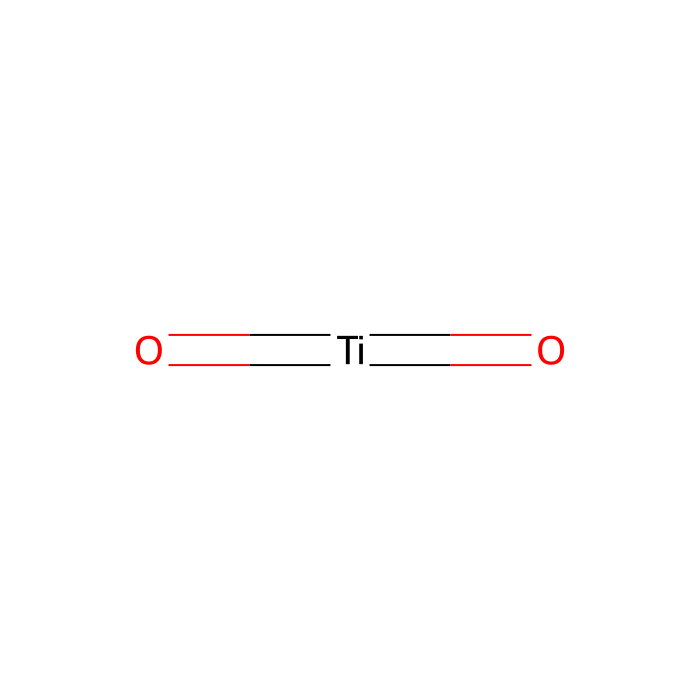
Determine the necessary mass, volume, or concentration for preparing a solution.
Titanium(IV) oxide - ≥99.5% metals basis, nanopowder,21nm , CAS No.13463-67-7
Disponível para encomenda
Synonyms
Titanium
Storage
Room temperature
Shipped In
Normal

≥99.5% metals basis, nanopowder,21nm for sensitive chromatographic and analytical workflows requiring minimal baseline interference.
Room temperature Ships Normal Check lot-specific COA for exact specifications.
SDS, COA, datasheet, and spec sheet available for download. Lot-specific COA accessible via lot number lookup.
Cited in 2596 peer-reviewed publications across chromatography, organic synthesis, and cross-coupling reactions.
Two main physico-chemically distinct polymorphs of TiO 2 are anatase and rutile. Anatase has a higher photocatalytic activity than rutile but is thermodynamically less stable.
Application
TiO 2 nanoparticles were used to study the photocatalytic hexane vapor degradation. It has been used as a sorbent for arsenic removal. TiO 2 nanoparticles are suitable for remediation of antiseptic components in wastewater by photocatalysis. It has also been used to study adsorption of DNA oligonucleotides by titanium dioxide nanoparticles.
Comprehensive hazard, handling, storage, and regulatory compliance document.
Download SDS →Lot-specific quality data. Enter your lot number to retrieve the exact COA.
Look up COA →Full quality attributes and acceptance criteria for this grade.
View spec sheet →Taxonomy Tree
| Kingdom | Inorganic compounds |
|---|---|
| Superclass | Mixed metal/non-metal compounds |
| Classe | Transition metal organides |
| Subclass | Transition metal oxides |
| Intermediate Tree Nodes | Not available |
| Direct Parent | Transition metal oxides |
| Alternative Parents | Inorganic salts Inorganic oxides |
| Molecular Framework | Not available |
| Substituents | Transition metal oxide - Inorganic oxide - Inorganic salt |
| Descrição | This compound belongs to the class of inorganic compounds known as transition metal oxides. These are inorganic compounds containing an oxygen atom of an oxidation state of -2, in which the heaviest atom bonded to the oxygen is a transition metal. |
| External Descriptors | titanium molecular entity |
Find and download the COA for your product by matching the lot number on the packaging.
| Lot Number | Certificate Type | Data | Item |
|---|---|---|---|
 G2617575 | Certificate of Analysis | Jul 03, 2026 | T431951 |
| G2617577 | Certificate of Analysis | Jul 03, 2026 | T431951 |
| I2511469 | Certificate of Analysis | May 29, 2025 | T431951 |
| I2511607 | Certificate of Analysis | May 29, 2025 | T431951 |
| E2520070 | Certificate of Analysis | Jun 07, 2024 | T431951 |
| G2411654 | Certificate of Analysis | Jun 07, 2024 | T431951 |
| G2411656 | Certificate of Analysis | Jun 07, 2024 | T431951 |
| G2411661 | Certificate of Analysis | Jun 07, 2024 | T431951 |
| B2419098 | Certificate of Analysis | Apr 20, 2023 | T431951 |
| D23261031 | Certificate of Analysis | Apr 20, 2023 | T431951 |
| D23261039 | Certificate of Analysis | Apr 20, 2023 | T431951 |
| D2326979 | Certificate of Analysis | Apr 20, 2023 | T431951 |
| E2414052 | Certificate of Analysis | Apr 20, 2023 | T431951 |
| Ponto de ebulição (°C) | 2900 °C/1013 hPa |
|---|---|
| Ponto de fusão (°C) | 1855 °C |
| Peso molecular | 79.866 g/mol |
| XLogP3 | |
| Hydrogen Bond Donor Count | 0 |
| Hydrogen Bond Acceptor Count | 2 |
| Rotatable Bond Count | 0 |
| Exact Mass | 79.9378 Da |
| Monoisotopic Mass | 79.9378 Da |
| Topological Polar Surface Area | 34.100 Ų |
| Heavy Atom Count | 3 |
| Formal Charge | 0 |
| Complexity | 18.300 |
| Isotope Atom Count | 0 |
| Defined Atom Stereocenter Count | 0 |
| Undefined Atom Stereocenter Count | 0 |
| Defined Bond Stereocenter Count | 0 |
| Undefined Bond Stereocenter Count | 0 |
| The total count of all stereochemical bonds | 0 |
| Covalently-Bonded Unit Count | 1 |