≥98% for sensitive chromatographic and analytical workflows requiring minimal baseline interference.
🌡
Storage & shipping
Store at 2-8°C,Protected from light,Argon charged Ships Wet ice Check lot-specific COA for exact specifications.
📋
Quality documents
SDS, COA, datasheet, and spec sheet available for download. Lot-specific COA accessible via lot number lookup.
📚
Literature proof
Cited in 0 peer-reviewed publications across chromatography, organic synthesis, and cross-coupling reactions.
Visão geral
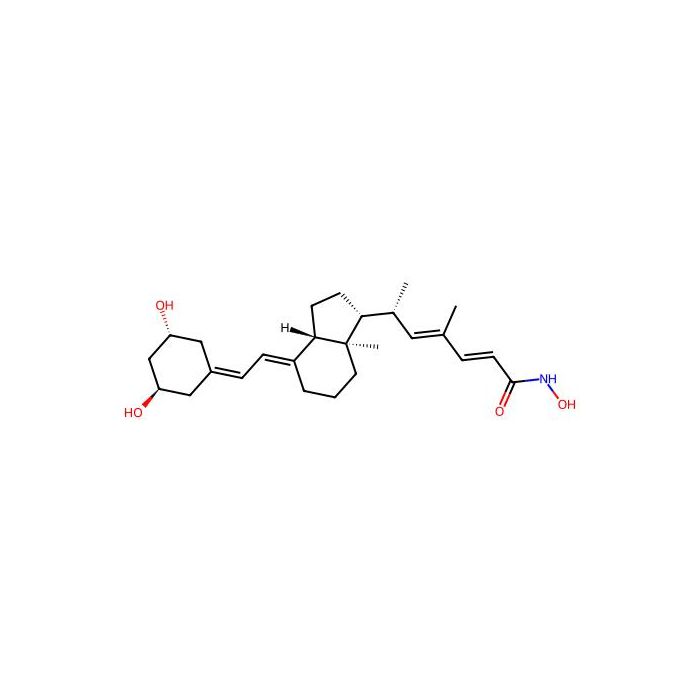
Triciferol functions as a multiple ligand with combined VDR agonist and HDAC antagonist activities. Triciferol binds directly to the VDR ( IC 50 =87 nM), and functions as an agonist with 1,25D-like potency on several 1,25D target genes. Triciferol induces marked tubulin hyperacetylation, and augments histone acetylation. Antiproliferative and cytotoxic activities.
In Vitro
Triciferol (0-10000 nM; 0-72 hours) is significantly more efficacious in suppressing the proliferation of estrogen receptor-negative human MDA-MB231 breast cancer cells. Treatment of MCF-7 cells with Triciferol (100-1000 nM) induces ≈2.5-fold higher rates of cell death than equimolar amounts of 1,25D. MCE has not independently confirmed the accuracy of these methods. They are for reference only. Cell Proliferation AssayCell Line: MDA-MB231 breast cancer cells Concentration: 0-10000 nM Incubation Time: 0-72 hours Result: Growth inhibition was statistically significantly different from that of 1,25D at concentrations of 1 nM or above.
Form:Solid
Specifications
Especificações e pureza
≥98%
Mecanismos bioquímicos e fisiológicos
Triciferol functions as a multiple ligand with combined VDR agonist and HDAC antagonist activities. Triciferol binds directly to the VDR ( IC 50 =87 nM), and functions as an agonist with 1,25D-like potency on several 1,25D target genes. Triciferol induce
Condições de armazenamento de armazenamento
Store at 2-8°C,Protected from light,Argon charged
Enviado em
Wet ice
Este produto requer transporte de cadeia fria. Serviços terrestres e outros serviços econômicos não estão disponíveis.
Determine the necessary mass, volume, or concentration for preparing a solution.
Dilution Calculator
Determine the dilution needed to prepare a stock solution.
Reconstitution Calculator
Revisões
Avaliações dos Clientes
Application Protocols
No tested applications, protocols, or recommended dilutions are provided in the Product Data for this item.
Validated uses (WB, IHC, IF, FC, enzymatic assays, etc.): Not specified for this item; refer to CoA/Spec Sheet.
Positive controls / reference conditions: Not specified for this item; refer to CoA/Spec Sheet.
Please consult the lot-specific documentation or contact Technical Support with your intended application; we can share any available internal data or literature references specific to the confirmed identity of this compound.
Biological Roles
No biological function, pathway association, or target information is provided in the Product Data for this compound.
Item-specific biological roles: Not specified for this item; refer to CoA/Spec Sheet and primary literature if available for the CAS number 957214-00-5.
General note for small-molecule libraries: Such compounds may be employed as probes or hits in biochemical and cellular assays once a target or phenotype is established through screening. Any putative mechanism of action should be validated with orthogonal assays (e.g., binding biophysics, genetic knockdown/overexpression) and counter-screens for off-targets.
Assay considerations: If the compound is light-sensitive, limit exposure during assay setup to preserve potency. Confirm stability in the assay matrix (buffer, serum, media) and verify nonspecific binding to plastics.
Research use only: This product is intended strictly for laboratory research. No biological efficacy, safety, or pharmacology is implied or claimed.
Buffer Applications
This product is not a buffering reagent, and no pKa or acid/base information is provided.
Buffer use: Not typically applicable. If the compound is used in biochemical assays, prepare buffers according to the assay’s requirements and introduce the compound as a separate stock solution in a compatible co-solvent (e.g., DMSO or ethanol) at low final percentages to avoid perturbing ionic strength and pH.
Practical tips (general):
Maintain constant co-solvent content across control and test wells.
For light-sensitive materials, use amber reservoirs/plates and minimize exposure.
If precipitation is observed, consider modest co-solvent increases within assay tolerance or the inclusion of accepted solubilizers (e.g., 0.01–0.05% non-ionic surfactant), followed by revalidation.
No item-specific buffer system or recipe is provided for this product.
Green Alternatives
Specific green chemistry considerations for this item cannot be assigned without structural and use-context information. The following general guidance applies to handling small-molecule library compounds and their solutions.
Prefer greener solvents for stock and processing when feasible:
Replace or minimize high-toxicity solvents (e.g., DMF) with ethanol, isopropanol, or water–cosolvent systems when compatible with the assay or analytical method.
For non-aqueous workflows, evaluate bio-based dipolar aprotics such as Cyrene or propylene carbonate where solubility and method constraints permit (method revalidation required).
Waste minimization:
Scale stocks appropriately to reduce expired waste; aliquot small volumes to avoid repeated thawing and discard.
Use micro-scale analytical methods (UHPLC, microplates) to cut solvent consumption.
Energy and stability: Store at the lowest energy cost that still meets stability requirements (here: 2–8°C, protected from light). Avoid unnecessary freezer use if not required by the CoA.
Packaging: Retain and reuse amber vials for light-sensitive materials where possible and compliant with your QC systems.
Trade-offs: Greener solvents may provide reduced solvency or altered assay performance and can demand method redevelopment (solubility, detection wavelength, viscosity effects). Validate thoroughly before substitution.
Pharmaceutical Uses
No pharmacopeial status, excipient role, or formulation guidance is provided for this item.
Regulatory/compendial: Not specified for this item; refer to CoA/Spec Sheet.
Use context: Supplied for research use only. Not for human or veterinary use, not for clinical or diagnostic applications. No therapeutic or clinical claims are made or implied.
Formulation R&D note (general): If using in preclinical research, characterize solubility and stability in intended vehicles (e.g., DMSO, ethanol/PEG/water mixtures) under subdued light, and confirm adsorption to plastics or glass. Observe institutional and regulatory guidelines for handling experimental compounds.
For any application beyond laboratory research, customer assumes full responsibility for regulatory assessment and suitability.
Physical Properties
Item-specific physicochemical parameters have not been provided for this product.
Appearance: Not specified for this item; refer to CoA/Spec Sheet.
Melting point / Boiling point: Not specified for this item; refer to CoA/Spec Sheet.
Density / Refractive index: Not specified for this item; refer to CoA/Spec Sheet.
Solubility profile: Not specified for this item; refer to CoA/Spec Sheet.
LogP / pKa: Not specified for this item; refer to CoA/Spec Sheet.
Practical guidance (general, non‑specification):
Given the storage instruction “Protected from light” and “Argon charged,” the compound may be oxygen- and/or light‑sensitive. Handle accordingly in amber vials, minimize headspace oxygen, and limit light exposure during weighing and solution preparation.
If physico-chemical properties are unknown, a small solubility screen is recommended: start with anhydrous DMSO or ethanol to prepare a concentrated stock (e.g., 10–50 mM), then dilute into the working medium. Confirm absence of precipitation by visual check or nephelometry.
Determine purity/identity empirically where needed (LC–MS, HPLC-UV/ELSD, NMR), as no item-specific values are listed here. For authoritative values, defer to the CoA/SDS.
Quality and Grades
Grade/Purity: Not specified for this item; refer to CoA/Spec Sheet.
Interpretation and guidance:
For small-molecule library items, typical quality controls may include LC–MS identity confirmation, HPLC purity assessment (UV/ELSD), and where relevant, NMR. Because no item-specific purity or stabilizer information is provided here, rely on the batch CoA for definitive data.
If low-UV work (e.g., analytical HPLC method development) is intended, verify the UV spectrum and impurity profile from the CoA to avoid baseline interference.
If you require a defined quality such as “analytical standard,” “bioactive screening grade,” or “trace-metal screened,” please contact us with the SKU and lot for available documentation or upgraded QC options.
When receiving the product:
Inspect packaging integrity (argon-charged container, light-protective vialing) and verify storage conditions upon receipt (2–8°C, protected from light).
Request and review the lot-specific CoA for: purity percentage and methodology, residual solvents, water content (if measured), and identity confirmation data.
Stabilizer/antioxidant presence: Not specified for this item; refer to CoA/Spec Sheet.
Reaction and Applications
Based on the Category Path, this item is part of a small-molecule/compound library. No reagent-grade or transformation-specific role is provided in the Product Data.
Primary use case (general): Research screening and discovery applications (biochemical or cell-based assays), target identification workflows, or as a reference compound where literature supports such use. Item-specific activity/target is not provided—consult CoA/literature for details before designing bioassays.
As a synthetic reagent: Not typically positioned as a general-purpose reagent or building block in the absence of structural information. Do not plan named reactions or derivatizations until the structure and stability attributes are confirmed.
Practical handling tips (general):
Prepare concentrated stocks in dry, oxygen-free solvent (commonly anhydrous DMSO or ethanol) under subdued light; aliquot to minimize freeze–thaw.
Validate solution stability over the intended usage period (e.g., short-term bench light exposure vs. protected storage).
For plate-based screening, confirm absence of precipitation upon dilution across the working concentration range.
Analytical characterization: If you need to confirm identity/purity pre-use, run LC–MS with a short gradient and dual UV/ELSD detection. For light-sensitive analytes, minimize autosampler residence time and use amber vials.
Because no manufacturer-supplied application notes are present for this item, these recommendations remain general and should be adapted once the compound’s identity and properties are confirmed.
Reaction Conditions
No reaction conditions can be recommended for this item because no structure, reactivity, or functional group information is provided in the Product Data.
Item-specific reaction parameters (solvent, temperature, catalysts, yields): Not specified for this item; refer to CoA/Spec Sheet and literature contingent on confirmed identity.
General laboratory handling (non-reaction): If preparing solutions, use dry, oxygen-free solvents, protect from light, and maintain an inert atmosphere. Validate solution stability empirically before extended use.
For synthetic planning, await definitive structural information and consult peer-reviewed literature corresponding to the confirmed compound identity (CAS 957214-00-5) before selecting conditions.
Safety and Handling
Safety details are not specified in the Product Data for this item; consult the SDS for authoritative information before use.
GHS classification / Signal word / H-statements / Pictograms: Not specified for this item; refer to SDS. Do not assume non-hazardous status in the absence of data.
Primary hazards (general): Unknown; handle as a potentially harmful laboratory chemical. Avoid inhalation, ingestion, and skin/eye contact. Because the item is shipped under wet ice and is argon charged, treat it as potentially air- or light-sensitive.
PPE (recommended good practice): Lab coat, safety glasses or face shield, and appropriate chemically resistant gloves (e.g., nitrile). Work in a certified chemical fume hood.
Handling notes:
Keep container tightly closed under an inert atmosphere; purge headspace with argon or nitrogen after each use.
Protect from ambient light; use amber vials and foil wrap as needed.
Avoid heat sources and moisture until properties are confirmed.
Incompatibilities (general caution): Strong oxidizers/reductants and bases/acids may be incompatible; verify once structure is confirmed. Do not mix with unknown reagents.
First aid (overview): If inhaled—move to fresh air; seek medical attention. Skin/eye contact—rinse with water for ≥15 minutes; remove contaminated clothing; seek medical attention. If swallowed—rinse mouth; do not induce vomiting; obtain medical attention. Always follow SDS instructions.
Spill response: Absorb with inert material, avoid dust/aerosol formation, and dispose per institutional and local regulations.
Solvent Selection
No item-specific solubility data are available; the following is general guidance for small-molecule library compounds, especially those stored under inert gas and protected from light.
Primary stock solvents (general practice):
DMSO (anhydrous): Broad solvating power for polar/nonpolar drug-like molecules; compatible with most biochemical assays at ≤0.1–1% v/v.
Ethanol or methanol (anhydrous): Useful alternatives when DMSO is undesirable; check assay tolerance (often ≤0.5–1% v/v).
DMF or acetonitrile (anhydrous): For challenging solubility; ensure compatibility with downstream assays or reactions.
Aqueous work: Many hydrophobic compounds precipitate upon direct water addition. Pre-dissolve in an organic solvent, then titrate into buffered media under vigorous mixing. Consider solubilizers (e.g., non-ionic surfactants at 0.01–0.1% or cyclodextrins) if permitted by the protocol.
Light/oxygen sensitivity: Prepare and handle solutions in amber glass; sparge solvents with inert gas if oxidation is a concern. Minimize headspace oxygen in storage vials by argon backfill.
When to choose alternatives: If DMSO reactivity or cell toxicity is problematic, evaluate ethanol or buffered co-solvent systems (e.g., 10–40% PEG400 with water) as appropriate to the application.
Ethanol: volatile; often assay compatible; lower solvency for very lipophilic analytes.
Acetonitrile: volatile, aprotic; good for analytical workflows; limited assay tolerance.
DMF: strong solvent; consider toxicity and remove carefully in workups.
Storage and Reconstitution
Storage conditions (as provided): Store at 2–8°C, protected from light, and keep argon charged (maintain an inert atmosphere).
Shipping condition: Shipped on wet ice.
Container handling: Use amber, airtight vials. After each use, re‑purge headspace with argon to maintain an inert environment. Minimize the number of times the container is opened to reduce oxygen/light exposure.
Stability: Not specified for this item; refer to CoA/Spec Sheet. Do not assume stability outside the stated storage conditions.
Reconstitution: Not specified for this item; refer to CoA/Spec Sheet. If a solvent recommendation is not provided on the CoA, determine solubility empirically on a small scale under inert atmosphere and subdued light.
Aliquoting: If solution preparation is required, prepare single-use aliquots to avoid repeated freeze–thaw and light exposure; store aliquots under inert gas at 2–8°C unless the CoA indicates otherwise.
Labeling: Note date of opening and any solution preparation details on the container to support internal stability tracking.
Always defer to the lot-specific CoA and SDS for definitive storage limits, solution stability, and handling precautions.
Structure and Identity
Brief overview: This product is listed in our small-molecule/compound library category. However, no structural identifiers are provided in the Product Data for this specific SKU.
Product name (catalog): Triciferol (SKU: T648621)
CAS: 957214-00-5
Chemical name (IUPAC/common): Not specified for this item; refer to CoA/Spec Sheet.
Molecular formula: Not specified for this item; refer to CoA/Spec Sheet.
Molecular weight: Not specified for this item; refer to CoA/Spec Sheet.
SMILES: Not specified for this item; refer to CoA/Spec Sheet.
InChIKey: Not specified for this item; refer to CoA/Spec Sheet.
CID (PubChem): Not specified for this item; refer to CoA/Spec Sheet.
Structural description (general note):
No 2D/3D structure, functional groups, or stereochemical information is available in the current Product Data. Please consult the Certificate of Analysis (CoA), specification sheet, or SDS for definitive identity attributes and structural descriptors prior to planning experiments.
If you require structural confirmation, we recommend acquisition of orthogonal data (e.g., 1H/13C NMR, HRMS, LC–MS purity profile), matched against the CoA reference where available.
Synthetic Utility
Without structural information, this item cannot be positioned as a synthetic building block or reagent.
Reactivity/functional groups: Not specified for this item; refer to CoA/Spec Sheet.
Named reactions / transformations: Not applicable absent known functional groups.
General guidance: If derivatization or analytical tagging is desired, obtain the full structural identity (SMILES/InChI, functional groups, stereochemistry) and stability profile, then plan transformations accordingly, with appropriate protection strategies for any light- or air-sensitive motifs.
Characterization: Prior to any synthetic use, confirm identity/purity by orthogonal methods (e.g., NMR, HRMS, LC–MS). Establish photostability and susceptibility to oxidation to guide reagent and solvent choices.
In its current catalog context, this item is best treated as a screening compound rather than a synthetic intermediate.
Target Specificity
Target/epitope/biomolecule: Not specified for this item; refer to CoA/Spec Sheet.
Species reactivity / selectivity: Not specified for this item; refer to CoA/Spec Sheet.
Assay-validated activity: Not specified for this item; refer to CoA/Spec Sheet.
Note: In the absence of manufacturer-provided data, no claims are made regarding binding partners, inhibitory profiles, or selectivity. Users should perform their own target profiling and orthogonal validation as appropriate for their research aims.
Usamos cookies para garantir o funcionamento adequado do site e, quando permitido, para melhorar a sua experiência. Você pode gerenciar suas preferências a qualquer momento nas Configurações. Saiba mais em nossa Política de Cookies.
Deseja que lhe enviemos uma mensagem quando tivermos descontos disponíveis?
Lembrar-me mais tarde
Obrigado! Por favor, verifique a sua caixa de entrada de e-mail para confirmar.
Products are supplied to verified businesses, institutions, and qualified professionals for research and development use only. Not for use in humans, animals, diagnosis, or therapy.