
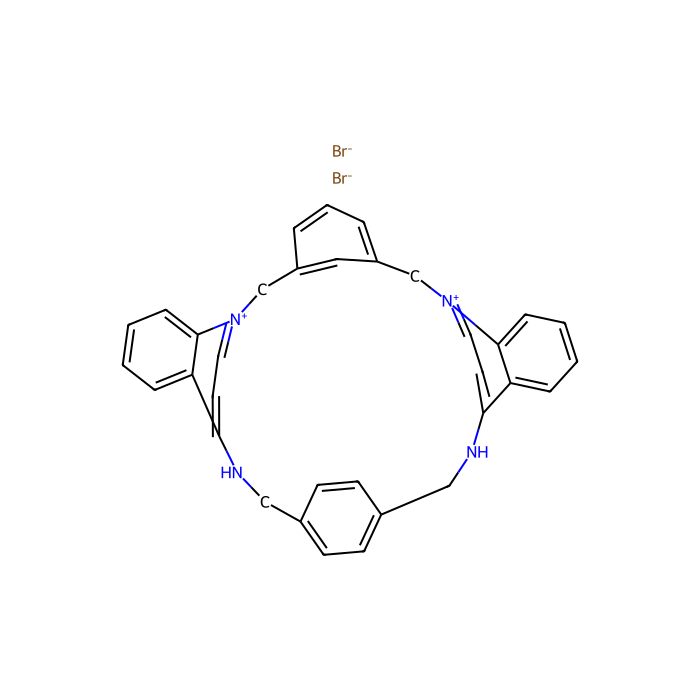
Determine the necessary mass, volume, or concentration for preparing a solution.
| Activity Type | Activity Value -log(M) | Mechanism of Action | Activity Reference | Publications (PubMed IDs) |
|---|
Taxonomy Tree
| Kingdom | Organic compounds |
|---|---|
| Superclass | Organoheterocyclic compounds |
| Classe | Quinolines and derivatives |
| Subclass | Aminoquinolines and derivatives |
| Intermediate Tree Nodes | Not available |
| Direct Parent | 4-aminoquinolines |
| Alternative Parents | Secondary alkylarylamines Aralkylamines Pyridinium derivatives Benzenoids Heteroaromatic compounds Azacyclic compounds Organic bromide salts Hydrocarbon derivatives Organic cations |
| Molecular Framework | Aromatic heteropolycyclic compounds |
| Substituents | 4-aminoquinoline - Secondary aliphatic/aromatic amine - Aralkylamine - Pyridine - Pyridinium - Benzenoid - Heteroaromatic compound - Secondary amine - Azacycle - Hydrocarbon derivative - Organic salt - Organonitrogen compound - Organic nitrogen compound - Amine - Organic bromide salt - Organic cation - Aromatic heteropolycyclic compound |
| Descrição | This compound belongs to the class of organic compounds known as 4-aminoquinolines. These are organic compounds containing an amino group attached to the 4-position of a quinoline ring system. |
| External Descriptors | Not available |
| Activity Type | Activity Value -log(M) | Mechanism of Action | Activity Reference | Publications (PubMed IDs) |
|---|
| Solubilidade | Solvent:DMSO, Max Conc. mg/mL: 7.21, Max Conc. mM: 10 |
|---|---|
| Sensibilidade | Light sensitive |
| Peso molecular | 654.4 |
| XLogP3 | |
| Hydrogen Bond Donor Count | 2 |
| Hydrogen Bond Acceptor Count | 4 |
| Rotatable Bond Count | 0 |
| Exact Mass | 654.082 Da |
| Monoisotopic Mass | 652.084 Da |
| Topological Polar Surface Area | 31.800 Ų |
| Heavy Atom Count | 40 |
| Formal Charge | 0 |
| Complexity | 689.000 |
| Isotope Atom Count | 0 |
| Defined Atom Stereocenter Count | 0 |
| Undefined Atom Stereocenter Count | 0 |
| Defined Bond Stereocenter Count | 0 |
| Undefined Bond Stereocenter Count | 0 |
| The total count of all stereochemical bonds | 0 |
| Covalently-Bonded Unit Count | 3 |
No vendor-tested application protocols are provided for this item. The following general guidance is offered for small-molecule tool compounds (not item-specific and not a substitute for method validation):
Always develop and validate protocols under your laboratory’s QA practices and consult the SDS for safe handling.
General/literature context (not item-specific claims):
Important: The present catalog entry does not specify target, potency, or selectivity for this particular lot; please consult primary literature for UCL 1684 generally and rely on your own characterization for your experimental system.
This product is not a classical buffering agent. However, practical buffer considerations apply when preparing assay solutions of small-molecule tool compounds:
Because no buffer recipes or pKa values are specified for this item, optimize buffer composition empirically for your assay format and document conditions alongside compound lot information.
For bioassay stock preparation, solvent selection and handling can influence environmental footprint. While this item is not a process solvent or bulk reagent, consider the following greener practices:
Illustrative comparison (general, not item-specific):
Operational tips:
Item-specific specifications:
General/literature context (not item-specific; verify experimentally):
This catalog item is positioned as a small-molecule library compound rather than a synthetic reagent. Consequently, it is not typically used as a solvent, coupling partner, or stoichiometric reagent in preparative organic synthesis.
Research applications (general/literature context, not item-specific claims):
If you require a building block or reagent grade material for synthesis, please refer to our dedicated reagents catalog. For this item, emphasize careful solution preparation, vehicle controls, and documentation of the specific salt form and purity (from the CoA) for reproducibility.
Not typically applicable. UCL 1684 is offered as a bioactive tool compound rather than a reagent used in chemical transformations. No standard preparative reaction conditions are associated with this item.
General laboratory handling for solution preparation (not reaction conditions):
Item-specific hazard data:
General precautions (good laboratory practice; not a substitute for SDS):
Item-specific instructions from Product Data:
Reconstitution (general guidance; verify with your lot’s CoA):
Note: All parameters not explicitly stated above are not specified for this item; refer to the CoA/SDS for definitive guidance.
Structural features (general/literature context):
This item is not typically employed as a synthetic building block or reagent. It is primarily used as a bioactive small molecule for screening and mechanism studies.
General notes for chemists considering derivatization (literature context, not item-specific):
For conventional synthetic tasks (cross-coupling, nucleophilic substitutions, etc.), please refer to dedicated reagents within our catalog.
Item-specific target data are not provided for this catalog entry.