≥99% para fluxos de trabalho cromatográficos e analíticos sensíveis que exigem interferência mínima da linha de base.
🌡
Armazenamento e envio
Store at -20°C Envio Ice chest + Ice pads. Consulte o COA específico do lote para obter as especificações exatas.
📋
Documentos de qualidade
SDS, COA, ficha técnica e folha de especificações disponíveis para download. COA específico do lote acessível por meio de pesquisa por número de lote.
📚
Comprovação documental
Citado em 0 publicações revisadas por pares nas áreas de cromatografia, síntese orgânica e reações de acoplamento cruzado.
Visão geral
Utreloxastat (PTC857) is a compound used for the research of the disorders including α-synucleinopathies, tauopathies, Amyotrophic lateral sclerosis (ALS), traumatic brain injury, and ischemic-reperfusion related injuries (patent WO2020081879A2, example A1).
Form:Solid
Especificações
Especificações e pureza
≥99%
Mecanismos bioquímicos e fisiológicos
Utreloxastat (PTC857) is a compound used for the research of the disorders including α-synucleinopathies, tauopathies, Amyotrophic lateral sclerosis (ALS), traumatic brain injury, and ischemic-reperfusion related injuries (patent WO2020081879A2, example A
Condições de armazenamento de armazenamento
Store at -20°C
Enviado em
Ice chest + Ice pads
Este produto requer transporte de cadeia fria. Serviços terrestres e outros serviços econômicos não estão disponíveis.
Pureza
≥99%
Nomes e identificadores
Sorrisos canónicos
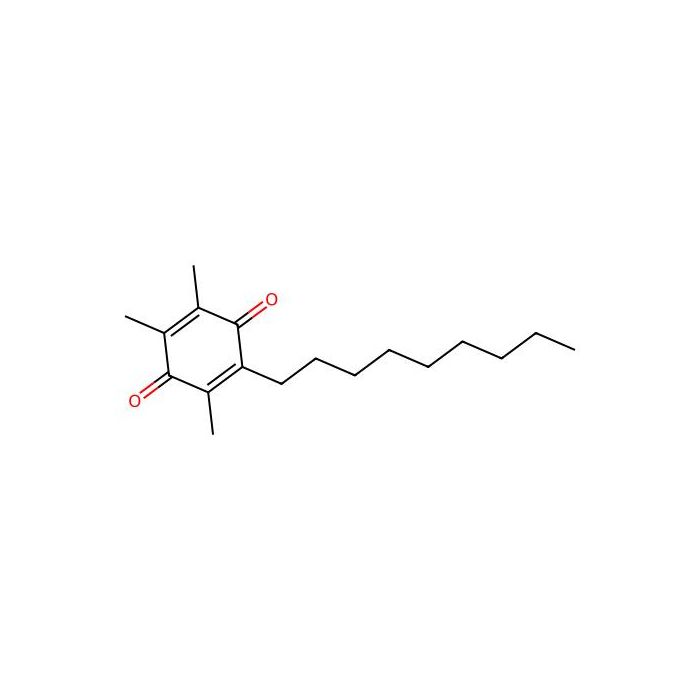
CCCCCCCCCC1=C(C(=O)C(=C(C1=O)C)C)C
SMILES isoméricas
CCCCCCCCCC1=C(C(=O)C(=C(C1=O)C)C)C
PubChem CID
46174641
Peso molecular
276.41
Documentação
📋 Ficha de dados de segurança (FDS)
Documento abrangente sobre perigos, manuseamento, armazenamento e conformidade regulamentar.
DMSO : 50 mg/mL (180.89 mM; ultrasonic and warming and heat to 60°C)
Peso molecular
276.400 g/mol
XLogP3
5.800
Hydrogen Bond Donor Count
0
Hydrogen Bond Acceptor Count
2
Rotatable Bond Count
8
Exact Mass
276.209 Da
Monoisotopic Mass
276.209 Da
Topological Polar Surface Area
34.100 Ų
Heavy Atom Count
20
Formal Charge
0
Complexity
438.000
Isotope Atom Count
0
Defined Atom Stereocenter Count
0
Undefined Atom Stereocenter Count
0
Defined Bond Stereocenter Count
0
Undefined Bond Stereocenter Count
0
The total count of all stereochemical bonds
0
Covalently-Bonded Unit Count
1
Calculadoras de soluções
Molarity Calculator
Determine the necessary mass, volume, or concentration for preparing a solution.
Dilution Calculator
Determine the dilution needed to prepare a stock solution.
Reconstitution Calculator
Revisões
Avaliações dos Clientes
Application Protocols
No tested or recommended application protocols are provided for this item in the product data. Refer to your internal SOPs and the scientific literature relevant to your assay system. All uses are for research purposes only.
Biological Roles
Item-specific biological targets or mechanisms are not provided in this listing. No endogenous biological role is claimed for this catalog item.
General considerations for small-molecule research tools (not item-specific)
Compounds in discovery libraries are evaluated for interaction with proteins, nucleic acids, membranes, or pathways. Any observed activity is context- and assay-dependent and must be independently confirmed.
Establish concentration–response relationships, on-target/off-target profiling, and cytotoxicity baselines before interpreting phenotypes.
Confirm apparent mechanisms of action by using orthogonal assays (biochemical vs cellular), counterscreens, and, where applicable, chemoproteomics.
Evaluate stability in relevant media (buffer, serum, microsomes) to ensure that readouts reflect the parent compound rather than degradation products.
Note: This product is supplied strictly for research use; no clinical, diagnostic, or therapeutic applications are implied or supported.
Buffer Applications
This product is not a buffering agent and is not typically used to set or maintain pH.
Assay buffer integration (general guidance)
When dosing from DMSO stocks, keep final DMSO concentration low (commonly ≤0.1–1% v/v) to minimize solvent effects on enzymes or cells.
To mitigate precipitation upon dilution, introduce the DMSO stock into vigorously stirred buffer or premix with a small volume of ethanol/PEG before dilution.
If ionizable groups are suspected, screen pH compatibility (e.g., pH 5–8) and monitor for degradation by LC.
For pH control, use established buffer systems (e.g., phosphate, HEPES, Tris) appropriate to the assay; this product is not a substitute for those reagents.
Green Alternatives
Where feasible, reduce environmental and safety footprint in handling and formulation. The following notes are general and not item-specific.
Greener dissolution and processing options
Prefer ethanol or water-cosolvent systems over DMF/DMAC where solubility allows.
Use aqueous enabling excipients (e.g., HP-β-cyclodextrin, Captisol) to minimize DMSO burden in biological assays, verifying that the excipient does not confound readouts.
For chromatography, consider ethanol or ethyl acetate in place of dichloromethane or acetonitrile when compatible with resolution.
Small comparison (general)
DMSO vs ethanol: DMSO offers higher solvency; ethanol offers better EHS profile and easier waste handling. Tradeoff is lower solubility.
DMF/DMAC vs MeOH/EtOH: Amide solvents have higher health concerns; alcohols are greener but may extract moisture and alter stability.
Operational suggestions
Scale solutions to immediate need; avoid over-preparing stocks that may expire.
Consolidate analytical runs to reduce solvent use; employ UPLC to lower mobile-phase volumes.
Segregate halogenated from non-halogenated waste; use solvent recovery where permitted.
Pharmaceutical Uses
No excipient role or pharmacopeial monograph is provided for this item.
Research/formulation context only (general guidance)
Preformulation screens: Determine solubility in pharmaceutically acceptable solvents/co-solvents (e.g., ethanol, PEG400) and assess chemical stability (hydrolysis, oxidation, photolysis) to inform research formulations.
Solid-state assessment: If adequate material is available, evaluate crystallinity/polymorph and hygroscopicity as these affect dissolution and handling.
Compatibility: Check adsorption to plastics and glass; surfactants or protein carriers (e.g., serum albumin in research media) can reduce loss.
Important: This product is supplied strictly for research use only; no claims are made or implied regarding therapeutic suitability or clinical applications.
Physical Properties
Item-specific physicochemical data have not been provided in this listing; consult the CoA/Spec Sheet for definitive specifications.
Appearance: Not specified for this item; refer to CoA/Spec Sheet.
Melting point (MP): Not specified for this item; refer to CoA/Spec Sheet.
Boiling point (BP): Not specified for this item; refer to CoA/Spec Sheet.
Density: Not specified for this item; refer to CoA/Spec Sheet.
Solubility: Not specified for this item; refer to CoA/Spec Sheet.
logP/logD, pKa, refractive index: Not specified for this item; refer to CoA/Spec Sheet.
General laboratory considerations (literature/practice—not item-specific)
Many small organic research compounds dissolve well in DMSO and DMF; aqueous solubility may be limited without co-solvent, surfactant, or pH adjustment.
Assess solubility empirically at room temperature in DMSO first (e.g., 10–50 mM trial), then prepare aqueous dilutions with controlled DMSO carryover.
If needed, consider co-solvent blends (e.g., DMSO:water, DMSO:PEG400:water) or inclusion complexes (e.g., HP-β-CD) for assay use.
Determine purity and stability by HPLC/UPLC with photodiode array and/or MS detection; perform accelerated stability screens (40–60 °C, light/air exposure) to establish handling limits.
Quality and Grades
Grade/purity: Not specified for this item; refer to CoA/Spec Sheet.
Interpreting grade and documentation (general guidance)
CoA review: Confirm identity (NMR/MS), purity (HPLC/UPLC, area % with method details), residual solvents, and water content (KF) when available.
Research/Screening grade: For small-molecule libraries, purity is typically reported by LC (often ≥95% by area), but confirm the exact figure on the CoA. Chromatographic purity does not guarantee absolute content; consider qNMR if assay precision is critical.
Stabilizers: If present, stabilizers or formulating excipients will be listed on the CoA/SDS. Their presence can affect analytical baselines and biological assays.
Batch-to-batch: Record lot numbers and retain spectra/chromatograms for method continuity; subtle differences in polymorph/solvate state may influence dissolution.
Reaction and Applications
This product is categorized under “small molecule and compound libraries” and is typically used as a test article or reference in discovery workflows rather than as a synthetic reagent.
Discovery and screening use (general, not item-specific)
Biochemical/cellular assays: Evaluate concentration–response, target engagement, and pathway modulation under controlled DMSO carryover.
ADME profiling: Solubility, permeability (e.g., PAMPA/Caco-2), microsomal stability, and protein binding to understand exposure potential.
Analytical controls: Establish LC–MS/MS quantitation methods for exposure or stability studies; generate standard curves from accurately weighed material.
If employing in chemistry workflows
Not commonly used as a reagent in named organic transformations; no item-specific reactivity data is provided.
If analog synthesis is planned, build orthogonal analytical methods (qNMR, HPLC–PDA, HRMS) to track impurity growth and degradation products.
Documentation
Record exact lot, preparation route (stock solvent, concentration), and storage history with each assay to ensure reproducibility across campaigns.
Reaction Conditions
No item-specific reaction conditions are applicable; this product is not listed as a reagent for chemical synthesis.
General laboratory handling conditions for test articles (not item-specific)
Stock solutions: Commonly prepared at 10–50 mM in anhydrous DMSO; filter through 0.22 µm PTFE if particulate is observed.
Stability checks: Assess freeze–thaw stability (up to 3–5 cycles), bench-top stability at room temperature (2–6 h), and light sensitivity (foil wrap) using HPLC.
Adsorption: Pre-rinse plasticware with dilute solution to minimize loss at low concentrations.
Temperature: Keep solutions on ice during assay staging if instability is suspected; otherwise, equilibrate to assay temperature before dosing to prevent precipitation.
Safety and Handling
Use appropriate laboratory precautions. Definitive hazard classification for this catalog item is not provided here—defer to the product SDS.
GHS classification, signal word, pictograms, H-statements: Not specified for this item; refer to SDS.
Research use: For research use only; not for human or veterinary use.
Safe handling (general best practice)
PPE: Lab coat, safety glasses, and suitable gloves (e.g., nitrile). Handle powders/solid particulates in a fume hood to avoid inhalation.
Avoid skin/eye contact and ingestion. Wash hands thoroughly after handling.
Prevent aerosol/dust formation; use antistatic measures if handling fine powders.
Chemical incompatibilities: Absent item-specific data, keep away from strong oxidizers/reductants, strong acids/bases, and ignition sources. Do not mix with unknown reagents.
First aid (general): Eye/skin contact—rinse with water for ≥15 minutes; inhalation—move to fresh air; ingestion—seek medical attention. Always follow SDS instructions.
Storage and transport
Storage conditions (item-specific): Store at -20 °C.
Shipping (item-specific): Shipped in ice chest with ice pads to help maintain a cool chain.
Minimize freeze–thaw; aliquot upon first opening. Protect from light and moisture unless data indicate otherwise.
Solvent Selection
Item-specific solubility parameters are not provided; choose solvents empirically and document outcomes.
General solvent strategy for small organic research compounds
Primary stock solvent: DMSO is typically preferred for high-concentration stocks (e.g., 10–50 mM) due to broad solvency and assay compatibility at ≤0.1–1% v/v carryover.
Secondary options: DMF, methanol, ethanol, acetonitrile for analytical preparations; PEG400 or Captisol/HP-β-CD for aqueous delivery in vivo-like models (research only).
Aqueous dilution: Add DMSO stock to vigorously stirred buffer to avoid local supersaturation/precipitation; include surfactants (e.g., 0.01–0.1% Tween 80) if compatible with the assay.
pH effects: If the compound is ionizable (unknown here), pH adjustment can modulate solubility; verify stability at adjusted pH by HPLC.
Quick comparison (general)
DMSO: Highest solvency; possible assay interference at high %.
Ethanol/MeOH: Lower solvency vs DMSO; generally more benign but can affect cells/enzymes.
ACN: Good for LC and sample prep; limited for biological assays.
Aqueous/CD complexes: Enable water-based delivery; may alter apparent potency—re-verify controls.
Storage and Reconstitution
Item-specific storage and logistics
Storage conditions: Store at -20 °C.
Shipping configuration: Ice chest with ice pads to maintain a cold chain during transit.
Reconstitution guidance (general, not item-specific)
Open under low-humidity conditions if moisture sensitivity is suspected. Allow the container to equilibrate to room temperature before opening to minimize condensation.
Prepare a small test stock (e.g., 10 mM) in anhydrous DMSO to assess solubility; gently warm (30–40 °C) and vortex/sonicate if needed. Do not overheat.
Sterile filtration (0.22 µm PTFE/nylon) may be used for cell-based assays if compatible with the solvent system.
Aliquot immediately into single-use vials to avoid repeated freeze–thaw. Store aliquots at -20 °C or below; protect from light.
Record preparation details (lot, concentration, solvent, date) and set review dates for periodic re-analysis by HPLC to confirm stability.
Note: Any item-specific specifications (water content, purity, stabilizers) are not provided here—consult the CoA/Spec Sheet for definitive instructions.
Structure and Identity
Overview of the catalog entry for professional use.
SKU: U646446
Product name: Utreloxastat
CAS: 1213269-96-5
PubChem CID: 46174641
Molecular formula: Not specified for this item; refer to CoA/Spec Sheet.
Molecular weight: Not specified for this item; refer to CoA/Spec Sheet.
SMILES: Not specified for this item; refer to CoA/Spec Sheet.
InChIKey: Not specified for this item; refer to CoA/Spec Sheet.
Structural notes
Item-specific structural features (ring systems, heteroatoms, stereochemistry): Not specified for this item; refer to CoA/Spec Sheet.
2D/3D depiction: Not provided in this listing. Consult the CoA/SDS or authoritative databases (e.g., the cited PubChem CID) for structural drawings and identifiers.
Identity control suggestions (general guidance)
Verify identity via orthogonal techniques: 1H/13C NMR, HRMS/ESI-MS, and HPLC/UPLC purity profiling. If chiral, add chiral HPLC.
Cross-reference CAS and CID during method setup to avoid mix-ups with similarly named investigational compounds.
Synthetic Utility
This item is supplied as a discrete small molecule for research use; it is not positioned as a general-purpose synthetic reagent or building block in this listing.
General considerations if derivatization is contemplated (not item-specific)
Without a disclosed structure here, reactivity cannot be predicted. If the structure is known to your team, plan protecting-group strategy and chemoselective handles accordingly.
Establish robust analytics (qNMR for assay, LC–MS for purity) before and after any transformations to ensure identity retention and track impurities.
For SAR efforts, define convergence points (core vs periphery) and design enabling intermediates that tolerate late-stage diversification.
If used merely as reference material
Use as a standard in analytical method development (e.g., LC–MS/MS calibration) with weight-based preparation and verified purity from the CoA.
Target Specificity
Not specified for this item; refer to CoA/Spec Sheet or primary literature associated with the CAS or CID for any publicly disclosed targets. No target claims are made in this catalog entry.
Perguntas frequentes
What is the purity of this product?
This product is supplied at ≥99% purity (chemical assay). Lot-specific values are stated on the Certificate of Analysis.
How should this product be stored?
Store at ?20 °C. Freezer storage is required to maintain the specified shelf life.
How is this product shipped?
This product ships in an insulated container with ice pads. Unpack on arrival and transfer it to the storage condition stated above.
What are the CAS number, molecular formula and molecular weight?
The CAS Number is 1213269-96-5, the molecular formula is C18H28O2, and the molecular weight is 276.41 g/mol.
What documentation is provided?
Available product documentation, including Certificates of Analysis (COA), Safety Data Sheets (SDS), and specification sheets, is shown in the product document area. Document availability and access follow the current site policy.
Usamos cookies para garantir o funcionamento adequado do site e, quando permitido, para melhorar a sua experiência. Você pode gerenciar suas preferências a qualquer momento nas Configurações. Saiba mais em nossa Política de Cookies.
Deseja que lhe enviemos uma mensagem quando tivermos descontos disponíveis?
Lembrar-me mais tarde
Obrigado! Por favor, verifique a sua caixa de entrada de e-mail para confirmar.
Products are supplied to verified businesses, institutions, and qualified professionals for research and development use only. Not for use in humans, animals, diagnosis, or therapy.