GRADE & PURITYCarrier Free?Carrier-free — supplied without added carrier protein/stabilizer. Use when carriers (e.g. BSA) would interfere with conjugation or sensitive assays.ExactAb™?ExactAb™ — Aladdin's antibody line emphasizing precision and validated quality. Use for reliable, specificity-validated antibody applications.Azide Free?Azide-free — without sodium azide preservative. Use in conjugations, cell work, or assays where azide is toxic or inhibitory.Validated?Validated grade — performance confirmed in defined applications before release. Use when you want documented assurance the reagent works as stated.High Performance?High-performance grade with optimized purity and performance characteristics. Use for sensitive analyses where ordinary grades fall short.≥95%(SDS-PAGE)0.5 mg/mL
Carrier Free,ExactAb™,Azide Free,Validated,High Performance,≥95%(SDS-PAGE),0.5 mg/mL Azide Free,Carrier Free,ExactAb™,High Performance,Validated for sensitive chromatographic and analytical workflows requiring minimal baseline interference.
🌡
Storage & shipping
Store at -20°C,Avoid repeated freezing and thawing Ships Ice chest + Ice pads Check lot-specific COA for exact specifications.
📋
Quality documents
SDS, COA, datasheet, and spec sheet available for download. Lot-specific COA accessible via lot number lookup.
📚
Literature proof
Cited in 0 peer-reviewed publications across chromatography, organic synthesis, and cross-coupling reactions.
Visão geral
Mouse anti V5 tag, clone G02/4B4, could be used for WB, ELISA and so on.
Specifications
Product Name
V5 tag Mouse mAb - Primary antibody, specific to Recombinant protein containing V5.
Sinónimos
GKPIPNPLLGLDST epitope tag, GKPIPNPLLGLDST tag, Protein Rev, Regulator of expression of viral proteins, V5 epitope tag | V5 tag Mouse Monoclonal Antibody | V5 tag Mouse mAb | Anti-V5 tag | Monoclonal Anti- V5 tag antibody | V5 tag Mouse Monoclonal An
Essential cofactor of the RNA polymerase L that plays a central role in the transcription and replication by forming the polymerase complex with RNA polymerase L and recruiting L to the genomic N-RNA template for RNA synthesis.
Also plays a central role i
Espécie hospedeira
Mouse
Especificidade
Recombinant protein containing V5.
Imunogénio
A recombinant protein containing V5.
Controlo positivo
WB: V5-transfected HEK293
Conjugação
Unconjugated
Grau
Azide Free, Carrier Free, ExactAb™, High Performance, Validated
Tipo de corrente de luz
kappa
SDS-PAGE
150.0 KDa
Método de purificação
Protein A purified
Concentração
0.5 mg/mL
Product Line
Produtos biológicos
Armazenamento e envio
Condições de armazenamento de armazenamento
Store at -20°C,Avoid repeated freezing and thawing
Enviado em
Ice chest + Ice pads
Estabilidade e armazenamento
Store at 2-8℃ short term (1-2 weeks). Store at -20℃ long term (24 months). Upon receipt, it is recommended to aliquot. Avoid freeze/thaw cycle.
Imagens
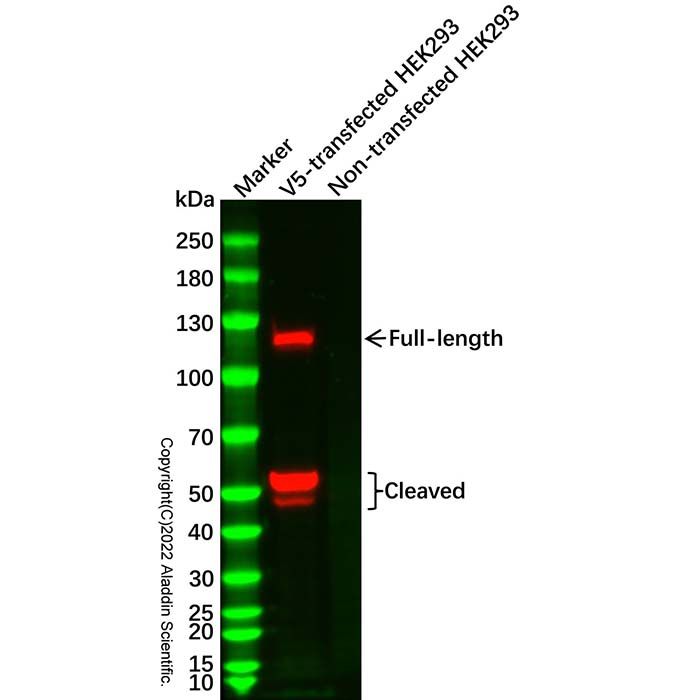
V5 Mouse mAb (Ab170507) - Western Blot
All lanes: V5 Mouse mAb (Ab170507) at 1/1000 dilution
Samples: Lysates at 20 µg per lane
Secondary: Goat Anti-Mouse IgG H&L (HRP) (Ab179001) at 1/20000 dilution
Predicted band size: 48, 115 kDa
Observed band size: 53, 119 kDa
Exposure time: 60.0 s
Documentation
📋 Safety Data Sheet (SDS)
Comprehensive hazard, handling, storage, and regulatory compliance document.
Determine the necessary mass, volume, or concentration for preparing a solution.
Dilution Calculator
Determine the dilution needed to prepare a stock solution.
Reconstitution Calculator
Revisões
Avaliações dos Clientes
Application Protocols
Tested/validated applications, recommended working dilutions, and positive control samples: Not specified for this item; refer to the product CoA/Spec Sheet and SDS for authoritative guidance.
General note:
As best practice, perform a small-scale titration in your assay format (WB, IF/ICC, IP, ELISA, or FC) to determine the optimal antibody amount, incubation time, and buffer composition for your specific sample and instrumentation.
Biological Roles
Applicability note: This product is an anti-tag monoclonal antibody for research use only; it does not have intrinsic biological roles in vivo.
General background (literature):
V5 epitope tag: A short peptide sequence (commonly GKPIPNPLLGLDST) derived from the P/V proteins of paramyxoviruses, widely used as a small, minimally perturbing affinity tag for recombinant protein detection and purification.
Function in research: The V5 tag provides a defined, high-affinity epitope recognized by anti-V5 antibodies, enabling consistent detection across different fusion proteins independent of native protein-specific antibodies.
Antibody–antigen interaction: Binding is non-covalent and driven by shape complementarity and hydrogen-bonding/hydrophobic contacts within the complementarity-determining regions (CDRs) of the monoclonal antibody.
Cellular/biochemical workflows: V5 tagging supports studies of protein expression levels, localization, trafficking, complex assembly, and post-translational modifications by enabling uniform detection.
Not applicable for this item:
No claims are made regarding clinical diagnostic or therapeutic roles. Species cross-reactivity is inherent to the tag (sequence-based) but specific performance parameters are not specified for this item; refer to CoA/Spec Sheet.
Buffer Applications
Item-specific tested buffer systems: Not specified for this item; refer to CoA/Spec Sheet.
General buffer guidance for V5 tag antibody workflows (literature/practice):
Western blot/ELISA: Use PBS or TBS at pH 7.4–7.6 with 0.05% Tween-20 for washes. Blocking with 3–5% BSA or milk (avoid milk if phospho-epitopes or biotin-streptavidin systems are involved). Carrier-free format reduces background in milk/BSA-based blocks.
Immunofluorescence/ICC: PBS or HEPES-buffered saline at pH 7.2–7.6; include permeabilizer (0.1–0.3% Triton X-100 or 0.1% saponin) for intracellular targets. For live-cell labeling (if applicable), maintain azide-free buffers and isotonicity.
Immunoprecipitation: Lysis buffers such as NP-40 or Triton X-100 based (e.g., 50 mM Tris pH 7.5, 150 mM NaCl, 1% NP-40) with protease/phosphatase inhibitors. Wash with reduced detergent (0.1–0.5%) to balance stringency vs yield.
Storage buffers: Neutral pH (7.2–7.6) with 10–50% glycerol for −20 °C storage if freezing is necessary. Maintain azide-free conditions for live-cell compatibility.
Notes:
Exact pH, salt, and additive composition for this item are not specified; consult the CoA/Spec Sheet and adapt to your assay.
Green Alternatives
Context for this item:
The product is Azide Free and Carrier Free, which can reduce environmental and downstream assay burdens. Sodium azide is acutely toxic to aquatic life; its absence lowers hazards in aqueous waste streams but requires stricter aseptic technique.
Greener practice considerations (general guidance):
Preservatives: If a preservative is necessary, consider low-toxicity alternatives at minimal effective concentrations (e.g., ProClin-type biocides) while ensuring appropriate waste handling. Validate for assay compatibility.
Stabilization without carriers: Use low-bind plastics to minimize protein loss; this avoids adding carrier proteins that increase bio-load in waste.
Energy footprint: Store working aliquots at 4 °C for short periods (days to a week) when feasible to reduce freezer usage, ensuring sterility and monitoring for microbial growth. Long-term storage remains at −20 °C per Product Data.
Buffer choices: Favor phosphate- or HEPES-based buffers prepared with ultrapure water; avoid volatile organic components.
Comparison (general):
Azide-containing antibody vs Azide-free (this item):
Pros (azide-free): compatible with live cells and enzyme conjugation; improved environmental profile.
Cons: no bacteriostatic protection; higher contamination risk—use sterile technique and smaller aliquots.
Waste management:
Segregate proteinaceous aqueous waste; avoid discharging azide-containing solutions to drains. Follow institutional green lab guidelines.
Pharmaceutical Uses
This product is labeled “For research use only” and is not intended for diagnostic, therapeutic, or clinical applications.
General considerations (literature/practice):
Anti-tag monoclonal antibodies, such as anti-V5, are commonly used as analytical reagents in biopharmaceutical development workflows (e.g., detection of tagged constructs during discovery, cell line development, and process analytics) but are not themselves pharmaceutical ingredients.
Carrier-free and azide-free formats are advantageous when downstream conjugation (e.g., to enzymes or fluorophores) is required for in-process analytics, or when interference from carriers/preservatives must be minimized.
Item-specific pharmacopeial status and QC tests:
Not specified for this item; refer to CoA/Spec Sheet for any compendial references or additional quality attributes relevant to regulated environments.
Physical Properties
Item-specific properties:
Appearance: Not specified for this item; refer to CoA/Spec Sheet.
Concentration, buffer composition, and excipients: Not specified for this item; refer to CoA/Spec Sheet.
Storage: Store at −20 °C; avoid repeated freezing and thawing.
General protein antibody properties (literature/general guidance; not item-specific specifications):
Antibodies are water-soluble globular proteins; typical storage buffers include PBS or HEPES with protein stabilizers (e.g., 0.1–1% carrier protein) unless carrier-free.
pI varies by clone (commonly pI ~6–9 for mouse IgG subclasses; literature); solubility is high in isotonic aqueous buffers at neutral pH.
Thermal sensitivity: prolonged exposure to >37 °C denatures most IgG; freeze–thaw cycles can reduce binding activity via aggregation.
Any parameters such as exact protein concentration, buffer salts, stabilizers, pH, or endotoxin level are not specified for this item; refer to CoA/Spec Sheet.
Carrier Free: Formulated without carrier proteins (e.g., BSA, gelatin). Implications: reduced background in immunoassays, compatibility with conjugation and mass spectrometry; may require low-bind plastics to minimize adsorption.
Azide Free: No sodium azide preservative. Advantages: compatible with live-cell applications and enzyme-based detection systems sensitive to azide; requires stricter aseptic handling.
ExactAb™: Branded quality indicator signifying tightly controlled production and characterization (binding, purity, and lot-to-lot consistency). Refer to CoA/Spec Sheet for the specific QC tests used for this item.
Validated, High Performance: Indicates internal application verification and performance benchmarking. Specific tested applications, species cross-reactivity, and performance metrics are not specified for this item; refer to datasheet/CoA.
What these grades mean in practice (general guidance for professional users):
Carrier-free and azide-free formats are preferred for custom conjugation (enzymes, fluorophores), cell-based assays, and sensitive biophysical workflows (ITC, SPR, BLI), avoiding interference from carriers or azide.
High-performance validation typically entails assessing specificity to the V5 epitope, minimal off-target binding in negative controls, and robustness across recommended assay conditions.
Not specified for this item; refer to CoA/Spec Sheet:
Item-specific applications explicitly provided: Not specified for this item; refer to datasheet/CoA.
General applications of V5 tag monoclonal antibodies (literature/practice; not item-specific claims):
Western blotting (WB): Detects V5-tagged fusion proteins denatured on membranes using anti-V5 primary followed by tagged secondary.
Immunofluorescence (IF)/Immunocytochemistry (ICC): Visualizes cellular localization of V5-tagged constructs in fixed/permeabilized cells.
Immunoprecipitation (IP)/Co-IP: Captures V5-tagged proteins (and associated complexes) from lysates using anti-V5 antibody bound to Protein A/G or magnetic beads.
ELISA: Detects V5-tagged proteins in solution as capture or detection reagent.
Flow cytometry (FC): Surface or intracellular detection of V5-tagged proteins in cell populations (permeabilization may be required).
Practical tips (general):
Epitope accessibility: The V5 tag (commonly GKPIPNPLLGLDST) should be placed N- or C-terminally with a flexible linker if needed to ensure exposure. Validate orientation and proximity to membranes or fusion partners.
Controls: Include untagged negative controls and peptide competition where applicable to confirm specificity.
Binding conditions: Maintain physiological salt (100–150 mM NaCl) and neutral pH ~7.4; add mild detergent (0.05% Tween-20) for WB/ELISA to reduce nonspecific interactions.
Beads selection: Choose Protein G or A based on the antibody’s subclass (subclass not specified for this item; confirm on CoA).
Reaction Conditions
Applicability note: There are no chemical “reaction conditions” per se for antibodies. Below are general incubation conditions for common immunoassays (literature/practice). These are not item-specific validated conditions.
General incubation guidelines (starting points):
Western blot (WB): Primary antibody incubation 1–2 h at room temperature or overnight at 4 °C in TBST or PBST with 3–5% BSA or milk. Wash 3× 5–10 min in TBST/PBST. Secondary per supplier’s guidance.
Immunofluorescence/ICC: Incubate primary 1 h at room temperature or overnight at 4 °C in blocking buffer (e.g., 1–3% BSA in PBS). Include permeabilizer for intracellular antigens. Wash 3× with PBS.
Immunoprecipitation (IP): Incubate lysate with antibody 1–2 h at 4 °C (or overnight) with rotation; capture on Protein A/G beads for 1 h; wash 3–5× with lysis/wash buffer; elute under denaturing or gentle conditions depending on downstream analysis.
ELISA: Coat capture reagent as appropriate; for detection with anti-V5, incubate primary 1 h at room temperature; optimize with pilot titrations.
Important for this item:
Tested applications, recommended dilutions, and validated conditions are not specified; consult the CoA/Spec Sheet. Start with small pilot titrations to determine optimal working ranges for your workflow.
Safety and Handling
Item-specific hazard information:
Signal word / H-statements / GHS classification / Pictograms: Not specified for this item; refer to SDS.
Research use: For research use only (from Product Data). Not for diagnostic or therapeutic use.
General safety guidance for antibodies and protein reagents (literature/practice):
PPE: Wear lab coat, disposable gloves, and safety glasses when handling solutions or lyophilized protein.
Biosafety: Treat as a low-hazard biological reagent but use aseptic technique to avoid microbial contamination. Avoid inhalation of aerosols and contact with skin/eyes.
Incompatibilities: Avoid strong oxidants, proteases, and extreme pH (<5 or >9) unless validated; these may denature or digest IgG. Avoid repeated freeze–thaw cycles (aggregation and loss of activity).
First aid: In case of skin/eye contact, rinse with water. If inhaled, move to fresh air. If swallowed, rinse mouth. Seek medical advice if irritation persists. Defer to SDS for authoritative instructions.
Waste: Dispose of protein solutions and contaminated materials according to institutional biological waste procedures.
Special notes for this item:
Azide Free: Lacks sodium azide; lowers acute aquatic toxicity concerns but also removes bacteriostatic protection—maintain sterility and store cold.
Carrier Free: No added protein carriers; reduces background in assays but may increase adsorption to plastics—use low-bind consumables.
Solvent Selection
Applicability note: For antibodies, “solvent” refers to the aqueous buffer system. No organic solvent selection is typically relevant.
Item-specific details:
Buffer composition and pH: Not specified for this item; refer to CoA/Spec Sheet.
General guidance (literature/practice):
Preferred media: Neutral isotonic buffers such as PBS (10–50 mM phosphate, 150 mM NaCl, pH 7.2–7.6) or HEPES-buffered saline (pH 7.2–7.6) support IgG stability.
Additives (when compatible with application): 0.01–0.05% nonionic surfactant (e.g., Tween-20) can reduce surface adsorption during handling; 10–50% glycerol enables −20 °C storage without freezing. For carrier-free formats, avoid protein carriers unless needed.
Avoid: High percentages of organic cosolvents, strong reducing agents, proteases, and extremes of pH/ionic strength unless validated for your assay.
Live-cell or enzyme-sensitive workflows: Azide-free is appropriate. Maintain sterility (0.22 µm filtration) if long-term refrigerated storage is needed.
When to choose alternatives:
For direct detection, consider purchasing pre-conjugated formats (fluorophore or HRP) to avoid an extra conjugation step.
For immobilization assays (SPR/BLI), use low-salt, amine-free buffers (e.g., acetate, pH 4–5) during coupling steps, then switch to running buffer (e.g., HBS-EP).
Storage and Reconstitution
Item-specific storage and shipping (from Product Data):
Storage: Store at −20 °C. Avoid repeated freezing and thawing.
Item-specific formulation details (concentration, buffer, pH, stabilizers): Not specified for this item; refer to CoA/Spec Sheet.
General handling guidance (literature/practice):
Upon receipt: Inspect for container integrity. If liquid, briefly centrifuge to collect contents. If lyophilized (not specified), reconstitute with sterile, antibody-grade buffer (e.g., PBS) to the desired concentration using low-bind tips/tubes.
Aliquoting: Immediately prepare small working aliquots to avoid freeze–thaw cycles. For −20 °C storage, consider adding sterile glycerol to 10–50% to enable storage without complete freezing if compatible with your application (maintain azide-free if live cells or azide-sensitive enzymes are used).
Aseptic technique: Because the product is azide-free, practice sterile handling (work in a biosafety cabinet when possible; use sterile buffers and 0.22 µm filtration for long-term refrigerated storage).
Stability monitoring: Track performance over time with control samples; avoid prolonged exposure to room temperature and protect from microbial contamination.
Disclaimers:
Exact reconstitution volume, target concentration, and buffer recipe are not specified for this item; consult the CoA/Spec Sheet for lot-specific instructions.
Structure and Identity
Item-specific facts (from Product Data):
Product: V5 tag Mouse mAb (monoclonal antibody)
Host/Type: Mouse monoclonal antibody
Grade/Attributes: Carrier Free; ExactAb™; Azide Free; Validated; High Performance
CAS/SMILES/InChIKey/CID: Not applicable for antibodies; not specified for this item; refer to CoA/Spec Sheet.
General/literature description of structure (for antibodies):
Most mouse monoclonal antibodies are immunoglobulin G (IgG) isotypes comprised of two heavy chains (~50 kDa each) and two light chains (~25 kDa each), linked by disulfide bonds (~150 kDa total).
Structural features: two antigen-binding fragments (Fab) containing variable domains (VH/VL) and a constant Fc region that mediates effector interactions; multiple intrachain and interchain disulfides; N-linked glycosylation typically in the Fc domain (glycoform depends on production system).
2D description in words: a Y‑shaped protein with two identical antigen-binding arms (complementarity-determining regions in each Fab) recognizing the V5 epitope tag, and a stem (Fc) conferring class/isotype properties.
Notes:
Exact amino acid sequence, isotype subclass (e.g., IgG1, IgG2a), and light chain type (κ/λ) are not specified for this item; refer to CoA/Spec Sheet.
Molecular formula and precise molecular weight are not used operationally for antibodies and are not specified for this item; refer to CoA/Spec Sheet.
Synthetic Utility
Not typically applicable: This product is a biological reagent (mouse monoclonal antibody) rather than a small-molecule building block or reagent.
Relevant notes for laboratory use (general/literature):
As an affinity reagent, anti-V5 antibodies enable “synthetic biology” and molecular biology workflows by providing a universal handle for detection, capture, or localization of V5-tagged constructs.
They can be immobilized on resins, magnetic beads, or sensor surfaces (e.g., via Protein A/G or covalent coupling chemistries) to perform purification, immunoassay assembly, or interaction analysis. Choice of immobilization chemistry depends on preserving antigen-binding site orientation.
Item-specific chemoselectivity/functional group information: Not applicable; no small-molecule reactivity parameters apply.
Antigen: V5 epitope tag (sequence commonly represented as GKPIPNPLLGLDST; sequence provided here as literature context, not as an item-specific specification).
Antibody type: Mouse monoclonal antibody (mAb).
Not specified for this item; refer to CoA/Spec Sheet:
Clone ID and isotype/subclass (e.g., IgG1, IgG2a) and light chain type (κ/λ).
Validated species or system compatibility (tag-based detection is generally species-independent but may be affected by fusion context).
Cross-reactivity, epitope mapping, and affinity/avidity metrics (KD, EC50).
General context (literature):
Anti-V5 antibodies recognize the linear V5 peptide epitope, enabling detection of V5-tagged fusion proteins across host species and expression systems, provided the epitope is accessible.
Perguntas frequentes
What is the purity of this product, and how is it determined?
This product is supplied at ≥95% purity, determined by SDS-PAGE. Lot-specific values are stated on the Certificate of Analysis.
What does ExactAb? mean?
ExactAb? indicates the product has been validated for use in rigorous antibody validation workflows. Validation may include positive/negative control samples, signal-to-noise testing, and protocol-specific QC. Lot-specific test data is published on the Certificate of Analysis where available.
What does Carrier Free mean?
Carrier Free indicates that the material has been processed and tested for specialty industrial processing. Specifications focus on the impurities that affect performance in that application — for example, metal content for electronics, particle size for batteries, refractive index for optics, or moisture content for moisture-sensitive processes.
How should this product be stored?
Store at ?20 °C. Avoid repeated freeze–thaw cycles. Aliquot into single-use volumes before freezing.
How is this product shipped?
This product ships in an insulated container with ice pads. Unpack on arrival and transfer it to the storage condition stated above.
What documentation is provided?
Available product documentation, including Certificates of Analysis (COA), Safety Data Sheets (SDS), and specification sheets, is shown in the product document area. Document availability and access follow the current site policy.
Need help choosing the grade?
Our grade selection guide covers purity, stabilizer status, and application suitability for all variants in our catalog.
Usamos cookies para garantir o funcionamento adequado do site e, quando permitido, para melhorar a sua experiência. Você pode gerenciar suas preferências a qualquer momento nas Configurações. Saiba mais em nossa Política de Cookies.
Deseja que lhe enviemos uma mensagem quando tivermos descontos disponíveis?
Lembrar-me mais tarde
Obrigado! Por favor, verifique a sua caixa de entrada de e-mail para confirmar.
Products are supplied to verified businesses, institutions, and qualified professionals for research and development use only. Not for use in humans, animals, diagnosis, or therapy.