Determine the necessary mass, volume, or concentration for preparing a solution.
BioReagent, Biological Stain, for Fluorescence analysis, for Microscopy, ≥90%(HPLC) Biological Stain,BioReagent,for Fluorescence analysis,for Microscopy for sensitive chromatographic and analytical workflows requiring minimal baseline interference.
Store at -20°C Ships Ice chest + Ice pads Check lot-specific COA for exact specifications.
SDS, COA, datasheet, and spec sheet available for download. Lot-specific COA accessible via lot number lookup.
Cited in 0 peer-reviewed publications across chromatography, organic synthesis, and cross-coupling reactions.
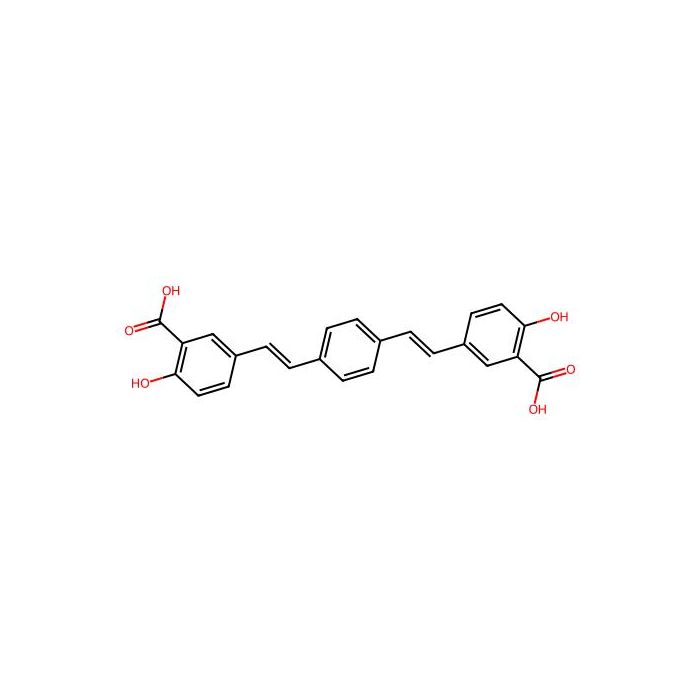
X-34 is a lipophilic and highly fluorescent marker used to examine pathological changes in Alzheimer’s disease (AD). This cellular dye was developed as a derivative of Congo red to be more compatible with in vivo applications. By replacing the azo groups (nitrogen-to-nitrogen double bonds) in Congo red with carbon-to-carbon double bonds and having more lipophilic salicylic acid groups, X-34 has proven to be highly fluorescent and have increased membrane permeability. X-34 detects β-sheet structures and labels amyloid plaques, neurofibrillary tangles (NFTs), neuropil threads, and vascular amyloid in AD brains (1).
Reagents:
1. X-34:Create a 5 mM stock solution of X-34 (200X) using the X-34 diluent. Create a 25 µM staining solution by further diluting the 5 mM stock solution using the X-34 diluent.
Note: X-34 diluent (40% EtOH, pH 10) is the recommended solvent for staining. A slight precipitate may be present, but will not interfere with the product's performance.
2. X-34 diluent (40% EtOH, pH 10): Combine 20 mL of EtOH in 29.5 mL of dH2O. Add 1 µL of 5M NaOH dropwise until the solution reaches pH 10. Bring the final volume of X-34 diluent to 50 mL with dH2O.
3. Differentiation buffer: 50 mM NaOH, 80% EtOH
Protocol:
1. Stain slides in 25 µM X-34 staining solution for 30 min at room temperature in the dark.
2. Rinse slides three times in dH2O.
3. Incubate for 2 min in the differentiation buffer.
4. Rinse slides three times in dH2O.
5. If desired, proceed with immunostaining.
6. Mount and image.
| Sorrisos canónicos | C1=CC(=CC=C1C=CC2=CC(=C(C=C2)O)C(=O)O)C=CC3=CC(=C(C=C3)O)C(=O)O |
|---|---|
| IUPAC Name | 5-[(E)-2-[4-[(E)-2-(3-carboxy-4-hydroxyphenyl)ethenyl]phenyl]ethenyl]-2-hydroxybenzoic acid |
| InChIKey | MCBNOAYTZBUCSX-KQQUZDAGSA-N |
| INCHI | 1S/C24H18O6/c25-21-11-9-17(13-19(21)23(27)28)7-5-15-1-2-16(4-3-15)6-8-18-10-12-22(26)20(14-18)24(29)30/h1-14,25-26H,(H,27,28)(H,29,30)/b7-5+,8-6+ |
| SMILES isoméricas | C1=CC(=CC=C1/C=C/C2=CC(=C(C=C2)O)C(=O)O)/C=C/C3=CC(=C(C=C3)O)C(=O)O |
| PubChem CID | 9930943 |
| Peso molecular | 402.4 |
Comprehensive hazard, handling, storage, and regulatory compliance document.
Download SDS →Lot-specific quality data. Enter your lot number to retrieve the exact COA.
Look up COA →Full quality attributes and acceptance criteria for this grade.
View spec sheet →Taxonomy Tree
| Kingdom | Organic compounds |
|---|---|
| Superclass | Phenylpropanoids and polyketides |
| Classe | Stilbenes |
| Subclass | Not available |
| Intermediate Tree Nodes | Not available |
| Direct Parent | Stilbenes |
| Alternative Parents | Salicylic acids Benzoic acids Styrenes Benzoyl derivatives 1-hydroxy-2-unsubstituted benzenoids Vinylogous acids Carboxylic acids Organooxygen compounds Organic oxides Hydrocarbon derivatives |
| Molecular Framework | Aromatic homomonocyclic compounds |
| Substituents | Stilbene - Salicylic acid - Salicylic acid or derivatives - Hydroxybenzoic acid - Benzoic acid or derivatives - Benzoic acid - Benzoyl - Styrene - 1-hydroxy-2-unsubstituted benzenoid - Phenol - Monocyclic benzene moiety - Benzenoid - Vinylogous acid - Carboxylic acid - Carboxylic acid derivative - Hydrocarbon derivative - Organic oxide - Organic oxygen compound - Organooxygen compound - Aromatic homomonocyclic compound |
| Descrição | This compound belongs to the class of organic compounds known as stilbenes. These are organic compounds containing a 1,2-diphenylethylene moiety. Stilbenes (C6-C2-C6 ) are derived from the common phenylpropene (C6-C3) skeleton building block. The introduction of one or more hydroxyl groups to a phenyl ring lead to stilbenoids. |
| External Descriptors | Not available |
| Solubilidade | DMSO: 2.0mg/mL |
|---|
Our grade selection guide covers purity, stabilizer status, and application suitability for all variants in our catalog.
View BioReagent grade guide → View Biological Stain grade guide → View for Fluorescence analysis grade guide → View for Microscopy grade guide →