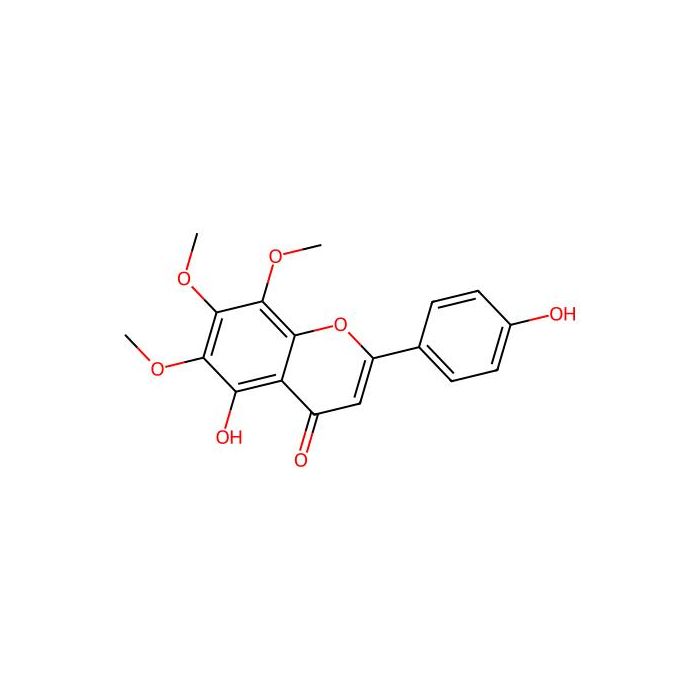
This compound belongs to the class of organic compounds known as 8-o-methylated flavonoids. These are flavonoids with methoxy groups attached to the C8 atom of the flavonoid backbone.
External Descriptors
Flavones and Flavonols
1. Djoumbou Feunang Y, Eisner R, Knox C, Chepelev L, Hastings J, Owen G, Fahy E, Steinbeck C, Subramanian S, Bolton E, Greiner R, and Wishart DS. ClassyFire: Automated Chemical Classification With A Comprehensive, Computable Taxonomy. Journal of Cheminformatics, 2016, 8:61.
Determine the necessary mass, volume, or concentration for preparing a solution.
Dilution Calculator
Determine the dilution needed to prepare a stock solution.
Reconstitution Calculator
Revisões
Avaliações dos Clientes
Application Protocols
No manufacturer‑validated application protocols are provided for this item. The following general workflows are offered as non‑binding guidance for common laboratory uses of polymethoxyflavones:
Preparation of analytical standard (LC–UV/LC–MS):
Accurately weigh xanthomicrol under low light.
Dissolve to 1.0 mg/mL in MeOH or ACN; sonicate if needed.
Prepare a serial dilution (e.g., 1.0 → 0.01 mg/mL).
Filter (0.22 µm PTFE) before injection.
Store working solutions at 2–8 °C, protected from light; verify stability.
DMSO stock for bioassays (research use only):
Dissolve at 10–50 mM in anhydrous DMSO.
Aliquot into amber vials under inert gas.
For experiments, dilute into pre‑equilibrated buffer with rapid mixing; keep final DMSO ≤0.5–1%.
Thin‑layer chromatography (TLC) method scouting:
• Plates: silica gel 60 F254.
• Mobile phases: EtOAc:hexane (3:2 to 4:1) or CHCl3:MeOH (95:5).
• Visualization: UV 254/365 nm; phenolic stains (e.g., vanillin–H2SO4) develop characteristic colors.
Always validate these conditions in your laboratory and consult the item’s CoA/SDS for any constraints specific to the supplied material.
Biological Roles
Note: The following summarizes literature knowledge about O‑methylated flavones and is provided for biochemical context only. This product is for research use only; no biological or clinical claims are made.
General biochemistry (literature):
Chemical class: Xanthomicrol is described as a polymethoxyflavone (flavone subclass) bearing both phenolic hydroxyls and multiple methoxy groups. O‑methylation typically modulates lipophilicity, membrane affinity, and metabolic stability relative to polyhydroxy flavones.
Plant origin: Reported in several Lamiaceae species (e.g., Dracocephalum, Thymus, Salvia; literature). In plants, O‑methylated flavones can serve as defense metabolites and UV protectants.
Biosynthesis: Derived from the phenylpropanoid pathway via flavone synthases acting on naringenin/chrysin precursors, followed by O‑methyltransferase‑catalyzed methylation at specific ring positions; phenolic hydroxylation often proceeds via cytochrome P450s (F6H/F8H) in specialized metabolism.
Physicochemical/biological implications: Increased methylation generally reduces aqueous solubility and hydrogen‑bond donating capacity, which can affect transport and enzyme interactions. The presence of a para‑phenolic OH can maintain some antioxidant and metal‑chelating capacity, whereas methoxy arrays modulate redox behavior.
Analytical biomarker role: Utilized as a reference standard for profiling polymethoxyflavones in botanical extracts by LC–MS/MS due to distinctive fragmentation (successive 15 Da losses, CO extrusion) and UV bands.
Experimental considerations:
For in vitro assays, carefully control final organic solvent content and verify solubility/aggregation state (e.g., dynamic light scattering or serial filtration) to avoid assay artifacts commonly seen with polyphenolics.
Buffer Applications
Not typically applicable. Xanthomicrol is not a buffering reagent and does not constitute a defined buffer system.
Practical guidance (if used in buffered assays):
Prepare concentrated stocks in DMSO or ethanol and dilute into the assay buffer with vigorous mixing. Maintain final organic solvent content at levels compatible with your system (commonly ≤0.5–1%).
Use co‑solvent systems or minimal surfactant (e.g., 0.01–0.05% nonionic detergent, assay‑dependent) to mitigate precipitation. Confirm solution clarity and stability over the assay timeframe.
Avoid strongly basic buffers (pH > 10), which can promote degradation (e.g., O‑demethylation or chromophore alteration) in conjugated flavones.
Green Alternatives
Context: The compound itself is a solid analyte. Greener practice centers on solvent selection, purification, and waste minimization when working with polymethoxyflavones like xanthomicrol.
Greener solvent choices (general guidance):
Prefer ethanol over methanol for routine dissolution and extraction when analytical constraints allow; EtOH has better environmental/health profile.
In RP‑HPLC, consider water/ethanol or water/ACN over water/MeOH if compatible with method sensitivity. ACN, while petro‑derived, often reduces pressure and run times (lower energy per analysis). MeOH is toxic; EtOH is greener but higher viscosity.
For demethylation chemistry, avoid halogenated solvents when possible. However, established protocols often rely on CH2Cl2 with BBr3; greener alternatives (e.g., 2‑MeTHF) may be feasible but require re‑optimization and careful safety assessment.
Comparison table (general; not item‑specific specs):
DMSO: high solubility; poor biodegradability concerns are modest; high boiling point increases energy for removal.
Ethanol: renewable, low toxicity; slightly reduced solubility versus DMSO for some flavones.
2‑MeTHF/EtOAc: greener medium for extractions vs. CH2Cl2; good partitioning of polymethoxyflavones.
Operational recommendations:
Use micro‑scale reactions and analytical‑scale screening to minimize waste in method development.
Apply solid‑phase extraction (SPE) for sample cleanup to reduce solvent volumes.
Where feasible, recover and recycle ACN/EtOAc via solvent distillation or institutional solvent recycling programs.
Document and justify any use of hazardous reagents (e.g., BBr3) in risk assessments; explore milder demethylation (e.g., catalytic hydrogenolysis of benzyl ethers if such protecting groups are employed during synthesis).
Pharmaceutical Uses
This product is provided strictly for research use. No therapeutic or clinical claims are made.
Reference standard: Polymethoxyflavones like xanthomicrol may be employed as analytical reference materials during characterization of botanical raw materials or dietary ingredient quality control (e.g., LC–UV/LC–MS method development, system suitability).
Excipients: Xanthomicrol is not a recognized excipient in major pharmacopeias and is not commonly used as a formulation aid. It is a specialized analytical/chemical standard rather than a processing additive.
Preformulation studies (research only): Solubility profiling in biorelevant media, stability versus pH and light, and partitioning experiments (shake‑flask logP/logD) can inform basic physicochemical understanding if xanthomicrol is being evaluated as a chemical probe.
Regulatory considerations:
No compendial monograph is indicated. For any regulated use, a full qualification package (identity, purity, residual solvents, stability data) would be required; this catalog item is not intended for such applications.
Appearance: Not specified for this item; refer to CoA/Spec Sheet.
Grade/Purity: Not specified for this item; refer to CoA/Spec Sheet.
Molecular weight: Not specified for this item; refer to CoA/Spec Sheet.
Literature/general values for xanthomicrol (for context only; not product specifications):
Physical state: typically a yellow crystalline solid (polymethoxyflavone class; literature).
Solubility: sparingly soluble in water; soluble in polar organic solvents such as DMSO, methanol, ethanol, acetonitrile (literature). A mixed solvent system (e.g., DMSO stock diluted into aqueous buffers with co‑solvent) is commonly used for biological assays.
UV–vis: characteristic flavone absorption bands around 270–280 nm (band II) and 330–360 nm (band I) depending on solvent and substitution (literature). Useful as an LC–UV reference.
LogP/logD: O‑methylation increases lipophilicity relative to hydroxylated flavones; reported cLogP for related 6,7,8‑trimethoxyflavones is typically in the 2.5–3.5 range (literature, indicative only).
Melting point, density, refractive index, pKa values: Not established here; consult primary literature or measure under your conditions if required.
Practical notes (general):
Prepare concentrated stocks (e.g., 10–50 mM) in anhydrous DMSO or MeOH for analytical or screening work; filter if necessary. Avoid prolonged exposure to strong light and base, which may promote O‑demethylation or oxidative changes.
Quality and Grades
Item-specific quality information provided here:
Grade/Purity: Not specified for this item; refer to CoA/Spec Sheet.
Interpretation and context (general guidance):
When purity is specified for analytical or bioassay use (e.g., ≥95% by HPLC), users typically expect accompanying chromatograms and NMR. In the absence of a stated grade, consult the lot‑specific CoA for purity (HPLC/UPLC assay, residual solvents, water content), identity (1H/13C NMR, MS), and any stabilizers.
UV background: Polymethoxyflavones exhibit strong UV absorbance; for chromatographic reference standards, low baseline impurity levels at 254–360 nm are desirable. HPLC suitability often includes a UV scan and single, symmetric peak in common systems (C18, MeOH/H2O or ACN/H2O with formic acid).
Stabilizers: None are indicated for this item. If a stabilizer is present in a particular lot, it will be declared on the CoA.
Impurity considerations (general): Potential related substances include partially demethylated flavones (e.g., scutellarein analogs), isomeric O‑methylation patterns, and residual plant‑derived matrices if sourced from natural products. For quantitative work (e.g., LC–MS reference), use an internal standard and verify response factors.
Recommendation: For regulated or quantitation-critical applications, request a current CoA and, if needed, spectral data (NMR, HRMS) and chromatographic purity profiles for the specific lot you will use.
Reaction and Applications
Manufacturer application text: Not provided beyond general research use; expanded context for professional users is given below (general chemistry; not product‑specific claims).
Representative research uses (literature/general):
Analytical reference standard: Use as a marker compound for polymethoxyflavone quantitation by LC–UV or LC–MS in natural product chemistry and metabolomics. Validate retention time, UV spectra (bands I/II), and MS fragmentation (loss of CH3 and CO patterns are diagnostic for O‑methylated flavones).
Photophysics/antioxidant assays: Evaluate radical scavenging or redox behavior relative to hydroxy/methoxy substitution, employing DPPH/ABTS assays (method development only; no biological claims).
Supramolecular/complexation studies: Phenolic OH can hydrogen bond; methoxy groups influence host–guest interactions.
Chemical transformations (as substrate or starting point; literature):
Selective O‑demethylation: BBr3 or BCl3 in CH2Cl2 at low temperature to reveal catechol/tetrahydroxy analogs; control stoichiometry to avoid over‑demethylation. Alternative: AlCl3/thiols or TMSI.
Ether formation/derivatization: Alkylation or acylation of phenolic OH (e.g., Mitsunobu alkylation, carbonate/ester installation) for pro‑analogs or conjugates.
Electrophilic substitution and metalation: Limited due to deactivation by –OMe; however, directed C–H functionalization on electron‑rich rings is reported under Pd/Ir catalysis for related flavones.
Reduction: Hydrogenation of the C2–C3 double bond affords flavanones; careful conditions (Pd/C, H2, ambient–50 psi) to preserve O‑aryl bonds.
Practical tips:
Strict exclusion of moisture/air is generally unnecessary for handling, but argon storage minimizes slow oxidation/discoloration.
For demethylations, quench BBr3 reactions into ice‑MeOH and neutralize cautiously; phenolic products can chelate silica—use buffered eluents.
Reaction Conditions
General literature conditions relevant to O‑methylated flavones (for planning; not item‑specific specifications):
Selective O‑demethylation (revealing phenols):
• BBr3 (1–3 equiv per –OMe) in dry CH2Cl2, −78 to 0 °C, 1–12 h. Quench with MeOH/ice–water; typical yields 50–90% depending on substitution and equivalents.
• BCl3 often milder/slower; TMSI (generated in situ from NaI/Me3SiCl) is an alternative in MeCN or CH2Cl2.
• AlCl3/thiophenol or molten pyridine•HCl have also been reported for anisole demethylation.
Phenolic acylation/alkylation:
• Acylation with acyl chlorides/anhydrides in pyridine or DCM/DMAP at 0–25 °C, 1–4 h; near‑quantitative conversions.
• Mitsunobu alkylation (R–OH, DIAD/DEAD, PPh3) in THF/CH2Cl2 at 0–25 °C; check chemoselectivity versus the 5‑OH which may be H‑bond stabilized.
Hydrogenation of C2–C3:
• Pd/C (5–10 wt%), H2 (1–3 bar), EtOH/EtOAc, 20–40 °C, 2–16 h to give flavanones; protect phenols if O‑dealkylation is problematic.
Analytical method development:
• RP‑HPLC on C18: water (0.1% HCO2H)/ACN or MeOH gradients; detection 254, 280, and 340 nm.
• LC–MS: APCI or ESI negative mode often affords [M–H]− with characteristic 15 Da losses for methoxy cleavage.
Notes:
Control moisture rigorously for Lewis‑acid demethylations.
Closely related O‑methylation isomers can coelute; orthogonal methods (e.g., phenyl‑hexyl columns) may help.
Always pilot on milligram scale before scale‑up and verify identity by NMR (diagnostic methoxy singlets, downfield 5‑OH if intramolecularly H‑bonded).
Safety and Handling
Authoritative safety information must be taken from the SDS for this specific item.
Item-specific hazard data (from this listing):
Signal word: Not specified for this item; refer to SDS.
H‑statements: Not specified for this item; refer to SDS.
GHS classification and pictograms: Not specified for this item; refer to SDS.
Storage conditions: Store at 2–8 °C, Argon charged. Shipments are on wet ice.
General safety guidance for flavonoid solids (not product‑specific):
Likely hazard profile: Many flavonoids are of low acute toxicity but can cause irritation. Treat as a lab chemical of unknown toxicity. Avoid inhalation of dust and contact with skin/eyes.
PPE: Wear lab coat, safety glasses, and appropriate gloves (e.g., nitrile). Handle powders in a fume hood or ventilated enclosure to minimize dust exposure.
Incompatibilities: Strong oxidizers; strong bases/acids can catalyze hydrolysis or O‑demethylation. Avoid prolonged basic conditions and strong UV exposure.
First aid (overview; consult SDS):
• Inhalation: Move to fresh air; seek medical advice if symptoms persist.
• Skin/eye contact: Rinse with water for several minutes; remove contaminated clothing; seek medical attention if irritation continues.
• Ingestion: Rinse mouth; obtain medical attention.
Spill response: Avoid dust formation; collect mechanically; dispose of in accordance with local regulations.
Special risks: No known peroxide formation tendency. Combustible organic solid—keep away from ignition sources.
Solvent Selection
Applicability: Xanthomicrol is a neutral, moderately lipophilic polyphenolic ether with limited aqueous solubility. Solvent choice is critical for handling, dissolution, and analytical performance.
General solvent behavior (literature/experience):
Water: Very low solubility. Use co‑solvents or surfactants for aqueous work.
DMSO: Excellent solubility; commonly used for concentrated stock solutions in screening or bioassays. Minimizes precipitation on dilution if final organic content ≥0.1–1%.
Methanol, ethanol: Good solubility; suitable for UV/LC analysis and preparative work. Ethanol favored for greener profiles.
Acetonitrile: Good analytical solvent; strong UV transparency. May be preferable for LC–MS due to volatility.
Ethyl acetate, acetone: Moderate–good solubility for extraction/partitioning.
Nonpolar solvents (hexanes, heptane, toluene): Limited solubility; toluene may dissolve at elevated temperature.
Selection guidance:
Analytical HPLC/UPLC: Dilute in MeOH or ACN; water + 0.1% formic acid improves peak shape in reversed‑phase methods.
Bioassay stocks: Prepare 10–50 mM in anhydrous DMSO; dilute into buffer ensuring final DMSO ≤0.5–1% to prevent precipitation; consider 0.05% Tween‑20 if needed (assay‑dependent).
Extraction/purification: Partition from alcoholic extracts into EtOAc; avoid strong base during workup to prevent O‑demethylation.
Small comparison (pros/cons):
DMSO: maximal solubility, but higher boiling point and potential assay interference.
MeOH/ACN: analytical cleanliness, volatility; watch for limited aqueous miscibility upon dilution for samples with low organic tolerance.
EtOH: greener alternative to MeOH; slightly lower elution strength in RP‑HPLC.
Storage and Reconstitution
Item-specific instructions:
Storage conditions: Store at 2–8 °C, Argon charged.
Shipped in: Wet ice.
Appearance: Not specified for this item; refer to CoA/Spec Sheet.
Stabilizers: None indicated; if present in a given lot, it will be listed on the CoA.
General reconstitution guidance (for solids; not a specification):
Upon receipt, allow the sealed container to equilibrate to room temperature before opening to minimize moisture condensation. Open under dry air or inert gas if possible.
For analytical work, prepare a concentrated stock in anhydrous DMSO, methanol, ethanol, or acetonitrile. Typical stock levels: 1–50 mM (or 0.5–5 mg/mL), depending on solubility and application. Mix by vortexing and gentle sonication; avoid prolonged heating.
Filter solutions through 0.22 µm PTFE for LC applications.
Aliquot stocks into amber vials, purge headspace with argon or nitrogen, and store at 2–8 °C. For longer-term storage, freezing at −20 °C (protect from repeated freeze–thaw) may be appropriate; confirm stability experimentally.
Stability considerations (general):
Protect from strong light and alkaline pH. Maintain inert atmosphere in partially used containers to minimize slow oxidative changes. Inspect periodically for discoloration or precipitation; discard if atypical.
Note: For any lot‑specific reconstitution solvent, concentration limit, water content, or assay purity, consult the CoA/Spec Sheet.
Structure and Identity
Brief description: Xanthomicrol is an O‑methylated flavone (polymethoxyflavonoid) typically described as 5,4′‑dihydroxy‑6,7,8‑trimethoxyflavone (literature). It features the flavone core (2‑phenyl‑4H‑chromen‑4‑one) bearing phenolic and methoxy substituents.
SKU: X1067092
Product name: Xanthomicrol
CAS: 16545-23-6
PubChem CID: 73207 (literature identifier)
InChIKey (item-specific): Not specified for this item; refer to CoA/Spec Sheet.
• Note: The string “330862” provided is not a standard InChIKey format.
SMILES (item-specific): Not specified for this item; refer to CoA/Spec Sheet.
Molecular formula (item-specific): Not specified for this item; refer to CoA/Spec Sheet.
Molecular weight (item-specific): Not specified for this item; refer to CoA/Spec Sheet.
Key structural features (general chemistry/literature):
Flavone scaffold: fused benzopyrone (chromen‑4‑one) with a pendant phenyl at C‑2.
Substituents (literature): three contiguous methoxy groups on the A‑ring (C‑6/7/8), phenolic OH at C‑5 (A‑ring) and at the 4′ position of the B‑ring.
Functional groups: one conjugated enone (4‑oxo), multiple aryl ethers (–O–CH3), and phenolic hydroxyls (–OH).
2D description in words: A planar chromen‑4‑one ring system fused to a benzene ring (A‑ring) carrying O‑substituents, and a para‑hydroxy phenyl B‑ring attached at C‑2 of the heteroaromatic core; overall highly conjugated and aromatic.
Important note: Exact identifiers and any stereochemical annotations (none expected for a simple flavone) applicable to this specific lot should be confirmed on the item’s CoA/Spec Sheet.
Synthetic Utility
Perspective: While xanthomicrol is often the target analyte, its functional group array also makes it a versatile intermediate for derivatization and SAR studies.
Key functional groups and reactivity (general):
Phenolic OH (typically at 5 and 4′): amenable to acylation (acyl chlorides/anhydrides, DMAP), alkylation (Mitsunobu/Williamson), carbonate/carbamate formation, and metal‑mediated coupling after conversion to aryl triflates.
Aryl methoxy groups (6,7,8): can be selectively demethylated with BBr3/BCl3 to unveil catechol/pyrogallol motifs, enabling further diversification (e.g., etherification, sulfation, glycosylation).
Conjugated enone (flavone core): participates in hydrogenation to flavanones; can undergo 1,4‑addition under strongly nucleophilic conditions, though the aromatic stabilization renders such additions limited.
Synthetic strategies (literature):
Late‑stage O‑methylation of polyhydroxyflavones (e.g., from baicalein/scutellarein) using MeI/Me2SO4 or methylating reagents under phase‑transfer; regioselectivity guided by hydroxyl acidity and intramolecular H‑bonding.
Demethylation–remethylation sequences to access diverse O‑substitution patterns.
Installation of linkers: React phenolic OH with NHS‑activated carbonates or PEGylated chloroformates to generate conjugable probes.
Utility in analytics:
Serves as a retention/fragmentation standard for method development. Derivatization (e.g., silylation as TMS ethers) enhances volatility for GC–MS where applicable.
Caveats:
Strong bases/acids may cause chromophore degradation; protect sensitive positions during multistep synthesis. Monitor reactions by LC–MS to distinguish closely related O‑methylation isomers.
Target Specificity
Not applicable for this product category. Xanthomicrol is a small‑molecule chemical standard, not an antibody or biologic. No antigen, epitope, species reactivity, clone, or isotype information applies.
If used as a biochemical probe in research, any “target” interactions (e.g., enzyme binding) must be established by the end user under their assay conditions; no such data are provided or implied for this catalog item.
We use cookies to ensure the website functions properly and, where permitted, to improve your experience. You can manage your preferences at any time in Settings. Learn more in our Cookie Policy.
Shall we send you a message when we have discounts available?
Remind me later
Thank you! Please check your email inbox to confirm.
Products are supplied to verified businesses, institutions, and qualified professionals for research and development use only. Not for use in humans, animals, diagnosis, or therapy.