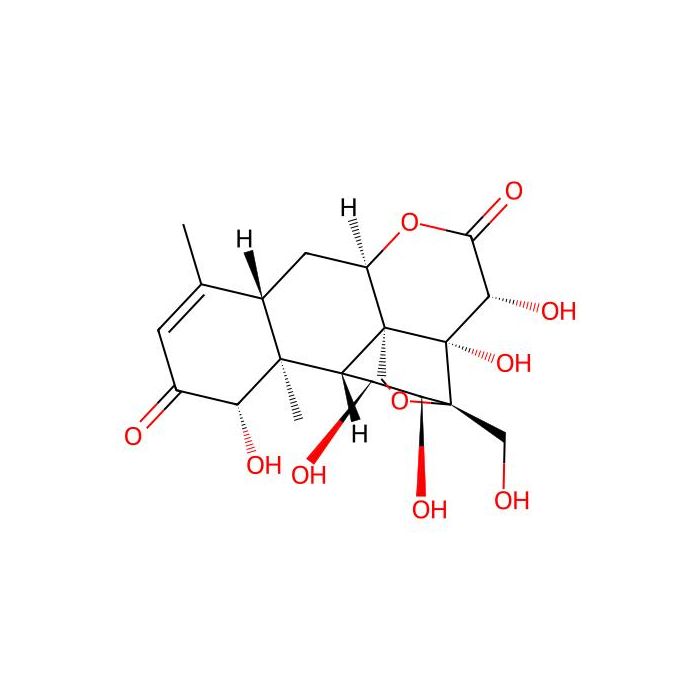
≥99% for sensitive chromatographic and analytical workflows requiring minimal baseline interference.
🌡
Storage & shipping
Store at -20°C Ships Ice chest + Ice pads Check lot-specific COA for exact specifications.
📋
Quality documents
SDS, COA, datasheet, and spec sheet available for download. Lot-specific COA accessible via lot number lookup.
📚
Literature proof
Cited in 0 peer-reviewed publications across chromatography, organic synthesis, and cross-coupling reactions.
Visão geral
Yadanziolide A, isolated from the cultivated dry seeds of Brucea javanica , has strong antiviral activities with IC 50 of 5.5 μM against tobacco mosaic virus. Yadanziolide A shows significant antitumor effects
Form:Solid
IC50& Target:IC50: 5.5 μM (Tobacco mosaic virus)
Specifications
Especificações e pureza
≥99%
Mecanismos bioquímicos e fisiológicos
Yadanziolide A, isolated from the cultivated dry seeds of Brucea javanica , has strong antiviral activities with IC 50 of 5.5 μM against tobacco mosaic virus. Yadanziolide A shows significant antitumor effects.
Condições de armazenamento de armazenamento
Store at -20°C
Enviado em
Ice chest + Ice pads
Este produto requer transporte de cadeia fria. Serviços terrestres e outros serviços econômicos não estão disponíveis.
This compound belongs to the class of organic compounds known as quassinoids. These are a group of compounds chemically degraded from triterpenes. According to their basic skeleton, quassinoids are categorized into five distinct groups, C-18, C-19, C-20, C-22 and C-25 types. The C-20 quassinoids can be further classified into two types, tetracyclic and the pentacyclic. The tetracyclic variety does not have oxygenation at C-20, while the pentacyclic quassinoids possess additional oxygenation at C-20 that allows for the formation of an additional ring.
External Descriptors
Not available
1. Djoumbou Feunang Y, Eisner R, Knox C, Chepelev L, Hastings J, Owen G, Fahy E, Steinbeck C, Subramanian S, Bolton E, Greiner R, and Wishart DS. ClassyFire: Automated Chemical Classification With A Comprehensive, Computable Taxonomy. Journal of Cheminformatics, 2016, 8:61.
Determine the necessary mass, volume, or concentration for preparing a solution.
Dilution Calculator
Determine the dilution needed to prepare a stock solution.
Reconstitution Calculator
Revisões
Avaliações dos Clientes
Application Protocols
No tested application protocols are provided for this item. General laboratory-use guidance is as follows:
Preparing assay stocks: Dissolve the material in dry, high-purity DMSO to 10–20 mM. Sonicate gently if needed. Filter (0.2 µm PTFE) to remove particulates if the application is sensitive.
Working concentrations: Titrate across a broad range (e.g., 0.01–50 µM) depending on assay type, ensuring final DMSO ≤0.5–1% unless otherwise validated.
Analytical confirmation: Verify concentration by an orthogonal method (e.g., qNMR using an internal standard, or UV–vis if extinction coefficient is known/established).
Documentation: Record lot number, exact mass dispensed, solvent, and preparation date. Attach CoA to your ELN entry for traceability.
Please consult the SDS and CoA for any item-specific precautions and adapt these general steps to your assay’s requirements.
Biological Roles
Item-specific biological function, targets, or pathways for Yadanziolide A are not provided in this listing. The compound is offered strictly for research use.
General considerations for plant-derived small molecules
Chemical biology: Such compounds are often evaluated in phenotypic or target-based assays to probe signaling pathways, enzyme modulation, or cellular stress responses. Results can be context-dependent and sensitive to solubility, aggregation, and redox environment.
ADME profiling: For early characterization, consider in vitro stability (microsomal/S9), plasma protein binding, and permeability assays. Ensure analytical standards and internal controls are in place.
Off-target assessment: Incorporate counterscreens (e.g., cytotoxicity, redox cycling, PAINS filters) and orthogonal assays to confirm specificity of observed effects.
Practical notes
Prepare fresh stocks and minimize freeze–thaw cycles to avoid degradation.
Include solvent controls and, if applicable, detergent controls to mitigate artifactual readouts.
No clinical or therapeutic claims are made for this product; it is supplied exclusively for laboratory research.
Buffer Applications
This item is a small organic compound and is not a buffering reagent. As such, classic buffer system guidance (e.g., phosphate, Tris, HEPES) does not typically apply.
Practical notes
If the compound must be used in aqueous buffers for bioassays, dissolve first in a suitable organic co-solvent (e.g., DMSO or ethanol), then dilute into the buffer while keeping final co-solvent levels low (commonly ≤0.5–1%).
Consider surfactants (e.g., 0.01% Tween-20) or carrier proteins (e.g., 0.1% BSA) if nonspecific adsorption or poor apparent solubility is observed.
For pH control and ionic strength, select an appropriate biological buffer separately from this compound.
Green Alternatives
When handling natural products and developing analytical or preparative workflows, solvent choice can substantially reduce environmental impact.
Greener solvent options (general guidance)
Replace chlorinated solvents: Use ethyl acetate, 2-methyltetrahydrofuran (2-MeTHF), cyclopentyl methyl ether (CPME), or methyl tert-butyl ether (MTBE) instead of dichloromethane/chloroform where performance allows.
Aqueous-organic systems: Favor water–acetonitrile or water–ethanol over purely organic eluents for RP-HPLC where detector compatibility permits.
Crystallization and trituration: Ethyl acetate/hexane or heptane mixtures can often substitute for DCM-based systems.
Illustrative comparison (general)
DCM vs 2-MeTHF: 2-MeTHF offers lower toxicity and is bio-derived; it is immiscible with water and suitable for many extractions. However, it can form peroxides over long storage—monitor and store with inhibitors as appropriate.
MeCN vs EtOH: Ethanol is renewable and less hazardous but has different eluotropic strength and UV cutoffs; may require method re-optimization.
Best practices
Start with solvent selection guides (e.g., CHEM21, ACS GCI) to map greener substitutes.
Validate that green alternatives do not compromise recovery, stability, or assay readouts for your specific batch of Yadanziolide A.
Note: No item-specific solvent constraints are provided; verify compatibility experimentally.
Pharmaceutical Uses
No pharmacopeial status, excipient role, or formulation use is specified for this item. Yadanziolide A is supplied for research use only and is not intended for human or veterinary use.
Research and development context (general)
Reference material: May serve as a reference standard for analytical method development and quantitation in natural product research.
Pre-formulation studies: If pursued, assess solubility in biorelevant media, stability in simulated gastric/intestinal fluids, and compatibility with common excipients; these activities are strictly research-stage and require independent verification.
Regulatory note
This product is not accompanied by GMP documentation and is not approved as an API, excipient, or dietary ingredient. Any exploration toward dosage form development must be done under appropriate regulatory and safety frameworks, independent of this listing.
Physical Properties
Item-specific physicochemical properties are not provided in the current product record and should be verified against the Certificate of Analysis (CoA) for the shipped lot.
Appearance: Not specified for this item; refer to CoA/Spec Sheet.
Molecular Weight: Not specified for this item; refer to CoA/Spec Sheet.
Molecular Formula: Not specified for this item; refer to CoA/Spec Sheet.
Melting point: Not specified for this item; refer to CoA/Spec Sheet.
Boiling point: Not specified for this item; refer to CoA/Spec Sheet.
Density: Not specified for this item; refer to CoA/Spec Sheet.
Refractive index: Not specified for this item; refer to CoA/Spec Sheet.
Solubility: Not specified for this item; refer to CoA/Spec Sheet.
logP, pKa: Not specified for this item; refer to CoA/Spec Sheet.
General guidance (chemistry knowledge, not item-specific)
Many plant-derived small molecules are handled at mg-scale and prepared as stock solutions in high-purity DMSO, MeOH, or acetonitrile for screening and analytics.
If sparingly soluble in aqueous media, co-solvents (≤1–2% DMSO or ethanol in final assay) or cyclodextrin inclusion may be used for biological assays. Confirm compatibility for your assay matrix.
For analytical method development (HPLC/UPLC), start with reversed-phase C18 gradients (e.g., water/0.1% formic acid to acetonitrile/0.1% formic acid) and optimize based on observed retention and UV profile.
Always prioritize lot-specific values from CoA/SDS for specifications.
Quality and Grades
Grade and purity information are not specified in the current listing for SKU Y646730.
Grade/Purity: Not specified for this item; refer to CoA/Spec Sheet.
How to interpret grades (general guidance)
Research or screening grade: Suitable for discovery workflows, biochemical assays, and library screening; verify purity by HPLC/UPLC and identity by NMR/MS.
Analytical/Reference standard grade: Typically accompanied by detailed characterization, including quantitative purity (e.g., qNMR), water/volatile content, and stability data.
What to expect from Aladdin Scientific natural products
Batch-specific CoA normally includes: HPLC purity, identity confirmation (MS/NMR), and storage guidance. Where relevant, residual solvent data and water content may be provided.
Stabilizers: If any stabilizer or additive is present, it will be stated explicitly on the CoA/label. Otherwise, material is supplied neat.
Recommendations
For quantitative work, verify purity with your in-house method (orthogonal to CoA conditions). If your application is UV-critical or bioassay-sensitive, request additional documentation (e.g., impurity profile, residual metals) as needed.
Reaction and Applications
This product is intended primarily as a research small molecule/natural product for chemical biology, reference material, and method development. Specific reactivity data for Yadanziolide A are not provided in the item record.
Typical research applications (general guidance)
Reference standard: Use for LC–MS method development, retention time matching, and quantitative calibration once purity and response factors are established.
Bioassay screening: Prepare DMSO stocks and evaluate in target panels; ensure appropriate controls for solvent and potential colloidal aggregation (include detergent controls where applicable).
Spectroscopic benchmarking: Record 1H/13C NMR, HRMS, and UV–vis to build an internal library and to confirm identity post-shipment.
Analytical tips
Stability checks: Perform short-term stability in DMSO at room temperature vs refrigerated autosampler (4–8°C). Assess carryover and adsorption to plastics; prefer glass vials when recovery is low.
Chromatography: Start with RP-HPLC (C18). If peak tailing occurs, test end-capped high-coverage phases or add volatile amines/acids as mobile-phase modifiers consistent with your detector.
If you intend to use the compound in synthesis (derivatization, semisynthesis), consult the CoA/SDS and primary literature for functional group inventory and selectivity, as this item record does not specify its exact reactive handles.
Reaction Conditions
Item-specific reaction conditions are not provided because the functional group inventory for Yadanziolide A is not specified in the listing.
General laboratory guidance for small natural products
Stock solution preparation: 1–20 mM in anhydrous DMSO or MeOH; verify complete dissolution. Store aliquots at -20°C to minimize freeze–thaw cycles.
Analytical methods: RP-UPLC with water/acetonitrile (0.1% formic acid) gradient, detection by UV (scan 200–400 nm) and MS in ESI± as appropriate.
Stability checks: Evaluate stability at room temperature, 4–8°C, and -20°C, and under light vs dark. Track by HPLC area% over 24–72 h.
If you plan chemical transformations, first establish the compound’s exact structure and sensitive motifs (e.g., acid/base or redox labile groups) using the CoA and independent characterization to avoid degradation.
Safety and Handling
Safety information specific to this item is not fully specified in the product record. Always review the Safety Data Sheet (SDS) for authoritative guidance.
Item-specific details
GHS Classification: Not specified for this item; refer to SDS.
Signal Word: Not specified for this item; refer to SDS.
Hazard (H) Statements: Not specified for this item; refer to SDS.
Pictograms: Not specified for this item; refer to SDS.
Research Use: For research use only (not for diagnostic or therapeutic use).
General laboratory precautions (good practice)
PPE: Lab coat, safety glasses, and appropriate chemical-resistant gloves. Handle powders/solids to minimize dust or aerosol formation.
Engineering controls: Use in a fume hood if there is any potential for dust, vapors, or volatile solvents during preparation.
Storage incompatibilities: Until specific data are known, segregate from strong oxidizers, strong acids/bases, and reactive reducing agents. Keep tightly sealed under inert atmosphere if the compound is air/moisture sensitive (verify via CoA/SDS).
First aid overview: In case of skin/eye contact, rinse with water for at least 15 minutes. If inhaled, move to fresh air. If ingested, seek medical attention. Refer to SDS for substance-specific measures.
Spill and disposal: Absorb small spills on inert material and dispose of as organic laboratory waste per institutional and local regulations.
Storage and shipping
Storage Conditions: Store at -20°C (per product data). Keep desiccated and protected from light if noted on CoA.
Item-specific solubility and polarity parameters are not provided. The following guidance reflects common practice for hydrophobic small natural products.
Primary stock solvents: High-purity DMSO (anhydrous), methanol, or acetonitrile often provide reliable dissolution at 1–20 mM. Filter through 0.2 µm PTFE if particulates persist.
Working solutions: Dilute stock into assay buffers with attention to final co-solvent percentage (commonly ≤0.5–1% DMSO or ethanol to avoid assay artifacts). Consider using Tween-20 (≤0.01%) or serum proteins as solubilizers if compatible.
Chromatographic solvents: Start with water/0.1% formic acid and acetonitrile/0.1% formic acid for RP-HPLC/UPLC method development. Adjust to methanol-based gradients if selectivity is needed.
Extraction/recovery: For sample prep, EtOAc or MTBE are typical first choices. If compound is highly nonpolar, heptane/EtOAc mixtures can improve partitioning.
Comparison (general, not item-specific)
DMSO vs DMF: DMSO is preferred for biotesting stocks due to lower volatility and common assay compatibility; DMF can be used but is often less favored in biological systems.
MeOH vs ACN: Methanol offers hydrogen bonding interactions and can aid dissolution of slightly polar motifs; acetonitrile gives lower viscosity and strong eluotropic strength in RP-HPLC.
Always confirm final solvent system and solubility experimentally with your batch.
Storage and Reconstitution
Storage
Storage Conditions: Store at -20°C (per product data). Protect from moisture and, if noted on CoA, from light. Keep container tightly closed.
Shipped In: Ice chest + ice pads (per product data) to maintain a cold chain during transit.
Shelf-life: Not specified for this item; refer to CoA/Spec Sheet. Monitor by periodic HPLC to assess stability.
Reconstitution and handling
Solvent selection: Prepare concentrated stocks in dry DMSO or methanol. Confirm complete dissolution visually and by analytical injection.
Aliquoting: Divide into single-use aliquots to minimize freeze–thaw cycles. Use low-bind polypropylene or glass vials depending on adsorption behavior.
Working solutions: Dilute into assay media immediately before use; avoid prolonged storage at room temperature. If aqueous suspension occurs, consider brief vortex/sonication or add compatible solubilizers.
Disposal
Dispose of unused material and solutions as organic chemical waste according to institutional and local regulations.
Note
Research Use Only. For lot-specific recommendations (e.g., photo/air sensitivity, solubility limits), consult the Certificate of Analysis and SDS for Y646730.
Structure and Identity
Yadanziolide A is supplied as a research-use-only small molecule (natural product class). The following identifiers are provided for this specific catalog item.
SKU: Y646730
Product Name: Yadanziolide A
CAS: 95258-14-3
PubChem CID: 10320238 (literature identifier)
InChIKey (provided): 309028
SMILES: Not specified for this item; refer to CoA/Spec Sheet.
Molecular Formula: Not specified for this item; refer to CoA/Spec Sheet.
Molecular Weight: Not specified for this item; refer to CoA/Spec Sheet.
Structural features
Structural class: Natural product; small molecule. Specific ring systems and functional groups are not provided in the item record.
2D structure description: Not specified for this item; refer to CoA/Spec Sheet.
Notes
Where exact identifiers (SMILES, formula) are needed for cheminformatics or analytical work, please consult the item’s Certificate of Analysis (CoA) or Specification Sheet for the batch-specific structure file (SDF/MOL) and analytical data (NMR, MS, HPLC).
Synthetic Utility
Specific functional groups and reactivity of Yadanziolide A are not provided in the item record; therefore, detailed synthetic transformations cannot be prescribed here.
General strategies for natural product handling and derivatization (non-item-specific)
Semisynthesis: Natural products are often diversified via protection/deprotection, esterification/amidation (if hydroxyl/carboxyl present), or hydrogenation/oxidation at defined sites. Confirm available functional handles via NMR and HRMS before planning routes.
Analytical-scale derivatization: Formation of UV-active or MS-enhancing derivatives may aid quantitation in complex matrices; ensure derivatives do not epimerize or rearrange.
Stability mapping: Subject the compound to forced degradation (acid/base, oxidative, thermal, photolytic) to identify liabilities and guide choice of protecting/storage conditions.
Practical guidance
Maintain an inert, dry environment during manipulations if the compound proves air/moisture sensitive.
For purification, consider RP-preparative HPLC with volatile buffers; avoid harsh silica conditions if decomposition is observed.
Target Specificity
Not applicable for this product type. Yadanziolide A is a small molecule and not an antibody or affinity reagent. No target binding specificity data are provided in the product record. For biochemical assays, users should determine activity and selectivity empirically and verify with orthogonal methods.
Perguntas frequentes
What is the purity of this product?
This product is supplied at ≥99% purity (chemical assay). Lot-specific values are stated on the Certificate of Analysis.
How should this product be stored?
Store at ?20 °C. Freezer storage is required to maintain the specified shelf life.
How is this product shipped?
This product ships in an insulated container with ice pads. Unpack on arrival and transfer it to the storage condition stated above.
What are the CAS number, molecular formula and molecular weight?
The CAS Number is 95258-14-3, the molecular formula is C20H26O10, and the molecular weight is 426.41 g/mol. InChIKey QXKKRGMRXXMDDP-JVDXBALSSA-N.
What documentation is provided?
Available product documentation, including Certificates of Analysis (COA), Safety Data Sheets (SDS), and specification sheets, is shown in the product document area. Document availability and access follow the current site policy.
Usamos cookies para garantir o funcionamento adequado do site e, quando permitido, para melhorar a sua experiência. Você pode gerenciar suas preferências a qualquer momento nas Configurações. Saiba mais em nossa Política de Cookies.
Deseja que lhe enviemos uma mensagem quando tivermos descontos disponíveis?
Lembrar-me mais tarde
Obrigado! Por favor, verifique a sua caixa de entrada de e-mail para confirmar.
Products are supplied to verified businesses, institutions, and qualified professionals for research and development use only. Not for use in humans, animals, diagnosis, or therapy.