Determine the necessary mass, volume, or concentration for preparing a solution.
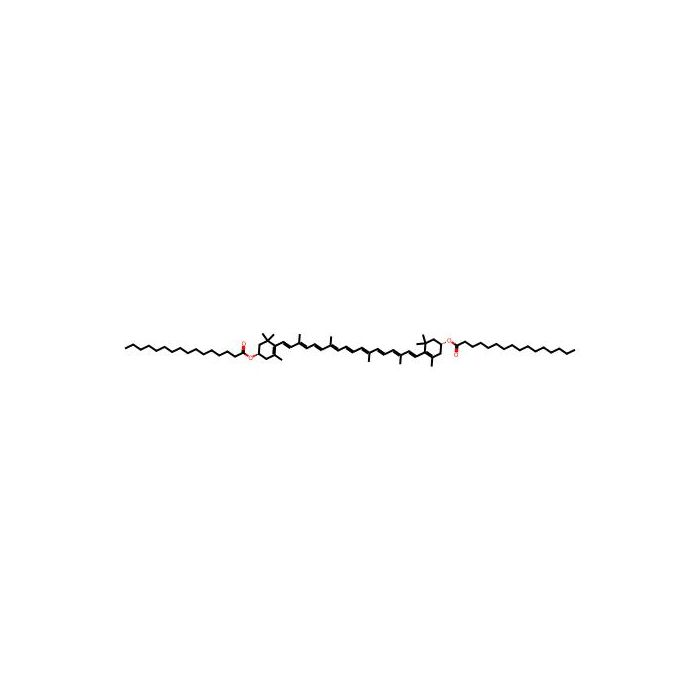
Zeaxanthin dipalmitate (Physalien) is a wolfberry-derived carotenoid, has anti-inflammatory and anti-oxidative stress effects. Zeaxanthin dipalmitate directly interact with p2X7 receptor ( K d =81.2 nM) and adiponectin receptor 1 ( AdipoR1 ; K d =533 nM) in a positive dose-dependent manner. Zeaxanthin dipalmitate restores mitochondrial autophagy functions suppressed by ethanol intoxication. Zeaxanthin dipalmitate can be used in the research of alcoholic fatty liver disease (AFLD) and retinitis pigmentosa (RP)
In Vitro
Zeaxanthin dipalmitate (1 µM; 2 h) totally or partially reverses the down-regulation of Atg5, beclin-1, and LC3A/B by ethanol (250 mM), and the up-regulation of p62 by ethanol in BRL-3A cells. Zeaxanthin dipalmitate (1 µM; 2 h) partially recovers the ethanol-suppressed LC3B in BRL-3A cells. Zeaxanthin dipalmitate (1 µM; 2 h) partially recovers the ethanol-suppressed cell viability and ethanol-induced aspase-3/7 activity of BRL-3A cells. Zeaxanthin dipalmitate (1 µM; 2 h) recovers the ethanol-induced inhibition of mitophagy in BRL-3A cells. MCE has not independently confirmed the accuracy of these methods. They are for reference only.
In Vivo
Zeaxanthin dipalmitate (10 mg/kg; p.o.; daily for 2 weeks) reduces the serum ALT and AST levels increased by long-term ethanol challenge in at AFLD Model . Zeaxanthin dipalmitate (10 mg/kg; p.o.; daily for 2 weeks) effectively attenuates the histological injury . Zeaxanthin dipalmitate (10 mg/kg; p.o.; daily for 2 weeks) attenuates the AFLD-induced hepatic apoptosis (reveal by caspase-3/7 activity) and inflammation (TNF-α) in rat . Zeaxanthin dipalmitate (approximately 4 μM; intravitreal injection for once) improves the visual behavior of rd10 mice and delays the degeneration of retinal photoreceptors. Zeaxanthin dipalmitate (approximately 4 μM; intravitreal injection for once) improves the light responses of photoreceptors, bipolar cells and retinal ganglion cells. Zeaxanthin dipalmitate (approximately 4 μM; intravitreal injection for once) reduces the expression of genes that are involved in inflammation, apoptosis and oxidative stress in rd10 mice. MCE has not independently confirmed the accuracy of these methods. They are for reference only.
Form:Solid
IC50& Target:p2X7/AdipoR1 receptor
Taxonomy Tree
| Kingdom | Organic compounds |
|---|---|
| Superclass | Lipids and lipid-like molecules |
| Classe | Prenol lipids |
| Subclass | Tetraterpenoids |
| Intermediate Tree Nodes | Carotenoids |
| Direct Parent | Xanthophylls |
| Alternative Parents | Fatty acid esters Dicarboxylic acids and derivatives Carboxylic acid esters Organic oxides Hydrocarbon derivatives Carbonyl compounds |
| Molecular Framework | Aliphatic homomonocyclic compounds |
| Substituents | Xanthophyll - Fatty acid ester - Fatty acyl - Dicarboxylic acid or derivatives - Carboxylic acid ester - Carboxylic acid derivative - Organic oxygen compound - Organic oxide - Hydrocarbon derivative - Organooxygen compound - Carbonyl group - Aliphatic homomonocyclic compound |
| Descrição | This compound belongs to the class of organic compounds known as xanthophylls. These are carotenoids containing an oxygenated carotene backbone. Carotenes are characterized by the presence of two end-groups (mostly cyclohexene rings, but also cyclopentene rings or acyclic groups) linked by a long branched alkyl chain. Carotenes belonging form a subgroup of the carotenoids family. Xanthophylls arise by oxygenation of the carotene backbone. |
| External Descriptors | C40 isoprenoids (tetraterpenes) |
| Peso molecular | 1045.7 |
|---|---|
| XLogP3 | 26.700 |
| Hydrogen Bond Donor Count | 0 |
| Hydrogen Bond Acceptor Count | 4 |
| Rotatable Bond Count | 42 |
| Exact Mass | 1044.89 Da |
| Monoisotopic Mass | 1044.89 Da |
| Topological Polar Surface Area | 52.600 Ų |
| Heavy Atom Count | 76 |
| Formal Charge | 0 |
| Complexity | 1850.000 |
| Isotope Atom Count | 0 |
| Defined Atom Stereocenter Count | 2 |
| Undefined Atom Stereocenter Count | 0 |
| Defined Bond Stereocenter Count | 9 |
| Undefined Bond Stereocenter Count | 0 |
| The total count of all stereochemical bonds | 9 |
| Covalently-Bonded Unit Count | 1 |
No application protocols are specified in the Product Data for this item. The following general, non-binding examples illustrate common laboratory uses; adjust to your system and consult primary literature.
These procedures are illustrative only and are not specifications for this product batch.
This section provides general biochemical context for zeaxanthin esters; it is not product-specific and does not imply any clinical use.
Note: Any references to metabolism or biological function are provided for research design context only. This product is for research use only and not for human or veterinary applications.
Zeaxanthin dipalmitate is not a buffering reagent and is practically insoluble in aqueous buffers. Consequently, it is not typically used to prepare or adjust pH in biochemical systems.
For experiments requiring strict aqueous compatibility, consider using delivery systems (liposomes, polymeric micelles) rather than attempting direct dissolution in buffer.
While the compound itself is a hydrophobic carotenoid diester, greener decisions can be made in its handling, analysis, and formulation by selecting lower-impact solvents and processes.
Trade-offs: Greener solvents can alter solubility, extraction selectivity, and chromatographic resolution. Validate changes with small-scale trials and adjust temperature, co-solvent ratios, and stationary phases accordingly.
No pharmacopeial or excipient status is provided in the Product Data for this item. The following points describe general research/formulation contexts only and do not imply suitability for clinical use.
Any application toward human or veterinary products requires independent assessment of regulatory status, residual solvents, stabilizers, and impurity/isomer profiles beyond what is provided here.
Item-specific physical constants are not provided in the Product Data. The following are general/literature characteristics for zeaxanthin diesters, offered as guidance only (not product specifications):
Always verify any quantitative property requirements against the item’s CoA/Spec Sheet before method development.
For method-critical work (e.g., quantitative HPLC), consult the item’s CoA/Spec Sheet for the definitive grade, purity basis (w/w, area%), and isomer profile before use.
Manufacturer Applications: Not specified in Product Data. The following are common research applications for zeaxanthin diesters (literature/general guidance):
Practical tips
The following conditions are provided as general literature guidance for working with zeaxanthin esters; they are not item-specific specifications.
Yields and kinetics strongly depend on isomer composition, oxygen exclusion, light exposure, and base strength; pilot trials are recommended.
Authoritative safety data and classification are provided in the product SDS; always defer to the SDS.
Zeaxanthin dipalmitate is an extremely hydrophobic carotenoid diester. Solvent choice governs solubility, stability, and handling.
Always filter solvents through alumina to remove peroxides when needed and verify solvent choice against your analytical or formulation method.
Research Use Note: For research use only.
Zeaxanthin dipalmitate is a diesterified xanthophyll carotenoid in which both terminal secondary alcohols of zeaxanthin are esterified with palmitic acid (hexadecanoate), yielding a highly lipophilic carotenoid diester.
Notes: Given identifiers are limited in the Product Data; for definitive structure strings (e.g., exact SMILES), please consult the item’s CoA/Spec Sheet or contact Technical Support.
Although primarily a target analyte/formulation component, zeaxanthin dipalmitate has utility in synthetic and preparative chemistry contexts (general literature guidance):
Handling note: The polyene backbone is highly sensitive—carry out reactions under inert atmosphere, subdued light, and with radical inhibitors where compatible.
Not applicable. Zeaxanthin dipalmitate is a small-molecule carotenoid diester and does not possess “target specificity” parameters such as antigen/epitope recognition, species cross-reactivity, clone, or isotype. For selectivity considerations relevant to this compound, see Reaction & Applications and Synthetic Utility.