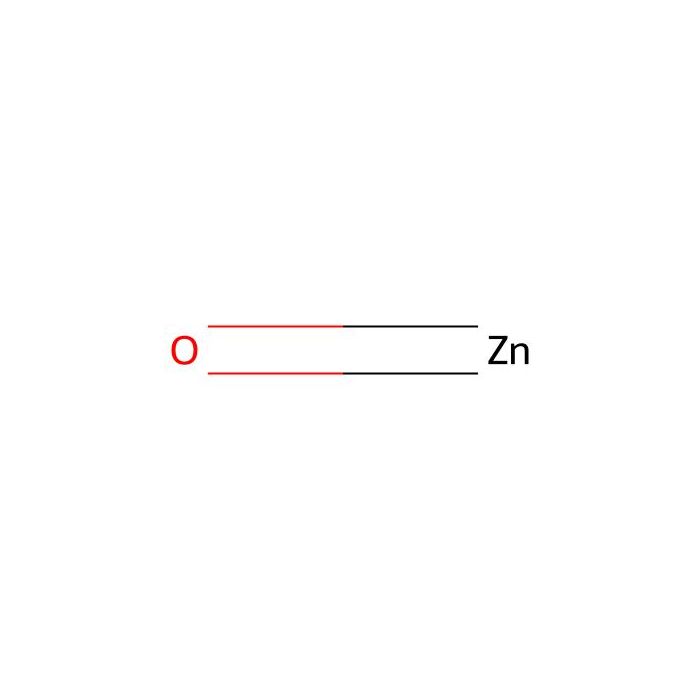
Zinc oxide - ≥98% , CAS No.1314-13-2

CAS: 1314-13-2 Cat. No.: Z579397 Fórmula: ZnO Peso molecular: 81.39 Número CE: 215-222-5
Disponível para encomenda
GRADE & PURITY ≥98%
Synonyms
Azo-77TT | Flores de zinci | Vandem VPC | Zinc Oxide Dispersion | Zinc oxide, Puratronic | Zincite | Zinc oxide, Nanotek? | Caswell No. 920 | FT-0640838 | RVPaque | Supertah | Zinc oxide substrate, 10x10x0.5mm, polished one side, 0001 orientation | Yttriu
Storage
Room temperature
Shipped In
Normal
★
Size
Alemanha (EU)
USA*
Price
Qty
500g
Z579397-500g
5 Em stock
Em stock ≥10

22,47€

27,68€
Gravar 5,21 € (18.81%)
12×500g
Z579397-12×500g
Sob encomenda · 8–12 semanas

248,09€

299,28€
Gravar 51,20 € (17.11%)
20×500g
Z579397-20×500g
Sob encomenda · 8–12 semanas

372,17€

494,52€
Gravar 122,35 € (24.74%)
Enter a quantity for the sizes you want to add.
🧪
Why this grade

≥98% for sensitive chromatographic and analytical workflows requiring minimal baseline interference.

🌡

Storage & shipping

Room temperature Ships Normal Check lot-specific COA for exact specifications.

📋

Quality documents

SDS, COA, datasheet, and spec sheet available for download. Lot-specific COA accessible via lot number lookup.

📚

Literature proof

Cited in 1358 peer-reviewed publications across chromatography, organic synthesis, and cross-coupling reactions.

Specifications

Sinónimos
Azo-77TT | Flores de zinci | Vandem VPC | Zinc Oxide Dispersion | Zinc oxide, Puratronic | Zincite | Zinc oxide, Nanotek? | Caswell No. 920 | FT-0640838 | RVPaque | Supertah | Zinc oxide substrate, 10x10x0.5mm, polished one side, 0001 orientation | Yttriu
Especificações e pureza
≥98%
Condições de armazenamento de armazenamento
Room temperature
Enviado em
Normal
Pureza
≥98%
Nomes e identificadores
Pubchem Sid
SMILES isoméricas
O=[Zn]
Número UN
3077
Grupo de embalagem
III
Peso molecular
81.39

Documentation

📋 Safety Data Sheet (SDS)

Comprehensive hazard, handling, storage, and regulatory compliance document.

Download SDS →

✅ Certificate of Analysis (COA)

Lot-specific quality data. Enter your lot number to retrieve the exact COA.

Look up COA →

📊 Datasheet

Quick-reference summary of product specifications and applications.

View datasheet →

🔬 Specification Sheet

Full quality attributes and acceptance criteria for this grade.

View spec sheet →

Advanced Data

Certificados(CoA,COO,BSE/TSE e Mapa de Análise)
C of A & Other Certificates(BSE/TSE, COO):
Analytical Chart:

Find and download the COA for your product by matching the lot number on the packaging.

6 results found

Lot NumberCertificate TypeDataItem
G2402550Certificate of AnalysisJul 12, 2024 Z579397
F2405545Certificate of AnalysisJun 14, 2024 Z579397
J2313504Certificate of AnalysisOct 24, 2023 Z579397
J2313503Certificate of AnalysisOct 23, 2023 Z579397
E2318664Certificate of AnalysisMay 31, 2023 Z579397
E2318656Certificate of AnalysisMay 30, 2023 Z579397
Propriedades químicas e físicas
Ponto de fusão (°C)1975℃
Peso molecular81.400 g/mol
XLogP3
Hydrogen Bond Donor Count0
Hydrogen Bond Acceptor Count1
Rotatable Bond Count0
Exact Mass79.9241 Da
Monoisotopic Mass79.9241 Da
Topological Polar Surface Area17.100 Ų
Heavy Atom Count2
Formal Charge0
Complexity2.000
Isotope Atom Count0
Defined Atom Stereocenter Count0
Undefined Atom Stereocenter Count0
Defined Bond Stereocenter Count0
Undefined Bond Stereocenter Count0
The total count of all stereochemical bonds0
Covalently-Bonded Unit Count1
FAQs e artigos
Applications of Nanoclay in Materials and Formulations: Dispersion Mechanisms, Performance Enhancement, and Product Selection
The Complete Guide to UV Absorbers: Definition & Scope, Key Engineering Metrics, Validation Methods, and Selection Navigation (Tables 1–3)
Light-Emitting Polymers (LEPs): A Practical Panorama - A Core PL/EL Mechanistic Framework, Material Family Map, and Structural “Design Knobs” (including Product Tables 1–4 and a selection guide)
Thermoelectric Materials Selection Guide: Evaluation Framework, Temperature-Range–System Map, and Modularization Gatekeeping Criteria (with Product Navigation Tables 1–4)
Ceramic Materials Guide: Basic Definitions, Classification Framework, and Research-Task-Oriented Selection (with Product Navigation and Tables 1–4)
Self-Assembled Nanodielectrics (SANDs): Self-Assembled Nanodielectric Layers for Low-Voltage Thin-Film Transistors (with Product Selection Guide)
Liquid Polyisoprene: Material Characteristics, Application Directions, and Selection Considerations
TCA-KTTS, a Titanate Coupling Agent Suitable for Use in Cosmetics: Basic Information, Application Characteristics, and Differences from 130 and 105
Structure–Property Relationship of Silicone Resins: Mechanisms of Heat Resistance, Weatherability, Hydrophobicity, and Coating Performance Analysis
From Molecular Design to Morphology Control: How Small-Molecule Donors Improve the Efficiency, Stability, and Processability of Organic Solar Cells
How ZnO Nanoparticle Electron Transport Layers Reduce Dark Current in Organic Photodetectors: Mechanisms, Film Quality, and Material Selection
How Should Montmorillonite Be Rationally Modified? Organic Modification, Inorganic Modification, and Application-Oriented Selection and Validation
Application Positioning, Scenario Selection, and Key Use Considerations for Chlorinated Rubber Resin in Coatings
Formulation Design of Chlorinated Rubber Coatings: Component Synergy and Performance Control
Waterborne Resin Application Guide: Formulation Synergy, Troubleshooting, and Technology Development Trends
Mechanisms and Control of Coating Yellowing: From Chromophoric Structure Formation to Source Diagnosis and Formulation Optimization
Resin Polarity in Coating Formulations: From Molecular Structure to Dissolution, Compatibility, Interfacial Interactions, and Formulation Design
Why Do Daily Chemical Products Become Opaque? Formation Mechanisms of Milky Turbidity, Pearlescence, and Coverage, and How to Select the Right Ingredients
Color-Development Mechanisms, Formulation Forms, and Selection/Application Logic of Colorants in Personal Care Products
Zinc–Bismuth Composite Catalysts for Polyurethane: Cure Control, Selection Methods, and Blend-Ratio Design
Mechanism of Kojic Acid in Reducing Hyperpigmentation: From Tyrosinase Inhibition to Melanin Production Regulation
The Dual-Targeted Skin-Brightening Mechanism of 4-MSK: Inhibiting Melanin Production and Reducing Epidermal Pigment Retention
Molecular Structure, Photochemical Behavior, and Role of Octocrylene in Sunscreen Formulations
UVA Absorption Mechanism of Avobenzone: Keto–Enol Tautomerism, Photochemical Instability, and Formulation Photostabilization Strategies
Anti-Photoaging Potential of Artemia Extract: UV-Induced Damage Cascades, HSP70-Related Stress Protection, and GP4G Metabolic Insights
The Sebum-Regulating Potential of Zinc PCA and Its Relationship with Stratum Corneum Hydration
Mechanism of Action of Tranexamic Acid in Pigmentation Care: From the Plasmin System to Regulation of Inflammation-Driven Pro-Melanogenic Signaling
Citations of This Product
Calculadoras de soluções
Revisões

Avaliações dos Clientes

Deseja que lhe enviemos uma mensagem quando tivermos descontos disponíveis?

Lembrar-me mais tarde

Obrigado! Por favor, verifique a sua caixa de entrada de e-mail para confirmar.

Ops! As notificações estão desativadas.