
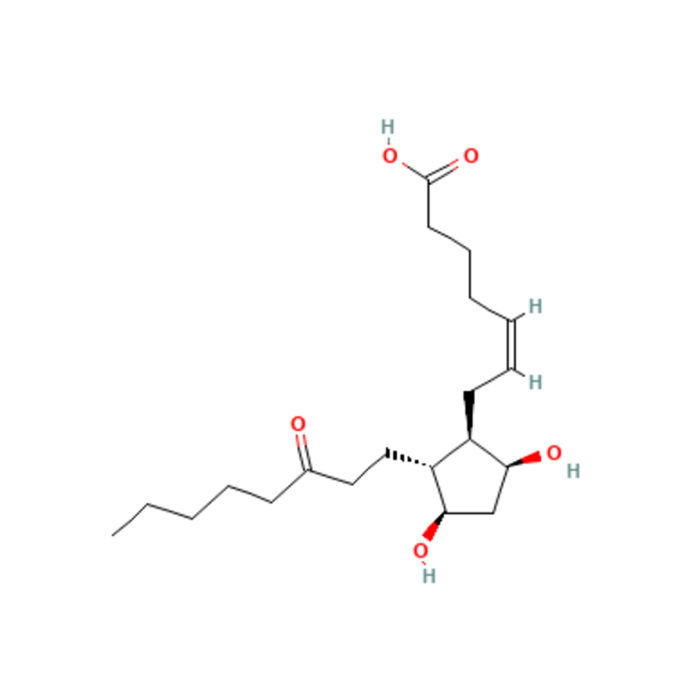
 F2506827
Determine the necessary mass, volume, or concentration for preparing a solution.
| Activity Type | Activity Value -log(M) | Mechanism of Action | Activity Reference | Publications (PubMed IDs) |
|---|
Moligand™, ≥95%, A solution in methyl acetate Moligand™ for sensitive chromatographic and analytical workflows requiring minimal baseline interference.
Store at -20°C Ships Ice chest + Ice pads Check lot-specific COA for exact specifications.
SDS, COA, datasheet, and spec sheet available for download. Lot-specific COA accessible via lot number lookup.
Cited in 0 peer-reviewed publications across chromatography, organic synthesis, and cross-coupling reactions.
13,14-Dihydro-15-keto-prostaglandin F2α is the first substantially accumulating metabolite of PGF2α , that is formed from 15-keto-PGF2α via the 15-hydroxy prostaglandin dehydrogenase pathway. This product has been used to measure the rate of|in vivo|production of PGF2α, and has been shown to covalently bind to bovine acetylcholine esterase.
| Sonrisas canónicas | CCCCCC(=O)CCC1C(CC(C1CC=CCCCC(=O)O)O)O |
|---|---|
| IUPAC Name | (Z)-7-[(1R,2R,3R,5S)-3,5-dihydroxy-2-(3-oxooctyl)cyclopentyl]hept-5-enoic acid |
| InChIKey | VKTIONYPMSCHQI-XAGFEHLVSA-N |
| INCHI | 1S/C20H34O5/c1-2-3-6-9-15(21)12-13-17-16(18(22)14-19(17)23)10-7-4-5-8-11-20(24)25/h4,7,16-19,22-23H,2-3,5-6,8-14H2,1H3,(H,24,25)/b7-4-/t16-,17-,18+,19-/m1/s1 |
| Isómeros SMILES | CCCCCC(=O)CC[C@H]1[C@@H](C[C@@H]([C@@H]1C/C=C\CCCC(=O)O)O)O |
| PubChem CID | 5283039 |
| Peso molecular | 354.48 |
Comprehensive hazard, handling, storage, and regulatory compliance document.
Download SDS →Lot-specific quality data. Enter your lot number to retrieve the exact COA.
Look up COA →Full quality attributes and acceptance criteria for this grade.
View spec sheet →Taxonomy Tree
| Kingdom | Organic compounds |
|---|---|
| Superclass | Lipids and lipid-like molecules |
| Clase | Fatty Acyls |
| Subclass | Eicosanoids |
| Intermediate Tree Nodes | Not available |
| Direct Parent | Prostaglandins and related compounds |
| Alternative Parents | Long-chain fatty acids Hydroxy fatty acids Unsaturated fatty acids Cyclopentanols Ketones Cyclic alcohols and derivatives Monocarboxylic acids and derivatives Carboxylic acids Organic oxides Hydrocarbon derivatives |
| Molecular Framework | Aliphatic homomonocyclic compounds |
| Substituents | Prostaglandin skeleton - Long-chain fatty acid - Hydroxy fatty acid - Cyclopentanol - Fatty acid - Unsaturated fatty acid - Cyclic alcohol - Ketone - Secondary alcohol - Carboxylic acid - Carboxylic acid derivative - Monocarboxylic acid or derivatives - Alcohol - Hydrocarbon derivative - Organic oxide - Organic oxygen compound - Carbonyl group - Organooxygen compound - Aliphatic homomonocyclic compound |
| Descripción | This compound belongs to the class of organic compounds known as prostaglandins and related compounds. These are unsaturated carboxylic acids consisting of a 20 carbon skeleton that also contains a five member ring, and are based upon the fatty acid arachidonic acid. |
| External Descriptors | Prostaglandins |
| Activity Type | Activity Value -log(M) | Mechanism of Action | Activity Reference | Publications (PubMed IDs) |
|---|
| Sensibilidad | Moisture sensitive |
|---|---|
| Punto de ebullición (°C) | 57° C |
| Punto de fusión (°C) | -98.05 °C |
| Peso molecular | 354.500 g/mol |
| XLogP3 | 2.600 |
| Hydrogen Bond Donor Count | 3 |
| Hydrogen Bond Acceptor Count | 5 |
| Rotatable Bond Count | 13 |
| Exact Mass | 354.241 Da |
| Monoisotopic Mass | 354.241 Da |
| Topological Polar Surface Area | 94.800 Ų |
| Heavy Atom Count | 25 |
| Formal Charge | 0 |
| Complexity | 432.000 |
| Isotope Atom Count | 0 |
| Defined Atom Stereocenter Count | 4 |
| Undefined Atom Stereocenter Count | 0 |
| Defined Bond Stereocenter Count | 1 |
| Undefined Bond Stereocenter Count | 0 |
| The total count of all stereochemical bonds | 1 |
| Covalently-Bonded Unit Count | 1 |
Our grade selection guide covers purity, stabilizer status, and application suitability for all variants in our catalog.
View Moligand™ grade guide →