Determine the necessary mass, volume, or concentration for preparing a solution.
| Activity Type | Activity Value -log(M) | Mechanism of Action | Activity Reference | Publications (PubMed IDs) |
|---|

Moligand™,≥90% Moligand™ for sensitive chromatographic and analytical workflows requiring minimal baseline interference.
Store at 2-8°C,Protected from light,Argon charged Ships Wet ice Check lot-specific COA for exact specifications.
SDS, COA, datasheet, and spec sheet available for download. Lot-specific COA accessible via lot number lookup.
Cited in 17 peer-reviewed publications across chromatography, organic synthesis, and cross-coupling reactions.
Product description:
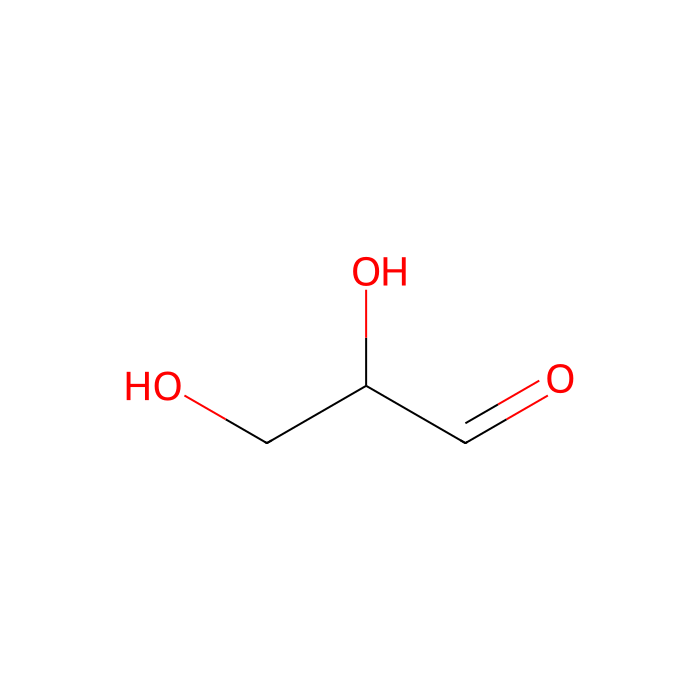
Glyceraldehyde is a simple monosaccharide. According to the number of carbon atoms and the type of carbonyl group, glyceraldehyde is a triose. It is a colorless sweet compound.
Application:
Dl-glyceraldehyde has been used for:
As a modifier for preparing crystalline solutions
As a substrate for measuring aldose reductase activity
The specific activity of GAPDH (glyceraldehyde-3-phosphate dehydrogenase) was determined in the preparation of d/ L-glyceraldehyde raw materials
Explanation:
Dl-glyceraldehyde is the substrate of aldose reductase.
| Pubchem Sid | 508807653 |
|---|---|
| Sonrisas canónicas | C(C(C=O)O)O |
| IUPAC Name | 2,3-dihydroxypropanal |
| InChIKey | MNQZXJOMYWMBOU-UHFFFAOYSA-N |
| INCHI | 1S/C3H6O3/c4-1-3(6)2-5/h1,3,5-6H,2H2 |
| Isómeros SMILES | C(C(C=O)O)O |
| Peso molecular | 90.08 |
| Reaxy-Rn | 635844 |
| Reaxys-RN_link_address | https://www.reaxys.com/reaxys/secured/hopinto.do?context=S&query=IDE.XRN=635844&ln= |
Comprehensive hazard, handling, storage, and regulatory compliance document.
Download SDS →Lot-specific quality data. Enter your lot number to retrieve the exact COA.
Look up COA →Full quality attributes and acceptance criteria for this grade.
View spec sheet →Taxonomy Tree
| Kingdom | Organic compounds |
|---|---|
| Superclass | Organic oxygen compounds |
| Clase | Organooxygen compounds |
| Subclass | Carbohydrates and carbohydrate conjugates |
| Intermediate Tree Nodes | Not available |
| Direct Parent | Monosaccharides |
| Alternative Parents | Alpha-hydroxyaldehydes Secondary alcohols 1,2-diols Short-chain aldehydes Primary alcohols Organic oxides Hydrocarbon derivatives |
| Molecular Framework | Aliphatic acyclic compounds |
| Substituents | Monosaccharide - Alpha-hydroxyaldehyde - Secondary alcohol - 1,2-diol - Organic oxide - Hydrocarbon derivative - Short-chain aldehyde - Primary alcohol - Carbonyl group - Aldehyde - Alcohol - Aliphatic acyclic compound |
| Descripción | This compound belongs to the class of organic compounds known as monosaccharides. These are compounds containing one carbohydrate unit not glycosidically linked to another such unit, and no set of two or more glycosidically linked carbohydrate units. Monosaccharides have the general formula CnH2nOn. |
| External Descriptors | DL-glyceraldehyde |
| Activity Type | Activity Value -log(M) | Mechanism of Action | Activity Reference | Publications (PubMed IDs) |
|---|
| Activity Type | Relation | Activity value | Units | Action Type | Journal | PubMed Id | doi | Assay Aladdin ID |
|---|
| Activity Type | Relation | Activity value | Units | Action Type | Journal | PubMed Id | doi | Assay Aladdin ID |
|---|
Find and download the COA for your product by matching the lot number on the packaging.
| Lot Number | Certificate Type | Fecha | Articulo |
|---|---|---|---|
 L2318397 L2318397 | Certificate of Analysis | Sep 21, 2026 | D589509 |
| C2511263 | Certificate of Analysis | Feb 22, 2025 | D589509 |
| C2511265 | Certificate of Analysis | Feb 22, 2025 | D589509 |
| C2511267 | Certificate of Analysis | Feb 22, 2025 | D589509 |
| L2318398 | Certificate of Analysis | Nov 24, 2023 | D589509 |
| L2318399 | Certificate of Analysis | Nov 24, 2023 | D589509 |
| Sensibilidad | Light sensitive;Air sensitive |
|---|---|
| Punto de fusión (°C) | 145°C |
| Peso molecular | 90.080 g/mol |
| XLogP3 | -1.600 |
| Hydrogen Bond Donor Count | 2 |
| Hydrogen Bond Acceptor Count | 3 |
| Rotatable Bond Count | 2 |
| Exact Mass | 90.0317 Da |
| Monoisotopic Mass | 90.0317 Da |
| Topological Polar Surface Area | 57.500 Ų |
| Heavy Atom Count | 6 |
| Formal Charge | 0 |
| Complexity | 43.300 |
| Isotope Atom Count | 0 |
| Defined Atom Stereocenter Count | 0 |
| Undefined Atom Stereocenter Count | 1 |
| Defined Bond Stereocenter Count | 0 |
| Undefined Bond Stereocenter Count | 0 |
| The total count of all stereochemical bonds | 0 |
| Covalently-Bonded Unit Count | 1 |
| 1. Ruite Lai, Qidong Hou, Guanjie Yu, Chao Xie, Hengli Qian, Tianliang Xia, Xinyu Bai, Yao Tang, Mian Laiq Ur Rehman, Meiting Ju. (2023) Incorporation of tin into zirconium phosphate to boost efficient conversion of trioses to lactic acid. CATALYSIS COMMUNICATIONS, [PMID:] [10.1016/j.catcom.2023.106803] |
| 2. Jinsheng Huang, Huiling Huang, Yiyao Wang, Bin Xu, Minzhao Lin, Shisong Han, Yuanyuan Yuan, Yong Wang, Xintao Shuai. (2023) Retinol-binding protein-hijacking nanopolyplex delivering siRNA to cytoplasm of hepatic stellate cell for liver fibrosis alleviation. BIOMATERIALS, [PMID:37167895] [10.1016/j.biomaterials.2023.122134] |
| 3. Gui-Hua Wei, Ting Lu, Hai-Yan Liu, Jiao-Xuan Bai, Qian Wang, Guang-Yue Li, Ying-Hua Liang. (2023) Exploring the continuous cleavage-oxidation mechanism of the catalytic oxidation of cellulose to formic acid: A combined experimental and theoretical study. FUEL, [PMID:] [10.1016/j.fuel.2023.127667] |
| 4. Yongfang Zhou, Thomas J.A. Slater, Xuanli Luo, Yi Shen. (2022) A versatile single-copper-atom electrocatalyst for biomass valorization. APPLIED CATALYSIS B-ENVIRONMENTAL, [PMID:] [10.1016/j.apcatb.2022.122218] |
| 5. Xiaomei Ning, Xiaosong Zhou, Jin Luo, Liang Zhan. (2021) PtBi on carbon cloth as efficient flexible electrode for electro-oxidation of liquid fuels. JOURNAL OF ELECTROANALYTICAL CHEMISTRY, [PMID:] [10.1016/j.jelechem.2021.115958] |
| 6. Haiyong Wang, Haosheng Xin, Chiliu Cai, Changhui Zhu, Zhongxun Xiu, Qiying Liu, Yujing Weng, Chenguang Wang, Xinghua Zhang, Shijun Liu, Zifang Peng, Longlong Ma. (2020) Selective C3-C4 Keto-Alcohol Production from Cellulose Hydrogenolysis over Ni-WOx/C Catalysts. ACS Catalysis, [PMID:] [10.1021/acscatal.0c02375] |
| 7. Ting Lu, Yucui Hou, Weize Wu, Muge Niu, Wei Li, Shuhang Ren. (2018) Catalytic oxidation of cellulose to formic acid in V(V)-Fe(III)-H2SO4 aqueous solution with O2. FUEL PROCESSING TECHNOLOGY, [PMID:] [10.1016/j.fuproc.2018.02.001] |
| 8. Xiaomei Ning, Yuhang Li, Hao Yu, Feng Peng, Hongjuan Wang, Yanhui Yang. (2016) Promoting role of bismuth and antimony on Pt catalysts for the selective oxidation of glycerol to dihydroxyacetone. JOURNAL OF CATALYSIS, [PMID:] [10.1016/j.jcat.2015.12.020] |
| 9. Xiaomei Ning, Hao Yu, Feng Peng, Hongjuan Wang. (2015) Pt nanoparticles interacting with graphitic nitrogen of N-doped carbon nanotubes: Effect of electronic properties on activity for aerobic oxidation of glycerol and electro-oxidation of CO. JOURNAL OF CATALYSIS, [PMID:] [10.1016/j.jcat.2015.02.010] |
| 10. Haichao Zhou, Jianglin Liu, Dalang Chen, Yanlin Qin, Tiejun Wang, Xueqing Qiu, Xuliang Lin. (2025) Boosting middle hydroxyl adsorption on lignin-derived carbon loaded MnO–Ni for glycerol conversion to dihydroxyacetone. AICHE JOURNAL, [PMID:] [10.1002/aic.70012] |
| 11. Liu Yang, Shang Huishan, Zhang Bing, Yan Dongpeng, Xiang Xu. (2024) Surface fluorination of BiVO4 for the photoelectrochemical oxidation of glycerol to formic acid. Nature Communications, 15 (1): (1-12). [PMID:39289360] [10.1038/s41467-024-52161-4] |
| 12. Tong Zhang, Haiyong Wang, Chenguang Wang, Qiying Liu. (2025) Catalytic hydrogenolysis of fructose to acetol over Ni/CeO2 catalysts. INDUSTRIAL CROPS AND PRODUCTS, [PMID:] [10.1016/j.indcrop.2025.122213] |
| 13. Shuang Wei, Sheng Zhong, Chao Bao, Linbo Huang, Kexin Li, Ruirui Wang, Bin He, Ruirui Zhang, Ruixia Liu. (2025) Interfacial Electronic Modulation of Co3O4/CeO2 Heterojunction for Optimizing C–C Bond Cleavage and Intermediate Adsorption in Glycerol Oxidation to Glycolic Acid. ACS Applied Materials & Interfaces, [PMID:41128629] [10.1021/acsami.5c18111] |
| 14. Zhenjun Liu, Tianpei Yang, Yi Shen. (2025) Enhancing the selectivity of glycerol electrooxidation toward C3 products through the synergistic effect of Au and Pt. INTERNATIONAL JOURNAL OF HYDROGEN ENERGY, [PMID:] [10.1016/j.ijhydene.2025.152668] |
| 15. Jiafeng Niu, Xiaoyu Zhu, Huibing Chi, Bin Ma, Hao Zhu, Zhaoxin Lu, Ping Zhu, Fengxia Lu. (2026) Reshaping the Binding Pocket of Aldo–Keto Reductase for Enhanced Stereoselectivity and Activity. JOURNAL OF AGRICULTURAL AND FOOD CHEMISTRY, [PMID:] [10.1021/acs.jafc.5c15071] |
| 16. Chen-Xi Li, Qian Ren, Feng Peng, Ming-Fei Li. (2026) Lignin-tailored synergistic catalyst with cobalt single-atom and zinc clusters dual-site for conversion of hemicellulose to lactic acid. BIORESOURCE TECHNOLOGY, [PMID:42155777] [10.1016/j.biortech.2026.134908] |
| 17. Haodong Xie, Yumeng Fo, Hongwei Zhang, Hua Xu, Xiao Zhang, Yingshuo Guo, Runze Li, Ruolin Zhang, Guilin Liu, Xicheng Jia, Jiazhou Li, Yuming Zhang, Meizan Jing, Weiyu Song, Wenhao Luo, Zhijie Wu. (2026) PtIn nanoalloy supported on Sn-MFI for efficient selective oxidation of glycerol to lactic acid. CHINESE JOURNAL OF CATALYSIS, [PMID:] [10.1016/S1872-2067(26)65047-4] |
Our grade selection guide covers purity, stabilizer status, and application suitability for all variants in our catalog.
View Moligand™ grade guide →