This compound belongs to the class of organic compounds known as organobromides. These are compounds containing a chemical bond between a carbon atom and a bromine atom.
External Descriptors
Not available
1. Djoumbou Feunang Y, Eisner R, Knox C, Chepelev L, Hastings J, Owen G, Fahy E, Steinbeck C, Subramanian S, Bolton E, Greiner R, and Wishart DS. ClassyFire: Automated Chemical Classification With A Comprehensive, Computable Taxonomy. Journal of Cheminformatics, 2016, 8:61.
Determine the necessary mass, volume, or concentration for preparing a solution.
Dilution Calculator
Determine the dilution needed to prepare a stock solution.
Reconstitution Calculator
Reseñas
Reseñas de cliente
Application Protocols
Not applicable. No tested bioassay protocols (e.g., WB, IHC, IF, FC) are associated with this small-molecule reagent. For chemical application guidance, see Reaction Conditions and Application sections.
Biological Roles
This product is a small synthetic organobromide used as a chemical reagent; it is not a biological buffer, metabolite, or biopolymer component.
General context (literature)
Alkyl dihalides can act as electrophiles that alkylate nucleophiles in biomolecules under harsh conditions, but 2,4‑dibromopentane has no known endogenous role in cells or organisms.
No established participation in metabolic pathways or signaling; any biological interactions would be non-specific alkylation and are typically undesirable outside controlled in vitro chemistry.
Research use note
For research use only. Not for human or veterinary use. Handle in a chemical fume hood and avoid biological exposure.
Buffer Applications
Not applicable. 2,4-Dibromopentane is a hydrophobic alkyl dihalide and does not function as an acid/base buffer or buffering component. For practical usage, refer instead to the Synthetic Utility, Reaction & Applications, and Reaction Conditions sections.
Green Alternatives
Context
2,4-Dibromopentane is a halogenated hydrocarbon; synthesis and use raise concerns (halogenated waste, persistence, potential toxicity). Greener strategies focus on reducing halogenated reagents, optimizing solvents, and maximizing atom economy.
Options (general guidance)
Replace halide leaving groups with renewable sulfonates when feasible: prepare the corresponding 2,4‑bis(mesylate/tosylate) and perform SN2 in greener solvents (e.g., MeCN, 2‑MeTHF). Tradeoff: mesylates may be less reactive toward some nucleophiles; tosylates increase molar mass and may complicate purifications.
For diene synthesis, use elimination from renewable diols via dehydration (e.g., via green catalysts) instead of double dehydrohalogenation of a dibromide.
Solvent choice: prefer 2‑MeTHF, CPME, or EtOAc over DMF/DMSO/CH2Cl2 when compatible with reaction kinetics and selectivity.
Catalysis: employ nickel/iron catalysis for cross-couplings in place of stoichiometric metal reductions; use electrochemistry for reductive couplings to minimize sacrificial metals.
Snapshot comparison (general)
Parameter | Halogenated route (this reagent) | Alternative approach
Waste profile | Halogenated salts/Br–, possible HBr | Nonhalogenated byproducts (e.g., sulfate) but still requires treatment
Solvent options | Often polar aprotic or chlorinated | Wider range of greener ethers/esters
Reactivity | High (good leaving group) | Often moderate; may require higher T or catalysts
Note: Selection should balance EHS impact with chemoselectivity and project timelines.
Pharmaceutical Uses
No direct excipient or formulation roles are typical for 2,4-dibromopentane.
General notes (context only; not specific to this item)
Small organobromides are occasionally used as synthetic intermediates in API route development (e.g., to introduce carbon skeletons or enable late-stage substitution). They are not used as pharmaceutical excipients.
Any use would be confined to chemical process development; the reagent itself is not intended for administration. For quality expectations in GMP settings, additional impurity and residual halide controls would be required (not specified for this item).
Physical Properties
Item-specific (from Product Data)
Appearance: Not specified for this item; refer to CoA/Spec Sheet.
Molecular formula: Not specified for this item; refer to CoA/Spec Sheet.
Molecular weight: Not specified for this item; refer to CoA/Spec Sheet.
Literature values (non-spec; approximate guidance for 2,4-dibromopentane and related C5 dibromides)
Phase at ambient conditions: typically a colorless to pale yellow liquid (literature, many alkyl dibromides are liquids at RT).
Boiling point: often in the ~200–225 °C range at 1 atm for C5 dibromide isomers; exact value for 2,4‑isomer varies by source and purity (literature).
Density (20–25 °C): commonly around 1.7–1.9 g/mL for C5 alkyl dibromides (literature trend).
Refractive index (nD20): typically ~1.50–1.54 for alkyl dibromides (literature trend).
Solubility: very low in water; miscible with many organic solvents (e.g., diethyl ether, dichloromethane, toluene, THF, acetone) (literature/general).
Partitioning: expected high logP due to nonpolar hydrocarbon backbone and heavy halogens (literature expectation for alkyl dihalides).
Notes
Use the product CoA/Spec Sheet for definitive specifications for this specific lot. Literature values are provided only to guide method development and safe handling.
Quality and Grades
Item-specific (from Product Data)
Grade/Purity: Not specified for this item; refer to CoA/Spec Sheet.
Stabilizers/Inhibitors: Not specified for this item; refer to CoA/Spec Sheet.
Guidance on grades (general)
For organohalides, common research grades include technical (synthetic use), ≥95–98% reagent grade, and high-purity grades for kinetic studies or mechanistic work. Higher purity can reduce side reactions (e.g., adventitious elimination or hydrolysis) and improve reproducibility in SN2 or organometallic formations.
If a stabilizer is present (not indicated for this item), understand its impact: basic stabilizers can inhibit intended E2 reactions; radical inhibitors may be inconsequential for polar substitution but could affect photochemical steps.
Verification and QC (recommendations)
Confirm identity by 1H/13C NMR (diagnostic methine resonances at C2/C4), GC–MS (M/M+2 isotopic pattern for Br), and HRMS when necessary.
Check residual halide purity and water content prior to air-/moisture-sensitive transformations; obtain lot-specific specs from the CoA.
Reaction and Applications
Functional profile (general)
Bifunctional secondary alkyl bromide enabling sequential or tandem transformations. The 1,3‑distance between leaving groups (C2/C4) supports difunctionalization or diene formation.
Representative applications (literature examples; expand per project needs)
Double SN2 substitution: installation of two nucleophiles (e.g., S–, N3–, CN–, RO–) to access 2,4‑disubstituted pentane scaffolds; stepwise selectivity can sometimes be tuned by steric and solvent control.
Elimination (E2): base‑promoted double dehydrohalogenation affords 2,4‑pentadiene. Strong, bulky bases (e.g., KOtBu) and elevated temperatures can drive bis‑elimination.
Organometallics: Mg insertion to form a di-Grignard reagent in THF, enabling addition to di- or polycarbonyl electrophiles to yield 1,3‑diol or advanced intermediates after quench.
Reductive transformations: Zn or Mg in protic media can effect dehalogenation to pentane; radical pathways (Bu3SnH/AIBN or modern tin-free variants) enable selective debromination.
Cross-coupling surrogates: while secondary alkyl bromides can be challenging, nickel-catalyzed cross-couplings (alkyl–alkyl or alkyl–aryl) under carefully optimized conditions are reported for related substrates.
Practical tips (general)
Control base strength and temperature to steer SN2 vs E2. Polar aprotic solvents enhance SN2 but can also accelerate eliminations for secondary bromides.
For di-Grignard formation, ensure clean surfaces on Mg (activate with I2 or 1,2‑dibromoethane); exclude moisture/oxygen.
Monitor by GC or 1H NMR; brominated carbons show characteristic downfield methine resonances and distinctive MS isotopic clusters (79/81Br).
Solvents: MeCN, DMF, DMSO; 0–80 °C depending on nucleophile strength and sterics.
Typical timelines: 1–24 h; monitor by GC or NMR. Secondary centers may require elevated temperature or phase-transfer catalysis.
Notes: Compete with E2; lower temperature and stronger nucleophiles favor substitution over elimination.
Double E2 elimination to 2,4‑pentadiene (literature)
Base: KOtBu, NaOtBu, or LDA; solvents: THF or t‑BuOH.
Conditions: 25–80 °C; inert atmosphere recommended. Hindered base improves E2 selectivity; staged addition can minimize side reactions.
Di‑Grignard formation (literature)
Reagent: Mg turnings activated with a crystal of I2 or 1,2‑dibromoethane; solvent: anhydrous THF or Et2O; 0–25 °C under N2/Ar.
Subsequent additions: electrophiles such as aldehydes, ketones, or diesters; quench with NH4Cl(aq). Rigorous exclusion of moisture/air is essential.
Reductive debromination (literature)
Metals: Zn/AcOH or Mg/EtOH at reflux; radical: AIBN with Bu3SnH (or safer silane variants) in toluene/benzene at 80–110 °C.
Workup/purification
Typical extractions with nonpolar or medium‑polarity solvents (Et2O, MTBE, DCM). Halogenated wastes must be segregated. Final purification by vacuum distillation or column chromatography as appropriate.
Yields
Strongly dependent on nucleophile/base and conditions; consult the primary literature for substrate‑specific performance. Use the CoA for any assay of this item.
Safety and Handling
Item-specific (from Product Data)
GHS classification, pictograms, signal word, H-statements: Not specified for this item; refer to SDS.
Storage: Room temperature
Shipping: Normal
General safety guidance for alkyl dibromides (literature/typical; defer to SDS)
Hazards: Many alkyl dibromides are harmful if inhaled, ingested, or absorbed through skin; cause skin/eye irritation; may cause respiratory irritation. Combustible liquid. Avoid release to the environment.
PPE: lab coat, nitrile gloves (change regularly), splash goggles; use in a fume hood to minimize inhalation exposure.
Handling: Avoid heat, open flames, and strong bases unless part of a controlled reaction (risk of rapid E2 elimination). Prevent contact with strong nucleophiles outside planned procedures. Avoid prolonged contact with metals that may catalyze decomposition.
First aid (overview; follow SDS): eye/skin contact—immediately flush with water for ≥15 min; inhalation—move to fresh air; ingestion—rinse mouth, do not induce vomiting; seek medical attention.
Spill/Fire: contain with inert absorbent; for fire use CO2, dry chemical, or foam. Thermal decomposition can emit HBr and brominated organics—wear appropriate respiratory protection for large incidents.
Waste
Collect halogenated organic waste separately per institutional and local regulations.
Solvent Selection
Role of compound: 2,4-Dibromopentane is a substrate/reagent (bifunctional electrophile), not a solvent.
Solubility/miscibility (literature/general)
Poorly soluble in water; readily soluble in common organic solvents (e.g., dichloromethane, chloroform, diethyl ether, THF, acetone, toluene, hexanes). Increased polarity of the medium enhances SN2 rates but can also accelerate competing elimination.
Choosing media by transformation (general guidance)
SN2 substitutions: polar aprotic solvents (DMSO, DMF, NMP, MeCN) favor nucleophilicity; for thiolate/cyanide/azide displacements, MeCN or DMF often balance rate and manageability.
E2 eliminations (to 2,4‑pentadiene): strong, non-nucleophilic bases in THF, t‑BuOH, or DMSO; lower polarity/higher steric bulk can bias E2 over SN2.
Organometallic formation (Mg insertion): ethereal solvents (THF, Et2O) are typically required; rigorously anhydrous and oxygen-free conditions are critical.
Comparison snapshot (general)
DCM vs. THF: DCM is inert and low-boiling for workups and alkylations; THF is preferred for Grignard formation and some anionic substitutions.
MeCN vs. DMF: MeCN offers easier removal and lower toxicity; DMF provides higher polarity for challenging SN2, but is harder to remove.
Note: Select solvent grade (anhydrous/dry, low water) to suppress hydrolysis and minimize elimination side pathways.
Storage and Reconstitution
Item-specific (from Product Data)
Storage conditions: Room temperature
Shipped in: Normal
General guidance for this class of materials
Keep container tightly closed in a cool, well-ventilated place; protect from moisture and prolonged light/heat.
If frequently opened, consider storing under inert gas (N2/Ar) to minimize adventitious hydrolysis or elimination over time.
Avoid contact with strong bases in storage; store away from oxidizers and reactive metals.
No reconstitution is required; this is typically supplied as a neat liquid. If dilution is needed for handling, use a dry, compatible solvent (e.g., anhydrous DCM, THF, or MeCN) and label secondary containers accordingly.
Stability notes (general)
Alkyl bromides are generally stable at RT when dry and sealed. Monitor for discoloration or HBr odor as signs of degradation; verify purity by GC before critical experiments.
Always defer to the product label and CoA/SDS for lot-specific recommendations.
Structure and Identity
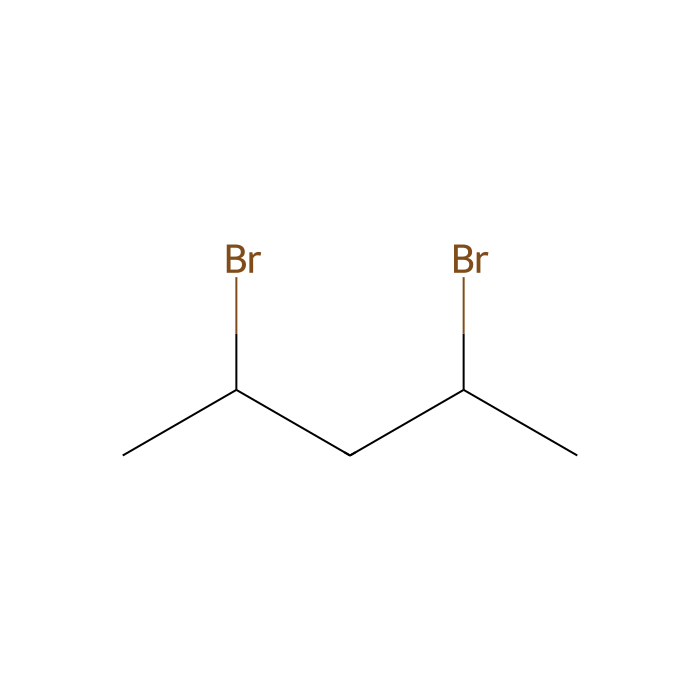
Brief overview: 2,4-Dibromopentane is a linear C5 alkyl dihalide bearing two secondary bromides at the 2- and 4-positions; it functions as a bifunctional electrophile.
Item-specific (from Product Data)
SKU: D155303
Product name: 2,4-Dibromopentane
CAS: 19398-53-9
InChIKey: 190341 (as provided)
SMILES: Not specified for this item; refer to CoA/Spec Sheet.
Grade/Purity: Not specified for this item; refer to CoA/Spec Sheet.
Functional groups: two secondary alkyl bromides (electrophilic centers capable of SN2/E2), saturated hydrocarbon backbone.
Stereochemistry: each brominated center (C2 and C4) is stereogenic; commercial material may be racemic at each center unless otherwise specified.
Structural description (2D, words; general)
A straight five‑carbon chain with bromine substituents on the second and fourth carbons. The termini are methyl groups (C1 and C5). C2 and C4 are secondary centers bearing Br, making the molecule a 1,3‑disposition of leaving groups across the chain.
Synthetic Utility
Bifunctional electrophile: Two secondary bromides at a 1,3‑relationship (C2/C4) enable diverse bond constructions.
Key transformations (literature/general)
Sequential SN2: Introduce two nucleophiles stepwise, enabling asymmetric substitution patterns at C2 and C4 by leveraging differential sterics or protecting-group strategies.
Di‑organometallic formation: Mg insertion to give a 1,3‑di-Grignard; addition to diesters/dialdehydes yields 1,3‑diols or extended frameworks after workup.
Reductive strategies: Metal-mediated or radical debromination to form less functionalized alkanes; useful for temporary activation/relay strategies.
Ring construction: Intramolecular reactions after one substitution can generate five-membered rings (via tethered nucleophiles) exploiting the remaining bromide for cyclization.
Retrosynthetic value
Serves as a masked 1,3‑dianion equivalent: nucleophile additions at C2/C4 after activation allow convergent assembly of 1,3‑disubstituted motifs common in natural products and materials precursors.
Practical considerations
Competing elimination is common for secondary bromides; temperature control and nucleophile choice are crucial.
Use excess nucleophile and polar aprotic media to push SN2; employ hindered bases and heat for clean E2.
Target Specificity
Not applicable. This product is a small-molecule chemical reagent and is not an antibody, probe, or biological targeting agent. No antigen/epitope or species reactivity information applies.
Preguntas frecuentes
What is the purity of this product, and how is it determined?
This product is supplied at ≥98% purity, determined by gas chromatography (GC). Lot-specific values are stated on the Certificate of Analysis.
How should this product be stored?
Store at room temperature.
How is this product shipped?
This product ships under standard ambient conditions. No temperature-controlled packaging is required.
What are the CAS number, molecular formula and molecular weight?
The CAS Number is 19398-53-9, the molecular formula is C5H10Br2, and the molecular weight is 229.94 g/mol. InChIKey KUZOHDYKJXNCSI-UHFFFAOYSA-N.
What documentation is provided?
Available product documentation, including Certificates of Analysis (COA), Safety Data Sheets (SDS), and specification sheets, is shown in the product document area. Document availability and access follow the current site policy.
Utilizamos cookies para garantizar el correcto funcionamiento del sitio web y, cuando esté permitido, para mejorar su experiencia. Puede gestionar sus preferencias en cualquier momento en Configuración. Más información en nuestra Política de Cookies.
¿Quieres que te enviemos un mensaje cuando tengamos descuentos disponibles?
Recordármelo más tarde
¡Gracias! Por favor, revisa tu bandeja de entrada de correo electrónico para confirmar.
Products are supplied to verified businesses, institutions, and qualified professionals for research and development use only. Not for use in humans, animals, diagnosis, or therapy.

 K2218221