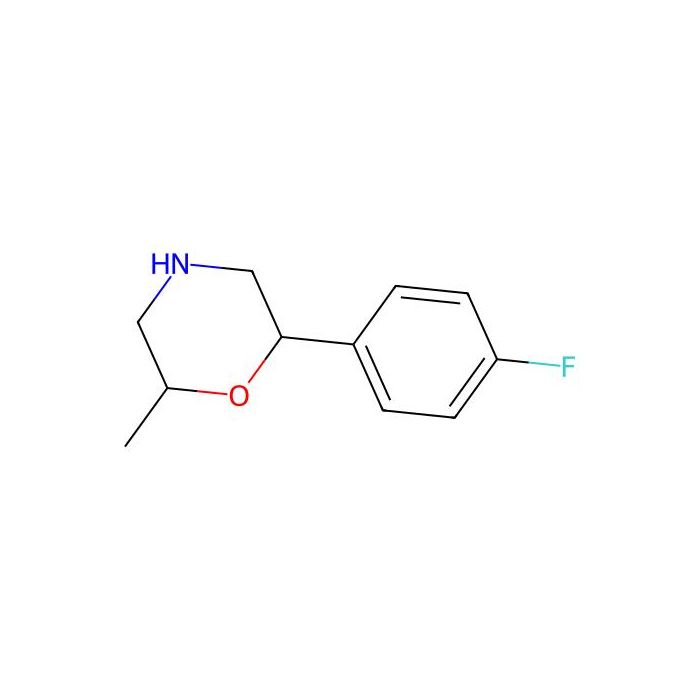
This compound belongs to the class of organic compounds known as phenylmorpholines. These are aromatic compounds containing a morpholine ring and a benzene ring linked to each other through a CC or a CN bond.
External Descriptors
Not available
1. Djoumbou Feunang Y, Eisner R, Knox C, Chepelev L, Hastings J, Owen G, Fahy E, Steinbeck C, Subramanian S, Bolton E, Greiner R, and Wishart DS. ClassyFire: Automated Chemical Classification With A Comprehensive, Computable Taxonomy. Journal of Cheminformatics, 2016, 8:61.
Certificados (CoA, COO, BSE/TSE y tabla de análisis)
C of A & Other Certificates(BSE/TSE, COO):
Analytical Chart:
Propiedades químicas y físicas
Peso molecular
195.230 g/mol
XLogP3
1.500
Hydrogen Bond Donor Count
1
Hydrogen Bond Acceptor Count
3
Rotatable Bond Count
1
Exact Mass
195.106 Da
Monoisotopic Mass
195.106 Da
Topological Polar Surface Area
21.300 Ų
Heavy Atom Count
14
Formal Charge
0
Complexity
180.000
Isotope Atom Count
0
Defined Atom Stereocenter Count
0
Undefined Atom Stereocenter Count
2
Defined Bond Stereocenter Count
0
Undefined Bond Stereocenter Count
0
The total count of all stereochemical bonds
0
Covalently-Bonded Unit Count
1
Calculadoras de soluciones
Molarity Calculator
Determine the necessary mass, volume, or concentration for preparing a solution.
Dilution Calculator
Determine the dilution needed to prepare a stock solution.
Reconstitution Calculator
Reseñas
Reseñas de cliente
Application Protocols
No standardized biological application protocols (e.g., WB, IHC, IF, FC) apply to this small-molecule reagent.
General laboratory use suggestions:
Prepare stock solutions in DMSO, MeCN, or DCM depending on the planned transformation; filter if particulate matter is observed.
For screening in chemical biology, consider forming a defined salt to improve aqueous handling; document concentration and pH rigorously.
For any specialized application, validate conditions empirically and consult the primary literature.
Biological Roles
This product is a small organic building block and is provided strictly for research use. No biological role is assigned to the material as supplied.
General context (literature-based):
Morpholine motifs are common in chemical biology probes and medicinal chemistry scaffolds due to tunable basicity and hydrogen-bonding properties; however, any specific biological activity requires context of the larger molecule into which the morpholine is incorporated.
The para-fluorophenyl group is frequently used to modulate metabolic stability and binding properties in SAR, but the standalone compound here is not intended for biological testing without appropriate hazard and regulatory review.
No clinical or therapeutic claims are made. For any work in biological systems, ensure appropriate approvals and consult the SDS for safe handling.
Buffer Applications
Not typically used as a defined buffer component.
While tertiary amines can participate in acid–base equilibria, this compound is not a standardized buffering agent with a defined pKa/pH window and is not recommended for preparing laboratory buffers. For buffer preparation, use established systems (e.g., phosphate, HEPES, Tris) and refer to their validated recipes.
If preparing aqueous solutions for screening, consider forming a water-soluble ammonium salt with a suitable acid; verify solubility and pH empirically.
Green Alternatives
Greener practice focuses on solvent and process choices rather than replacing the heterocycle itself (which is often structure-critical in discovery chemistry).
Prefer 2-MeTHF or CPME over THF/Et2O for extractions and some reactions (better EHS profile, lower peroxide risk than ethers like THF; check compatibility with amines).
Use EtOAc or Me-THF/DCM mixtures instead of neat chlorinated solvents where feasible; replace DMF/DMSO with MeCN or propylene carbonate when solubility allows.
For recrystallizing amine salts, ethanol/isopropanol and water–alcohol mixtures are greener than chlorinated solvents.
Trade-offs:
High-boiling polar aprotics (DMF/DMSO) provide superior solubility but are energy intensive to remove; plan solvent swaps or antisolvent crystallizations to reduce footprint.
Aryl fluoride functionality increases persistence under harsh conditions; choose catalytic, atom-economical routes (e.g., Pd-catalyzed C–H functionalization) to minimize halogenated waste.
Process suggestions:
Employ continuous-flow or microwave conditions to reduce reaction times/energy.
Opt for catalytic over stoichiometric activation (e.g., organocatalysis or low loading transition-metal catalysis) with benign bases (carbonate) when compatible with the amine substrate.
Pharmaceutical Uses
No pharmacopeial or excipient status is provided. This product is offered for research use only.
General formulation context (literature-based):
Morpholine-containing amines are common in medicinal chemistry intermediates and screening libraries. They may be converted to salts (e.g., hydrochloride, mesylate) to improve crystallinity and handling in discovery workflows.
Any use in GMP or clinical manufacturing would require qualification, specification setting, and regulatory assessment; none of these are implied by this catalog listing.
Item-specific notes:
Grade/Purity: Not specified for this item; refer to CoA/Spec Sheet.
Molecular Weight/Formula: Not specified for this item; refer to CoA/Spec Sheet.
Physical Properties
Item-specific physico-chemical specifications are not provided in the Product Data. Refer to the CoA/Spec Sheet for exact measured values.
Appearance: Not specified for this item; refer to CoA/Spec Sheet.
Boiling point: Not specified for this item; refer to CoA/Spec Sheet. (For context, morpholine derivatives often boil in the 180–260 °C range at ambient pressure; literature generalization.)
Melting point: Not specified for this item; refer to CoA/Spec Sheet.
Density: Not specified for this item; refer to CoA/Spec Sheet.
Refractive index: Not specified for this item; refer to CoA/Spec Sheet.
Good solubility in polar aprotic solvents (DMF, DMSO, MeCN) and chlorinated solvents (DCM, CHCl3).
Moderate solubility in short-chain alcohols; limited solubility expected in water compared to morpholine due to aryl/methyl substitution.
Acid-base: tertiary amine (conjugate acid pKa for morpholine ≈ 8.3–8.6, literature). Substitution may shift basicity slightly.
Partitioning: Aryl/methyl substitution increases hydrophobicity vs morpholine (qualitative literature note).
Note: All numerical values that would constitute item-specific specifications (e.g., exact bp/mp, density) are Not specified for this item; refer to CoA/Spec Sheet.
Quality and Grades
Grade/Purity: Not specified for this item; refer to CoA/Spec Sheet.
Stabilizers/inhibitors: Not specified for this item; refer to CoA/Spec Sheet.
Interpretation and guidance:
In the absence of a stated grade, verify fit-for-purpose via CoA: assay/purity method (e.g., GC, HPLC, NMR), residual solvents, and identity (NMR, MS, IR).
For structure-rich heterocycles, review diastereomeric ratio (if applicable) and any optical rotation data; the 2,6-disubstituted morpholine framework can present stereochemical complexity.
If using in chromatographic or trace analysis contexts, ensure UV-Vis background and residual amines/aldehydes meet your method requirements (request HPLC/LC–MS suitable grade where applicable).
Metal content, water, and peroxide levels: Not specified for this item; refer to CoA/Spec Sheet.
Documentation recommended for regulated workflows:
Batch-specific CoA with purity profile and analytical chromatograms.
SDS aligned with your jurisdiction.
If chiral/diastereomeric composition is critical, request additional stereochemical characterization.
Reaction and Applications
This 2,6-disubstituted morpholine serves as a versatile intermediate and base in synthesis, particularly in medicinal chemistry campaigns exploring morpholine motifs.
Representative applications (literature/general):
Building block incorporation: introduces a morpholine vector into aryl frameworks via C–C or C–N bond formation after appropriate functionalization (e.g., N-acylation/alkylation, oxidation to N-oxide followed by rearrangements).
Salt formation: readily forms ammonium salts with mineral or sulfonic acids for purification, crystallinity, or formulation of screening libraries.
Protection/derivatization: N-acyl or N-carbamate derivatives can modulate basicity and lipophilicity; benzylation/alkylation at N provides tertiary amine variants for SAR.
Late-stage modification: aryl para-fluoride is typically inert to nucleophilic aromatic substitution in the absence of ring activation; however, it provides a spectroscopic handle and can be leveraged in directed metalation (strong bases) or as a leaving group under specialized cross-coupling protocols (literature-advanced).
Organocatalysis/base: tertiary amines can act as mild bases or nucleophilic catalysts (e.g., for Michael additions) in non-protic media when sterics/electronics permit.
Practical tips:
Drying: if water-sensitive transformations are planned, dry under high vacuum over P2O5 or molecular sieves; amines can retain moisture via hydrogen bonding.
Acid scavenging: tertiary amines can neutralize generated HX; account for stoichiometry to avoid salt precipitation.
Stereochemistry: if a single diastereomer is required, consider asymmetric synthesis or chromatographic resolution; monitor by chiral HPLC or NMR with chiral shift reagents.
Reaction Conditions
General literature-guided conditions for transforming tertiary morpholine derivatives (not item-specific specifications):
N-Acylation/Carbamoylation: acid chlorides or activated esters, 0–25 °C in DCM, THF, or MeCN with base (NEt3, DIPEA). Typical times 0.5–4 h. Monitor to avoid over-acylation or O-acylation; tertiary amine favors N-acylation.
N-Alkylation/Quaternization: alkyl halides or sulfonates in MeCN, acetone, or DMF with mild heating (25–60 °C). Quaternary ammonium salts may crystallize from EtOAc/ether.
N-Oxide formation: m-CPBA or H2O2/AcOH at 0–25 °C in DCM/MeCN; work up with reducing sulfites if needed. Times 1–3 h.
Directed α-functionalization: strong bases (e.g., s-BuLi/TMEDA) at −78 to −40 °C under inert atmosphere can effect metalation α to heteroatoms in related systems; quench with electrophiles (advanced practice; ensure compatibility with aryl fluoride).
Salt formation: treat with HCl(g) in Et2O or ethanolic HCl at 0–25 °C to afford crystalline hydrochloride salts; isolate by filtration and dry under vacuum.
Solvents: DCM, MeCN, THF, DMF/DMSO (for high solubility); choose greener options when possible (EtOAc, 2-MeTHF).
Yields: highly substrate/condition dependent; 60–95% commonly reported for clean N-acylations/alkylations in morpholine series (literature generality). Always optimize on small scale and verify by NMR/LC–MS.
Safety and Handling
Hazard classification is not provided in the Product Data. Treat as an organic amine with typical irritant properties until the SDS is reviewed.
GHS/CLP: Not specified for this item; refer to SDS.
Signal word / H-statements / Pictograms: Not specified for this item; refer to SDS.
General precautions (good laboratory practice):
PPE: lab coat, nitrile gloves, safety glasses; use in a chemical fume hood.
Avoid: inhalation of vapors/aerosols and skin/eye contact. Amines can be irritant/corrosive to mucous membranes.
Incompatibilities (general for tertiary amines): strong oxidizers, strong acids (forms salts; heat evolution possible), acylation/alkylation reagents; may attack certain plastics.
Spill/first aid (overview):
Skin/eye contact: rinse with water for at least 15 minutes; remove contaminated clothing; seek medical attention.
Inhalation: move to fresh air; seek medical attention if symptoms persist.
Ingestion: rinse mouth; do not induce vomiting; seek medical advice.
Fire safety: Treat as combustible organic; use CO2, dry chemical, or foam. Amines may emit nitrogen oxides and HF-containing species if the aryl fluoride burns; firefighters should wear SCBA.
Always consult the SDS for authoritative safety, toxicity, and disposal guidance before use.
Solvent Selection
As a moderately polar, tertiary amine–containing heterocycle with an aryl substituent, this compound dissolves best in polar organic media.
Polarity class (qualitative, literature): polar aprotic–compatible; amphiphilic due to tertiary amine and ring oxygen, but hydrophobic aryl/methyl reduce water solubility vs morpholine.
Preferred solvents for stock solutions and reactions: DMSO, DMF, acetonitrile, dichloromethane, chloroform, THF, ethyl acetate, methanol/ethanol (check for salt formation in acidic alcohols).
Aqueous handling: formation of water-soluble ammonium salts is possible upon protonation with mineral or organic acids; free base likely shows limited water solubility.
Chromatography: elutes at moderate to high Rf on silica; add a small % of base (e.g., 0.5–2% triethylamine) to mobile phase to suppress tailing of basic analytes (general tip).
Comparison (general guidance):
DCM vs EtOAc: DCM offers stronger solvation for arylated amines; EtOAc is greener and suitable for workups/extractions.
MeCN vs DMF/DMSO: MeCN provides lower viscosity and easier removal; DMF/DMSO maximize solubility for highly substituted amines but are higher boiling.
Alcohols: useful for salt formation and recrystallization of amine salts; may promote side reactions in strong acylation/alkylation conditions.
Shipped in: Not specified for this item; refer to CoA/Spec Sheet.
Handling and stability (general guidance):
Keep container tightly closed in a dry, well-ventilated area. Protect from strong acids/oxidants.
If prolonged storage is anticipated, consider inert headspace (N2/Ar) to minimize oxidative discoloration typical of some amines.
Avoid moisture ingress; amines can absorb CO2/acidic vapors and form salts.
Reconstitution/preparation of solutions:
For stock solutions, dissolve in dry DMSO, DMF, MeCN, THF, or DCM to the desired concentration (e.g., 10–100 mM for library work). Filter through a PTFE syringe filter (0.2–0.45 µm) if needed.
For aqueous work, prepare a water-soluble salt by adding a stoichiometric acid (e.g., HCl, H2SO4, methane sulfonic acid) and then dilute with water or buffer; verify pH and stability.
Storage of solutions: DMSO or MeCN stocks are best kept at 2–8 °C or −20 °C in sealed vials; minimize freeze–thaw cycles by aliquoting. Light protection is generally not critical but recommended for long-term storage.
Always refer to the product’s CoA and SDS for definitive guidance on stability and handling.
Structure and Identity
A substituted morpholine bearing a para-fluorophenyl at C-2 and a methyl at C-6; a useful heteroaromatic building block for discovery chemistry.
Stereochemistry: C-2 and C-6 are stereogenic centers in 2,6-disubstituted morpholines. Unless otherwise specified, commercial material is typically supplied as a mixture of diastereomers/enantiomers (literature note).
2D description: a chair-like morpholine ring where the nitrogen and oxygen occupy opposite ring positions; the C-2 bears a 4-fluorophenyl substituent, and the C-6 bears a methyl group; the aromatic ring carries F at para.
Synthetic Utility
Key reactivity derives from the tertiary amine/ether ring and the para-fluorophenyl substituent.
Functional group handles:
Tertiary amine: N-acylation, N-alkylation, quaternization (to ammonium salts), or oxidation to N-oxide (facilitates subsequent rearrangements or C–H functionalizations; literature).
Ether oxygen: generally inert; can direct metalation adjacent to heteroatoms under strong bases.
Aryl fluoride: typically robust to many conditions; can participate in specialized cross-couplings or directed metalations; useful as a spectroscopic/analytical tag.
Stereochemical considerations: 2,6-disubstituted morpholines present two stereocenters. Access to single stereoisomers may be achieved via asymmetric synthesis, chiral pool strategies, or resolution (diastereomeric salt formation or chiral chromatography).
Retrosynthetic value: enables rapid installation of morpholine moiety into aryl frameworks; complementary to strategies that attach morpholine via N-linkage. The C-linked morpholine may exhibit different conformational and electronic properties in SAR matrices.
Purification/handling: amine-containing molecules can tail on silica; add 0.5–2% NEt3 to eluent or use basic alumina. Salt formation/crystallization is often effective for bulk purification.
This substrate is suitable for library diversification, fragment elaboration, and as a scaffold in structure–property exploration.
Target Specificity
Not applicable. This product is a small-molecule building block, not a biological targeting reagent (e.g., antibody, ligand standard). No antigen/epitope specificity, species reactivity, or clone information applies.
Preguntas frecuentes
What is the purity of this product?
This product is supplied at ≥98% purity (chemical assay). Lot-specific values are stated on the Certificate of Analysis.
How should this product be stored?
Store at room temperature.
What are the CAS number, molecular formula and molecular weight?
The CAS Number is 1099679-40-9, the molecular formula is C11H14FNO, and the molecular weight is 195.24 g/mol. InChIKey LKPBWYNPOQOBRH-UHFFFAOYSA-N.
What documentation is provided?
Available product documentation, including Certificates of Analysis (COA), Safety Data Sheets (SDS), and specification sheets, is shown in the product document area. Document availability and access follow the current site policy.
Utilizamos cookies para garantizar el correcto funcionamiento del sitio web y, cuando esté permitido, para mejorar su experiencia. Puede gestionar sus preferencias en cualquier momento en Configuración. Más información en nuestra Política de Cookies.
¿Quieres que te enviemos un mensaje cuando tengamos descuentos disponibles?
Recordármelo más tarde
¡Gracias! Por favor, revisa tu bandeja de entrada de correo electrónico para confirmar.
Products are supplied to verified businesses, institutions, and qualified professionals for research and development use only. Not for use in humans, animals, diagnosis, or therapy.