This compound belongs to the class of organic compounds known as pyrazines. These are compounds containing a pyrazine ring, which is a six-member aromatic heterocycle, that consists of two nitrogen atoms (at positions 1 and 4) and four carbon atoms.
External Descriptors
Not available
1. Djoumbou Feunang Y, Eisner R, Knox C, Chepelev L, Hastings J, Owen G, Fahy E, Steinbeck C, Subramanian S, Bolton E, Greiner R, and Wishart DS. ClassyFire: Automated Chemical Classification With A Comprehensive, Computable Taxonomy. Journal of Cheminformatics, 2016, 8:61.
Determine the necessary mass, volume, or concentration for preparing a solution.
Dilution Calculator
Determine the dilution needed to prepare a stock solution.
Reconstitution Calculator
Reseñas
Reseñas de cliente
Application Protocols
No vendor-validated biological application protocols apply to this small-molecule reagent. For synthetic use, see Reaction Conditions and Synthetic Utility for general literature procedures. Optimize stoichiometry, catalyst, ligand, base, solvent, and temperature for your specific substrates.
Biological Roles
This product is a synthetic heteroaromatic building block and is not intended for biological use. No endogenous biological role is associated with 2,6-dibromopyrazine.
General context (literature)
Pyrazine motifs appear in natural products and biochemical ligands; however, dihalogenated pyrazines like 2,6-dibromopyrazine are primarily synthetic intermediates.
Electron-deficient azines can interact with nucleophiles and π-systems, but specific biochemical interactions for this compound have not been established.
Research positioning
Use is confined to chemical synthesis of heteroaromatic frameworks that may later be evaluated in materials or medicinal chemistry pipelines. Any biological evaluation should be conducted on downstream compounds, not on this intermediate.
Research Use Note: For research use only.
Buffer Applications
Not typically applicable. 2,6-Dibromopyrazine is a neutral, poorly water-soluble heteroaromatic building block and is not used to prepare aqueous buffers or as a buffering agent. For practical information relevant to this product, see Reaction & Applications, Synthetic Utility, and Reaction Conditions.
Green Alternatives
While 2,6-dibromopyrazine itself is a specific building block, its use can be made greener by judicious selection of solvents, catalysts, and coupling partners.
Greener solvent choices (literature guidance)
Replace dioxane/DMF where possible with 2-MeTHF, CPME, toluene, or water-containing mixtures; consider propylene carbonate or Cyrene for polar needs.
Employ aqueous micellar catalysis (e.g., TPGS-750-M) for Suzuki couplings to reduce organic solvent usage.
Catalyst and base economy
Use modern ligand systems enabling ppm–low mol% Pd or Ni catalysis; recycle catalysts when feasible.
Favor inorganic bases with lower EHS concerns (K2CO3, K3PO4) over strong alkoxides unless required.
Consider aryl boronic acids/esters over stannanes to avoid organotin waste (Stille) and associated toxicity.
All greener substitutions should be validated on small scale to ensure yield/selectivity are maintained.
Pharmaceutical Uses
Role in pharma workflows (general)
Utilized as a synthetic intermediate to access 2,6-disubstituted pyrazines and related scaffolds in discovery and process chemistry. It may feed into SAR campaigns or materials leads where a pyrazine core is required.
Excipient/formulation status
Not an excipient and not used as a formulation aid. No pharmacopeial monograph is associated with this intermediate (general observation).
Manufacturing considerations
For GMP-adjacent work, control of residual palladium/nickel (from couplings), inorganic halide, and potential debrominated byproducts in downstream APIs is important. Those controls apply to derivatives, not to this reagent itself.
No therapeutic or clinical claims are made for this product; it is intended solely for research and laboratory synthesis.
Physical Properties
Item-specific specifications
Appearance: Not specified for this item; refer to CoA/Spec Sheet.
Molecular Formula (item): Not specified for this item; refer to CoA/Spec Sheet.
Molecular Weight (item): Not specified for this item; refer to CoA/Spec Sheet.
Literature/general properties (for contextual planning; not item specifications)
Physical state: typically a crystalline solid; halogenated pyrazines often range from off-white to pale yellow (literature, varies by lot/purity).
Aromaticity: electron-deficient azine; ring nitrogens lower LUMO, facilitating oxidative addition and SNAr.
Solubility profile: low in water; soluble to moderately soluble in polar aprotic organics (DMF, DMSO, NMP) and chlorinated solvents; variable in ethers and aromatics depending on temperature and additives (literature, qualitative).
Volatility: low; handled as a non-volatile solid under typical lab conditions (literature).
Partitioning: increased lipophilicity vs chloro analogue due to bromine; logP not robustly tabulated in standard sources (literature; check primary data if needed).
Practical notes
For weighing and transfers, minimize exposure to ambient moisture to preserve coupling performance.
Dissolution can be improved by mild warming and use of co-solvents (e.g., DMSO spike into dioxane/toluene) where compatible with the reaction.
Quality and Grades
Grade/Purity (item-specific): Not specified for this item; refer to CoA/Spec Sheet.
Interpreting grades (general guidance)
Research or synthetic-grade halogenated building blocks are typically controlled for identity (NMR/GC/LC-MS), assay/purity, and residual solvents. HPLC or ≥98% grades are often preferred for catalyst-sensitive cross-couplings to minimize side reactions.
UV-absorbance specifications (for chromatographic use) and trace-metal content limits may be critical for some applications but are not provided here; consult the CoA if your process is metal-sensitive.
Stabilizers/additives
None are indicated for this item. If present in other lots, stabilizers should be disclosed on the CoA/label as they can influence catalysis; absence/presence is application-dependent.
Batch-specific documentation
For lot-resolved assay, water content, residual solvents, and impurity profile, use the Aladdin CoA and specification sheet. These documents also confirm storage and shipping controls that support material integrity for research use.
Reaction and Applications
2,6-Dibromopyrazine is a versatile electrophile for building 2,6-disubstituted pyrazines and related scaffolds.
Cross-coupling (literature)
Suzuki–Miyaura: couples with aryl/heteroaryl/alkenyl boron reagents under Pd catalysis. Electron-poor pyrazine accelerates oxidative addition; stepwise mono- then di-coupling is feasible by stoichiometry and time control.
Buchwald–Hartwig amination: installation of (hetero)arylamines or cyclic amines with Pd/biaryl phosphine ligands (e.g., BrettPhos, XPhos). The 2- and 6-positions often show similar reactivity; site-selectivity can be tuned by transient protection or directing effects of first substituent.
Negishi/Stille/Kumada: organozinc, organostannane, or Grignard partners provide C–C bonds under Pd/Ni catalysis; manage functional-group tolerance accordingly.
Nucleophilic aromatic substitution (SNAr)
The diazine ring enables substitution by strong nucleophiles (alkoxides, amines, thiolates) especially with heat and polar aprotic solvents; sequential substitutions can be orchestrated.
Annulations and heteroannulations
As a di-electrophile, it participates in N- and C-annulations to furnish fused systems via double coupling/cyclization sequences.
Practical tips
Dry, oxygen-free conditions improve yields in Pd/Ni catalysis; degas solvents and maintain inert atmosphere (argon as specified for storage).
For stepwise functionalization, isolate the mono-substituted intermediate to exploit differential reactivity of the remaining C–Br.
Monitor by LC/MS or GC to manage over-reaction or protodehalogenation.
Reaction Conditions
General literature guidance (optimize per substrate/catalyst; not item specifications):
Suzuki–Miyaura couplings
Catalyst: Pd(dppf)Cl2·DCM (0.5–2 mol%) or Pd-PEPPSI/IPr (0.1–1 mol%).
Ligand options: dppf, SPhos, XPhos for hindered partners.
Base: K2CO3, K3PO4, Cs2CO3 (2–3 equiv).
Solvent: 1,4-dioxane/H2O (3:1), 2-MeTHF/H2O, or toluene/H2O.
Temperature/time: 60–100 °C, 2–16 h.
Notes: For stepwise mono-coupling, limit equivalents of boron partner and shorten reaction time, then re-engage for second substitution.
Base: NaOtBu or K3PO4 depending on amine nucleophilicity.
Solvent: toluene, dioxane, or DMA.
Temperature: 80–110 °C.
Notes: Electron-poor aryl bromides respond well; monitor for over-arylation with polyamines.
SNAr substitutions
Nucleophiles: RO–, R2NH, RS–.
Solvent: DMSO/DMF/NMP.
Base: NaH, KOtBu, or the nucleophile’s conjugate base.
Temperature: 80–150 °C (substrate dependent).
Metal–halogen exchange (advanced)
Directed lithiation/Br–Li exchange at low temperature can be used but requires careful quench control and cryogenic techniques.
Always confirm on analytical scale; adjust ligand/base to control selectivity of 2 vs 6 substitution if non-equivalent after first coupling.
Safety and Handling
GHS and hazard statements
Signal word: Not specified for this item; refer to SDS.
H-Statements/GHS Classification/Pictograms: Not specified for this item; refer to SDS.
General laboratory precautions (good practice for halogenated heteroaromatics; not a substitute for SDS)
Use in a fume hood; avoid inhalation of dust and contact with skin/eyes.
Recommended PPE: lab coat, safety glasses, nitrile gloves; consider double-gloving for extended handling.
Avoid generating dust; use antistatic measures when weighing.
Incompatibilities and stability (general)
Store under inert gas (argon) as specified; keep container tightly closed in a dry environment.
Avoid strong bases at elevated temperature outside controlled reaction conditions; avoid strong oxidizers and reducing agents.
Halogenated aromatics can undergo metal-catalyzed transformations; keep away from reactive metals except as intended in synthesis.
First-aid overview (consult SDS for details)
Skin/eye contact: rinse with water for at least 15 minutes; remove contaminated clothing; seek medical attention if irritation persists.
Inhalation: move to fresh air; medical evaluation if symptoms occur.
Ingestion: rinse mouth; do not induce vomiting; seek medical attention.
Waste disposal
Collect halogenated organic waste in designated containers; follow institutional and local regulations.
Solvent Selection
This substrate is a moderately lipophilic, electron-poor dihalide. Solvent choice is typically driven by the intended transformation (cross-coupling vs. SNAr) and catalyst system.
Polarity/miscibility (literature, general)
Poorly water-soluble; dissolves in polar aprotic organics (DMF, DMSO, NMP) and often in dioxane, THF (warm), toluene, and chlorinated solvents.
For biphasic couplings, dioxane/H2O or toluene/H2O with phase-transfer bases is common.
Selection tips by transformation
Suzuki–Miyaura: 1,4-dioxane/H2O or 2-MeTHF/H2O to balance solubility and base compatibility; DMF/H2O for challenging substrates.
Buchwald–Hartwig amination: toluene, xylene, or dioxane with bulky biaryl phosphines; DMA/DMF for harder nucleophiles.
SNAr with alkoxides/amines: DMSO, DMF, or NMP to stabilize anionic nucleophiles; temperature control is critical to manage over-substitution.
Small comparison (literature trends)
Dioxane vs 2-MeTHF: similar solvency; 2-MeTHF offers better sustainability and easier removal.
DMF/DMA vs NMP: high polarity aids dissolution but consider regulatory/ESG constraints; alternatives like propylene carbonate or Cyrene may be viable with compatible bases/catalysts.
Always align solvent choice with catalyst/ligand/base and substrate solubility; verify on small scale before scale-up.
Storage and Reconstitution
Item-specific storage and shipping
Storage Conditions: Store at 2–8 °C, argon charged (per Product Data). Keep container tightly closed in a dry place.
Shipped In: Wet ice (per Product Data).
Handling guidance (general best practice for this class)
Minimize exposure to air and moisture to preserve coupling performance; backfill with argon after each use.
Bring cold material to room temperature under inert atmosphere before opening to prevent condensation.
Protect from prolonged light and heat during storage.
Reconstitution/solution preparation
Solid reagent; no reconstitution is required. For stock solutions, prepare in dry, oxygen-free solvents compatible with your intended reaction (e.g., anhydrous dioxane, toluene, DMF, or DMSO). Filter if particulates remain.
Store any prepared solutions at low temperature under inert gas; assess stability by test reaction or analytical checks prior to reuse.
Always consult the product’s label and CoA for lot-specific guidance, and refer to the SDS for safety-critical information.
Structure and Identity
A dihalo-heteroaromatic electrophile for cross-coupling and SNAr chemistry.
Item-specific identifiers (from Product Data)
SKU: D138534
CAS: 23229-25-6
InChIKey: Not specified for this item; refer to CoA/Spec Sheet.
SMILES: Not specified for this item; refer to CoA/Spec Sheet.
Literature structural information (general reference; not item-specific specs)
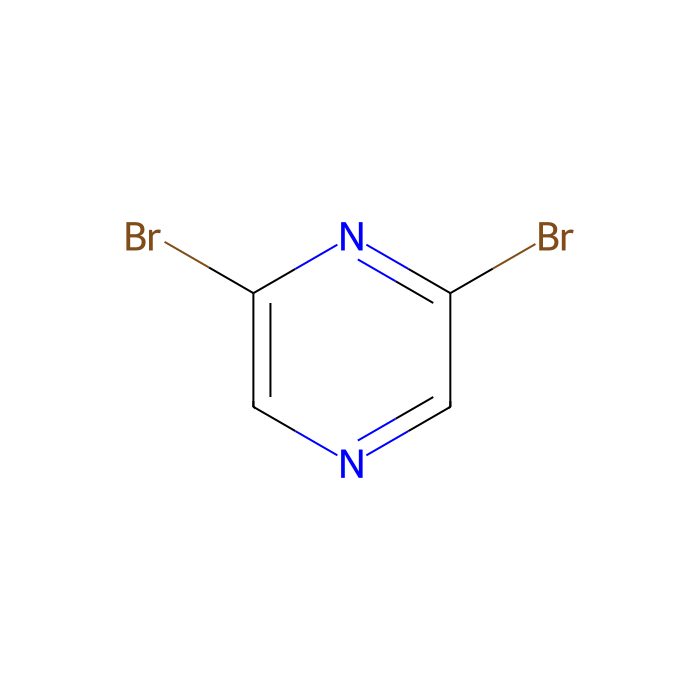
Common name: 2,6-Dibromopyrazine
Molecular formula (literature): C4H2Br2N2
Molecular weight (literature): ~241.88 g/mol
Core scaffold: a six-π-electron aromatic pyrazine ring (1,4-diazabenzene) bearing bromine substituents at the 2- and 6-positions (both ortho to a ring nitrogen), rendering the ring strongly deactivated and predisposed to oxidative addition and/or SNAr.
Functional groups: two aryl–bromides on an electron-deficient diazine ring; two ring nitrogens (sp2) that withdraw electron density and direct reactivity.
2D description in words
A planar, symmetric heteroaromatic ring with nitrogens at positions 1 and 4; bromine atoms at positions 2 and 6; remaining positions (3 and 5) are CH. No stereocenters.
Note: Exact structural strings (SMILES/InChI) and analytical identifiers for this specific item are not provided above; consult the CoA or specification sheet for definitive item-level identity data.
Synthetic Utility
Electrophilic handle density
Two C–Br bonds on an electron-poor pyrazine enable sequential or convergent installations of C-, N-, O-, or S-based substituents. This supports rapid diversification into 2,6-disubstituted pyrazine libraries.
Reactivity features (literature)
Enhanced oxidative addition due to ring deactivation by two ring nitrogens; facilitates Pd/Ni catalysis at moderate temperatures compared with benzene analogues.
SNAr viability allows metal-free routes for certain nucleophiles under forcing conditions, enabling orthogonal strategies (e.g., one site via coupling, the other via SNAr).
Retrosynthetic value
Serves as a linchpin for assembling diamino-, diaryl-, aryl-amino-, aryl-alkoxy-, and di(heteroaryl) pyrazines. Mono-functional intermediates can be leveraged to bias second-site selectivity.
Named reaction contexts
Suzuki–Miyaura, Buchwald–Hartwig, Ullmann-type (Cu) couplings for N/O substituents (substrate/performance dependent), and nickel-catalyzed cross-couplings for cost-sensitive routes.
Practical guidance
Start with small-scale ligand/base screens to establish selectivity and minimize protodehalogenation. Dry, oxygen-free conditions and appropriate base strength (e.g., K3PO4, Cs2CO3) are commonly effective.
Purification often via silica chromatography; halogenated aromatics may streak—use hexanes/EtOAc or heptane/EtOAc gradients; add 0.1–1% Et3N when basic products tail.
Target Specificity
Not applicable. This product is a small-molecule building block, not a biological macromolecule or immunoreagent. No antigen/epitope/clone/isotype information applies.
Preguntas frecuentes
What is the purity of this product?
This product is supplied at ≥95% purity (chemical assay). Lot-specific values are stated on the Certificate of Analysis.
How should this product be stored?
Store at 2–8 °C under argon. It is supplied under an argon blanket; reseal under inert gas after each use.
How is this product shipped?
This product ships chilled on wet ice. Unpack on arrival and transfer it to the storage condition stated above.
What are the CAS number, molecular formula and molecular weight?
The CAS Number is 23229-25-6, the molecular formula is C4H2Br2N2, and the molecular weight is 237.88 g/mol. InChIKey JXKQTRCEKQCAGH-UHFFFAOYSA-N.
What documentation is provided?
Available product documentation, including Certificates of Analysis (COA), Safety Data Sheets (SDS), and specification sheets, is shown in the product document area. Document availability and access follow the current site policy.
Utilizamos cookies para garantizar el correcto funcionamiento del sitio web y, cuando esté permitido, para mejorar su experiencia. Puede gestionar sus preferencias en cualquier momento en Configuración. Más información en nuestra Política de Cookies.
¿Quieres que te enviemos un mensaje cuando tengamos descuentos disponibles?
Recordármelo más tarde
¡Gracias! Por favor, revisa tu bandeja de entrada de correo electrónico para confirmar.
Products are supplied to verified businesses, institutions, and qualified professionals for research and development use only. Not for use in humans, animals, diagnosis, or therapy.

 J2222261