≥99% para flujos de trabajo cromatográficos y analíticos sensibles que requieren una interferencia mínima de la línea base.
🌡
Almacenamiento y envío
Room temperature Envío Normal. Consulte el COA específico del lote para conocer las especificaciones exactas.
📋
Documentos de calidad
SDS, COA, ficha técnica y hoja de especificaciones disponibles para descargar. COA específico del lote accesible mediante búsqueda por número de lote.
📚
Prueba documental
Citado en 6 publicaciones revisadas por pares sobre cromatografía, síntesis orgánica y reacciones de acoplamiento cruzado.
Descripción general
2-Acetylpyrrole undergoes alkylation reaction with alkyl iodide in benzene/solid KOH system in the presence of 18-crown-6 to yield the corresponding 1-alkyl derivative.
2-Acetylpyrrole has been used in the synthesis of 2-acetyl-1-pyrroline
This compound belongs to the class of organic compounds known as aryl alkyl ketones. These are ketones have the generic structure RC(=O)R', where R = aryl group and R'=alkyl group.
External Descriptors
methyl ketone - aromatic ketone - pyrroles
1. Djoumbou Feunang Y, Eisner R, Knox C, Chepelev L, Hastings J, Owen G, Fahy E, Steinbeck C, Subramanian S, Bolton E, Greiner R, and Wishart DS. ClassyFire: Automated Chemical Classification With A Comprehensive, Computable Taxonomy. Journal of Cheminformatics, 2016, 8:61.
Determine the necessary mass, volume, or concentration for preparing a solution.
Dilution Calculator
Determine the dilution needed to prepare a stock solution.
Reconstitution Calculator
Reseñas
Reseñas de cliente
Application Protocols
No assay-specific protocols are provided for this small-molecule reagent in the Product Data.
General laboratory usage examples (literature/general; adapt to your system):
Preparation of the oxime derivative for analytical characterization:
Dissolve 2-acetylpyrrole (1.0 equiv) in EtOH. Add hydroxylamine hydrochloride (1.2 equiv) and NaOAc (1.5 equiv). Stir at 40 °C for 2–4 h. Work up and analyze by NMR/GC–MS.
5-Bromination as a handle for cross-coupling:
Cool a DCM solution of 2-acetylpyrrole to 0 °C. Add NBS (1.05 equiv) portionwise under N2, stir 1 h, then warm to rt. Quench with aq. Na2S2O3, extract, and purify. Use resulting 5-bromo intermediate in Suzuki coupling.
NaBH4 reduction to secondary alcohol:
Charge MeOH with substrate (0.1–0.5 M) at 0 °C. Add NaBH4 (1.2 equiv) slowly. After gas evolution subsides, warm to rt until completion. Quench with saturated NH4Cl, extract with EtOAc, dry, and concentrate.
These are illustrative research procedures only. For batch-specific operational limits (e.g., water, metals), consult the CoA. Always perform appropriate safety and hazard assessments prior to scale-up.
Biological Roles
Item-specific biological function/assay roles: Not specified for this item; for research use only (per Product Data).
General/literature context (not product specifications and not medical claims):
Pyrrole-containing motifs are fundamental in biochemistry (e.g., porphyrins in heme, chlorophyll). While 2-acetylpyrrole itself is a simple synthetic fragment, the pyrrolic core is common in natural products and cofactors.
Maillard chemistry: 2-acylpyrroles, including 2-acetylpyrrole, are reported as aroma-impact compounds formed during thermal processing of carbohydrates and amino acids in foods, contributing roasted/nutty notes (literature). Such observations are relevant to analytical chemistry and flavor chemistry research, not to consumption or clinical use.
Reactivity in biological matrices: The carbonyl moiety can undergo Schiff-base formation with primary amines (e.g., amino acids) under dehydrating conditions; this is a generic carbonyl property leveraged in analytical derivatization protocols.
Physicochemical behavior: As a small, polar heteroaromatic, it may partition between aqueous and lipid environments depending on pH and solvent composition; the pyrrolic NH is not basic under physiological pH, while the carbonyl remains an H-bond acceptor.
Important disclaimer: Any biological discussion above is for general background relevant to research chemists. This product is designated for research use only and is not intended for food, cosmetic, diagnostic, or therapeutic applications.
Buffer Applications
This compound is not a buffering reagent and is not typically used to prepare pH-stabilizing buffer systems. Its pyrrolic NH is weakly acidic and not suitable for conventional buffer formulation.
For buffer preparation, consider dedicated buffering species (e.g., phosphate, HEPES, MOPS, acetate). If 2-acetylpyrrole is present in a biochemical assay, select a buffer that does not react with carbonyls (avoid primary amine-containing buffers like Tris when carbonyl derivatization must be minimized).
When derivatizing the carbonyl (e.g., oxime formation), mildly acidic aqueous buffers (acetate, pH ~4–5) or neutral phosphate buffers in aqueous-organic mixtures are often employed (literature/general). Always verify compatibility experimentally.
Green Alternatives
While 2-acetylpyrrole is itself the substrate, greener choices can be made around solvent and reagent selection.
Greener solvent choices (literature/general):
Replace DCM with EtOAc, toluene, or cyclopentyl methyl ether (CPME) where feasible.
Substitute THF with 2-MeTHF for enolate chemistry; similar performance with improved renewability and higher boiling point.
Favor ethanol or isopropanol for carbonyl derivatization steps instead of MeOH or DMF when compatible.
Comparison (general guidance):
Property | Conventional | Greener alternative | Tradeoffs
Enolate medium | THF | 2-MeTHF | Slightly lower polarity; often adequate; improved EHS profile.
Use catalytic hydrogenation over stoichiometric metal hydrides for ketone reductions when scale permits (less waste).
Choose aqueous catalysts (e.g., micellar catalysis) for certain condensations to reduce organic solvent use, if compatible with the pyrrolic N–H.
Process intensity:
Conduct reactions at ambient temperature/pressure when possible and use flow chemistry for hazardous halogenations to minimize inventory and improve heat management.
Note: Always confirm that greener alternatives maintain chemoselectivity and regioselectivity, especially on electron-rich pyrrole rings.
Pharmaceutical Uses
Item-specific pharmacopeial status or excipient role: Not specified for this item; refer to CoA/Spec Sheet.
General context (no medical/therapeutic claims):
2-Acetylpyrrole is primarily a synthetic intermediate in medicinal chemistry programs. Its combination of an enolizable methyl ketone and an electron-rich heteroaromatic ring enables rapid diversification toward heteroaryl ketones, alcohols, and more complex scaffolds.
Common roles in drug-substance R&D (literature/general):
Fragment for SAR exploration of pyrrole-containing leads.
Precursor to 2-substituted/5-substituted pyrrole libraries via selective EAS or cross-coupling following halogenation.
Handle for pro-drug or linker installation through carbonyl chemistry (oximes, hydrazones, reductive amination), strictly in a research/manufacturing context.
Process considerations: When used in GMP settings, control of residual solvents, related substances (e.g., dimers/aldol products), and polymorphism (if solid derivatives are formed) is critical. For this catalog item, consult batch documentation for purity and impurity profiles suitable for non-GMP research.
Physical Properties
Item-specific specifications (exact numeric specs such as BP, MP, density, UV cutoff, residuals): Not specified for this item; refer to CoA/Spec Sheet.
General/literature properties for 2-acetylpyrrole (for reference only; not product specifications):
Physical state: typically a colorless to pale yellow liquid with a characteristic heteroaromatic odor (literature/general).
Acid–base: weakly acidic NH (pyrrolic proton does not ionize readily in water); carbonyl oxygen is a hydrogen-bond acceptor; the molecule acts as both H-bond donor (via [nH]) and acceptor (via C=O) (general chemistry).
Polarity: polar, due to the conjugated ketone and the pyrrolic NH; expected to have moderate dipole moment and modest octanol/water partitioning (literature/general, qualitative).
Solubility: miscible with many polar organic solvents (e.g., alcohols, esters, ethers, chlorinated solvents); expected moderate solubility in water via H-bonding, but not fully miscible (literature/general, qualitative).
UV–Vis: conjugation of the carbonyl with the pyrrole ring typically yields π→π* absorption in the near-UV; specific cutoffs/absorptivities are context- and solvent-dependent (literature/general).
Practical notes (general):
May show slight darkening on prolonged light/air exposure due to oxidation/polymerization pathways typical of activated heteroaromatics; store as recommended to maintain appearance.
For analytical work, determine exact refractive index, density, or water content from the batch CoA when required.
Quality and Grades
Item-specific grade/purity: Not specified for this item; refer to CoA/Spec Sheet for assay, GC purity, and impurity profile.
How to interpret common grades (general guidance):
Analytical/Reagent grade: typically suitable for most synthetic applications; may have broader impurity limits than HPLC grade.
HPLC/UV grade (if offered): controlled for low UV absorbance and particulate content; appropriate for detector-sensitive applications.
Synthesis grade: optimized for preparative chemistry; assay and moisture limits defined for reproducibility.
Stabilizers/inhibitors:
For 2-acetylpyrrole, stabilizers are generally not required; none are declared in the Product Data. If stabilizers are used in other suppliers’ materials, they can influence reactivity (e.g., base-sensitive reactions). Always verify on the CoA.
Batch-specific documentation:
CoA should provide: identification (IR/NMR), assay (e.g., GC), residual solvents, water (Karl Fischer), and appearance. For chromatography-intensive use or sensitive catalysis, request detailed trace analyses (e.g., metals) as needed.
Fit-for-purpose tips:
For enolate chemistry or low-background analytical work, confirm water, peroxide (if relevant), and non-volatile residue levels on the batch CoA.
If using in aroma/volatiles research, verify odor purity by GC–MS to detect trace pyrazines/pyridines that can bias sensory panels.
Reaction and Applications
Use 2-acetylpyrrole as a versatile building block that combines a reactive methyl ketone with an electron-rich, N–H-bearing heteroaromatic ring.
Carbonyl derivatization: oxime/hydrazone/semicarbazone formation for characterization or protection; imine/enamine chemistry with primary/secondary amines under dehydrating conditions.
Reductions: chemoselective NaBH4 or catalytic hydrogenation to 2-(1-hydroxyethyl)pyrrole; further reduction/deoxygenation sequences furnish ethylpyrrole derivatives.
Enolate-based couplings: base-promoted aldol condensations with aldehydes; Claisen/Dieckmann-type condensations with appropriate partners; use LDA, NaHMDS, or t-BuOK under anhydrous conditions.
Electrophilic aromatic substitution (on pyrrole ring): halogenation, acylation, sulfonylation, and Vilsmeier–Haack formylation with strong regioselectivity typically favoring the 5-position when the 2-position is substituted (literature trend).
Cross-coupling after prefunctionalization: convert to 2-acyl-5-halopyrroles for Suzuki–Miyaura, Stille, or Buchwald–Hartwig couplings to elaborate aryl/alkyl substituents (general strategy).
Heterocycle construction: serves as a synthon for porphyrinoid fragments, or as a nucleophilic partner in Paal–Knorr-like elaborations when additional dicarbonyl partners are introduced (indirect strategies).
Practical tips:
The pyrrolic N–H can coordinate or be acylated; consider transient N-protection (e.g., N-Boc) to direct lithiation or improve selectivity.
Control basicity carefully: strong base can induce self-condensation of the acetyl group; quench at low temperature.
Employ inert atmosphere and dry solvents for anion chemistry; monitor by TLC/GC–MS due to potential for rapid overreaction on activated rings.
Reaction Conditions
General guidance (literature; optimize per substrate and scale):
Oxime/hydrazone formation:
Solvent: EtOH, MeOH, or EtOH/H2O; catalyst: AcOH (0.1–1 equiv) to promote dehydration.
Temperature: ambient to 50 °C; time: 1–6 h, monitor by TLC/LC–MS.
NaBH4 reduction to secondary alcohol:
Solvent: MeOH, EtOH, or THF/MeOH; 0–25 °C under N2; 1–2 equiv NaBH4; quench carefully to avoid ring reduction.
Workup: aqueous quench, extract with EtOAc; dry and purify by column.
Enolate chemistry (aldol coupling):
Base: LDA or NaHMDS (1.1–1.5 equiv) in dry THF or 2-MeTHF at −78 to −40 °C; then add aldehyde electrophile slowly.
Notes: Pre-protect the N–H if competitive N-acylation or coordination affects selectivity; maintain anhydrous conditions.
Electrophilic halogenation at C-5:
Reagent: NBS (1.0–1.1 equiv) in dry DMF, DCM, or MeCN; 0 °C to rt; protect from light.
Quench: sodium thiosulfate wash; proceed to cross-coupling if desired.
Cross-coupling (after 5-halogenation):
Suzuki–Miyaura: Pd(PPh3)4 (1–3 mol%), base (K2CO3, Cs2CO3), solvent (dioxane/H2O, 2-MeTHF/H2O), 60–90 °C.
Protect the N–H to enhance catalyst stability if inhibition is observed.
Reductive amination (on carbonyl):
Amine (1.2–2.0 equiv), AcOH or Ti(i-OPr)4 as promoter in i-PrOH/MeOH; reduce with NaBH3CN or H2/Pd-C at 0–25 °C.
These are representative literature conditions intended as starting points; verify compatibility with your substrate set and consult primary references.
Safety and Handling
Item-specific hazard declarations:
Signal word: Not specified for this item; refer to SDS.
H-statements: Not specified for this item; refer to SDS.
GHS classification/pictograms: Not specified for this item; refer to SDS.
General safety guidance for 2-acetylpyrrole (literature/analog-based, not a substitute for the SDS):
Expected hazards: May cause skin/eye irritation; harmful if swallowed; vapors may be irritating. Avoid inhalation and contact. Ketones and heteroaromatics can be combustible; keep away from ignition sources.
Personal protective equipment: lab coat, safety glasses or splash goggles, and appropriate chemically resistant gloves (e.g., nitrile). Use in a fume hood to control vapors.
Handling: Avoid strong oxidizers (risk of exothermic reaction). Strong bases may induce aldol-type self-condensation at the acetyl moiety or ring lithiation; strong acids can promote electrophilic substitution and potential resinification.
First aid (overview; defer to SDS):
Inhalation: move to fresh air; seek medical attention if symptoms persist.
Skin: wash with soap and water; remove contaminated clothing.
Eyes: rinse cautiously with water for several minutes; remove contact lenses; seek medical advice if irritation continues.
Ingestion: rinse mouth; seek medical attention.
Fire-fighting: Use standard media (CO2, dry chemical, foam). Combustion may produce CO, CO2, nitrogen oxides.
Spill response: Absorb with inert material; avoid discharge to drains; ventilate area.
Storage (from Product Data):
Store at room temperature. Keep container tightly closed in a cool, well-ventilated place, protected from light and incompatible reagents. Consult the SDS for definitive guidance.
Solvent Selection
This product is a heteroaromatic reagent, not a bulk solvent. Solvent choice should maximize solubility while supporting the intended transformation.
General solvent compatibility (literature/general):
Expected to dissolve readily in polar organic media: EtOAc, acetone, acetonitrile, DCM, THF, alcohols.
Moderately soluble in water; fully miscible with many aprotic polar solvents.
Selection considerations:
For nucleophilic or base-mediated transformations (e.g., enolate chemistry), use dry, aprotic solvents (THF, 2-MeTHF, MTBE, toluene, MeCN) to suppress side reactions (self-condensation, hydrolysis).
For carbonyl derivatizations (oxime/hydrazone formation), alcoholic solvents (MeOH, EtOH, i-PrOH) or buffered aqueous/MeOH mixtures often give good rates; control pH to favor nucleophile addition without catalyzing decomposition.
For electrophilic aromatic substitution on the ring (e.g., halogenation, sulfonylation), employ halogenated solvents (DCM) or nitromethane as needed, keeping temperature low to maintain regioselectivity.
Comparison notes (general):
THF vs 2-MeTHF: 2-MeTHF offers improved sustainability and water tolerance; both solvate enolates effectively.
DCM vs EtOAc: DCM affords broader substrate solubility and inertness; EtOAc is greener and often adequate for extractions and medium-polar reactions.
Always verify solubility on small scale and dry solvents where water sensitivity is expected.
Storage and Reconstitution
Storage conditions (from Product Data): Store at room temperature. Shipments are made under normal conditions.
Container/atmosphere (general best practice): Keep tightly closed in an amber glass bottle. Minimize headspace oxygen if long-term storage is anticipated (optional nitrogen blanket). Protect from strong light and heat sources to limit discoloration or degradation typical of electron-rich heteroaromatics.
Incompatibilities: Avoid strong oxidizing agents. Strong acids or bases can promote undesired side reactions (electrophilic substitution, aldol-type condensations, or N-acylation). Segregate from reactive halogenating agents unless in controlled reaction setups.
Reconstitution: Not applicable. This item is typically supplied neat. If concentration solutions are required, prepare freshly in a compatible dry solvent (e.g., THF, MeCN, EtOAc, alcohols) and use promptly.
Stability monitoring: Inspect periodically for changes in appearance or odor. For sensitive applications (e.g., catalysis or analytics), verify purity by GC/LC before use.
Research use only: As noted in Product Data, this product is for research use only and not for human or animal use.
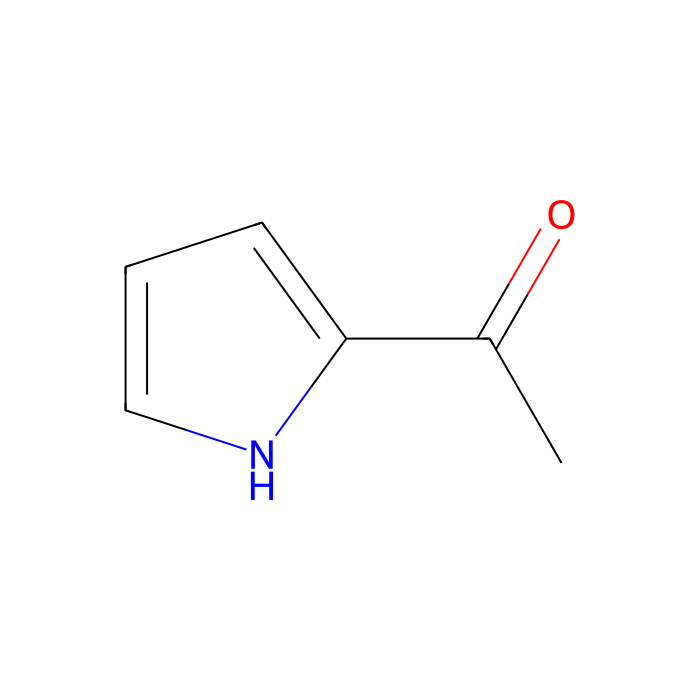
Structure and Identity
A heteroaromatic building block bearing both a pyrrolic N–H and an acetyl (methyl ketone) substituent at the 2-position of the ring.
Item-specific identifiers (from Product Data):
CAS: 1072-83-9
CID: 14079
InChIKey: 140232 (as provided)
SMILES: Not specified for this item; refer to CoA/Spec Sheet.
Preferred IUPAC name (literature): 1-(1H-pyrrol-2-yl)ethanone (2-acetylpyrrole)
Molecular formula (literature): C6H7NO
Molecular weight (literature): ~109.13 g/mol
Typical SMILES (literature): CC(=O)c1cc[nH]c1 (one of several equivalent depictions)
Structural features (general chemistry description):
Five-membered aromatic ring containing one pyrrolic nitrogen ([nH]), conferring aromaticity and hydrogen-bond donor capability.
An acetyl group (–COCH3) at the 2-position (α to the pyrrolic nitrogen), providing a conjugated aryl methyl ketone moiety that is both electrophilic (at C=O) and enolizable (α-CH3).
The ring is planar; the carbonyl is conjugated with the pyrrole π-system, often leading to modest bathochromic UV absorption relative to unsubstituted pyrrole (literature/general).
No stereocenters; the molecule is achiral.
2D description in words: a five-membered aromatic ring with one NH; moving clockwise from N, the adjacent carbon (C-2) bears an acetyl substituent (–C(=O)CH3); the remaining ring positions are unsubstituted carbons.
Synthetic Utility
Key functional elements and reactivity (general/literature):
Carbonyl (acetyl) functionality:
Electrophilic center amenable to nucleophilic additions (e.g., organometallics, hydrides) and derivatization (oximes, hydrazones, imines).
α-Carbon enolizes under base (LDA, NaHMDS), enabling aldol, Claisen, and Michael-type reactions; careful control prevents self-condensation.
Pyrrolic ring (N–H heteroarene):
Strongly activated toward electrophilic aromatic substitution; with 2-substitution, reactions tend to occur at the 5-position. Reagents include NBS/NCS (halogenation), sulfonyl chlorides (sulfonylation), and Vilsmeier reagents (formylation).
N-protection (Boc, SEM, Ts) can suppress undesired N-acylation or coordination and direct metalation at C-5 (e.g., s-BuLi/TMEDA), enabling subsequent cross-couplings.
Retrosynthetic value:
Serves as a convergent node: combine a pyrrole core (from Paal–Knorr or Knorr syntheses) with acylation to access 2-acylpyrroles; conversely, elaborate from 2-acetylpyrrole to higher-order heteroaryl frameworks via coupling.
Derivatization pathways:
Reduction: to secondary alcohols or alkanes (via Clemmensen/Wolff–Kishner-type sequences when functional-group tolerance allows).
Oxidation: Baeyer–Villiger to corresponding N-unsubstituted lactams is generally not applicable; however, selective oxidation at the ring or side chain can furnish diketones (context-dependent).
Cross-coupling: After 5-halogenation, perform Suzuki–Miyaura to introduce aryl/alkenyl groups; maintain mild conditions to avoid ring overreaction.
Analytical notes:
Monitor transformations by 1H NMR (diagnostic pyrrolic NH ~10–11 ppm; methyl ketone singlet ~2–2.5 ppm, solvent-dependent) and by GC–MS/LC–MS (M+ ~109, literature).
Target Specificity
Not applicable. This product is a small-molecule heteroaromatic reagent and does not possess biological target specificity in the way antibodies, probes, or inhibitors are defined in this catalog context. No antigen/epitope, clone, isotype, or species reactivity data apply to this item.
Preguntas frecuentes
What is the purity of this product?
This product is supplied at ≥99% purity (chemical assay). Lot-specific values are stated on the Certificate of Analysis.
How should this product be stored?
Store at room temperature.
How is this product shipped?
This product ships under standard ambient conditions. No temperature-controlled packaging is required.
What are the CAS number, molecular formula and molecular weight?
The CAS Number is 1072-83-9, the molecular formula is C6H7NO, and the molecular weight is 109.13 g/mol. InChIKey IGJQUJNPMOYEJY-UHFFFAOYSA-N.
What documentation is provided?
Available product documentation, including Certificates of Analysis (COA), Safety Data Sheets (SDS), and specification sheets, is shown in the product document area. Document availability and access follow the current site policy.
Utilizamos cookies para garantizar el correcto funcionamiento del sitio web y, cuando esté permitido, para mejorar su experiencia. Puede gestionar sus preferencias en cualquier momento en Configuración. Más información en nuestra Política de Cookies.
¿Quieres que te enviemos un mensaje cuando tengamos descuentos disponibles?
Recordármelo más tarde
¡Gracias! Por favor, revisa tu bandeja de entrada de correo electrónico para confirmar.
Products are supplied to verified businesses, institutions, and qualified professionals for research and development use only. Not for use in humans, animals, diagnosis, or therapy.

 J2609115