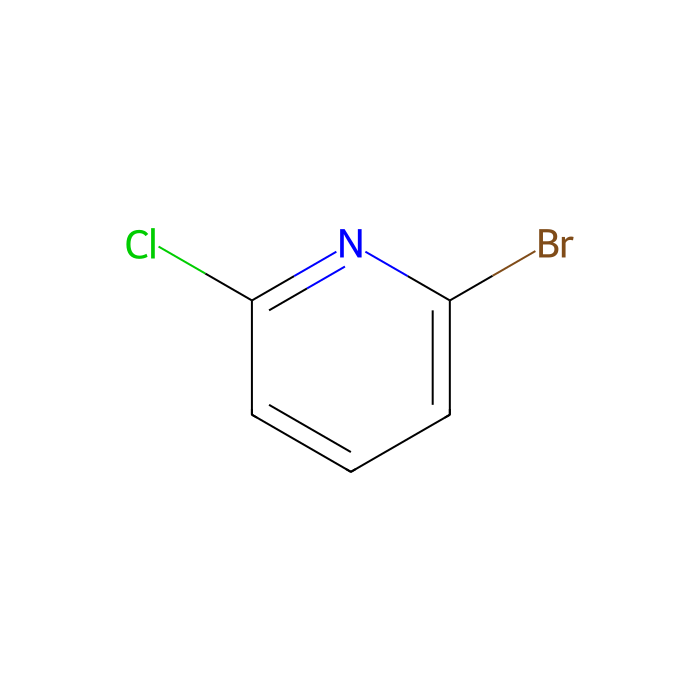
2-Bromo-6-chloropyridine - ≥98%(GC) , CAS No.5140-72-7

CAS: 5140-72-7 Cat. No.: B136352 Fórmula: C5H3BrClN Peso molecular: 192.44 Beilstein Registry Number: 20(5)5,433 Número EC: 225-904-4
Disponible para pedir
CALIDAD & PUREZA ≥98%(GC)
Synonyms
6-Bromo-2-chloropyridine|2-Chloro-6-bromopyridine|Pyridine, 2-bromo-6-chloro-|2-Bromo-6-chloropyridine
Storage
Room temperature,Argon charged
Shipped In
Normal
★
Talla
USA
Alemania (EU)*
Precio
Cantidad
250mg
B136352-250mg
5 Disponible
—
9,90US$
1g
B136352-1g
4 Disponible
—
10,90US$
5g
B136352-5g
1 Disponible
—
11,90US$
10g
B136352-10g
Fabricado bajo pedido · 8–12 semanas

12,90US$

19,90US$
Guardar 7,00 US$ (35.18%)
25g
B136352-25g
3 Disponible
—

27,90US$

41,90US$
Guardar 14,00 US$ (33.41%)
Enter a quantity for the sizes you want to add.

Descripción general

A halogenated compound used for biochemical research.

Especificaciones

Sinónimos
6-Bromo-2-chloropyridine | 2-Chloro-6-bromopyridine | Pyridine, 2-bromo-6-chloro- | 2-Bromo-6-chloropyridine
Especificaciones y pureza
≥98%(GC)
Condiciones de almacenamiento de almacenamiento
Room temperature,Argon charged
Enviado en
Normal
Pureza
≥98%(GC)
Nombres e identificadores
Pubchem Sid
Pubchem Sid Url
https://pubchem.ncbi.nlm.nih.gov/substance/504755317
SMILES
C1=CC(=NC(=C1)Br)Cl
IUPAC Name
2-bromo-6-chloropyridine
InChIKey
JWTZSVLLPKTZJP-UHFFFAOYSA-N
InChI
1S/C5H3BrClN/c6-4-2-1-3-5(7)8-4/h1-3H
Isómeros SMILES
C1=CC(=NC(=C1)Br)Cl
WGK Alemania
1
Peso molecular
192.44
Beilstein
20(5)5,433
Reaxys
1634772
Reaxys-RN_link_address
https://www.reaxys.com/reaxys/secured/hopinto.do?context=S&query=IDE.XRN=1634772&ln=

Datos avanzados

Taxonomic Classification

Taxonomy Tree

KingdomOrganic compounds
SuperclassOrganoheterocyclic compounds
ClasePyridines and derivatives
SubclassHalopyridines
Intermediate Tree Nodes Not available
Direct ParentPolyhalopyridines
Alternative Parents 2-halopyridines  Aryl chlorides  Aryl bromides  Heteroaromatic compounds  Azacyclic compounds  Organopnictogen compounds  Organonitrogen compounds  Organochlorides  Organobromides  Hydrocarbon derivatives  
Molecular FrameworkAromatic heteromonocyclic compounds
Substituents Polyhalopyridine - 2-halopyridine - Aryl halide - Aryl chloride - Aryl bromide - Heteroaromatic compound - Azacycle - Organic nitrogen compound - Organopnictogen compound - Hydrocarbon derivative - Organonitrogen compound - Organochloride - Organobromide - Organohalogen compound - Aromatic heteromonocyclic compound
DescripciónThis compound belongs to the class of organic compounds known as polyhalopyridines. These are organic compounds containing a pyridine ring substituted at two or more positions by a halogen atom.
External Descriptors Not available
Estructura 3D
Modelo de Estructura Química Interactiva


Certificados (CoA, COO, BSE/TSE y tabla de análisis)
C of A & Other Certificates(BSE/TSE, COO):
Analytical Chart:

Find and download the COA for your product by matching the lot number on the packaging.

5 results found

Lot NumberCertificate TypeFechaArticulo
J2112282J2112282Certificate of AnalysisApr 03, 2025 B136352
J2112283J2112283Certificate of AnalysisApr 03, 2025 B136352
J2112285J2112285Certificate of AnalysisApr 03, 2025 B136352
J2112287J2112287Certificate of AnalysisApr 03, 2025 B136352
E2327466E2327466Certificate of AnalysisMar 05, 2025 B136352
Propiedades químicas y físicas
Solubilidadsoluble in MeOH
SensibilidadMoisture sensitive
Punto de fusión (°C)90 °C
Peso molecular192.44
XLogP32.200
Hydrogen Bond Donor Count0
Hydrogen Bond Acceptor Count1
Rotatable Bond Count0
Exact Mass190.914 Da
Monoisotopic Mass190.914 Da
Topological Polar Surface Area12.900 Ų
Heavy Atom Count8
Formal Charge0
Complexity78.800
Isotope Atom Count0
Defined Atom Stereocenter Count0
Undefined Atom Stereocenter Count0
Defined Bond Stereocenter Count0
Undefined Bond Stereocenter Count0
The total count of all stereochemical bonds0
Covalently-Bonded Unit Count1
Seguridad y peligros (GHS)
Pictogramas
GHS05,   GHS07
Señal
Danger
Indicaciones de peligro

H302:Harmful if swallowed

H312:Harmful in contact with skin

H315:Causes skin irritation

H318:Causes serious eye damage

H319:Causes serious eye irritation

H332:Harmful if inhaled

H335:May cause respiratory irritation

Precauciones

P261:Avoid breathing dust/fume/gas/mist/vapors/spray.

P264:Wash hands [and …] thoroughly after handling.

P270:Do not eat, drink or smoke when using this product.

P271:Use only outdoors or in a well-ventilated area.

P280:Wear protective gloves/protective clothing/eye protection/face protection.

P321:Specific treatment (see ... on this label).

P330:Rinse mouth.

P302+P352:IF ON SKIN: wash with plenty of water.

P304+P340:IF INHALED: Remove person to fresh air and keep comfortable for breathing.

P305+P351+P338:IF IN EYES: Rinse cautiously with water for several minutes. Remove contact lenses if present and easy to do - continue rinsing.

P362+P364:Take off contaminated clothing and wash it before reuse.

P405:Store locked up.

P403+P233:Store in a well-ventilated place. Keep container tightly closed.

P501:Dispose of contents/container to an approved waste disposal plant.

P264+P265:Wash hands [and …] thoroughly after handling. Do not touch eyes.

P301+P317:IF SWALLOWED: Get medical help.

P305+P354+P338:IF IN EYES: Immediately rinse with water for several minutes. Remove contact lenses if present and easy to do. Continue rinsing.

P317:Get emergency medical help.

P337+P317:If eye irritation persists: Get medical help.

P332+P317:If skin irritation occurs: Get medical help.

P319:Get medical help if you feel unwell.

WGK Alemania
1
Reaxys
1634772
Reaxys-RN_link_address
https://www.reaxys.com/reaxys/secured/hopinto.do?context=S&query=IDE.XRN=1634772&ln=
Calculadoras de soluciones
Reseñas

Reseñas de cliente

Application Protocols

Not applicable. No standardized bioassay or imaging protocols are associated with this small-molecule building block. For synthetic applications, refer to the Reaction Conditions and Synthetic Utility sections for representative procedures and optimization guidance.

Biological Roles

This product is a synthetic heteroaromatic building block and is not intended for biological administration. No endogenous biological role is associated with 2-bromo-6-chloropyridine.

General context for chemists (not clinical/therapeutic claims):

  • The pyridine motif is prevalent in bioactive molecules due to its tunable basicity, hydrogen-bond acceptor character, and influence on solubility and metabolic stability. However, the dihalogenated derivative itself is primarily a precursor, not a probe.
  • In medicinal chemistry workflows, 2,6-dihalopyridines enable rapid library generation via orthogonal C–Br/C–Cl functionalization to access 2,6-disubstituted analogs for SAR.
  • Metabolic considerations of derived pyridines (general): N-oxidation (flavin monooxygenases), N-glucuronidation (rare), and ring hydroxylation by CYPs depending on substitution. Such pathways apply to final scaffolds, not this reagent as supplied.

Research Use Note: For research use only (per Product Data). Any biological testing should be performed on appropriately derivatized compounds with full safety and compliance review.

Buffer Applications

Not typically applicable. 2-Bromo-6-chloropyridine is a neutral, poorly water-soluble organic building block and is not used to formulate aqueous buffer systems. For experimental workflows involving this substrate, focus on the Solvent Selection, Reaction & Applications, and Synthetic Utility sections for relevant guidance.

Green Alternatives

Greener choices for processes involving 2-bromo-6-chloropyridine primarily concern solvent and catalyst selection. Replace traditional high-toxicity or high-VOC solvents and minimize precious-metal loadings where feasible.

  • Solvent replacements (literature/guidance):
    • THF → 2-MeTHF (biorenewable, higher boiling, easier phase splits).
    • DCM → EtOAc or MeTHF (reduced chlorinated waste).
    • DMF/DMAc → Cyrene, propylene carbonate, or green ether esters when catalyst/solubility permit.
    • Toluene/xylene → CPME or anisole for higher-temperature couplings with improved safety.

Comparison snapshot (general):

| Use case | Conventional | Greener alternative | Trade-offs | |---|---|---|---| | Suzuki in THF/H2O | THF | 2-MeTHF/H2O | Slightly different solubility; similar performance with base tuning | | Amination in toluene | Toluene | CPME or anisole | Higher bp aids heat; may require ligand/base re-optimization | | Workup/partition | DCM | EtOAc | Slower phase disengagement with some salts; safer profile |

  • Catalysts and bases:
    • Explore Ni catalysis for C–Cl activation to reduce Pd use; adjust ligands (bipyridines, phenanthrolines).
    • Solid carbonate bases (K3PO4, Cs2CO3) can simplify aqueous waste streams versus hydroxides.

Remember: Verify stability of this dihalopyridine in new solvent matrices and ensure acceptable impurity profiles before scale-up.

Pharmaceutical Uses

No excipient or pharmacopeial status is specified for this item; it is supplied for research use only.

Context for process and medicinal chemists (general, non-clinical):

  • Role: Versatile intermediate for assembling 2,6-disubstituted pyridine cores common in agrochemicals and investigational drug candidates (e.g., as ligands, hinge-binding motifs, or aromatic linkers).
  • Manufacturing relevance: Orthogonal halides allow convergent assembly, reducing protecting-group operations and enabling modular late-stage diversification.
  • Quality considerations: If a route targets cGMP manufacture downstream, establish impurity profiles early (halide scrambling, residual metals from couplings), and define acceptance criteria for residual starting material in ICH-compliant impurity studies on the final API—not on this reagent.
  • Workup/purification: Recrystallization of products from EtOAc/hexanes or MeOH/water blends can reduce halogenated solvent usage; charcoal treatments may remove Pd traces post-coupling.

No therapeutic or clinical claims are made or implied for this product.

Physical Properties

Item-specific specifications are not provided in the Product Data; refer to the CoA/Spec Sheet for guaranteed values. The following are literature/general properties to guide method development (not certificate specifications):

  • Molecular formula (literature): C5H3BrClN
  • Molecular weight (calculated): 192.44 g/mol
  • Physical state/appearance: Not specified for this item; refer to CoA/Spec Sheet.
  • Boiling point: Typical values for 2-halopyridines fall in the 200–230 °C range (literature, indicative only). Specific bp for this item: Not specified; consult literature/SDS.
  • Melting point: Not specified for this item; refer to CoA/Spec Sheet.
  • Density: Not specified for this item; refer to CoA/Spec Sheet. Halopyridines often have densities >1 due to halogen content (general trend).
  • Solubility (general): Good solubility in common organic solvents (e.g., toluene, THF, dioxane, DCM, DMF, DMAc). Low solubility in water expected for neutral halopyridines.
  • LogP/logD: Not specified for this item. Dihalogenation typically increases hydrophobicity (general trend).
  • Refractive index: Not specified for this item; refer to CoA/Spec Sheet.
  • UV characteristics: Aromatic absorption expected in the 200–300 nm range (literature, qualitative); no item-specific UV cutoffs are provided.

Always confirm critical parameters experimentally under your specific conditions and by consulting the SDS/CoA for authoritative values.

Quality and Grades
  • Item-specific grade/purity: Not specified for this item; refer to CoA/Spec Sheet.
  • Stabilizers/inhibitors: Not specified for this item; refer to CoA/Spec Sheet.

Context for professional users (general guidance):

  • Typical grades for small-molecule building blocks include “98%+” purity for standard synthesis, and higher-purity or low-residue grades when trace metals/UV absorbance are critical (e.g., for library synthesis or analytics). In the absence of an item-specific grade listing, plan to verify purity by qNMR, HPLC/GC, or HRMS prior to scale-up.
  • Metal content: For Pd-catalyzed cross-couplings, residual Pd or other metals are not expected in a neat reagent, but downstream purifications may demand low metal backgrounds. If metal limits are critical, specify acceptance criteria and request supporting documentation.
  • Halide identity and ratio: This substrate contains both Br and Cl. Confirm identity/purity by 1H/13C NMR (diagnostic α-pyridyl shifts) and high-resolution MS to rule out positional isomers or mono-halogenated impurities.
  • Water/peroxide/UV cutoff: Not specified for this item; refer to CoA/Spec Sheet. While peroxides are not typical concerns for halopyridines, confirm absence of oxidative impurities when conducting sensitive organometallic steps.

If your application demands HPLC-grade solvents or metal-screened reagents during coupling, align internal SOPs with target impurity specifications prior to campaign manufacture.

Reaction and Applications

2-Bromo-6-chloropyridine is a versatile dihalopyridine enabling orthogonal functionalization. The C–Br bond is generally more reactive than C–Cl, allowing sequential coupling strategies.

  • Cross-coupling sequences (general literature):
    • Step 1: Selective Suzuki (or Negishi/Kumada) at C–Br to install aryl/alkyl substituents using Pd(0) catalysts (e.g., Pd(PPh3)4) in dioxane/H2O or THF/H2O with K2CO3 or K3PO4.
    • Step 2: Amination or further C–C coupling at C–Cl under more forcing conditions using Buchwald ligands (e.g., BrettPhos, XPhos) with Pd2(dba)3 or Pd(OAc)2, or use Ni catalysts for sp2–sp2 couplings.
  • N-oxide route: Oxidation to the pyridine N-oxide (m-CPBA, H2O2/AcOH) can activate the ring toward SNAr at C-2/C-4, then subsequent deoxygenation (PCl3, Zn/AcOH) restores the pyridine.
  • Directed metalation/halogen–lithium exchange:
    • The α-bromo position adjacent to N undergoes rapid Br/Li exchange with n-BuLi or t-BuLi at cryogenic temperatures, enabling electrophile trapping (formylation, acylation). TMEDA can improve regioselectivity.
  • Applications:
    • Assembly of 2,6-disubstituted pyridines present in ligands, agrochemical scaffolds, and materials.
    • Construction of chelating motifs (e.g., pyridyl-amine or pyridyl-alkoxy) for coordination chemistry.
  • Practical notes:
    • Maintain rigorously anhydrous conditions for organometallic steps; pre-dry solvents and glassware.
    • Exploit halogen chemoselectivity to minimize protecting-group steps and streamline convergent routes.
Reaction Conditions

The following are representative literature-style conditions for method development (general guidance; not item-specific specifications):

  • Suzuki–Miyaura at C–Br (selective):

    • Catalyst: 2–5 mol% Pd(PPh3)4 or Pd2(dba)3 + PPh3.
    • Base: K2CO3 (2–3 equiv) or K3PO4; aqueous 2 M solutions work well.
    • Solvent: 1,4-dioxane/H2O (3:1) or 2-MeTHF/H2O.
    • Temperature/time: 70–95 °C, 2–12 h.
    • Note: Minimal conversion at C–Cl under these conditions provides chemoselectivity.
  • Buchwald–Hartwig amination at C–Cl (after C–Br functionalization):

    • Catalyst/ligand: Pd2(dba)3 (1–2 mol% Pd) + BrettPhos or XPhos (2–4 mol%).
    • Base: NaOtBu or K3PO4 (3 equiv).
    • Solvent: toluene, CPME, or dioxane.
    • Temperature/time: 90–120 °C, 6–18 h.
  • Negishi/Kumada couplings:

    • C–Br site reacts readily with R–ZnX (Pd or Ni catalysts) or RMgX (Ni catalysts, 0–60 °C) for rapid C–C formation.
  • Halogen–lithium exchange (on C–Br):

    • Reagents: n-BuLi (1.1–1.5 equiv) ± TMEDA.
    • Solvent: anhydrous THF or Et2O.
    • Temperature: −78 to −40 °C; quench with electrophiles (DMF, CO2, R–CHO, MeI).
  • N-oxide/SNAr route:

    • Oxidation: m-CPBA (1.2–1.5 equiv) in DCM, 0–25 °C.
    • SNAr: nucleophile in MeCN/DMF, 50–100 °C.
    • Deoxygenation: PCl3 or Zn/AcOH, 0–50 °C.

Always verify selectivity between C–Br and C–Cl under your catalyst system; ligand choice is pivotal for engaging the aryl chloride.

Safety and Handling

Safety classifications (GHS signal word, hazard statements, pictograms) are not specified in the Product Data for this item. Always consult the product SDS for authoritative hazard information before use. The following guidance reflects general practices for halogenated heteroaromatics.

  • Anticipated hazards (general): May cause skin/eye irritation and respiratory irritation; harmful if swallowed. Combustible but typically high-boiling. Avoid inhalation of vapors or dust/aerosols.
  • Personal protective equipment (PPE):
    • Lab coat, nitrile gloves, and splash-resistant safety goggles.
    • Handle in a fume hood to control vapors and potential byproducts during couplings or base-mediated reactions.
  • Handling notes:
    • Keep containers tightly closed. Product Data specifies storage under an argon atmosphere at room temperature; maintain inert headspace to minimize oxidative discoloration and moisture ingress during long storage.
    • Avoid strong bases and organolithiums except under controlled conditions, as α-halopyridines undergo rapid metal–halogen exchange and directed lithiation.
    • Incompatibilities (general): Strong oxidizers/reductants; finely divided reactive metals; strong acids/bases can alter reactivity.
  • First-aid overview (consult SDS for details):
    • Inhalation: Move to fresh air; seek medical attention if symptoms persist.
    • Skin/eye contact: Rinse with water for at least 15 minutes; remove contaminated clothing; obtain medical advice if irritation continues.
    • Ingestion: Rinse mouth; do not induce vomiting; seek medical attention.
  • Waste: Collect halogenated organic waste in appropriately labeled containers; follow institutional and regulatory disposal protocols.
Solvent Selection

As a neutral, moderately polar heteroaromatic, 2-bromo-6-chloropyridine dissolves well in many organic solvents. Selection should be driven by the planned transformation (e.g., cross-coupling, lithiation, or SNAr) and workup considerations.

  • Polarity/miscibility (general):
    • Good solubility in ethers (THF, 2-MeTHF), polar aprotics (DMF, DMAc, NMP, DMSO), and chlorinated solvents (DCM), as well as aromatics (toluene, xylene).
    • Water: low solubility expected; use biphasic systems for aqueous base couplings.
  • Common choices by reaction class:
    • Suzuki–Miyaura: dioxane/H2O, THF/H2O, 2-MeTHF/H2O, or toluene/H2O with phase-transfer if needed.
    • Buchwald–Hartwig amination (on the C–Cl site after selective C–Br coupling): toluene, dioxane, CPME, or tert-amyl alcohol; DMF/DMAc for more challenging substrates.
    • Metal–halogen exchange/lithiation: anhydrous THF or Et2O at −78 to −40 °C; add TMEDA for enhanced lithiation selectivity.
    • SNAr (via N-oxide activation): MeCN, DMF, DMSO.
  • Practical tips:
    • Start with solvents that balance solubility and catalyst stability; screen 2–3 classes during optimization.
    • If crystallization-driven purification is desired, consider toluene/hexanes or EtOAc/hexanes systems post-reaction.
    • For scale-up, prioritize lower-toxicity, higher-boiling choices (e.g., 2-MeTHF, CPME) to enable higher-temperature couplings while easing solvent recovery.
Storage and Reconstitution
  • Storage conditions (from Product Data): Store at room temperature under an argon atmosphere. Maintain a tight seal and inert headspace to minimize moisture/air exposure over long-term storage.
  • Shipping: Shipped under normal conditions (per Product Data).
  • Reconstitution/solution preparation (general guidance):
    • Prepare stock solutions in dry organic solvents compatible with your intended use (e.g., anhydrous THF, toluene, DCM, DMF, or 2-MeTHF). Typical concentrations for screening are 0.1–1.0 M.
    • Use oven-dried glassware and inert gas techniques (N2/Ar) when preparing solutions for air- or moisture-sensitive transformations (e.g., lithiation, Pd/Ni-catalyzed couplings).
    • Filter solutions if particulates are observed; pass through PTFE membranes compatible with organic solvents.
  • Stability notes (general):
    • Dihalopyridines are generally stable at ambient temperature; prolonged exposure to strong light or base can induce degradation or discoloration.
    • Avoid repeated freeze–thaw of solutions; prepare fresh aliquots for sensitive steps.
  • Item-specific specifications (appearance, purity, stabilizers): Not specified for this item; refer to CoA/Spec Sheet.

Always consult the SDS for detailed handling and storage safety information. For extended storage after opening, re-purge the container headspace with argon before re-sealing.

Structure and Identity

A dihalogenated heteroaromatic building block featuring a pyridine ring bearing bromine at C2 and chlorine at C6 (both α to the ring nitrogen). Suitable for orthogonal halogen chemistry.

  • Item-specific identifiers (from Product Data)
    • CAS: 5140-72-7
    • CID: 78820
    • InChIKey (as provided): 172180
    • SKU: B136352
  • Structure descriptors (literature/computed; not item-specific)
    • Molecular formula (calc.): C5H3BrClN
    • Molecular weight (calc.): 192.44 g/mol
    • SMILES (literature): n1c(Br)cccc1Cl (equivalently: Clc1cccc(Br)n1)
    • 2D structural description: a six‑membered aromatic ring with one ring nitrogen (pyridine). The carbon adjacent to N on one side (C-2) bears Br; the carbon adjacent on the opposite side (C-6) bears Cl. The remaining ring positions are unsubstituted carbons.
  • Functional group features (general chemistry)
    • Heteroaromatic ring (pyridine) with a ring sp2 nitrogen (Lewis basic).
    • Two aryl–halide bonds of differing leaving-group ability: C–Br (more reactive) and C–Cl (less reactive), enabling sequential/orthogonal cross-couplings or substitutions.
    • Potential to form the N-oxide, which can further modulate reactivity in SNAr sequences.

Note: Where an exact identifier is not present in Product Data, literature values are supplied for chemical context only.

Synthetic Utility

Key features that make 2-bromo-6-chloropyridine valuable in synthesis:

  • Orthogonal aryl halides: The C–Br site undergoes oxidative addition more readily than C–Cl, enabling stepwise installation of two distinct substituents with high chemoselectivity.
  • Heteroatom incorporation: After C–Br functionalization, the C–Cl can be engaged in Buchwald–Hartwig amination to introduce primary/secondary amines or anilines, building bidentate ligands or bioisosteric motifs.
  • Carbon–carbon bond formation: Suzuki (boron partners), Negishi (organozinc), Kumada (Grignard, often Ni-catalyzed), and Stille (organostannanes) at the bromo site; more forcing conditions or tailored ligands unlock the chloro site.
  • Directed metalation: The pyridine N directs metallation/halogen–lithium exchange at C-2 under cryogenic conditions, enabling electrophilic trapping (e.g., DMF → aldehydes; CO2 → carboxylic acids) before or after manipulating the chloro site.
  • N-oxide strategy: Temporary oxidation to the N-oxide activates positions for SNAr with phenoxides/alkoxides or amines, then deoxygenation restores the pyridine.
  • Retrosynthetic value: Serves as a linchpin for constructing 2,6-disubstituted pyridines without pre-installing directing groups, streamlining library synthesis and scale-up routes.

Practical: Begin with the bromide for high-yield couplings; reserve the chloride for the second, more demanding transformation, selecting ligands that specifically accelerate C–Cl activation.

Target Specificity

Not applicable. This product is a small-molecule chemical building block, not a biological targeting reagent (e.g., antibody, enzyme inhibitor standard, or probe). No antigen, epitope, or species reactivity information applies.

Preguntas frecuentes

What is the purity of this product, and how is it determined?
This product is supplied at ≥98% purity, determined by gas chromatography (GC). Lot-specific values are stated on the Certificate of Analysis.
How should this product be stored?
Store at room temperature under argon. It is supplied under an argon blanket; reseal under inert gas after each use.
How is this product shipped?
This product ships under standard ambient conditions. No temperature-controlled packaging is required.
What are the CAS number, molecular formula and molecular weight?
The CAS Number is 5140-72-7, the molecular formula is C5H3BrClN, and the molecular weight is 192.44 g/mol. InChIKey JWTZSVLLPKTZJP-UHFFFAOYSA-N.
What documentation is provided?
Available product documentation, including Certificates of Analysis (COA), Safety Data Sheets (SDS), and specification sheets, is shown in the product document area. Document availability and access follow the current site policy.

¿Quieres que te enviemos un mensaje cuando tengamos descuentos disponibles?

Recordármelo más tarde

¡Gracias! Por favor, revisa tu bandeja de entrada de correo electrónico para confirmar.

¡Vaya! Las notificaciones están desactivadas.