Determine the necessary mass, volume, or concentration for preparing a solution.
Taxonomy Tree
| Kingdom | Organic compounds |
|---|---|
| Superclass | Lipids and lipid-like molecules |
| Clase | Fatty Acyls |
| Subclass | Fatty acids and conjugates |
| Intermediate Tree Nodes | Not available |
| Direct Parent | Medium-chain fatty acids |
| Alternative Parents | Unsaturated fatty acids Straight chain fatty acids Monocarboxylic acids and derivatives Carboxylic acids Organic oxides Hydrocarbon derivatives Carbonyl compounds |
| Molecular Framework | Aliphatic acyclic compounds |
| Substituents | Medium-chain fatty acid - Unsaturated fatty acid - Straight chain fatty acid - Monocarboxylic acid or derivatives - Carboxylic acid - Carboxylic acid derivative - Organic oxygen compound - Organic oxide - Hydrocarbon derivative - Organooxygen compound - Carbonyl group - Aliphatic acyclic compound |
| Descripción | This compound belongs to the class of organic compounds known as medium-chain fatty acids. These are fatty acids with an aliphatic tail that contains between 4 and 12 carbon atoms. |
| External Descriptors | Unsaturated fatty acids |
Find and download the COA for your product by matching the lot number on the packaging.
| Lot Number | Certificate Type | Fecha | Articulo |
|---|---|---|---|
| Certificate of Analysis | Jan 19, 2026 | B301308 | |
| Certificate of Analysis | Jan 19, 2026 | B301308 | |
| Certificate of Analysis | Jan 19, 2026 | B301308 | |
| Certificate of Analysis | Dec 31, 2025 | B301308 | |
| Certificate of Analysis | Sep 16, 2025 | B301308 | |
| Certificate of Analysis | Sep 16, 2025 | B301308 | |
| Certificate of Analysis | Sep 16, 2025 | B301308 | |
| Certificate of Analysis | Sep 16, 2025 | B301308 | |
| Certificate of Analysis | Sep 16, 2025 | B301308 | |
| Certificate of Analysis | Jul 07, 2023 | B301308 | |
| Certificate of Analysis | Aug 06, 2022 | B301308 |
| Índice de refracción | 1.4600 |
|---|---|
| Punto de inflamación (°F) | 214°F |
| Punto de inflamación (°C) | 101°C |
| Punto de ebullición (°C) | 148-149°/19mm |
| Peso molecular | 140.18 |
| XLogP3 | 2.800 |
| Hydrogen Bond Donor Count | 1 |
| Hydrogen Bond Acceptor Count | 2 |
| Rotatable Bond Count | 3 |
| Exact Mass | 140.084 Da |
| Monoisotopic Mass | 140.084 Da |
| Topological Polar Surface Area | 37.300 Ų |
| Heavy Atom Count | 10 |
| Formal Charge | 0 |
| Complexity | 159.000 |
| Isotope Atom Count | 0 |
| Defined Atom Stereocenter Count | 0 |
| Undefined Atom Stereocenter Count | 0 |
| Defined Bond Stereocenter Count | 0 |
| Undefined Bond Stereocenter Count | 0 |
| The total count of all stereochemical bonds | 0 |
| Covalently-Bonded Unit Count | 1 |
H302:Harmful if swallowed
H312:Harmful in contact with skin
H314:Causes severe skin burns and eye damage
H332:Harmful if inhaled
P260:Do not breathe dust/fume/gas/mist/vapors/spray.
P261:Avoid breathing dust/fume/gas/mist/vapors/spray.
P264:Wash hands [and …] thoroughly after handling.
P270:Do not eat, drink or smoke when using this product.
P271:Use only outdoors or in a well-ventilated area.
P280:Wear protective gloves/protective clothing/eye protection/face protection.
P321:Specific treatment (see ... on this label).
P330:Rinse mouth.
P363:Wash contaminated clothing before reuse.
P301+P330+P331:IF SWALLOWED: Rinse mouth. Do NOT induce vomiting.
P302+P352:IF ON SKIN: wash with plenty of water.
P304+P340:IF INHALED: Remove person to fresh air and keep comfortable for breathing.
P362+P364:Take off contaminated clothing and wash it before reuse.
P405:Store locked up.
P501:Dispose of contents/container to an approved waste disposal plant.
P301+P317:IF SWALLOWED: Get medical help.
P305+P354+P338:IF IN EYES: Immediately rinse with water for several minutes. Remove contact lenses if present and easy to do. Continue rinsing.
P317:Get emergency medical help.
P302+P361+P354:IF ON SKIN: Take off Immediately all contaminated clothing. Immediately rinse with water for several minutes.
P316:Get emergency medical help immediately.
No assay/application protocols (e.g., WB, IHC, IF, FC) are provided for this item. As a small-molecule reagent, usage depends on the chosen synthetic or analytical procedure.
Refer to primary literature or method-specific SOPs for detailed procedures and safety controls.
This product is intended for research use only.
General/literature context (not product-specific, no clinical claims)
Practical note
Not typically used as a buffering agent. 2-Octynoic acid is a hydrophobic carboxylic acid with limited water solubility and lacks a suitable pKa/pH range and solubility profile for conventional lab buffers.
Because 2-octynoic acid is a substrate/reagent, greener practice focuses on solvent and reagent choices for its transformations rather than replacing the molecule itself.
Greener solvent options (general)
Greener coupling strategies (general)
Energy and safety considerations
Example comparison (general, illustrative)
No pharmacopeial listing or excipient status is specified for this item; refer to CoA/Spec Sheet.
Item-specific specifications
Literature/general physicochemical data (for reference; not item specifications)
Notes
Item-specific quality information
Guidance on typical grades for this compound class (general)
Considerations for 2-octynoic acid
General reactivity profile
Representative transformations (literature/general)
Practical tips
Use cases
General guidance from literature (not item specifications):
Amide/ester couplings
Acid chloride route
Selective hydrogenation of C≡C
Hydration to ketone
Halogenation/hydrohalogenation
Workup considerations
All conditions should be optimized on small scale; yields and selectivities depend on catalyst, solvent, and substituent effects.
Item-specific hazard information
General safety guidance for alkynoic acids (literature/general)
Always consult the product SDS for authoritative, lot-specific hazard information and response measures.
Applicability: 2-Octynoic acid is a reagent/substrate rather than a bulk solvent. This section addresses solvents suitable for dissolving and reacting this compound.
Polarity and solvation (general)
Choosing by application
Small comparison (general)
Dry your chosen solvent if water-sensitive activations are planned (e.g., acid chloride formation, CDI coupling).
Item-specific storage/shipping
General guidance
Solution handling
Research Use Note: For research use only (from Product Data).
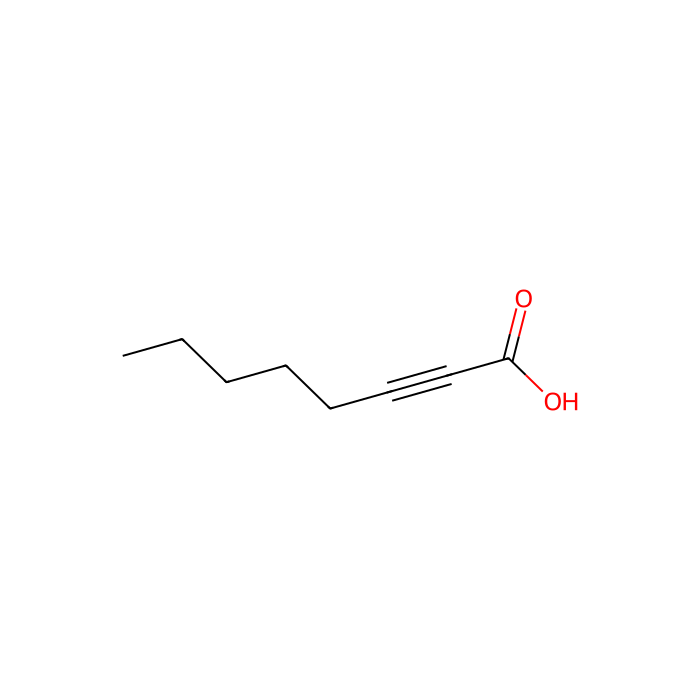
Brief overview: 2-Octynoic acid (oct-2-ynoic acid) is an eight‑carbon, unsaturated carboxylic acid bearing an internal alkyne at the 2‑position relative to the carboxyl.
Item-specific (from Product Data)
Literature identity (for reference; not item specifications)
2D structural description (literature): A terminal carboxyl group is attached to an sp‑hybridized carbon that forms a C≡C bond with the adjacent carbon, followed by a saturated methylene chain terminating in a methyl group.
Functional group leverage
Retrosynthetic value
Representative strategies (literature/general)
Analytical tracking
Not applicable. This product is a small-molecule reagent, not a biological targeting agent (e.g., antibody, enzyme, or ligand with defined epitope/clone). No target specificity data are provided for this item.