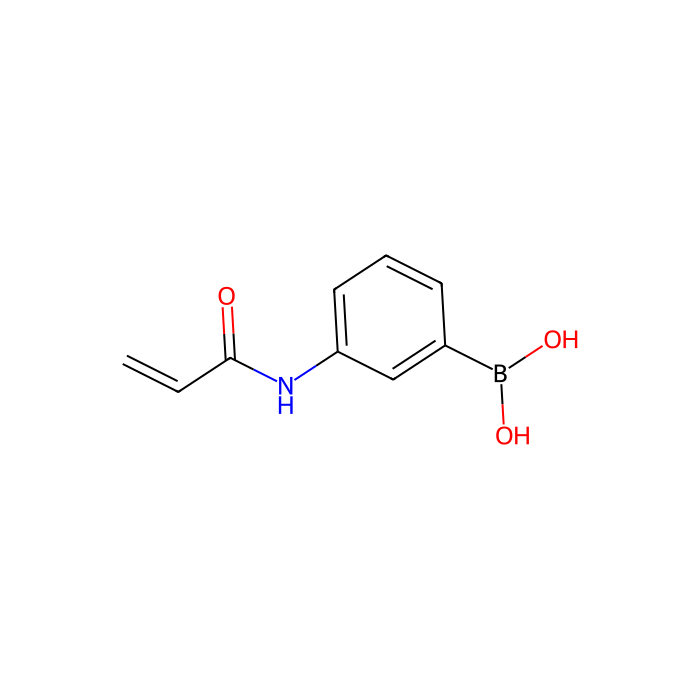
3-Acrylamidophenylboronic Acid (contains varying amounts of Anhydride) - ≥97% , CAS No.99349-68-5

CAS: 99349-68-5 Cat. No.: A188951 Peso molecular: 190.99 Número EC: 690-696-8
Disponible para pedir
GRADE & PURITY ≥97%
Synonyms
A846009 | AC-30997 | [3-(prop-2-enamido)phenyl]boronic acid | SCHEMBL235432 | 3-Acrylamidobenzeneboronic Acid | DTXSID50438076 | Phenylboronate acrylamide | BL009552 | SY066256 | AKOS006291555 | AKOS003632579 | FT-0685348 | 3-Acrylamidophenylboronic acid
Storage
Store at 2-8°C
Shipped In
Wet ice
 ·  off list, applied to all prices below.
Size
Estado
Price
Qty
250mg
A188951-250mg
3
9,90US$
1g
A188951-1g
2
15,90US$
5g
A188951-5g
3
49,90US$
10g
A188951-10g
8-12 wks(?) Production requires sourcing of materials. We appreciate your patience and understanding.
89,90US$
25g
A188951-25g
3
189,90US$
100g
A188951-100g
1
649,90US$
Enter a quantity for the sizes you want to add.
🧪

Why this grade

≥97% for sensitive chromatographic and analytical workflows requiring minimal baseline interference.

🌡

Storage & shipping

Store at 2-8°C Ships Wet ice Check lot-specific COA for exact specifications.

📋

Quality documents

SDS, COA, datasheet, and spec sheet available for download. Lot-specific COA accessible via lot number lookup.

📚

Literature proof

Cited in 16 peer-reviewed publications across chromatography, organic synthesis, and cross-coupling reactions.

Descripción general

3-Acrylamidophenylboronic acid (AAPBA) is a monomeric compound of boronic acid. The boronic acid group (-B(OH)₂) can form reversible covalent bonds with certain molecules such as diols or sugars. This unique property can be used in the design of molecular sensors to detect and quantify specific types of analytes, such as sugars and biomolecules. The hydrophilicity of the amide group makes it more suitable for drug delivery applications. It can also be used as a synthetic building block to synthesize boronic acid polymers or copolymers for use in biomedical engineering and glucose monitoring biosensors.
Application
3-Acrylamidophenylboronic acid can be used:
As a monomer to synthesize methacrylic acid-3-acrylamidophenylboronic acid copolymer (PMAA-co-AAPBA), which is used as a supramolecular receptor for biosensors. AAPBA helps to enhance the water solubility and binding affinity of the copolymer. This copolymer is used for carbohydrate sensing in aqueous solution.
As a monomer to prepare poly (3-acrylamidophenylboronic acid-b-diethylene glycol dimethacrylate) to make glucose-sensitive nanoparticles for insulin delivery. The specific binding of AAPBA to the diol in the glucose molecule can induce glucose response to the block copolymer.
As a monomer and cross-linker to synthesize self-healing composite hydrogels for tissue engineering and drug delivery systems. This gel can mimic the properties of natural tissues and provide an environment suitable for cell growth. AAPBA polymerizes with acrylamide and acts on the (HPG) cis-diol group of hydroxypropyl guar guar to form a hydrogel with good mechanical strength and rapid self-healing properties.

Specifications

Sinónimos
A846009 | AC-30997 | [3-(prop-2-enamido)phenyl]boronic acid | SCHEMBL235432 | 3-Acrylamidobenzeneboronic Acid | DTXSID50438076 | Phenylboronate acrylamide | BL009552 | SY066256 | AKOS006291555 | AKOS003632579 | FT-0685348 | 3-Acrylamidophenylboronic acid
Especificaciones y pureza
≥97%
Condiciones de almacenamiento de almacenamiento
Store at 2-8°C
Enviado en
Wet ice
Este producto requiere envío en cadena de frío. Los servicios terrestres y otros servicios económicos no están disponibles.
Pureza
≥97%
Nombres e identificadores
Pubchem Sid504765393
Pubchem Sid Urlhttps://pubchem.ncbi.nlm.nih.gov/substance/504765393
Sonrisas canónicasB(C1=CC(=CC=C1)NC(=O)C=C)(O)O
IUPAC Name[3-(prop-2-enoylamino)phenyl]boronic acid
InChIKeyULVXDHIJOKEBMW-UHFFFAOYSA-N
INCHI1S/C9H10BNO3/c1-2-9(12)11-8-5-3-4-7(6-8)10(13)14/h2-6,13-14H,1H2,(H,11,12)
Isómeros SMILES B(C1=CC(=CC=C1)NC(=O)C=C)(O)O
Peso molecular 190.99
Reaxy-Rn 9908929
Reaxys-RN_link_address https://www.reaxys.com/reaxys/secured/hopinto.do?context=S&query=IDE.XRN=9908929&ln=

Documentation

📋 Safety Data Sheet (SDS)

Comprehensive hazard, handling, storage, and regulatory compliance document.

Download SDS →

✅ Certificate of Analysis (COA)

Lot-specific quality data. Enter your lot number to retrieve the exact COA.

Look up COA →

📊 Datasheet

Quick-reference summary of product specifications and applications.

View datasheet →

🔬 Specification Sheet

Full quality attributes and acceptance criteria for this grade.

View spec sheet →

Advanced Data

Taxonomic Classification

Taxonomy Tree

KingdomOrganic compounds
SuperclassBenzenoids
ClaseBenzene and substituted derivatives
SubclassAnilides
Intermediate Tree Nodes Not available
Direct ParentAnilides
Alternative Parents N-arylamides  Acrylic acids and derivatives  Secondary carboxylic acid amides  Boronic acids  Organic metalloid salts  Organometalloid compounds  Organic oxides  Hydrocarbon derivatives  Carbonyl compounds  
Molecular FrameworkAromatic homomonocyclic compounds
Substituents Anilide - N-arylamide - Acrylic acid or derivatives - Boronic acid derivative - Boronic acid - Carboxamide group - Secondary carboxylic acid amide - Carboxylic acid derivative - Organic metalloid salt - Organic nitrogen compound - Carbonyl group - Organooxygen compound - Organonitrogen compound - Organic metalloid moeity - Organic oxygen compound - Hydrocarbon derivative - Organic oxide - Aromatic homomonocyclic compound
DescripciónThis compound belongs to the class of organic compounds known as anilides. These are organic heterocyclic compounds derived from oxoacids RkE(=O)l(OH)m (l not 0) by replacing an OH group by the NHPh group or derivative formed by ring substitution.
External Descriptors Not available
Estructura 3D
Modelo de Estructura Química Interactiva


Certificados (CoA, COO, BSE/TSE y tabla de análisis)
C of A & Other Certificates(BSE/TSE, COO):
Analytical Chart:

Find and download the COA for your product by matching the lot number on the packaging.

40 results found

Lot NumberCertificate TypeFechaArticulo
G2307533Certificate of AnalysisApr 07, 2026 A188951
D2613134Certificate of AnalysisMar 10, 2026 A188951
D2613135Certificate of AnalysisMar 10, 2026 A188951
D2613136Certificate of AnalysisMar 10, 2026 A188951
D2613137Certificate of AnalysisMar 10, 2026 A188951
D2613138Certificate of AnalysisMar 10, 2026 A188951
D2613139Certificate of AnalysisMar 10, 2026 A188951
C2010118Certificate of AnalysisSep 28, 2025 A188951
L2517019Certificate of AnalysisJul 21, 2025 A188951
G2531170Certificate of AnalysisJul 21, 2025 A188951
G2531153Certificate of AnalysisJul 21, 2025 A188951
G2531152Certificate of AnalysisJul 21, 2025 A188951
G2531151Certificate of AnalysisJul 21, 2025 A188951
G2531150Certificate of AnalysisJul 21, 2025 A188951
G2531149Certificate of AnalysisJul 21, 2025 A188951
J2210248Certificate of AnalysisJul 10, 2025 A188951
J2210346Certificate of AnalysisJul 10, 2025 A188951
B2626059Certificate of AnalysisDec 03, 2024 A188951
C2517379Certificate of AnalysisDec 03, 2024 A188951
C2517373Certificate of AnalysisDec 03, 2024 A188951
C2517370Certificate of AnalysisDec 03, 2024 A188951
C2517358Certificate of AnalysisDec 03, 2024 A188951
K2125826Certificate of AnalysisSep 20, 2024 A188951
L1824020Certificate of AnalysisJul 04, 2024 A188951
L2318079Certificate of AnalysisNov 29, 2023 A188951
L2318078Certificate of AnalysisNov 29, 2023 A188951
K2419682Certificate of AnalysisNov 29, 2023 A188951
L2318080Certificate of AnalysisNov 29, 2023 A188951
G2403005Certificate of AnalysisNov 29, 2023 A188951
L2318104Certificate of AnalysisNov 29, 2023 A188951
L2318105Certificate of AnalysisNov 29, 2023 A188951
L2318106Certificate of AnalysisNov 29, 2023 A188951
L2318108Certificate of AnalysisNov 29, 2023 A188951
J2307075Certificate of AnalysisSep 19, 2022 A188951
K2324086Certificate of AnalysisSep 19, 2022 A188951
J2210250Certificate of AnalysisSep 19, 2022 A188951
J2210249Certificate of AnalysisSep 19, 2022 A188951
J2210161Certificate of AnalysisSep 19, 2022 A188951
D2319428Certificate of AnalysisSep 19, 2022 A188951
G2304383Certificate of AnalysisSep 19, 2022 A188951

Show more ⌵

Propiedades químicas y físicas
Punto de fusión (°C)129-146°C
Peso molecular190.990 g/mol
XLogP3
Hydrogen Bond Donor Count3
Hydrogen Bond Acceptor Count3
Rotatable Bond Count3
Exact Mass191.075 Da
Monoisotopic Mass191.075 Da
Topological Polar Surface Area69.600 Ų
Heavy Atom Count14
Formal Charge0
Complexity220.000
Isotope Atom Count0
Defined Atom Stereocenter Count0
Undefined Atom Stereocenter Count0
Defined Bond Stereocenter Count0
Undefined Bond Stereocenter Count0
The total count of all stereochemical bonds0
Covalently-Bonded Unit Count1
Citations of This Product
Referencias
1. Shulan Jiang, Li Xia, Hao Ma, Tingting Yang, Linmao Qian.  (2023)  pH and temperature dual-responsive hydrogel actuator with bidirectional bending behavior and ultra large bending angle.  EUROPEAN POLYMER JOURNAL,      [PMID:] [10.1016/j.eurpolymj.2023.112296]
2. Li Luolin, Yu Zheng, Liu Jianfeng, Yang Manyi, Shi Gongpu, Feng Ziqi, Luo Wei, Ma Huiru, Guan Jianguo, Mou Fangzhi.  (2023)  Swarming Responsive Photonic Nanorobots for Motile-Targeting Microenvironmental Mapping and Mapping-Guided Photothermal Treatment.  Nano-Micro Letters,  15  (1): (1-19).  [PMID:37247162] [10.1007/s40820-023-01095-5]
3. Yangjie Li, Site Luo, Yongqiang Gui, Xin Wang, Ziyuan Tian, Haihu Yu.  (2023)  Difunctional Hydrogel Optical Fiber Fluorescence Sensor for Continuous and Simultaneous Monitoring of Glucose and pH.  Biosensors-Basel,  13  (2): (287).  [PMID:36832053] [10.3390/bios13020287]
4. Wenhua Yi, Luo Hai, Yuze Luo, Junqin Li, Ke Yang, Lidan He, Shidong Yang, Le Deng, Dinggeng He.  (2023)  A highly stretchable, adhesive and absorbent hybrid hydrogel dressing for photothermal/chemodynamic antibacterial therapy.  NEW JOURNAL OF CHEMISTRY,  47  (10): (5011-5020).  [PMID:] [10.1039/D2NJ06100G]
5. Shulan Jiang, Li Xia.  (2022)  Bioinspired High-Performance Bilayer, pH-Responsive Hydrogel with Superior Adhesive Property.  Polymers,  14  (20): (4425).  [PMID:36298003] [10.3390/polym14204425]
6. Xiaomei Dai, Jifang Ma, Qiang Zhang, Qingqing Xu, Lele Yang, Feng Gao.  (2021)  Simultaneous inhibition of planktonic and biofilm bacteria by self-adapting semiconducting polymer dots.  Journal of Materials Chemistry B,  (33): (6658-6667).  [PMID:34378630] [10.1039/D1TB01070K]
7. Yulong Lan, Yao Wang, Xiaoliang Qi, Erya Cai, Yajing Xiang, XinXin Ge, Hangbin Xu, Xiaojing Chen, Ying Li, Yizuo Shi, Jianliang Shen, Zhiyong Liao.  (2024)  A modified hyaluronic acid hydrogel with strong bacterial capture and killing capabilities for drug-resistant bacteria-infected diabetic wound healing.  INTERNATIONAL JOURNAL OF BIOLOGICAL MACROMOLECULES,      [PMID:39233168] [10.1016/j.ijbiomac.2024.135301]
8. Dunyi Xiao, Huiru Ma, Wei Luo, Jianguo Guan.  (2024)  Agarose-Based Hydrogel Film with Embedded Oriented Photonic Nanochains for Sensing pH.  Polymers,  16  (11): (1530).  [PMID:38891476] [10.3390/polym16111530]
9. Gongpu Shi, Luying Si, Jinyang Cai, Hao Jiang, Yun Liu, Wei Luo, Huiru Ma, Jianguo Guan.  (2024)  Photonic Nanochains for Continuous Glucose Monitoring in Physiological Environment.  Nanomaterials,  14  (11): (964).  [PMID:38869588] [10.3390/nano14110964]
10. Hu Xu, Xin Chen, Yujuan Jia, Xinran Gao, Shuaihang Guo, Dongxu Jia, Yanxia Zhang, Qian Yu.  (2025)  A trifunctional coating for biofilm prevention: integrating antifouling, photothermal killing, and quorum sensing interference.  JOURNAL OF COLLOID AND INTERFACE SCIENCE,      [PMID:40795591] [10.1016/j.jcis.2025.138628]
11. Na Su, Hongxiang Ou, Shucheng Liu, Fang Zhu, Honglai Xue, Xuan Zhang.  (2025)  Covalent organic frameworks-based microspheres with precisely designed recognition sites for selective adsorption of luteolin.  SEPARATION AND PURIFICATION TECHNOLOGY,      [PMID:] [10.1016/j.seppur.2025.135370]
12. Zixiang Wang, Xueyang Yin, Chenyang Zhuang, Kang Wu, Huiren Wang, Zhengzhong Shao, Bo Tian, Hong Lin.  (2024)  Injectable Regenerated Silk Fibroin Micro/Nanosphere with Enhanced Permeability and Stability for Osteoarthritis Therapy.  Small,      [PMID:39101301] [10.1002/smll.202405049]
13. Yingjuan Zhou, Jiaxin Yang, Yan Li, Xin Shu, Yucen Cai, Ping Xu, Wenyan Huang, Zhangyou Yang, Rong Li.  (2024)  Multifunctional nanocomposites mediated novel hydrogel for diabetic wound repair.  Journal of Materials Chemistry B,      [PMID:38502068] [10.1039/D3TB02283H]
14. Xiaoliang Qi, Yulong Lan, Jing Chen, Yajing Xiang, Yingying Wang, Liting Jiang, Yujie Dong, Jiaxin Li, Zhiyong Liao, Zhangping Li, Jianliang Shen.  (2025)  An Endogenous Adenosine Triphosphate-Activated Hydrogel Prodrug System for Healing Multidrug-Resistant Bacteria Infected Diabetic Foot Ulcers.  Advanced Healthcare Materials,      [PMID:40492903] [10.1002/adhm.202500688]
15. Yongqing Zhang, Xiaolong Shang, Jiaqi Guo, Ling Ao, Caihong Shen, Miao Liu, Feng Lin, Wenxian Li, Liqiang Zhang, Baoguo Sun, Wei Dong, Xiaotao Sun, Yanfei Xiong, Songtao Wang, Bo Deng.  (2025)  A computationally driven screening-construction-mechanism strategy of magnetic molecularly imprinted polymers for aliphatic aldehydes detection.  FOOD CHEMISTRY,      [PMID:41213261] [10.1016/j.foodchem.2025.146974]
16. Chunhui Li, Maohang Huang, Huan Yu, Qing Yang, Lijing Hao, Yunhua Chen.  (2025)  pH- and Temperature-Responsive Nanogel Adhesive for Tunable Interfacial Bonding of Hydrogel Materials.  MACROMOLECULAR RAPID COMMUNICATIONS,      [PMID:41401353] [10.1002/marc.202500861]
Calculadoras de soluciones
Reseñas

Reseñas de cliente

Shall we send you a message when we have discounts available?

Remind me later

Thank you! Please check your email inbox to confirm.

Oops! Notifications are disabled.