Determine the necessary mass, volume, or concentration for preparing a solution.
Taxonomy Tree
| Kingdom | Organic compounds |
|---|---|
| Superclass | Organoheterocyclic compounds |
| Clase | Pyridines and derivatives |
| Subclass | Not available |
| Intermediate Tree Nodes | Not available |
| Direct Parent | Pyridines and derivatives |
| Alternative Parents | Ketoximes Heteroaromatic compounds Azacyclic compounds Organopnictogen compounds Organic oxygen compounds Hydrocarbon derivatives |
| Molecular Framework | Aromatic heteromonocyclic compounds |
| Substituents | Pyridine - Heteroaromatic compound - Ketoxime - Azacycle - Organic nitrogen compound - Organic oxygen compound - Organopnictogen compound - Hydrocarbon derivative - Organonitrogen compound - Aromatic heteromonocyclic compound |
| Descripción | This compound belongs to the class of organic compounds known as pyridines and derivatives. These are compounds containing a pyridine ring, which is a six-member aromatic heterocycle which consists of one nitrogen atom and five carbon atoms. |
| External Descriptors | Not available |
| Peso molecular | 136.15 |
|---|---|
| XLogP3 | 0.800 |
| Hydrogen Bond Donor Count | 1 |
| Hydrogen Bond Acceptor Count | 3 |
| Rotatable Bond Count | 1 |
| Exact Mass | 136.064 Da |
| Monoisotopic Mass | 136.064 Da |
| Topological Polar Surface Area | 45.500 Ų |
| Heavy Atom Count | 10 |
| Formal Charge | 0 |
| Complexity | 128.000 |
| Isotope Atom Count | 0 |
| Defined Atom Stereocenter Count | 0 |
| Undefined Atom Stereocenter Count | 0 |
| Defined Bond Stereocenter Count | 1 |
| Undefined Bond Stereocenter Count | 0 |
| The total count of all stereochemical bonds | 1 |
| Covalently-Bonded Unit Count | 1 |
H301:Toxic if swallowed
H315:Causes skin irritation
H319:Causes serious eye irritation
H335:May cause respiratory irritation
P261:Avoid breathing dust/fume/gas/mist/vapors/spray.
P264:Wash hands [and …] thoroughly after handling.
P270:Do not eat, drink or smoke when using this product.
P271:Use only outdoors or in a well-ventilated area.
P280:Wear protective gloves/protective clothing/eye protection/face protection.
P321:Specific treatment (see ... on this label).
P330:Rinse mouth.
P302+P352:IF ON SKIN: wash with plenty of water.
P304+P340:IF INHALED: Remove person to fresh air and keep comfortable for breathing.
P305+P351+P338:IF IN EYES: Rinse cautiously with water for several minutes. Remove contact lenses if present and easy to do - continue rinsing.
P362+P364:Take off contaminated clothing and wash it before reuse.
P405:Store locked up.
P403+P233:Store in a well-ventilated place. Keep container tightly closed.
P501:Dispose of contents/container to an approved waste disposal plant.
P264+P265:Wash hands [and …] thoroughly after handling. Do not touch eyes.
P301+P316:IF SWALLOWED: Get emergency medical help immediately.
P337+P317:If eye irritation persists: Get medical help.
P332+P317:If skin irritation occurs: Get medical help.
P319:Get medical help if you feel unwell.
Not applicable. No validated bioassay protocols (e.g., WB, IHC, IF, FC) are associated with this small molecule. For synthetic or analytical uses, refer to the Reaction Conditions and Solvent Selection sections for general laboratory guidance.
No item-specific biological testing data are provided. The following are general observations about pyridine oximes in biochemical contexts; they are NOT claims for this specific product.
Chemical biology utility (literature)
Metal binding
Protonation states (literature)
Cautions
For biological or biochemical experiments, confirm purity (including E/Z ratio and residual carbonyl precursor) and assess stability in the chosen buffer to avoid confounding outcomes.
This compound is not a standard buffering agent. While the pyridine nitrogen can be protonated (pKa of the pyridinium typically ~5–5.5, literature) and the oxime OH is weakly acidic (pKa ~10–11, literature), 4‑acetylpyridine oxime is not commonly used to formulate buffers with defined capacity.
For applications requiring buffering capacity, use established buffer systems and include this compound only as a solute/analyte.
Solvent choices
Reagent selection for rearrangements (literature)
Energy and workup efficiency
Comparison snapshot (literature)
Note: Green substitutions must be validated for yield, selectivity (E/Z isomer effects), and downstream processing. Always assess solvent/reagent compatibility with your catalyst and substrate set.
No pharmacopeial status or excipient role is provided in the Product Data. This compound is offered for research use only.
Research/manufacturing context (literature/general)
Compliance note
Item-specific specifications were not provided in the Product Data. The following are general/literature descriptors for 4-acetylpyridine oxime; they are NOT the certificate/specification for this item.
For authoritative, lot-specific values (mp range, water or metal content, residue on ignition, etc.), consult the item’s CoA/Spec Sheet.
Item-specific grade/purity: Not specified for this item; refer to CoA/Spec Sheet.
General guidance on grades (context for this compound type)
Oxime-specific quality considerations
Stabilizers: None indicated in Product Data. If present, stabilizers would be disclosed on the CoA/SDS.
This oxime is a versatile intermediate and ligand, bridging carbonyl protection chemistry, rearrangements, reductions, and coordination.
Protective/derivatization chemistry
Rearrangements (literature)
Reductions and N–O transformations (literature)
Coordination/ligand chemistry
Cross-coupling and further functionalization (literature)
Analytical applications
Practical notes: Dry conditions limit hydrolysis; control temperature to avoid uncontrolled Beckmann rearrangement under strong acids; monitor E/Z ratio if stereochemical outcomes matter.
Guidance below is based on literature precedents for pyridyl ketoximes and is not specific to any single protocol. Optimize for your substrate, scale, and equipment.
Beckmann rearrangement (to amide)
Reduction to amines (N–O cleavage)
O-/N-alkylation of oxime
Metal complexation
Notes: Control moisture in dehydrative steps; avoid strong acids when oxime hydrolysis is undesired. Track E/Z isomer effects on rates and selectivity.
Classification and labeling (item-specific)
General hazards (class-based, literature)
Storage and incompatibilities
Handling and PPE
First aid (overview; defer to SDS)
Always consult the product’s SDS for definitive hazard classification, exposure limits, and emergency procedures.
4-Acetylpyridine oxime is a polar, hydrogen-bonding heteroaromatic solid. Solvent choice should reflect its dual donor/acceptor character and intended transformation (e.g., coordination, rearrangement, reduction).
Polarity and miscibility (literature/general)
Selection tips
Practical comparison (literature)
Storage (item-specific)
General handling
Reconstitution and solution handling (general)
Stability of solutions (general)
For lot-specific stability, purity, and any special precautions, consult the CoA and SDS. Research use only.
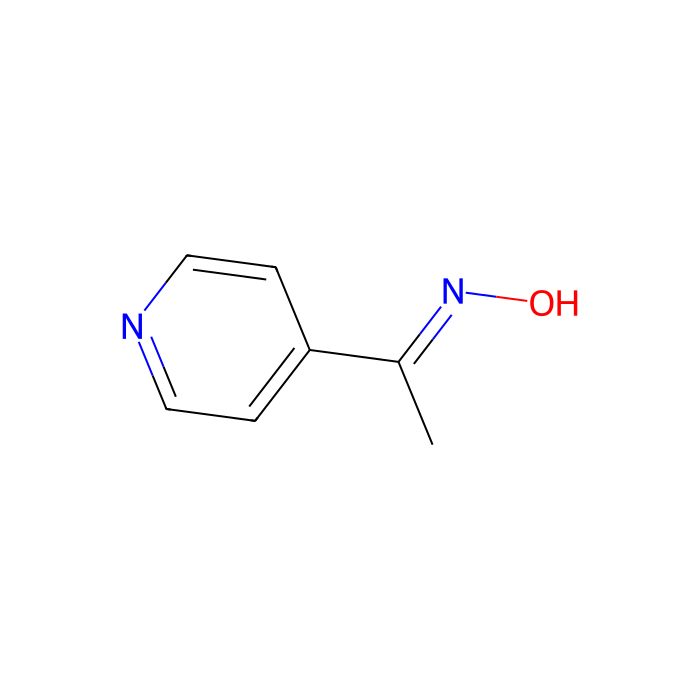
A pyridine-containing ketoxime derived from 4-acetylpyridine; features a para-pyridyl ring bearing a methyl–oxime functional group.
Item-specific identifiers (from Product Data)
Structural description (general/literature)
Nominal composition and mass (literature)
2D description in words: A planar pyridine ring with the ring nitrogen at the “top.” Directly opposite (para) is a carbon bearing a C=N–OH moiety to which a methyl group is attached; the C=N double bond can be E or Z relative to the ring.
Functional group leverage
Retrosynthetic value
Named transformations (literature)
Coordination chemistry
Analytical note: Track E/Z isomer ratios by 1H NMR (diagnostic methyl and –NOH resonances) and by 13C/15N NMR; confirm product identity post-transformation via HRMS and, where relevant, X-ray crystallography.
Not applicable. This product is a small-molecule research chemical (not an antibody, enzyme, or biological probe with defined biomolecular targets). No antigen/epitope or species reactivity data are provided or expected.