≥95%(T) for sensitive chromatographic and analytical workflows requiring minimal baseline interference.
🌡
Storage & shipping
Store at 2-8°C,Argon charged Ships Wet ice Check lot-specific COA for exact specifications.
📋
Quality documents
SDS, COA, datasheet, and spec sheet available for download. Lot-specific COA accessible via lot number lookup.
📚
Literature proof
Cited in 3 peer-reviewed publications across chromatography, organic synthesis, and cross-coupling reactions.
Descripción general
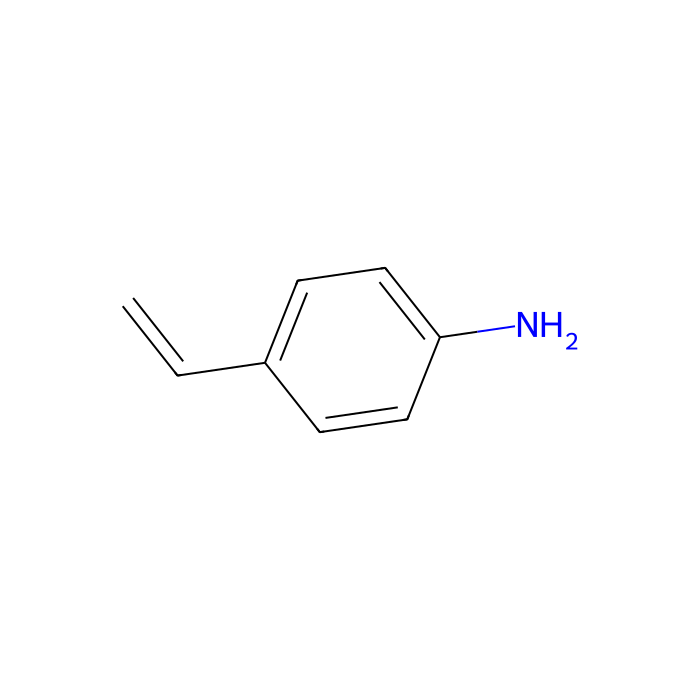
4-Vinylaniline (4-VAn) is a primary amine surfactant. 4-VAn undergoes graft copolymerization with poly(tetrafluoroethylene) (PTFE) and Si surface, followed by oxidative copolymerization with aniline. Thus, it renders PTFE and Si surface conductive.4-VAn is coupled with hydrogen terminated Si surfaces for electroless metal and synthetic metal deposition.Palladium(II) schiff base complexes derived from Allylamine and vinylaniline has been reported. It also acts as a second surfactant for coating nanomagnetic particles. It is used in functionalization of single-walled carbon nanotube through solvent free functionalization.
General description 4-Vinylaniline is a vinyl-substituted aromatic amine that is widely used as a crosslinking agent in the production of resins, adhesives, and coatings, enhancing their mechanical properties and chemical resistance. It can be polymerized by methods like radical polymerization, cationic polymerization, or oxidative polymerization to form poly(4-vinylaniline) or P4VA. 4- Vinylaniline can be selectively polymerized or chemically modified to respond to specific analytes or stimuli, allowing the development of conductive polymers for biosensors. Application 4-Vinylaniline can be used as: A monomer to prepare electrically conductive polyvinylaniline/polyaniline (PVAN/PANI) bilayer for surface modification of bacterial cellulose (BC) nanofibril network. This material can be utilized as an electrochemical biosensor for nerve regenerative medicine. To functionalize carbon nanodots for in vivo fluorometric biosensors, for the detection of mercury and cysteine. As a precursor to prepare conductive and biocompatible hydrogels forwound healing applications.
Specifications
Sinónimos
p-Aminostyrene | 4-vinylphenylamine | P4VA
Especificaciones y pureza
≥95%(T)
Condiciones de almacenamiento de almacenamiento
Store at 2-8°C, Argon charged
Enviado en
Wet ice
Este producto requiere envío en cadena de frío. Los servicios terrestres y otros servicios económicos no están disponibles.
This compound belongs to the class of organic compounds known as styrenes. These are organic compounds containing an ethenylbenzene moiety.
External Descriptors
Not available
1. Djoumbou Feunang Y, Eisner R, Knox C, Chepelev L, Hastings J, Owen G, Fahy E, Steinbeck C, Subramanian S, Bolton E, Greiner R, and Wishart DS. ClassyFire: Automated Chemical Classification With A Comprehensive, Computable Taxonomy. Journal of Cheminformatics, 2016, 8:61.
We use cookies to ensure the website functions properly and, where permitted, to improve your experience. You can manage your preferences at any time in Settings. Learn more in our Cookie Policy.
Shall we send you a message when we have discounts available?
Remind me later
Thank you! Please check your email inbox to confirm.
Products are supplied to verified businesses, institutions, and qualified professionals for research and development use only. Not for use in humans, animals, diagnosis, or therapy.

 I2526149