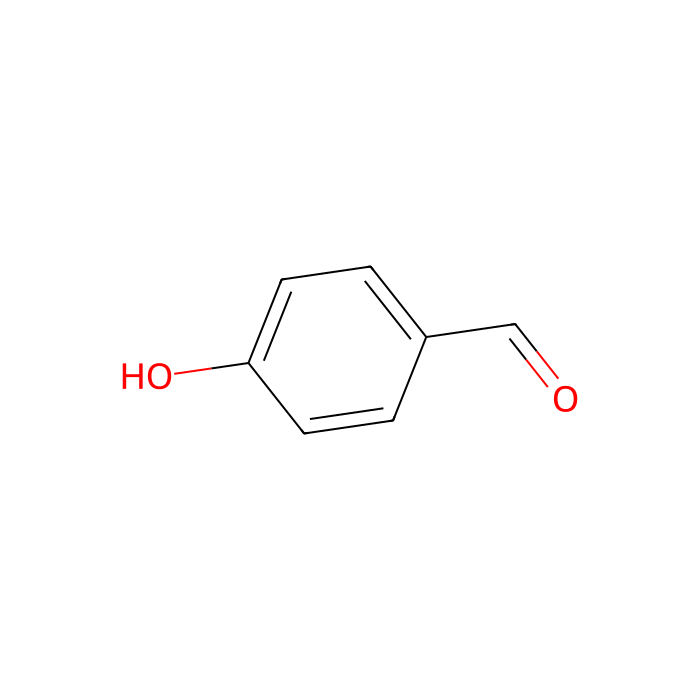
4-Hydroxybenzaldehyde - ≥95%(HPLC) , CAS No.123-08-0

CAS: 123-08-0 Cat. No.: H431620 Fórmula: C7H6O2 Peso molecular: 122.12 Beilstein Registry Number: 471352 Número EC: 204-599-1
Disponible para pedir
CALIDAD & PUREZA ≥95%(HPLC)
Synonyms
p-Hydroxybenzaldehyde, Pract.|P-HYDROXYBENZALDEHYDE [MI]|4-Formylphenol|4-formyl-phenol|Benzaldehyde, p-hydroxy-|4-Hydroxy-benzaldehyde-1,2,3,4,5,6-13C6|p-hydroxybenzaldehye|4-Hydroxybenzaldehyde-d5|4-HYDROXYBENZALDEHYDE [FHFI]|p-Formylphenol|4-hydroxibenzaldehyde|p-Oxybenzaldehyde|p-Hydroxybenzaldehyde|p-Hydroxy-benzaldehyde|4-formyl phenol|4-hydroxybezaldehyde|p-hydroxibezaldehyde|4-hydoxybenzaldehyde|USAF M-6|4-hydroxylbenzaldehyde|4-Hydroxybenzenecarbonal|BISOPROLOL FUMARATE IMPURITY S [EP IMPURITY]|HYDROXYBENZALDEHYDE [INCI]|4hydroxybenzaldehyde|4-hydroxybenzaldehyde|4--hydroxybenzaldehyde|4-HYDROXY-BENZALDEHYDE|Benzaldehyde, 4-hydroxy-|H-3800|p-hydroxy benzaldehyde|p-hydroxyl benzaldehyde|4-Hydroxy benzaldehyde|4-hydroxy- benzaldehyde|PARA-HYDROXY BENZALDEHYDE|4-hydroxyl benzaldehyde|Para-Hydroxybenzaldehyde|4-Hydroxybenzaldehyde; Bisoprolol Fumarate Imp. S (EP); Bisoprolol Imp. S (EP); Bisoprolol Fumarate Impurity S; Bisoprolol Impurity S|4-Hydroxybenzaldehye
Storage
Room temperature,Argon charged
Shipped In
Normal
★
Talla
USA
Alemania (EU)*
Precio
Cantidad
50g
H431620-50g
3 Disponible
—
9,90US$
250g
H431620-250g
3 Disponible
—
22,90US$
Enter a quantity for the sizes you want to add.

Descripción general

Application

4-Hydroxybenzaldehyde may be used as a reactant during the synthesis of 4-(4-hydroxyphenyl)-but-3-ene-2-one (a raspberry ketone precursor) and [(pyrrole-2,5-diyl)-co-(benzylidene)]. It may also be used to prepare nonlinear optical quinolinium single crystals (an OHQ–TMS compound) via a condensation reaction with 1,2-dimethylquinolinium 2,4,6-trimethylbenzenesulfonate in methanol.

Especificaciones

Sinónimos
p-Hydroxybenzaldehyde, Pract. | P-HYDROXYBENZALDEHYDE [MI] | 4-Formylphenol | 4-formyl-phenol | Benzaldehyde, p-hydroxy- | 4-Hydroxy-benzaldehyde-1,2,3,4,5,6-13C6 | p-hydroxybenzaldehye | 4-Hydroxybenzaldehyde-d5 | 4-HYDROXYBENZALDEHYDE [FHFI] | p-Formylphenol | 4-hydroxibenzaldehyde | p-Oxybenzaldehyde | p-Hydroxybenzaldehyde | p-Hydroxy Show more
Especificaciones y pureza
≥95%(HPLC)
Condiciones de almacenamiento de almacenamiento
Room temperature,Argon charged
Enviado en
Normal
Pureza
≥95%(HPLC)
Nombres e identificadores
Pubchem Sid
Pubchem Sid Url
https://pubchem.ncbi.nlm.nih.gov/substance/504750354
SMILES
C1=CC(=CC=C1C=O)O
IUPAC Name
4-hydroxybenzaldehyde
InChIKey
RGHHSNMVTDWUBI-UHFFFAOYSA-N
InChI
1S/C7H6O2/c8-5-6-1-3-7(9)4-2-6/h1-5,9H
Isómeros SMILES
C1=CC(=CC=C1C=O)O
WGK Alemania
2
RTECS
CU6475000
Número ONU
1988
Peso molecular
122.12
Beilstein
471352
Reaxys
471352
Reaxys-RN_link_address
https://www.reaxys.com/reaxys/secured/hopinto.do?context=S&query=IDE.XRN=471352&ln=

Datos avanzados

Taxonomic Classification

Taxonomy Tree

KingdomOrganic compounds
SuperclassOrganic oxygen compounds
ClaseOrganooxygen compounds
SubclassCarbonyl compounds
Intermediate Tree Nodes Aldehydes - Aryl-aldehydes - Benzaldehydes
Direct ParentHydroxybenzaldehydes
Alternative Parents Benzoyl derivatives  1-hydroxy-2-unsubstituted benzenoids  Organic oxides  Hydrocarbon derivatives  
Molecular FrameworkAromatic homomonocyclic compounds
Substituents Hydroxybenzaldehyde - Benzoyl - 1-hydroxy-2-unsubstituted benzenoid - Phenol - Benzenoid - Monocyclic benzene moiety - Organic oxide - Hydrocarbon derivative - Aromatic homomonocyclic compound
DescripciónThis compound belongs to the class of organic compounds known as hydroxybenzaldehydes. These are organic aromatic compounds containing a benzene ring carrying an aldehyde group and a hydroxyl group.
External Descriptors a small molecule
Estructura 3D
Modelo de Estructura Química Interactiva


Objetivos asociados (humanos)
TYR Tclin Tyrosinase (717 Activities)
Activity TypeRelationActivity valueUnitsAction TypeJournalPubMed IddoiAssay Aladdin ID
ACHE Tclin Acetylcholinesterase (18204 Activities)
Activity TypeRelationActivity valueUnitsAction TypeJournalPubMed IddoiAssay Aladdin ID
SLC6A1 Tclin GABA transporter 1 (308 Activities)
Activity TypeRelationActivity valueUnitsAction TypeJournalPubMed IddoiAssay Aladdin ID
ABAT Tclin Gamma-amino-N-butyrate transaminase (140 Activities)
Activity TypeRelationActivity valueUnitsAction TypeJournalPubMed IddoiAssay Aladdin ID
ALDH5A1 Tclin Succinate semialdehyde dehydrogenase (19 Activities)
Activity TypeRelationActivity valueUnitsAction TypeJournalPubMed IddoiAssay Aladdin ID
BCHE Tclin Butyrylcholinesterase (7174 Activities)
Activity TypeRelationActivity valueUnitsAction TypeJournalPubMed IddoiAssay Aladdin ID
MPO Tchem Myeloperoxidase (1002 Activities)
Activity TypeRelationActivity valueUnitsAction TypeJournalPubMed IddoiAssay Aladdin ID
AOX1 Tchem Aldehyde oxidase (429 Activities)
Activity TypeRelationActivity valueUnitsAction TypeJournalPubMed IddoiAssay Aladdin ID
HT-1080 (3966 Activities)
Activity TypeRelationActivity valueUnitsAction TypeJournalPubMed IddoiAssay Aladdin ID
HT-29 (80576 Activities)
Activity TypeRelationActivity valueUnitsAction TypeJournalPubMed IddoiAssay Aladdin ID
K562 (73714 Activities)
Activity TypeRelationActivity valueUnitsAction TypeJournalPubMed IddoiAssay Aladdin ID
MCF7 (126967 Activities)
Activity TypeRelationActivity valueUnitsAction TypeJournalPubMed IddoiAssay Aladdin ID
A549 (127892 Activities)
Activity TypeRelationActivity valueUnitsAction TypeJournalPubMed IddoiAssay Aladdin ID
T47D (39041 Activities)
Activity TypeRelationActivity valueUnitsAction TypeJournalPubMed IddoiAssay Aladdin ID
HCT-116 (91556 Activities)
Activity TypeRelationActivity valueUnitsAction TypeJournalPubMed IddoiAssay Aladdin ID
WiDr (1835 Activities)
Activity TypeRelationActivity valueUnitsAction TypeJournalPubMed IddoiAssay Aladdin ID
HepG2 (196354 Activities)
Activity TypeRelationActivity valueUnitsAction TypeJournalPubMed IddoiAssay Aladdin ID
HUVEC (11049 Activities)
Activity TypeRelationActivity valueUnitsAction TypeJournalPubMed IddoiAssay Aladdin ID
KB (17409 Activities)
Activity TypeRelationActivity valueUnitsAction TypeJournalPubMed IddoiAssay Aladdin ID
HeLa (62764 Activities)
Activity TypeRelationActivity valueUnitsAction TypeJournalPubMed IddoiAssay Aladdin ID
SIRT1 Tchem NAD-dependent deacetylase sirtuin 1 (3505 Activities)
Activity TypeRelationActivity valueUnitsAction TypeJournalPubMed IddoiAssay Aladdin ID
IDO1 Tchem Indoleamine 2,3-dioxygenase (6650 Activities)
Activity TypeRelationActivity valueUnitsAction TypeJournalPubMed IddoiAssay Aladdin ID
SW1573 (1008 Activities)
Activity TypeRelationActivity valueUnitsAction TypeJournalPubMed IddoiAssay Aladdin ID
Y79 (258 Activities)
Activity TypeRelationActivity valueUnitsAction TypeJournalPubMed IddoiAssay Aladdin ID
Objetivos asociados (no humanos)
Staphylococcus aureus (210822 Activities)
Activity TypeRelationActivity valueUnitsAction TypeJournalPubMed IddoiAssay Aladdin ID
Bacillus subtilis (32866 Activities)
Activity TypeRelationActivity valueUnitsAction TypeJournalPubMed IddoiAssay Aladdin ID
Mycobacterium tuberculosis (203094 Activities)
Activity TypeRelationActivity valueUnitsAction TypeJournalPubMed IddoiAssay Aladdin ID
Plasmodium falciparum (966862 Activities)
Activity TypeRelationActivity valueUnitsAction TypeJournalPubMed IddoiAssay Aladdin ID
Candida albicans (78123 Activities)
Activity TypeRelationActivity valueUnitsAction TypeJournalPubMed IddoiAssay Aladdin ID
Candida tropicalis (8381 Activities)
Activity TypeRelationActivity valueUnitsAction TypeJournalPubMed IddoiAssay Aladdin ID
Meloidogyne incognita (862 Activities)
Activity TypeRelationActivity valueUnitsAction TypeJournalPubMed IddoiAssay Aladdin ID
Mus musculus (284745 Activities)
Activity TypeRelationActivity valueUnitsAction TypeJournalPubMed IddoiAssay Aladdin ID
L1210 (27553 Activities)
Activity TypeRelationActivity valueUnitsAction TypeJournalPubMed IddoiAssay Aladdin ID
RAW264.7 (28094 Activities)
Activity TypeRelationActivity valueUnitsAction TypeJournalPubMed IddoiAssay Aladdin ID
HT-22 (3261 Activities)
Activity TypeRelationActivity valueUnitsAction TypeJournalPubMed IddoiAssay Aladdin ID
B16-F10 (4610 Activities)
Activity TypeRelationActivity valueUnitsAction TypeJournalPubMed IddoiAssay Aladdin ID
rep Replicase polyprotein 1ab (378 Activities)
Activity TypeRelationActivity valueUnitsAction TypeJournalPubMed IddoiAssay Aladdin ID
Perknaster fuscus (7 Activities)
Activity TypeRelationActivity valueUnitsAction TypeJournalPubMed IddoiAssay Aladdin ID
Cirsium arvense (30 Activities)
Activity TypeRelationActivity valueUnitsAction TypeJournalPubMed IddoiAssay Aladdin ID
Mecanismos de acción
Certificados (CoA, COO, BSE/TSE y tabla de análisis)
C of A & Other Certificates(BSE/TSE, COO):
Analytical Chart:

Find and download the COA for your product by matching the lot number on the packaging.

7 results found

Lot NumberCertificate TypeFechaArticulo
C2603644C2603644Certificate of AnalysisAug 14, 2023 H431620
E2615092E2615092Certificate of AnalysisAug 14, 2023 H431620
H2324511H2324511Certificate of AnalysisAug 14, 2023 H431620
H2324512H2324512Certificate of AnalysisAug 14, 2023 H431620
H2324513H2324513Certificate of AnalysisAug 14, 2023 H431620
H2324514H2324514Certificate of AnalysisAug 14, 2023 H431620
H2325021H2325021Certificate of AnalysisAug 14, 2023 H431620
Propiedades químicas y físicas
Punto de inflamación (°F)345°F
Punto de inflamación (°C)174℃
Punto de fusión (°C)117 °C
Peso molecular122.12
XLogP31.400
Hydrogen Bond Donor Count1
Hydrogen Bond Acceptor Count2
Rotatable Bond Count1
Exact Mass122.037 Da
Monoisotopic Mass122.037 Da
Topological Polar Surface Area37.300 Ų
Heavy Atom Count9
Formal Charge0
Complexity93.100
Isotope Atom Count0
Defined Atom Stereocenter Count0
Undefined Atom Stereocenter Count0
Defined Bond Stereocenter Count0
Undefined Bond Stereocenter Count0
The total count of all stereochemical bonds0
Covalently-Bonded Unit Count1
Seguridad y peligros (GHS)
Pictogramas
Señal
Warning
Indicaciones de peligro

H315:Causes skin irritation

H319:Causes serious eye irritation

H335:May cause respiratory irritation

Precauciones

P261:Avoid breathing dust/fume/gas/mist/vapors/spray.

P305+P351+P338:IF IN EYES: Rinse cautiously with water for several minutes. Remove contact lenses if present and easy to do - continue rinsing.

WGK Alemania
2
RTECS
CU6475000
Reaxys
471352
Reaxys-RN_link_address
https://www.reaxys.com/reaxys/secured/hopinto.do?context=S&query=IDE.XRN=471352&ln=
Índice Merck
4811
Preguntas frecuentes y artículos
Citations of This Product
Calculadoras de soluciones
Reseñas

Reseñas de cliente

Application Protocols

No antibody/assay kit-style protocols apply to this small molecule. Typical uses are synthetic and analytical.

  • For synthetic transformations, see Reaction Conditions and Synthetic Utility tabs for literature-guided procedures.
  • For analytical use (general):
    • GC/HPLC purity checks using reversed-phase C18 with water–acetonitrile (0.1% acid to sharpen peaks) or GC with appropriate temperature program after silylation if needed.
    • NMR: dissolve in CDCl3, DMSO-d6, or CD3OD; characteristic aldehyde proton ~9.7–10.0 ppm; phenolic OH often broad and solvent-dependent (may exchange).
Biological Roles

General, literature-based context (no clinical claims):

  • Phenolic aromatic aldehydes like 4-hydroxybenzaldehyde occur as metabolites or transformation products in plant phenylpropanoid pathways and during lignin depolymerization/oxidation.
  • The phenolic functionality confers antioxidant and radical-scavenging tendencies in model systems (phenoxyl formation), while the aldehyde group participates in Schiff base formation with biomolecules (reversible imines with amines) in vitro.
  • In microbial and plant metabolism (literature), p-hydroxybenzaldehyde can be an intermediate en route to p-hydroxybenzoic acid and p-hydroxybenzyl alcohol, linking to ubiquinone (coenzyme Q) biosynthetic precursors in certain organisms.
  • In biochemical assays, it is sometimes used as a model phenolic aldehyde to study enzyme-catalyzed oxidations/reductions (e.g., aldehyde dehydrogenases, oxidases) and non-enzymatic reactions (e.g., protein carbonylation models).

Note: These are general literature observations. This product is designated for research use only; suitability for biological systems should be empirically determined and guided by SDS and institutional policies.

Buffer Applications

This compound is not a buffering agent and is not typically used to prepare pH buffer systems. Its phenolic pKa (~7.8–8.1, literature) can influence solution pH upon deprotonation, but it is not employed as a controlled buffer component.

For experiments involving this molecule in aqueous media, select a compatible external buffer (e.g., phosphate, HEPES, Tris) that does not react with aldehydes (avoid primary amine buffers for imine-sensitive experiments). Adjust solvent cosolvent content (e.g., ethanol, DMSO) to ensure solubility while maintaining buffer capacity.

Green Alternatives

Consider both greener sourcing of 4-hydroxybenzaldehyde and greener media for its reactions.

  • Greener sourcing (literature): Lignin valorization and biobased routes from p-hydroxycinnamic derivatives can provide renewable feedstocks versus petrochemical benzaldehyde routes. Availability is market/region dependent.
  • Greener solvent choices (literature-based guidance):
    • For condensations and imine formations: ethanol or water–ethanol mixtures can replace acetonitrile or toluene; microwave or solvent-free grinding methods are reported for some Knoevenagel/chalcone reactions.
    • For olefinations (Wittig/HWE): 2-MeTHF or CPME can reduce flammability/peroxide risk relative to THF/diethyl ether while maintaining reactivity.
    • For O-alkylation: acetone or propylene carbonate (where feasible) can substitute for DMF/DMSO; phase-transfer in PEG-400/water is also reported.

Small comparison (literature):

  • THF vs 2-MeTHF: similar performance in Wittig; 2-MeTHF offers higher boiling point, better water tolerance, often from renewable sources.
  • Acetonitrile vs ethanol: ethanol is greener and often adequate for imines/Knoevenagel; acetonitrile provides higher polarity for poorly soluble substrates.

Trade-offs: Greener solvents may change solubility or rates; ensure adequate mixing and, if needed, mild heating or catalysts to maintain yields.

Pharmaceutical Uses

No item-specific pharmacopeial status or excipient grade is provided for this product. Not specified for this item; refer to CoA/Spec Sheet.

General context (non-clinical, literature):

  • 4-Hydroxybenzaldehyde is a small-molecule building block and analytical standard rather than a common pharmaceutical excipient. It may be used in process R&D as a starting material or impurity reference for related aromatic systems (e.g., p-hydroxybenzoates, parabens, and vanilloid-related structures).
  • In formulation labs, aldehydes can react with primary amine excipients or APIs to form imines; thus, contact with amine-containing matrices is typically avoided unless intentionally exploited (e.g., reversible conjugation studies). Any such use requires careful compatibility studies and is strictly for research/manufacturing development contexts, not therapeutic claims.
Physical Properties

Only literature/general values are provided below for context; they are not item-specific specifications.

  • Phase/appearance (literature): white to off-white crystalline solid
  • Melting point (literature): ~112–116 °C
  • Boiling point (literature): ~246–249 °C at 1 atm (may undergo partial decomposition); ~196–198 °C at ~18–20 mmHg
  • Density (literature): ~1.27 g/cm³ (solid; calculated/compiled values)
  • Solubility (literature):
    • Water: low/sparingly soluble (phenolic hydrogen bonding increases slightly vs benzaldehyde)
    • Organic solvents: readily soluble in ethanol, methanol, acetone, ethyl acetate, dichloromethane; moderately soluble in toluene; highly soluble in DMSO and DMF
  • Acid–base properties (literature): phenolic pKa ~7.8–8.1 (aqueous, 25 °C), enabling deprotonation under mild base
  • LogP (literature): ~1.5–1.7 (neutral form)
  • UV–Vis (literature): π→π* absorption in near-UV; phenolate formation induces bathochromic shift

Item-specific specifications (BP/MP/density/solvent content/UV cutoff/metals, etc.): Not specified for this item; refer to CoA/Spec Sheet.

Quality and Grades
  • Item-specific grade/purity: Not specified for this item; refer to CoA/Spec Sheet for purity, assay method, and impurity profile.
  • Typical grades encountered for this chemical (general information):
    • Analytical Reagent (AR): Suitable for routine analytical and synthetic work; controlled impurity levels.
    • Synthesis/Technical: Adequate for bulk transformations where trace impurities are less critical.
    • High-Purity or GC/HPLC grade: Lower UV background and volatile/non-volatile impurity limits, beneficial for photochemical studies or trace analysis.
  • Stabilization: This substance is generally shipped neat without stabilizers. Some users blanket with inert gas and store tightly sealed to mitigate slow oxidation to p-hydroxybenzoic acid. If a stabilizer or inhibitor is present for a specific lot, it will be disclosed on the CoA/Spec Sheet (not specified here).
  • What to check on receipt (practical guidance):
    • Appearance and melting point range to assess gross purity.
    • GC/HPLC chromatogram for aldehyde vs. acid/alcohol byproducts.
    • Residual solvents, moisture (Karl Fischer), and aldehyde content where reaction stoichiometry is critical.
  • Regulatory/trace specs (metals, halides, etc.): Not specified for this item; refer to CoA/Spec Sheet.
Reaction and Applications

As a para-hydroxy-substituted aromatic aldehyde, 4-hydroxybenzaldehyde is a versatile electrophile and phenolic handle for synthesis.

  • Condensation chemistry (literature):
    • Schiff bases/aldimines with primary amines; reversible, typically driven by water removal or mild heating; useful for ligand synthesis and dynamic covalent assemblies.
    • Knoevenagel condensations with active methylene compounds (e.g., malononitrile, ethyl cyanoacetate) using piperidine, ammonium acetate, or amine bases — furnishing cinnamate-like or push–pull olefins.
    • Claisen–Schmidt aldol with acetophenones under base, yielding chalcones; phenol can be left free or protected depending on subsequent steps.
  • Carbon–carbon bond formation (literature):
    • Wittig and Horner–Wadsworth–Emmons olefinations to access p-hydroxystyrenes and cinnamates; E/Z control via reagent choice and conditions.
    • Reformatsky-type additions to the aldehyde; nucleophilic additions (RMgX, RLi) to give benzylic alcohols — ensure phenol protection or strong base control.
  • Functional group interconversions (literature):
    • Reduction of the aldehyde to p-hydroxybenzyl alcohol (NaBH4, catalytic hydrogenation); to hydrocarbons via Wolff–Kishner/Clemmensen (if compatible).
    • Oxidation to p-hydroxybenzoic acid (e.g., KMnO4, TEMPO/bleach); selective oxidation possible under mild conditions.
    • Phenol derivatization: O-alkylation or O-acylation to ethers/esters; silyl protection (TBS, TBDPS) recommended for strong-base chemistry.
  • Materials and ligand uses (literature): Precursor to azo dyes (via diazotization of anilines on derived imines), Schiff-base ligands for coordination chemistry, and monomers/crosslinkers in phenolic resins.
Reaction Conditions

General, literature-guided conditions (not item-specific specifications; optimize per substrate and scale):

  • Schiff base formation: 4-hydroxybenzaldehyde (1.0 eq) + primary amine (1.0–1.2 eq) in ethanol or toluene; catalytic acetic acid or 3Å molecular sieves; 25–80 °C, 0.5–12 h. Typical isolated yields 70–95% depending on amine volatility and water removal.
  • Knoevenagel condensation: With malononitrile or ethyl cyanoacetate in ethanol, 2-MeTHF, or acetonitrile; base such as piperidine, ammonium acetate, or DBU (1–20 mol%); 25–60 °C, 0.5–4 h; often 80–98% yields.
  • Claisen–Schmidt (chalcone): Acetophenone (1.0–1.5 eq), NaOH or KOH (10–30 mol%) in ethanol or aqueous ethanolic media; 0–25 °C to control side reactions, then warm to 40–60 °C; 2–24 h; 60–90% yields.
  • Wittig/HWE olefination: Phosphonium ylide or phosphonate (1.2–1.5 eq) in THF/2-MeTHF or toluene; base NaHMDS/KOtBu (for ylide generation) or NaH (for HWE); −78 to 25 °C; 1–6 h; E/Z ratio dependent on reagent and temperature.
  • O-alkylation: Alkyl halide (1.1–1.5 eq), K2CO3/Cs2CO3 in acetone or acetonitrile; 25–60 °C; 2–16 h; typically 70–95% yields. For hindered halides, phase-transfer (TBAB) in toluene/water can help.
  • Reductions: NaBH4 in MeOH/EtOH at 0–25 °C for benzylic alcohol; catalytic hydrogenation (H2, Pd/C, 1–10 wt%) may also reduce C=C if present.

Notes: Maintain inert atmosphere (argon, as per storage guidance) for moisture/air-sensitive steps. Phenol protection or careful base choice minimizes over-alkylation and side reactions.

Safety and Handling

Item-specific GHS classification, H-statements, pictograms: Not specified for this item; refer to SDS.

General safety considerations for phenolic aromatic aldehydes (literature/good practice):

  • Hazards: Irritating to skin, eyes, and respiratory tract; aldehydes can be sensitizers. Phenolic OH can enhance dermal absorption. Avoid inhalation of dust.
  • PPE: Use nitrile gloves, lab coat, and splash goggles. Handle solids in a fume hood to control dust and vapors from solutions.
  • Storage: As directed for this item — store at room temperature under an argon blanket (Product Data). Keep container tightly closed, dry, and protected from light/air to limit slow air-oxidation to the corresponding acid (p-hydroxybenzoic acid).
  • Incompatibilities: Strong oxidizers (accelerate oxidation), strong bases (form phenolate; may increase reactivity in condensations), strong reducing agents (may reduce the aldehyde to p-hydroxybenzyl alcohol). Avoid prolonged contact with alkalis or acids in the presence of air/heat.
  • Handling tips: Minimize headspace oxygen; if preparing solutions, use anhydrous solvents when base- or nucleophile-sensitive reactions are planned. For weighing, break up agglomerates gently to reduce dusting.
  • First aid (overview; consult SDS):
    • Skin/eye contact: Rinse with plenty of water for ≥15 minutes; remove contaminated clothing; seek medical advice if irritation persists.
    • Inhalation: Move to fresh air; seek medical attention if symptoms occur.
    • Ingestion: Rinse mouth; do not induce vomiting; obtain medical advice.
Solvent Selection

This solid dissolves well in many polar organic solvents; solvent choice is typically dictated by the transformation at the aldehyde or phenol.

  • Polarity and interactions (general): Aromatic aldehyde with a phenolic OH; engages in hydrogen bonding (as donor and acceptor). Solubility is good in polar protic and aprotic solvents; limited in water.
  • Common solvents (literature-based guidance):
    • Protic: ethanol, methanol, isopropanol — favored for condensations (e.g., Knoevenagel) and imine formations; water content can be beneficial or detrimental depending on equilibrium.
    • Aprotic: acetonitrile, ethyl acetate, acetone, 2-MeTHF, CPME — good balance of solubility and workup; greener choices often preferred.
    • High-boiling: DMF, DMSO — useful for SNAr or O-alkylation after phenol deprotonation; consider greener alternatives when feasible.
  • Selection tips:
    • For base-catalyzed condensations: ethanol or 2-MeTHF with catalytic piperidine or secondary amine; remove water (Dean–Stark) if needed.
    • For Wittig/HWE reactions: THF, 2-MeTHF, or toluene under dry inert conditions.
    • For O-alkylation: polar aprotics (acetone, acetonitrile) with K2CO3 or Cs2CO3.
  • Quick comparison (literature):
    • Ethanol (green, miscible with water) vs acetonitrile (higher dipole, easy removal). 2-MeTHF/CPME offer hydrophobic, water-tolerant media with improved safety profiles compared to THF.
Storage and Reconstitution

Item-specific conditions (Product Data):

  • Storage Conditions: Room temperature, Argon charged. Keep tightly closed, dry, and protected from air/light to minimize slow oxidation to p-hydroxybenzoic acid.
  • Shipped In: Normal.

General guidance (good practice; not a specification):

  • Solid stability: Aldehydes can oxidize over time; an inert headspace (argon) and desiccation are beneficial. Avoid prolonged exposure to elevated temperatures.
  • Solution handling: Prepare solutions freshly when possible. For short-term stock solutions, store under inert gas at 2–8 °C, protected from light; monitor for formation of acid/alcohol by HPLC or NMR if reusing.
  • Solvent choices for reconstitution: Ethanol, methanol, acetonitrile, acetone, ethyl acetate, DMSO, or DMF provide rapid dissolution; aqueous solubility is limited, so use cosolvents for aqueous applications.
  • Container compatibility: Glass recommended; aldehydes may react slowly with amine-functional container linings. Use PTFE-lined caps where possible.
  • Freeze–thaw: As a solid, not applicable. For solutions, minimize freeze–thaw cycles to reduce concentration drift and byproduct formation.

Research Use Note: For research use only.

Structure and Identity

Brief overview: 4-Hydroxybenzaldehyde (para-hydroxybenzaldehyde) is an aromatic aldehyde bearing a phenolic OH para to the formyl group, offering dual reactivity (phenol and aldehyde) on a single benzene ring.

  • Item-specific identifiers (Product Data)
    • SKU: H431620
    • Product Name: 4-Hydroxybenzaldehyde
    • CAS: 123-08-0
    • PubChem CID: 126
    • InChIKey: 315625 (as provided)
    • Storage note (see Storage tab): Room temperature, Argon charged
  • Literature/computed identifiers (for reference; not item specifications)
    • Common molecular formula (literature): C7H6O2
    • Typical molecular weight (literature): 122.12 g/mol
    • Common SMILES (literature): O=Cc1ccc(O)cc1
    • Common InChIKey (literature): FAVNISQARKNNHN-UHFFFAOYSA-N
  • Structural features (general description)
    • Aromatic ring with two para-substituted functions: an aldehyde (–CHO, meta-directing, strongly electron-withdrawing) and a phenol (–OH, ortho/para-directing, hydrogen-bond donor/acceptor).
    • The 2D structure can be described as a benzene ring bearing an OH group at the 1-position and a CHO at the 4-position (para relationship), creating a conjugated p-hydroxybenzylidene motif.
    • Functional groups: phenol, aldehyde; both enable condensation, oxidation/reduction, and ether/ester derivatization chemistry.
Synthetic Utility

Strategic roles (literature):

  • Electrophilic aldehyde center:
    • Entry to alkenes via Wittig/Horner–Wadsworth–Emmons to give p-hydroxystyrenes and cinnamates (handles for further cross-coupling, hydrogenation, or Michael chemistry).
    • Nucleophilic additions (Grignard/organolithium) to furnish p-hydroxybenzylic alcohols; subsequent oxidation/elimination can diversify scaffolds.
    • Aldol/Claisen–Schmidt to chalcones — versatile intermediates to flavonoids and aurones.
  • Phenolic OH handle:
    • O-alkylation/acylation to tune electronics/solubility of the ring; ether/ester formation controls directing effects for later substitutions.
    • Protection (TBS, MOM, benzyl) enables strongly basic or metalation conditions targeting the aldehyde, or facilitates selective transformations on the aldehyde without competitive O-alkylation.
  • Oxidation/reduction manifold:
    • Selective oxidation to p-hydroxybenzoic acid (gateway to parabens via esterification).
    • Reduction to p-hydroxybenzyl alcohol, then to p-hydroxy toluene derivatives via dehydration/hydrogenation pathways.
  • Retrosynthetic value: The para orientation simplifies planning for symmetrical derivatives and eliminates regiochemical ambiguity common to ortho/para-directing systems.

Practical tip: Phenolate formation accelerates some condensations but can also promote side O-alkylation; choose base and solvent to balance aldehyde vs oxygen reactivity.

Target Specificity

Not applicable to this small-molecule reagent. No antigen/epitope or biological target specifications are associated with this catalog item.

  • Item-specific data: None provided; this product is a chemical building block for research use only.

¿Quieres que te enviemos un mensaje cuando tengamos descuentos disponibles?

Recordármelo más tarde

¡Gracias! Por favor, revisa tu bandeja de entrada de correo electrónico para confirmar.

¡Vaya! Las notificaciones están desactivadas.