Determine the necessary mass, volume, or concentration for preparing a solution.
≥97% for sensitive chromatographic and analytical workflows requiring minimal baseline interference.
Protected from light,Store at -20°C,Desiccated Ships Ice chest + Ice pads Check lot-specific COA for exact specifications.
SDS, COA, datasheet, and spec sheet available for download. Lot-specific COA accessible via lot number lookup.
Cited in 3 peer-reviewed publications across chromatography, organic synthesis, and cross-coupling reactions.
Fluorescent Dye Carboxylic Acids and Their Succinimidyl Esters
Succinimidyl esters are proven to be the best reagents for amine modifications because the amide bonds that are formed are essentially identical to, and as stable as the natural peptide bonds. These reagents are generally stable and show good reactivity and selectivity with aliphatic amines. There are few factors that need be considered when SE compounds are used for conjugation reaction:
1). Solvents:For the most part, reactive dyes are hydrophobic molecules and should be dissolved in anhydrous dimethylformamide (DMF) or dimethylsulfoxide (DMSO).
2). Reaction pH:The labeling reactions of amines with succinimidyl esters are strongly pH dependent. Amine-reactive reagents react with non-protonated aliphatic amine groups, including the terminal amines of proteins and the e-amino groups of lysines. Thus amine acylation reactions are usually carried out above pH 7.5. Protein modifications by succinimidyl esters can typically be done at pH 7.5-8.5, whereas isothiocyanates may require a pH 9.0-10.0 for optimal conjugations.
3).Reaction Buffers:Buffers that contain free amines such as Tris and glycine and thiol compounds must be avoided when using an amine-reactive reagent. Ammonium salts (such as ammonium sulfate and ammonium acetate) that are widely used for protein precipitation must also be removed (such as viadinlysis) before performing dye conjugations.
4). Reaction Temperature:Most conjugations are done at room temperature. However, either elevated or reduced temperature may be required for a particular labeling reaction.
Features and Biological Applications
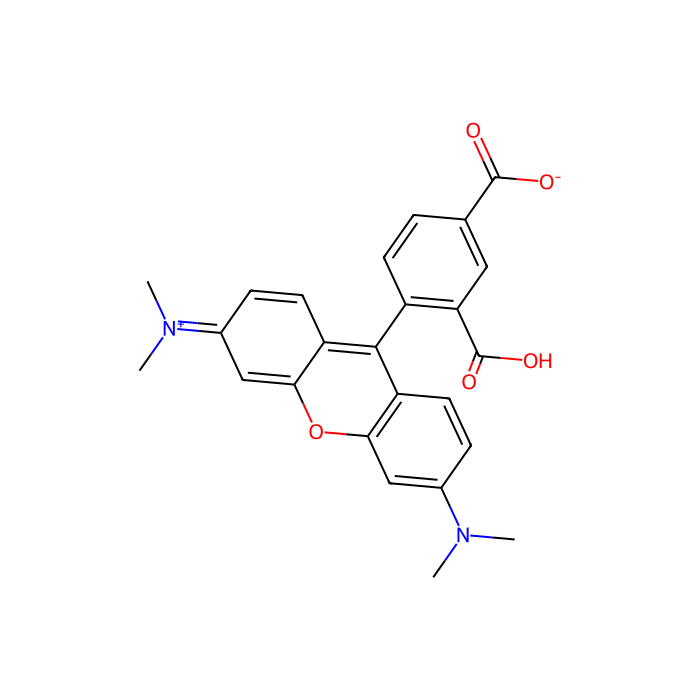
5-TAMRA is the purified single isomer of 5(6)-TAMRA. It is widely used to label peptides and proteins. It is preferred for some complicated biological applications where reproducibility is more critical than material cost since the minor positional difference between 5-TAMRA and 6-TAMRA might affect some biological properties of the underlying conjugates.
Product parameter
Ex(nm):541
Em(nm):568
References
1. Evans NA, et al. (2001). Visualizing differences in ligand-induced beta-arrestin-GFP interactions and trafficking between three recently characterized G protein-coupled receptors. J Neurochem77, 476-85.
2. Hahn, M., et al., Influence of fluorophor dye labels on the migration behavior of polymerase chain reaction—amplified short tandem repeats during denaturing capillary electrophoresis.Electrophoresis2001, 22, 2691-700.
3. Yoo H and Juliano RL (2000). Enhanced delivery of antisense oligonucleotides with fluorophore- conjugated PAMAM dendrimers. Nucleic Acids Res28, 4225-31.
| Pubchem Sid | 504761672 |
|---|---|
| Pubchem Sid Url | https://pubchem.ncbi.nlm.nih.gov/substance/504761672 |
| Sonrisas canónicas | CN(C)C1=CC2=C(C=C1)C(=C3C=CC(=[N+](C)C)C=C3O2)C4=C(C=C(C=C4)C(=O)[O-])C(=O)O |
| IUPAC Name | 3-carboxy-4-[3-(dimethylamino)-6-dimethylazaniumylidenexanthen-9-yl]benzoate |
| InChIKey | YMZMTOFQCVHHFB-UHFFFAOYSA-N |
| INCHI | 1S/C25H22N2O5/c1-26(2)15-6-9-18-21(12-15)32-22-13-16(27(3)4)7-10-19(22)23(18)17-8-5-14(24(28)29)11-20(17)25(30)31/h5-13H,1-4H3,(H-,28,29,30,31) |
| Isómeros SMILES | CN(C)C1=CC2=C(C=C1)C(=C3C=CC(=[N+](C)C)C=C3O2)C4=C(C=C(C=C4)C(=O)[O-])C(=O)O |
| WGK Alemania | 3 |
| Peso molecular | 430.45 |
| Reaxy-Rn | 27597948 |
| Reaxys-RN_link_address | https://www.reaxys.com/reaxys/secured/hopinto.do?context=S&query=IDE.XRN=27597948&ln= |
Comprehensive hazard, handling, storage, and regulatory compliance document.
Download SDS →Lot-specific quality data. Enter your lot number to retrieve the exact COA.
Look up COA →Full quality attributes and acceptance criteria for this grade.
View spec sheet →Taxonomy Tree
| Kingdom | Organic compounds |
|---|---|
| Superclass | Organoheterocyclic compounds |
| Clase | Benzopyrans |
| Subclass | 1-benzopyrans |
| Intermediate Tree Nodes | Dibenzopyrans |
| Direct Parent | Xanthenes |
| Alternative Parents | M-phthalic acid and derivatives Benzoic acids Benzoyl derivatives Dialkylarylamines Dicarboxylic acids and derivatives Secondary ketimines Heteroaromatic compounds Amino acids Carboxylic acid salts Oxacyclic compounds Carboxylic acids Hydrocarbon derivatives Organic oxides Organic salts Organic zwitterions Organooxygen compounds Organopnictogen compounds |
| Molecular Framework | Aromatic heteropolycyclic compounds |
| Substituents | Xanthene - Meta_phthalic_acid - Benzoic acid or derivatives - Benzoic acid - Benzoyl - Dialkylarylamine - Tertiary aliphatic/aromatic amine - Monocyclic benzene moiety - Dicarboxylic acid or derivatives - Benzenoid - Heteroaromatic compound - Secondary ketimine - Amino acid or derivatives - Amino acid - Carboxylic acid salt - Tertiary amine - Carboxylic acid derivative - Oxacycle - Carboxylic acid - Organic salt - Organic nitrogen compound - Amine - Hydrocarbon derivative - Organic oxide - Organopnictogen compound - Organic oxygen compound - Organic zwitterion - Organonitrogen compound - Organooxygen compound - Aromatic heteropolycyclic compound |
| Descripción | This compound belongs to the class of organic compounds known as xanthenes. These are polycyclic aromatic compounds containing a xanthene moiety, which consists of two benzene rings joined to each other by a pyran ring. |
| External Descriptors | xanthenes |
Find and download the COA for your product by matching the lot number on the packaging.
| Lot Number | Certificate Type | Fecha | Articulo |
|---|---|---|---|
| Certificate of Analysis | Jun 11, 2026 | C272928 | |
| Certificate of Analysis | May 18, 2026 | C272928 | |
| Certificate of Analysis | Apr 02, 2026 | C272928 | |
| Certificate of Analysis | Mar 18, 2026 | C272928 | |
| Certificate of Analysis | Feb 04, 2026 | C272928 | |
| Certificate of Analysis | Jan 20, 2026 | C272928 | |
| Certificate of Analysis | Dec 12, 2025 | C272928 | |
| Certificate of Analysis | Dec 12, 2025 | C272928 | |
| Certificate of Analysis | May 11, 2023 | C272928 | |
| Certificate of Analysis | May 11, 2023 | C272928 |
| Sensibilidad | Light and moisture sensitive |
|---|---|
| Punto de inflamación (°F) | 92.5 °C |
| Punto de inflamación (°C) | 92.5°C |
| Peso molecular | 430.500 g/mol |
| XLogP3 | 3.200 |
| Hydrogen Bond Donor Count | 1 |
| Hydrogen Bond Acceptor Count | 6 |
| Rotatable Bond Count | 3 |
| Exact Mass | 430.153 Da |
| Monoisotopic Mass | 430.153 Da |
| Topological Polar Surface Area | 92.900 Ų |
| Heavy Atom Count | 32 |
| Formal Charge | 0 |
| Complexity | 875.000 |
| Isotope Atom Count | 0 |
| Defined Atom Stereocenter Count | 0 |
| Undefined Atom Stereocenter Count | 0 |
| Defined Bond Stereocenter Count | 0 |
| Undefined Bond Stereocenter Count | 0 |
| The total count of all stereochemical bonds | 0 |
| Covalently-Bonded Unit Count | 1 |
| 1. Yijun Luo, Yuxia Luo, Yuxi Liu, Yin Huang, Ping Yu, Hao Ma, Xinping Li, Zhao Zhang, Cuiling Zhang, Chaohao Chen, Philip A. Gale, Guochen Bao. (2024) A Hybrid Strategy to Enhance Small-Sized Upconversion Nanocrystals. BIOSENSORS & BIOELECTRONICS, [PMID:39657555] [10.1016/j.bios.2024.117003] |
| 2. Yajing Yang, Fenglin Li, Dayin Sun, Yilan Ye, Zhenzhong Yang. (2024) Large-Scale Synthesis of Reactive Janus Inorganic/Polymer Colloidal Dimer. MACROMOLECULES, [PMID:] [10.1021/acs.macromol.3c02334] |
| 3. Li Shuo, Xu Bing, Lu Ming-jun, Wu Qian-wen, Qin Wen-qing, Dai Zi-qi, Li Xiao-jiao-yang, Bai Jin-zhao, Lei Hai-min, Liu Run-ping. (2026) A sinomenine derivative protects life-threatening inflammatory injuries via covalently binding to a novel allosteric inhibition site of IRF3. ACTA PHARMACOLOGICA SINICA, [PMID:41545756] [10.1038/s41401-025-01723-3] |