Determine the necessary mass, volume, or concentration for preparing a solution.
≥99% for sensitive chromatographic and analytical workflows requiring minimal baseline interference.
Protected from light,Desiccated,Store at -80°C Ships Dry ice packs + Cold packs Check lot-specific COA for exact specifications.
SDS, COA, datasheet, and spec sheet available for download. Lot-specific COA accessible via lot number lookup.
Cited in 3 peer-reviewed publications across chromatography, organic synthesis, and cross-coupling reactions.
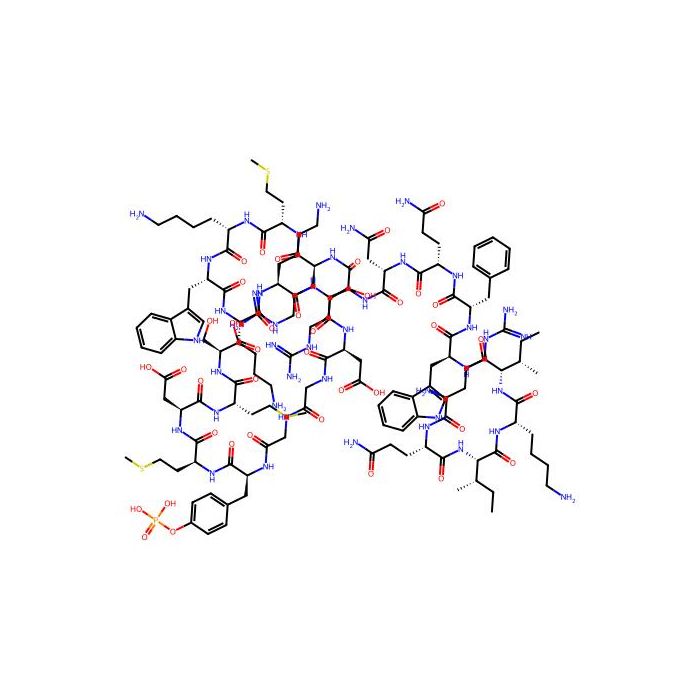
740 Y-P (740YPDGFR; PDGFR 740Y-P) is a potent and cell-permeable PI3K activator. 740 Y-P readily binds GST fusion proteins containing both the N- and C- terminal SH2 domains of p85 but fails to bind GST alone
In Vitro
740 Y-P (50 μg/mL; 48 hours) specificly stimulates mitogenesis in medium is better than EGF or FGF at stimulating entry into S-phase, it shows the percentage of cells in S-phase for 48.3% in C2 cells. Additionally, LY294002 or Wortmannin potently inhibits the mitogenic response stimulated by the peptide. 740 Y-P (1 μg/mL) stimulates mitogenesis at the lowest concentration tested. The peptide stimulates mitogenesis in both the presence and absence of serum (0.5%), and in the former instance a maximal response observed at 50 μg/mL. 740Y-P to stimulate mitogenesis is highly specific and not a general feature of a cell permeable SH2 domain binding peptides. 740 Y-P (30 μM; 24 hours) remarkably inhibits the level of LC3-II/LC3-I in GO-induced PC12 cells. MCE has not independently confirmed the accuracy of these methods. They are for reference only. Western Blot AnalysisCell Line: PC12 cells Concentration: 30 μM Incubation Time: 24 hours Result: Inhibited the protein expression of LC3-II.
In Vivo
740 Y-P is not only internalised in living cells but can also interact with p85 in vivo . 740 Y-P (intraperitoneal injection; 10 mg/kg; 6 weeks) decreases the degree of ROS levels in Aβ(25-32) treated hippocampal tissues and increases the extent of AKT and PI3K phosphorylation in alzheimer’s disease (AD) rat model. MCE has not independently confirmed the accuracy of these methods. They are for reference only.
Form:Solid
IC50& Target:PI3K
| Sonrisas canónicas | CCC(C)C(C(=O)NC(CCCCN)C(=O)NC(C(C)CC)C(=O)NC(CC1=CNC2=CC=CC=C21)C(=O)NC(CC3=CC=CC=C3)C(=O)NC(CCC(=O)N)C(=O)NC(CC(=O)N)C(=O)NC(CCCNC(=N)N)C(=O)NC(CCCNC(=N)N)C(=O)NC(CCSC)C(=O)NC(CCCCN)C(=O)NC(CC4=CNC5=CC=CC=C54)C(=O)NC(CCCCN)C(=O)NC(CCCCN)C(=O)NC(CO)C(=O)NC(CC(=O)O)C(=O)NCC(=O)NCC(=O)NC(CC6=CC=C(C=C6)OP(=O)(O)O)C(=O)NC(CCSC)C(=O)NC(CC(=O)O)C(=O)NC(CCSC)C(=O)NC(CO)C(=O)O)NC(=O)C(CCC(=O)N)NC(=O)C(CCCNC(=N)N)N |
|---|---|
| IUPAC Name | (3S)-3-[[(2S)-2-[[(2S)-2-[[2-[[2-[[(2S)-2-[[(2S)-2-[[(2S)-6-amino-2-[[(2S)-6-amino-2-[[(2S)-2-[[(2S)-6-amino-2-[[(2S)-2-[[(2S)-2-[[(2S)-2-[[(2S)-4-amino-2-[[(2S)-5-amino-2-[[(2S)-2-[[(2S)-2-[[(2S,3S)-2-[[(2S)-6-amino-2-[[(2S,3S)-2-[[(2S)-5-amino-2-[[(2S)-2-amino-5-carbamimidamidopentanoyl]amino]-5-oxopentanoyl]amino]-3-methylpentanoyl]amino]hexanoyl]amino]-3-methylpentanoyl]amino]-3-(1H-indol-3-yl)propanoyl]amino]-3-phenylpropanoyl]amino]-5-oxopentanoyl]amino]-4-oxobutanoyl]amino]-5-carbamimidamidopentanoyl]amino]-5-carbamimidamidopentanoyl]amino]-4-methylsulfanylbutanoyl]amino]hexanoyl]amino]-3-(1H-indol-3-yl)propanoyl]amino]hexanoyl]amino]hexanoyl]amino]-3-hydroxypropanoyl]amino]-3-carboxypropanoyl]amino]acetyl]amino]acetyl]amino]-3-(4-phosphonooxyphenyl)propanoyl]amino]-4-methylsulfanylbutanoyl]amino]-4-[[(2S)-1-[[(1S)-1-carboxy-2-hydroxyethyl]amino]-4-methylsulfanyl-1-oxobutan-2-yl]amino]-4-oxobutanoic acid |
| InChIKey | XCGMILZGRGEWHL-QYGSNONCSA-N |
| INCHI | 1S/C141H222N43O39PS3/c1-8-75(3)114(184-128(208)94(46-48-108(148)188)164-116(196)84(146)32-25-56-156-139(150)151)136(216)174-90(38-20-24-55-145)127(207)183-115(76(4)9-2)137(217)180-101(65-80-70-160-86-34-16-14-31-83(80)86)132(212)175-99(62-77-28-11-10-12-29-77)130(210)170-93(45-47-107(147)187)123(203)177-102(66-109(149)189)133(213)169-92(40-27-58-158-141(154)155)119(199)167-91(39-26-57-157-140(152)153)120(200)171-95(49-59-225-5)124(204)166-88(36-18-22-53-143)121(201)176-100(64-79-69-159-85-33-15-13-30-82(79)85)131(211)168-87(35-17-21-52-142)118(198)165-89(37-19-23-54-144)122(202)181-105(73-185)135(215)178-103(67-112(192)193)117(197)162-71-110(190)161-72-111(191)163-98(63-78-41-43-81(44-42-78)223-224(220,221)222)129(209)172-96(50-60-226-6)125(205)179-104(68-113(194)195)134(214)173-97(51-61-227-7)126(206)182-106(74-186)138(218)219/h10-16,28-31,33-34,41-44,69-70,75-76,84,87-106,114-115,159-160,185-186H,8-9,17-27,32,35-40,45-68,71-74,142-146H2,1-7H3,(H2,147,187)(H2,148,188)(H2,149,189)(H,161,190)(H,162,197)(H,163,191)(H,164,196)(H,165,198)(H,166,204)(H,167,199)(H,168,211)(H,169,213)(H,170,210)(H,171,200)(H,172,209)(H,173,214)(H,174,216)(H,175,212)(H,176,201)(H,177,203)(H,178,215)(H,179,205)(H,180,217)(H,181,202)(H,182,206)(H,183,207)(H,184,208)(H,192,193)(H,194,195)(H,218,219)(H4,150,151,156)(H4,152,153,157)(H4,154,155,158)(H2,220,221,222)/t75-,76-,84-,87-,88-,89-,90-,91-,92-,93-,94-,95-,96-,97-,98-,99-,100-,101-,102-,103-,104-,105-,106-,114-,115-/m0/s1 |
| Isómeros SMILES | CC[C@H](C)[C@@H](C(=O)N[C@@H](CCCCN)C(=O)N[C@@H]([C@@H](C)CC)C(=O)N[C@@H](CC1=CNC2=CC=CC=C21)C(=O)N[C@@H](CC3=CC=CC=C3)C(=O)N[C@@H](CCC(=O)N)C(=O)N[C@@H](CC(=O)N)C(=O)N[C@@H](CCCNC(=N)N)C(=O)N[C@@H](CCCNC(=N)N)C(=O)N[C@@H](CCSC)C(=O)N[C@@H](CCCCN)C(=O)N[C@@H](CC4=CNC5=CC=CC=C54)C(=O)N[C@@H](CCCCN)C(=O)N[C@@H](CCCCN)C(=O)N[C@@H](CO)C(=O)N[C@@H](CC(=O)O)C(=O)NCC(=O)NCC(=O)N[C@@H](CC6=CC=C(C=C6)OP(=O)(O)O)C(=O)N[C@@H](CCSC)C(=O)N[C@@H](CC(=O)O)C(=O)N[C@@H](CCSC)C(=O)N[C@@H](CO)C(=O)O)NC(=O)[C@H](CCC(=O)N)NC(=O)[C@H](CCCNC(=N)N)N |
| PubChem CID | 90488730 |
| Peso molecular | 3270.7 |
Comprehensive hazard, handling, storage, and regulatory compliance document.
Download SDS →Lot-specific quality data. Enter your lot number to retrieve the exact COA.
Look up COA →Full quality attributes and acceptance criteria for this grade.
View spec sheet →Taxonomy Tree
| Kingdom | Organic compounds |
|---|---|
| Superclass | Organic Polymers |
| Clase | Polypeptides |
| Subclass | Not available |
| Intermediate Tree Nodes | Not available |
| Direct Parent | Polypeptides |
| Alternative Parents | Peptides Arginine and derivatives Phenylalanine and derivatives Glutamine and derivatives Asparagine and derivatives Aspartic acid and derivatives Isoleucine and derivatives Methionine and derivatives N-acyl-L-alpha-amino acids Tryptamines and derivatives Alpha amino acid amides Serine and derivatives Phenyl phosphates 3-alkylindoles Amphetamines and derivatives Tricarboxylic acids and derivatives Phenoxy compounds Beta hydroxy acids and derivatives N-acyl amines Substituted pyrroles Heteroaromatic compounds Amino acids Secondary carboxylic acid amides Guanidines Primary carboxylic acid amides Sulfenyl compounds Azacyclic compounds Dialkylthioethers Carboximidamides Carboxylic acids Hydrocarbon derivatives Imines Organic oxides Monoalkylamines Carbonyl compounds Primary alcohols Organopnictogen compounds |
| Molecular Framework | Aromatic heteropolycyclic compounds |
| Substituents | Polypeptide - Alpha peptide - Phenylalanine or derivatives - Arginine or derivatives - Glutamine or derivatives - Methionine or derivatives - Isoleucine or derivatives - Aspartic acid or derivatives - Asparagine or derivatives - N-acyl-alpha-amino acid - N-acyl-alpha amino acid or derivatives - N-acyl-l-alpha-amino acid - Alpha-amino acid amide - Triptan - Serine or derivatives - Phenyl phosphate - Aryl phosphate - Aryl phosphomonoester - N-substituted-alpha-amino acid - Alpha-amino acid or derivatives - 3-alkylindole - Amphetamine or derivatives - Tricarboxylic acid or derivatives - Indole - Indole or derivatives - Phenoxy compound - Beta-hydroxy acid - N-acyl-amine - Fatty acyl - Hydroxy acid - Organic phosphoric acid derivative - Phosphoric acid ester - Monocyclic benzene moiety - Substituted pyrrole - Benzenoid - Fatty amide - Pyrrole - Heteroaromatic compound - Amino acid - Guanidine - Carboxamide group - Primary carboxylic acid amide - Secondary carboxylic acid amide - Amino acid or derivatives - Dialkylthioether - Azacycle - Carboxylic acid derivative - Carboxylic acid - Organoheterocyclic compound - Thioether - Carboximidamide - Sulfenyl compound - Alcohol - Imine - Primary aliphatic amine - Organonitrogen compound - Organooxygen compound - Organosulfur compound - Carbonyl group - Primary alcohol - Primary amine - Hydrocarbon derivative - Organic oxide - Amine - Organopnictogen compound - Organic oxygen compound - Organic nitrogen compound - Aromatic heteropolycyclic compound |
| Descripción | This compound belongs to the class of organic compounds known as polypeptides. These are peptides containing ten or more amino acid residues. |
| External Descriptors | Not available |
| Solubilidad | DMSO : 25 mg/mL (7.64 mM; Need ultrasonic) H2O : 5 mg/mL (1.53 mM; ultrasonic and adjust pH to 3 with 0.5%CH3COOH) |
|---|---|
| Peso molecular | 3270.700 g/mol |
| XLogP3 | -18.300 |
| Hydrogen Bond Donor Count | 50 |
| Hydrogen Bond Acceptor Count | 50 |
| Rotatable Bond Count | 117 |
| Exact Mass | 3269.56 Da |
| Monoisotopic Mass | 3268.56 Da |
| Topological Polar Surface Area | 1470.000 Ų |
| Heavy Atom Count | 227 |
| Formal Charge | 0 |
| Complexity | 7280.000 |
| Isotope Atom Count | 0 |
| Defined Atom Stereocenter Count | 25 |
| Undefined Atom Stereocenter Count | 0 |
| Defined Bond Stereocenter Count | 0 |
| Undefined Bond Stereocenter Count | 0 |
| The total count of all stereochemical bonds | 0 |
| Covalently-Bonded Unit Count | 1 |
| 1. Zhuang Cuicui, Zhang Ruoqing, Bai Jiangang, Zhang Xinying, Zhao Jinhui. (2024) Lycopene promoted M2 macrophage polarization via inhibition of NOTCH1-PI3K-mTOR-NF-κB-JMJD3-IRF4 pathway in response to Escherichia coli infection in J744A.1 cells. ARCHIVES OF MICROBIOLOGY, 206 (6): (1-11). [PMID:38713385] [10.1007/s00203-024-03971-z] |
| 2. Xiaomei Du, Kexin Wang, Xiaoyan Sang, Xiangxing Meng, Jiao Xie, Tianxin Wang, Xiaozhi Liu, Qun Huang, Nan Zhang, Hao Wang. (2024) Naringin ameliorates H2O2-induced oxidative damage in cells and prolongs the lifespan of female Drosophila melanogaster via the insulin signaling pathway. Food Science and Human Wellness, [PMID:] [10.26599/FSHW.2022.9250103] |
| 3. Qing Su, Jia Chen. (2025) Regulatory Effect and Mechanism of Tanshinone I on Cell Apoptosis in Steroid-Induced Osteonecrosis of the Femoral Head. KAOHSIUNG JOURNAL OF MEDICAL SCIENCES, [PMID:40966112] [10.1002/kjm2.70086] |