
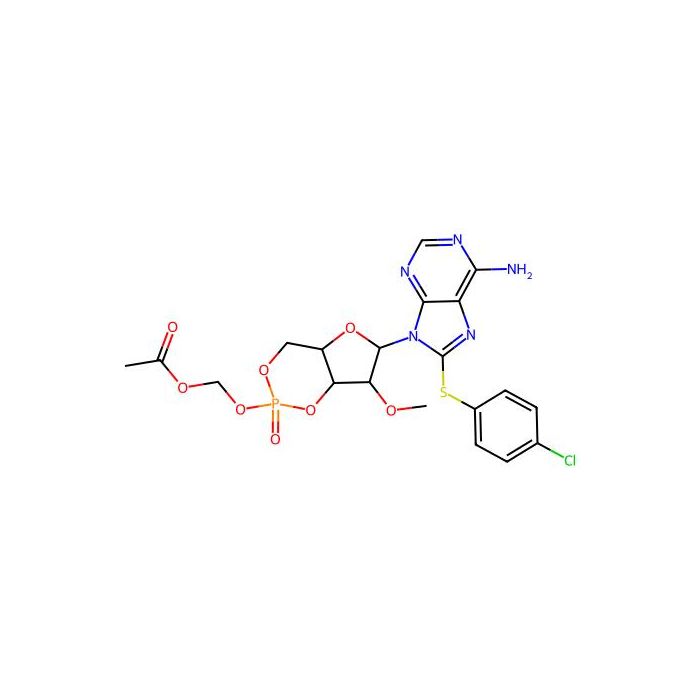
Determine the necessary mass, volume, or concentration for preparing a solution.
8-pCPT-2'-O-Me-cAMP-AM - ≥99% , CAS No.1152197-23-3
Disponible para pedir
GRADE & PURITY ≥99%
Storage
Store at -20°C
Shipped In
Ice chest + Ice pads
≥99% for sensitive chromatographic and analytical workflows requiring minimal baseline interference.
Store at -20°C Ships Ice chest + Ice pads Check lot-specific COA for exact specifications.
SDS, COA, datasheet, and spec sheet available for download. Lot-specific COA accessible via lot number lookup.
Cited in 0 peer-reviewed publications across chromatography, organic synthesis, and cross-coupling reactions.
8-pCPT-2'-O-Me-cAMP-AM is a cyclic AMP analogue, selectively activates Epac-Rap signaling pathway. 8-pCPT-2'-O-Me-cAMP-AM protects renal function by activating Epac from ischemia injury. 8-pCPT-2'-O-Me-cAMP-AM also stimulates insulin secretion by interaction with PKA pathway.
In Vitro
8-pCPT-2'-O-Me-cAMP-AM (2.5 μM; 30 min) activates Epac and prevents adherens junction disassembly during hypoxia (60 min). 8-pCPT-2'-O-Me-cAMP-AM can cross the plasma membrane and is able to alter diverse cellular functions that include Rap1 GTPase activity, PKB, and ERK1/2 protein kinase activity, phospholipase C activity, Ca 2+ signaling, ion channel activity, exocytosis, cell adhesion, and gene expression. 8-pCPT-2'-O-Me-cAMP-AM stimulates insulin secretion with dose-dependent and glucose metabolism-dependent (0.1 or 1.11 mM) actions. 8-pCPT-2'-O-Me-cAMP-AM (20 μM) activates the cAMP reporter Epac1-camps, while 8-pCPT-2'-O-Me-cAMP doesn’t in INS-1 cells. 8-pCPT-2'-O-Me-cAMP-AM (0.3-3.0 μM; 0-300 sec) activates Epac1-camps in a dose- and time-dependent manner in high throughput assay. MCE has not independently confirmed the accuracy of these methods. They are for reference only.
In Vivo
8-pCPT-2'-O-Me-cAMP-AM (intrarenal injection; ) activates renal Rap1 and likely is caused by activation of Epac in the tubular epithelium . 8-pCPT-2'-O-Me-cAMP-AM preserves renal function by Epac activation and reduces tubular epithelial-cell stress during ischemia . MCE has not independently confirmed the accuracy of these methods. They are for reference only. Animal Model: IR injuried mouse model Dosage: 1.45 mM Administration: Intrarenal injection; mice were sacrificed at 24, 48, or 72 hours after ischemia Result: Protected renal injury during ischemia.
Form:Oil
| Sonrisas canónicas | CC(=O)OCOP1(=O)OCC2C(O1)C(C(O2)N3C4=NC=NC(=C4N=C3SC5=CC=C(C=C5)Cl)N)OC |
|---|---|
| IUPAC Name | [(4aR,6R,7R,7aR)-6-[6-amino-8-(4-chlorophenyl)sulfanylpurin-9-yl]-7-methoxy-2-oxo-4a,6,7,7a-tetrahydro-4H-furo[3,2-d][1,3,2]dioxaphosphinin-2-yl]oxymethyl acetate |
| InChIKey | FZMWUFYPEVDWPA-SILPBKOMSA-N |
| INCHI | 1S/C20H21ClN5O8PS/c1-10(27)30-9-32-35(28)31-7-13-15(34-35)16(29-2)19(33-13)26-18-14(17(22)23-8-24-18)25-20(26)36-12-5-3-11(21)4-6-12/h3-6,8,13,15-16,19H,7,9H2,1-2H3,(H2,22,23,24)/t13-,15-,16-,19-,35?/m1/s1 |
| Isómeros SMILES | CC(=O)OCOP1(=O)OC[C@@H]2[C@@H](O1)[C@H]([C@@H](O2)N3C4=NC=NC(=C4N=C3SC5=CC=C(C=C5)Cl)N)OC |
| PubChem CID | 90488978 |
| Peso molecular | 557.9 |
Comprehensive hazard, handling, storage, and regulatory compliance document.
Download SDS →Lot-specific quality data. Enter your lot number to retrieve the exact COA.
Look up COA →Full quality attributes and acceptance criteria for this grade.
View spec sheet →Taxonomy Tree
| Kingdom | Organic compounds |
|---|---|
| Superclass | Nucleosides, nucleotides, and analogues |
| Clase | Purine nucleotides |
| Subclass | Cyclic purine nucleotides |
| Intermediate Tree Nodes | Not available |
| Direct Parent | 3',5'-cyclic purine nucleotides |
| Alternative Parents | Pentose phosphates Glycosylamines Diarylthioethers Monosaccharide phosphates 6-aminopurines Thiophenol ethers Chlorobenzenes Aminopyrimidines and derivatives Phosphate esters N-substituted imidazoles Imidolactams Aryl chlorides Tetrahydrofurans Heteroaromatic compounds Carboxylic acid esters Amino acids and derivatives Sulfenyl compounds Oxacyclic compounds Monocarboxylic acids and derivatives Dialkyl ethers Azacyclic compounds Primary amines Organopnictogen compounds Organochlorides Organic oxides Hydrocarbon derivatives Carbonyl compounds |
| Molecular Framework | Aromatic heteropolycyclic compounds |
| Substituents | 3',5'-cyclic purine ribonucleotide - Pentose phosphate - Diarylthioether - N-glycosyl compound - Glycosyl compound - Monosaccharide phosphate - 6-aminopurine - Purine - Imidazopyrimidine - Aryl thioether - Thiophenol ether - Halobenzene - Chlorobenzene - Aminopyrimidine - Imidolactam - Benzenoid - Pyrimidine - Phosphoric acid ester - Organic phosphoric acid derivative - N-substituted imidazole - Monosaccharide - Monocyclic benzene moiety - Aryl halide - Aryl chloride - Heteroaromatic compound - Tetrahydrofuran - Imidazole - Azole - Carboxylic acid ester - Amino acid or derivatives - Oxacycle - Azacycle - Organoheterocyclic compound - Sulfenyl compound - Thioether - Monocarboxylic acid or derivatives - Ether - Dialkyl ether - Carboxylic acid derivative - Organic nitrogen compound - Organic oxygen compound - Organopnictogen compound - Organic oxide - Hydrocarbon derivative - Primary amine - Organosulfur compound - Organooxygen compound - Organonitrogen compound - Organochloride - Organohalogen compound - Carbonyl group - Amine - Aromatic heteropolycyclic compound |
| Descripción | This compound belongs to the class of organic compounds known as 3',5'-cyclic purine nucleotides. These are purine nucleotides in which the oxygen atoms linked to the C3 and C5 carbon atoms of the ribose moiety are both bonded the same phosphorus atom of the phosphate group. |
| External Descriptors | Not available |