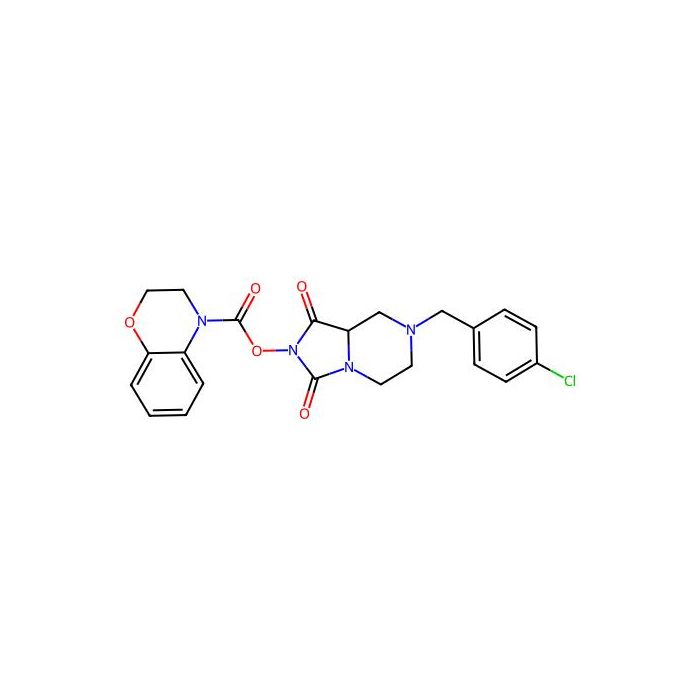
ABC99 is an N-hydroxyhydantoin (NHH) carbamate that selectively inhibits the Wnt-deacylating enzyme NOTUM ( IC 50 =13 nM). ABC99 preserves Wnt3A signaling in the presence of NOTUM
In Vitro
ABC99 (0.1~10 μΜ; 2 hours; SW620 cells) inhibits NOTUM in a concentration-dependent manner. ABC99 preserves Wnt-3A activity in the presence of NOTUM in a concentration-dependent manner. MCE has not independently confirmed the accuracy of these methods. They are for reference only. Western Blot AnalysisCell Line: SW620 cells Concentration: 0.1~10 μΜ Incubation Time: 2 hours Result: Inhibited NOTUM in a concentration-dependent manner.
IC50& Target:IC50: 13 nM (Notum)
Especificaciones
Especificaciones y pureza
10mM in DMSO
Mecanismos bioquímicos y fisiológicos
ABC99 is an N-hydroxyhydantoin (NHH) carbamate that selectively inhibits the Wnt-deacylating enzyme NOTUM ( IC 50 =13 nM). ABC99 preserves Wnt3A signaling in the presence of NOTUM.
Condiciones de almacenamiento de almacenamiento
Store at -80°C
Enviado en
Dry ice packs + Cold packs
Este producto requiere envío en cadena de frío. Los servicios terrestres y otros servicios económicos no están disponibles.
Certificados (CoA, COO, BSE/TSE y tabla de análisis)
C of A & Other Certificates(BSE/TSE, COO):
Analytical Chart:
Calculadoras de soluciones
Molarity Calculator
Determine the necessary mass, volume, or concentration for preparing a solution.
Dilution Calculator
Determine the dilution needed to prepare a stock solution.
Reconstitution Calculator
Reseñas
Reseñas de cliente
Application Protocols
No validated application protocols are provided in the current Product Data.
Item-specific recommendations: Not specified for this item; refer to CoA/Spec Sheet.
General starting points (research use only)
Stock preparation: Prepare a concentrated DMSO stock (e.g., 10–50 mM) if soluble; vortex and sonicate as needed. Record exact concentration by weight-in or quantitative NMR where possible.
Biochemical assays: Final DMSO 0.1–1% v/v; include vehicle controls and positive/negative reference compounds.
Cell-based assays: Titrate to minimize vehicle (≤0.1–0.5% DMSO when possible); perform preliminary cytotoxicity/viability assessments.
Analytical QC: Verify identity/purity by LC–MS and purity by HPLC/UPLC prior to key studies.
Note: These are general, literature-based practices and are not item-specific instructions.
Biological Roles
Item-specific biological targets, pathways, and mechanisms are not provided for ABC99. No claims regarding biological activity or therapeutic use are made or implied. The following points outline general considerations for small-molecule test articles in research.
Item-specific (from Product Data)
Biological target/mechanism: Not specified for this item; refer to CoA/Spec Sheet.
General research context (non-clinical)
Use as a chemical probe candidate is contingent on demonstrated potency, selectivity, and lack of assay interference; none of these attributes are specified here for ABC99.
If targets are later identified, orthogonal validation is recommended (biochemical assay, biophysical binding such as SPR/ITC, and cellular phenotypes).
Consider potential pan-assay interference (PAINS) liabilities; run counter-screens (redox cycling, aggregation, fluorescence interference) before drawing conclusions.
For cell-based work, determine maximum non-toxic vehicle concentration and assess compound cytotoxicity independently of target engagement.
Data stewardship
Record batch/lot, storage history, and stock concentration; verify identity/purity prior to critical studies.
Include positive/negative controls and vehicle controls in all experiments.
Buffer Applications
ABC99 is not a buffering agent, and no acid/base constants or buffering ranges are provided.
Item-specific buffer role: Not applicable.
Practical guidance (general)
When preparing assay buffers containing ABC99, select a buffer system appropriate for the biology (e.g., HEPES pH 7.4, PBS, Tris) and confirm compatibility with the solvent vehicle (e.g., 0.1–1% DMSO).
Filter-sterilize final solutions where appropriate and include vehicle-only controls. Avoid extreme pH unless stability of ABC99 is established.
Green Alternatives
Because ABC99 is a small-molecule test article rather than a bulk solvent/reagent, “green alternatives” primarily concern solvent choices and sample preparation practices. Item-specific solvent preferences are not available; the following guidance is general.
Greener solvent considerations (general)
Prefer water where feasible; enhance solubility with minimal co-solvent.
Favor lower-toxicity, biorenewable options when compatible with the compound and assay (e.g., 2-MeTHF or Cyrene for synthetic operations; ethanol over methanol when possible for biological work).
Minimize DMSO/DMF usage to the lowest effective percentage; employ accurate vehicle controls.
Comparison (general guidance)
DMSO vs ethanol
DMSO: Highest solvency; potential cytotoxicity and assay interference at elevated %.
Ethanol: Lower toxicity profile; lower solvency for highly lipophilic compounds.
ACN vs MeOH (analytical)
ACN: Lower viscosity, better for UHPLC; supply risk and toxicity considerations.
MeOH: More benign but may give different selectivity in LC.
Operational best practices
Scale down experiments to reduce solvent consumption.
Use closed systems and chilled autosamplers to reduce evaporative losses.
Implement solvent recycling where validated for analytical methods.
Trade-offs
Greener solvents may not dissolve hydrophobic chemotypes effectively; a hybrid approach (water + minimal DMSO) is often necessary.
Pharmaceutical Uses
No pharmacopeial status, excipient roles, or formulation uses are provided for ABC99.
Item-specific pharmaceutical use: Not specified for this item; refer to CoA/Spec Sheet.
General note (research only)
As a screening compound, ABC99 may be evaluated in discovery research settings. No clinical, diagnostic, or therapeutic use is claimed or supported by the provided data. Any formulation development would be exploratory and for non-clinical laboratory research only.
Physical Properties
Item-specific values are not disclosed in the provided data. Where applicable, consult the CoA/Spec Sheet for definitive specifications.
Appearance: Not specified for this item; refer to CoA/Spec Sheet.
Melting point: Not specified for this item; refer to CoA/Spec Sheet.
Boiling point: Not specified for this item; refer to CoA/Spec Sheet.
Density: Not specified for this item; refer to CoA/Spec Sheet.
Refractive index: Not specified for this item; refer to CoA/Spec Sheet.
pKa: Not specified for this item; refer to CoA/Spec Sheet.
LogP/LogD: Not specified for this item; refer to CoA/Spec Sheet.
Solubility: Not specified for this item; refer to CoA/Spec Sheet.
General guidance (literature/practice for small-molecule library members)
Many discovery compounds are provided as lyophilized solids or concentrated DMSO stock solutions; solubility is often highest in DMSO, DMF, or mixtures with water and co-solvent (e.g., 10–50% DMSO in buffer).
If solid, perform a small solvent screen (DMSO, DMF, MeOH, EtOH, acetonitrile, PBS + co-solvent) to identify a suitable vehicle; warm gently (≤40 °C) and sonicate as needed.
Avoid prolonged heating or high-pH conditions unless stability data are available, as unknown functionalities can undergo hydrolysis or oxidation.
Quality and Grades
Item-specific grade/purity: Not specified for this item; refer to CoA/Spec Sheet.
Context for screening compounds (general guidance)
Purity conventions: Discovery/screening compounds are commonly offered at ≥95% purity by HPLC/UPLC with MS identity confirmation; however, the exact acceptance criteria for ABC99 are not specified here and must be verified on the CoA.
Identity testing: Typically includes LC–MS and/or NMR. Residual solvents, water content (KF), and counter-ion content may be reported depending on supplier practices.
Form: Such compounds may be delivered as a dry film/solid or as a DMSO stock solution at a defined concentration. The format for ABC99 is not specified in the current data.
Stabilizers/additives: Not specified for this item; refer to CoA/Spec Sheet.
Implications for use
For quantitative biology/chemistry, confirm purity and concentration from the CoA before preparing assay stocks.
If low-UV impurities are a concern (e.g., for LC/UV detection), examine the UV trace in the CoA chromatogram or perform in-house QC.
If salts/solvates are present, account for counter-ion and solvate content when calculating molar concentrations.
Reaction and Applications
This product is categorized as a small-molecule/compound-library member for research use rather than a classical reagent/solvent. No specific synthetic or catalytic application is provided in the Product Data.
Item-specific applications (from catalog): Not specified for this item; refer to CoA/Spec Sheet.
General research applications (non-clinical)
Chemical biology and screening
Use as a test article in high-throughput or focused screens; evaluate activity across biochemical, biophysical, or cell-based assays.
Structure–activity relationship (SAR) development: If analog series are available, compare potency and selectivity trends.
Target deconvolution workflows: Thermal shift, CETSA, DARTS, affinity capture, or chemoproteomics when tagging/derivatization is feasible.
Analytical characterization
Establish reference spectra (LC–MS/MS, NMR if quantity permits) for identity tracking in assays.
Stability/metabolism studies
Evaluate chemical stability in stock solvents and in buffered media; microsomal or S9 stability for early ADME screening (research use only).
Note: Without structural information for ABC99, do not assume reactivity or compatibility with specific assay chemistries (e.g., redox-coupled readouts) until interference testing is performed.
Reaction Conditions
This section generally covers reagent use in synthetic reactions. ABC99 is listed as a small-molecule library member with no disclosed reactivity profile or intended use as a reagent.
Item-specific reaction conditions: Not applicable; no data provided.
General guidance (if derivatization is attempted in research)
Establish solvent compatibility (DMSO, DMF, MeOH, ACN) and confirm stability by LC–MS prior to any transformation.
Start with mild conditions (ambient temperature, neutral pH, catalytic loadings if applicable) and monitor by LC–MS/UPLC to avoid degradation.
Purify derivatives using appropriate chromatography while tracking mass balance and impurity formation.
Safety and Handling
Authoritative safety information resides in the product’s SDS. The following summarizes what is known from the Product Data and general laboratory practice.
Item-specific hazard information
GHS Classification: Not specified for this item; refer to SDS.
Signal Word: Not specified for this item; refer to SDS.
H-Statements: Not specified for this item; refer to SDS.
Pictograms: Not specified for this item; refer to SDS.
Storage and shipping (from Product Data)
Storage Conditions: Store at −80 °C.
Shipped in: Dry ice packs + cold packs.
General handling guidance (good laboratory practice)
Use in a fume hood; avoid inhalation of dust/aerosols and contact with skin/eyes.
Avoid incompatible conditions until confirmed by SDS/CoA (strong oxidants/reductants, extremes of pH, prolonged light/air exposure).
In case of contact: rinse affected area with water for ≥15 minutes; seek medical attention per SDS instructions.
Waste: collect in labeled organic waste compatible with the diluent/solvent matrix; follow institutional and local regulations.
Special risks (general)
Unknown stability profile: minimize freeze–thaw by aliquoting; protect from moisture and light until stability is known.
If supplied in DMSO, note DMSO’s strong skin penetration; avoid skin contact.
Solvent Selection
Item-specific solubility/polarity are not provided. The following is general, literature-based guidance for small-molecule library compounds where the structure is undisclosed.
First-line vehicles (general)
DMSO: Most universally effective; prepare concentrated stocks (e.g., 10–50 mM) and dilute into assay media last.
DMF or NMP: Useful when DMSO solubility is limited; verify biocompatibility for cell assays.
Alcohols (MeOH, EtOH): Moderate polarity, miscible with water; often suitable for analytical sample prep.
Acetonitrile: LC-friendly; good for preparing analytical standards.
Aqueous formulation strategies (general)
Cosolvent: 1–5% DMSO or EtOH in buffer can aid dissolution; titrate to the minimum effective percentage.
Surfactants: 0.01–0.1% nonionic surfactant (e.g., Tween 80, Pluronic F-68) can improve dispersion; validate for biological compatibility.
pH adjustment: If acidic/basic groups are suspected, mild pH shifts (pH 6–8) may enhance solubility; avoid extremes without stability data.
Practical tips
Warm gently (≤40 °C) and sonicate resistant suspensions; filter 0.2 µm for analytical work if soluble and stable.
Record final cosolvent % in all assays; include vehicle controls.
Comparison snapshot (general)
DMSO: Maximum solvating power; potential biological effects at >0.5–1% v/v.
MeOH/EtOH: Easier evaporation; lower solvency than DMSO.
ACN: LC-compatible; limited for biological assays.
Buffers alone: Only if the compound is inherently water-soluble.
Storage and Reconstitution
Item-specific (from Product Data)
Storage Conditions: Store at −80 °C.
Shipped in: Dry ice packs + cold packs.
Item-specific unknowns
Appearance, concentration (if solution), stabilizers: Not specified for this item; refer to CoA/Spec Sheet.
General reconstitution guidance for small-molecule library members (literature/practice)
If supplied as a solid/film: Equilibrate to room temperature in a desiccator before opening to prevent moisture condensation. Dissolve in dry DMSO to prepare a 10–50 mM stock, as solubility allows.
If supplied in DMSO: Inspect for precipitation or phase separation upon arrival; warm to room temperature and vortex to rehomogenize.
Aliquoting: Divide into single-use portions to avoid repeated freeze–thaw. Store aliquots at −80 °C in tightly sealed, inert containers (e.g., amber vials or plates) with headspace minimized.
Handling: Protect from light and moisture until stability is known. Avoid extended exposure at room temperature; keep on cold blocks during setup.
Thawing: Thaw quickly at room temperature, mix, and use promptly. Refreeze unused aliquots immediately; avoid multiple freeze–thaw cycles.
Stability note
Specific shelf-life and stability-in-solution are not provided; confirm by periodic LC–MS/HPLC and visual inspection. Refer to CoA for any lot-specific stability guidance.
Structure and Identity
Brief overview: ABC99 is listed as a small-molecule library member for research use. Structural identifiers are largely not disclosed in the current product data.
Item-specific (from Product Data)
SKU: A656172
Product Name: ABC99
CAS: 2331255-53-7
PubChem CID: 134817170
Molecular Formula: Not specified for this item; refer to CoA/Spec Sheet.
Molecular Weight: Not specified for this item; refer to CoA/Spec Sheet.
InChIKey: Not specified for this item; refer to CoA/Spec Sheet.
SMILES: Not specified for this item; refer to CoA/Spec Sheet.
Structural features
Functional groups, ring systems, stereochemistry: Not specified for this item; refer to CoA/Spec Sheet.
2D structure description (general)
Without a provided SMILES/InChI or structure file, detailed description of pharmacophore features, heteroatom content, or stereocenters cannot be given for this item. Please consult the CoA, Spec Sheet, or SDS for structural depiction if available.
Synthetic Utility
Without structural information, specific synthetic roles for ABC99 cannot be defined.
Item-specific synthetic role: Not specified for this item; refer to CoA/Spec Sheet.
General considerations
If ABC99 possesses functional handles (unknown), it could potentially be derivatized for SAR, photoaffinity labeling, or immobilization for target deconvolution; feasibility depends entirely on its undisclosed structure and stability.
For method development or analytical spike-recovery studies, ABC99 may serve as a test analyte once its detection parameters (LC–MS transitions, UV maxima) are established experimentally.
Target Specificity
Target information is not provided for ABC99.
Item-specific data
Target/Pathway: Not specified for this item; refer to CoA/Spec Sheet.
Species selectivity: Not specified for this item; refer to CoA/Spec Sheet.
Off-target profile: Not specified for this item; refer to CoA/Spec Sheet.
General recommendation
If target data become available, assess selectivity via a panel of orthogonal assays and relevant counterscreens to exclude assay interference.
Utilizamos cookies para garantizar el correcto funcionamiento del sitio web y, cuando esté permitido, para mejorar su experiencia. Puede gestionar sus preferencias en cualquier momento en Configuración. Más información en nuestra Política de Cookies.
¿Quieres que te enviemos un mensaje cuando tengamos descuentos disponibles?
Recordármelo más tarde
¡Gracias! Por favor, revisa tu bandeja de entrada de correo electrónico para confirmar.
Products are supplied to verified businesses, institutions, and qualified professionals for research and development use only. Not for use in humans, animals, diagnosis, or therapy.