GRADE & PURITYMoligand™?Moligand™ — Aladdin's line of ligands and bioactive small molecules. Use for receptor, pathway, and binding studies needing defined small-molecule tools.10mM in DMSO
Moligand™, 10mM in DMSO Moligand™ for sensitive chromatographic and analytical workflows requiring minimal baseline interference.
🌡
Storage & shipping
Store at -80°C Ships Dry ice packs + Cold packs Check lot-specific COA for exact specifications.
📋
Quality documents
SDS, COA, datasheet, and spec sheet available for download. Lot-specific COA accessible via lot number lookup.
📚
Literature proof
Cited in 1 peer-reviewed publications across chromatography, organic synthesis, and cross-coupling reactions.
Descripción general
Information
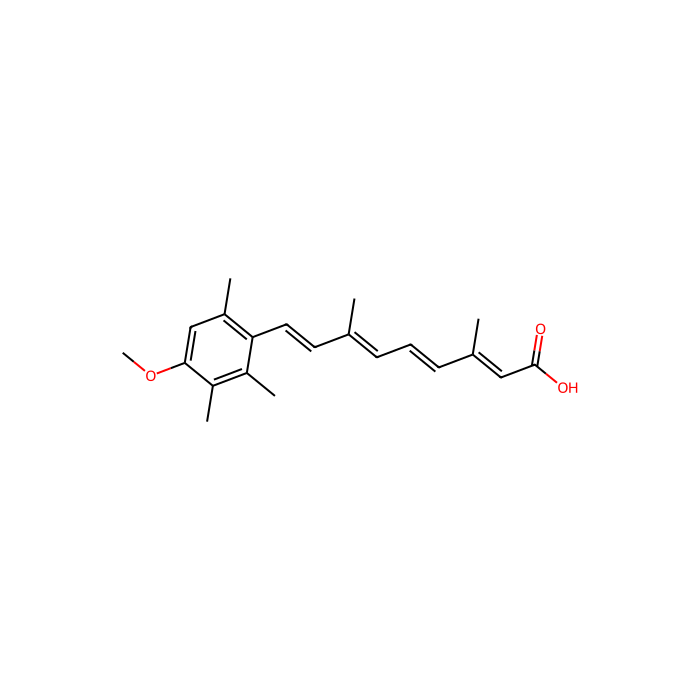
Acitretin Acitretin (Etretin, RO 10-1670) is a second generation retinoid used for psoriasis. In vitro
Acitretin stimulates ADAM10 promoter activity with an EC(50) of 1.5 mM and leads to an increase of mature ADAM10 protein that results in a two- to three-fold increase of the ratio between alpha- and beta-secretase activity in neuroblastoma cells. Acitretin (5-20 μM) impairs mitochondrial phosphorylation efficiency as demonstrated by the decrease in the state 3 respiration and ATP levels, and by the increase in the lag phase of ADP phosphorylation cycle, without affecting the membrane potential. Acitretin induces Ca(2+)-mediated mitochondrial permeability transition (MPT) and decreased the adenine nucleotide translocase (ANT) content. Acitretin preferentially inhibits the growth of SCL-1 cells in a dose- and time-dependent manner, but not of non-malignant keratinocyte HaCaT cells. Acitretin increases the levels of CD95 (Fas), CD95-ligand and Fas-associated death domain. Acitretin is able to induce apoptosis in skin cancer cells possibly via death receptor CD95 apoptosis pathway without affecting the viability of normal keratinocyte.
In vivo
Acitretin undergoes alpha-oxidation, chain shortening O-demethylation, and glucuronidation in the perfused rat liver. Acitretin rapidly appears in liver and muscle of rats, where it undergoes redistribution into skin and adipose tissue. Cell Data
We use cookies to ensure the website functions properly and, where permitted, to improve your experience. You can manage your preferences at any time in Settings. Learn more in our Cookie Policy.
Shall we send you a message when we have discounts available?
Remind me later
Thank you! Please check your email inbox to confirm.
Products are supplied to verified businesses, institutions, and qualified professionals for research and development use only. Not for use in humans, animals, diagnosis, or therapy.