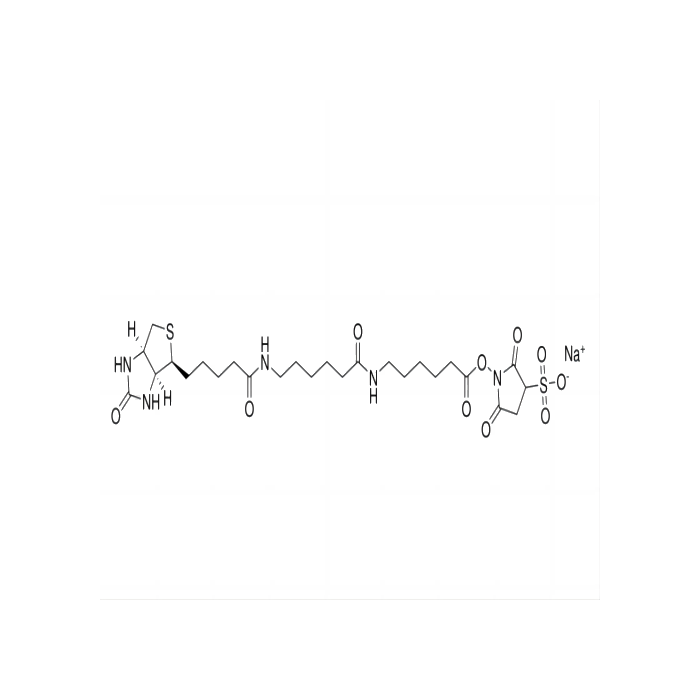
N-Hydroxysulfosuccinimide (NHS) esters of biotin are the most popular type of biotinylation reagent. NHS-activated biotins react efficiently with primary amino groups (-NH2) in alkaline buffers to form stable amide bonds. Proteins (e.g., antibodies) typically have several primary amines that are available as targets for labeling, including the side chain of lysine (K) residues and the N-terminus of each polypeptide.
Varieties of biotin NHS-ester reagents differ in length, solubility, cell permeability and cleavability. Non-sulfonated NHS-biotins are cell permeable but must be dissolved in organic solvent such as DMSO or DMF. Sulfo-NHS biotins (and those with pegylated spacers) are directly water soluble but not membrane permeable. Varieties containing disulfide bonds can be cleaved using reducing agents, enabling the biotin group to be disconnected from the labeled protein.
Application:
Sulfo-NHS-LC-LC-biotin finds extensive applications in scientific research for the purpose of protein labeling and detection. Its utilization in protein purification allows for the isolation of biotinylated proteins from intricate mixtures. Moreover, it plays a vital role in protein-protein interaction studies, enabling investigations into the binding affinity and specificity of proteins. Additionally, it serves as a valuable tool in protein quantification, facilitating the measurement of specific protein levels within a given sample.
Features and benefits:
• Protein labeling—biotinylate antibodies to facilitate immobilization, purification or detection using streptavidin resins or probes
• Cell surface labeling—biotinylates only surface proteins of whole cells because the negatively charged reagent does not permeate cell membranes
• Amine-reactive—reacts with primary amines (-NH2), such as the side-chain of lysines (K) or the amino-termini of polypeptides
• Soluble—charged sulfo-NHS group increases reagent water solubility compared to ordinary NHS-ester compounds
• Irreversible—forms permanent amide bonds; spacer arm cannot be cleaved
• Doubly long —spacer arm (total length added to target) is 22.4 angstroms; this extended arm helps to minimize steric hindrance for biotin binding

 D2503510