Determine the necessary mass, volume, or concentration for preparing a solution.
| Activity Type | Activity Value -log(M) | Mechanism of Action | Activity Reference | Publications (PubMed IDs) |
|---|

≥98% for sensitive chromatographic and analytical workflows requiring minimal baseline interference.
Store at -20°C Ships Ice chest + Ice pads Check lot-specific COA for exact specifications.
SDS, COA, datasheet, and spec sheet available for download. Lot-specific COA accessible via lot number lookup.
Cited in 0 peer-reviewed publications across chromatography, organic synthesis, and cross-coupling reactions.
Information
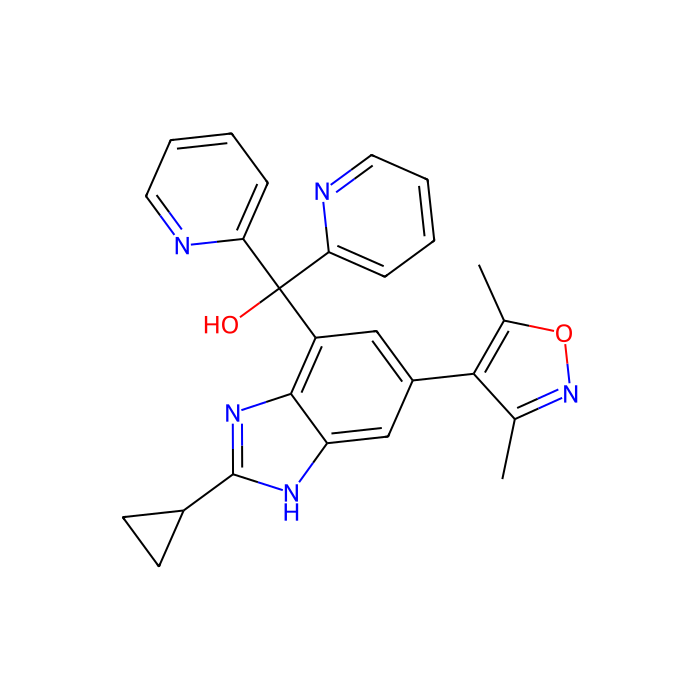
Alobresib (GS-5829) Alobresib (GS-5829) is a novel BET inhibitor that represents a highly effective therapeutics agent against recurrent/chemotherapy-resistant USC-overexpressing c-Myc. Alobresib (GS-5829) inhibits CLL cell proliferation and induces leukemia cell apoptosis through deregulation of key signaling pathways, such as BLK , AKT , ERK1/2 , and MYC . Alobresib (GS-5829) also inhibits NF-κB signaling.
Targets
BET ; BLK ; Akt ; ERK1/2 ; MYC 33297,
In vitro
In-vitro experiments demonstrates high sensitivity of USC cell-lines to the exposure to GS-5829 causing a dose-dependent decrease in the phosphorylated levels of c-Myc and a dose-dependent increase in caspase activation (apoptosis). GS-5829 inhibits CLL cell proliferation and induces leukemia cell apoptosis through deregulation of key signaling pathways, such as BLK, AKT, ERK1/2, and MYC. IκBα modulation indicates that GS-5829 also inhibits NF-κB signaling. GS-5829-induced apoptosis results from an imbalance between positive (BIM) and negative regulators (BCL-XL) of the intrinsic apoptosis pathway.
In vivo
GS-5829 has impressive activity against USC primary tumors as well as USC xenografts. Assessment of c-Myc expression in tumors exposed to the GS-5829 demonstrates down-regulation of both total and phospho c-Myc proteins. GS-5829 demonstrates excellent bioavailability after oral administration and is significantly more effective than JQ1 at the doses used in comparative experiments in vivo against USC xenografts. Clinical studies with GS-5829 in USC patients harboring disease resistant to standard salvage chemotherapy are warranted.
Cell Research(from reference)
Cell lines:PBMC, MEC-1
Concentrations:100 nM, 200 nM, 400 nM, 800 nM
Incubation Time:72 h, 24 h
Comprehensive hazard, handling, storage, and regulatory compliance document.
Download SDS →Lot-specific quality data. Enter your lot number to retrieve the exact COA.
Look up COA →Full quality attributes and acceptance criteria for this grade.
View spec sheet →Taxonomy Tree
| Kingdom | Organic compounds |
|---|---|
| Superclass | Organoheterocyclic compounds |
| Clase | Benzimidazoles |
| Subclass | Not available |
| Intermediate Tree Nodes | Not available |
| Direct Parent | Benzimidazoles |
| Alternative Parents | Pyridines and derivatives Benzenoids Tertiary alcohols Isoxazoles Imidazoles Heteroaromatic compounds Oxacyclic compounds Azacyclic compounds Organonitrogen compounds Hydrocarbon derivatives Aromatic alcohols |
| Molecular Framework | Aromatic heteropolycyclic compounds |
| Substituents | Benzimidazole - Pyridine - Benzenoid - Azole - Imidazole - Isoxazole - Tertiary alcohol - Heteroaromatic compound - Azacycle - Oxacycle - Organic nitrogen compound - Organic oxygen compound - Organooxygen compound - Organonitrogen compound - Alcohol - Aromatic alcohol - Hydrocarbon derivative - Aromatic heteropolycyclic compound |
| Descripción | This compound belongs to the class of organic compounds known as benzimidazoles. These are organic compounds containing a benzene ring fused to an imidazole ring (five member ring containing a nitrogen atom, 4 carbon atoms, and two double bonds). |
| External Descriptors | Not available |
| Activity Type | Activity Value -log(M) | Mechanism of Action | Activity Reference | Publications (PubMed IDs) |
|---|
Find and download the COA for your product by matching the lot number on the packaging.
| Lot Number | Certificate Type | Fecha | Articulo |
|---|---|---|---|
 E2615043 E2615043 | Certificate of Analysis | May 28, 2026 | A414297 |
| C2504075 | Certificate of Analysis | Sep 13, 2022 | A414297 |
| K2219094 | Certificate of Analysis | Sep 13, 2022 | A414297 |
| K2219095 | Certificate of Analysis | Sep 13, 2022 | A414297 |
| K2219137 | Certificate of Analysis | Sep 13, 2022 | A414297 |
| K2219138 | Certificate of Analysis | Sep 13, 2022 | A414297 |
| K2219139 | Certificate of Analysis | Sep 13, 2022 | A414297 |
| K2219140 | Certificate of Analysis | Sep 13, 2022 | A414297 |
| K2219142 | Certificate of Analysis | Sep 13, 2022 | A414297 |
| Solubilidad | Solubility (25°C) In vitro DMSO: 87 mg/mL (198.86 mM); Ethanol: 11 mg/mL (25.14 mM); Water: ˂1 mg/mL |
|---|---|
| DMSO (mg/ml) Solubilidad máxima | 87 |
| DMSO (mM) Solubilidad máxima | 198.86168826716 |
| Agua (mg/ml) Solubilidad máxima | ˂1 |
| Peso molecular | 437.500 g/mol |
| XLogP3 | 3.200 |
| Hydrogen Bond Donor Count | 2 |
| Hydrogen Bond Acceptor Count | 6 |
| Rotatable Bond Count | 5 |
| Exact Mass | 437.185 Da |
| Monoisotopic Mass | 437.185 Da |
| Topological Polar Surface Area | 101.000 Ų |
| Heavy Atom Count | 33 |
| Formal Charge | 0 |
| Complexity | 672.000 |
| Isotope Atom Count | 0 |
| Defined Atom Stereocenter Count | 0 |
| Undefined Atom Stereocenter Count | 0 |
| Defined Bond Stereocenter Count | 0 |
| Undefined Bond Stereocenter Count | 0 |
| The total count of all stereochemical bonds | 0 |
| Covalently-Bonded Unit Count | 1 |